Review
. 2018 Mar 12;200(7):e00580-17.
doi: 10.1128/JB.00580-17. Print 2018 Apr 1.

History of CRISPR-Cas from Encounter with a Mysterious Repeated Sequence to Genome Editing Technology

Affiliations
Review

History of CRISPR-Cas from Encounter with a Mysterious Repeated Sequence to Genome Editing Technology

Yoshizumi Ishino et al. J Bacteriol. .

Abstract

Clustered regularly interspaced short palindromic repeat (CRISPR)-Cas systems are well-known acquired immunity systems that are widespread in archaea and bacteria. The RNA-guided nucleases from CRISPR-Cas systems are currently regarded as the most reliable tools for genome editing and engineering. The first hint of their existence came in 1987, when an unusual repetitive DNA sequence, which subsequently was defined as a CRISPR, was discovered in the Escherichia coli genome during an analysis of genes involved in phosphate metabolism. Similar sequence patterns were then reported in a range of other bacteria as well as in halophilic archaea, suggesting an important role for such evolutionarily conserved clusters of repeated sequences. A critical step toward functional characterization of the CRISPR-Cas systems was the recognition of a link between CRISPRs and the associated Cas proteins, which were initially hypothesized to be involved in DNA repair in hyperthermophilic archaea. Comparative genomics, structural biology, and advanced biochemistry could then work hand in hand, not only culminating in the explosion of genome editing tools based on CRISPR-Cas9 and other class II CRISPR-Cas systems but also providing insights into the origin and evolution of this system from mobile genetic elements denoted casposons. To celebrate the 30th anniversary of the discovery of CRISPR, this minireview briefly discusses the fascinating history of CRISPR-Cas systems, from the original observation of an enigmatic sequence in E. coli to genome editing in humans.

Keywords: archaea; casposon; genome editing; repeated sequence.


Figures

FIG 1
FIG 1
The structural features of CRISPR. The repeat sequences with constant length generally have dyad symmetry to form a palindromic structure (shown by arrows). Two examples are shown by the first identified CRISPR from E. coli (bacteria) and H. mediterranei (archaea). The spacer regions also have a constant length but no sequence homology.
FIG 2
FIG 2
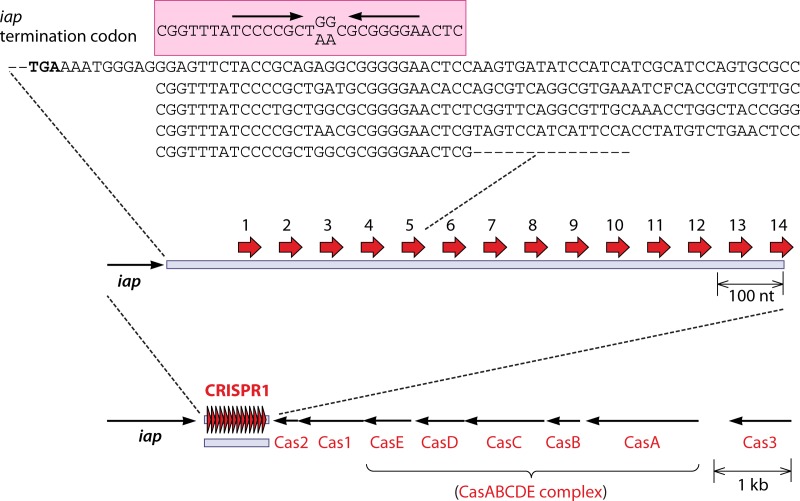
The first CRISPR found in E. coli. As a result of the iap gene analysis from E. coli, a very ordered repeating sequence was found downstream of the iap gene. The conserved sequence unit was repeated 5 times with a constant length of spaces in 1987. It turns out that the repeat was 14 times in total by the subsequent genome analysis. The cas gene cluster was also identified at the downstream region. nt, nucleotides.
FIG 3
FIG 3
The first CRISPR sequence in E. coli. The exact same region, downstream of the iap gene, which was found in 1987 by a conventional dideoxy sequencing, was read by a cycle sequencing with fluorescent labeling recently. The CRISPR units are shown by pink shading.
FIG 4
FIG 4
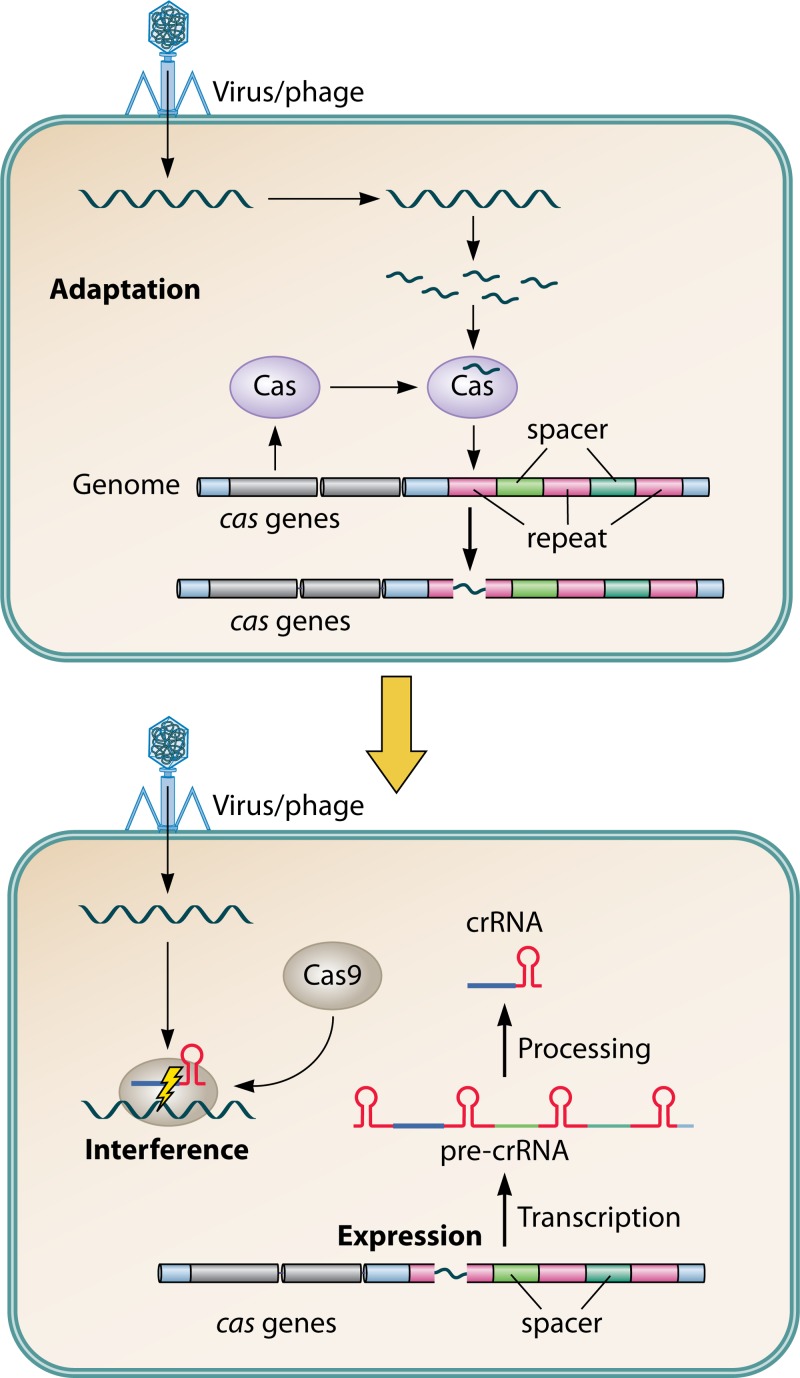
Process of CRISPR-Cas acquired immune system. (Top) Adaptation. The invading DNA is recognized by Cas proteins, fragmented and incorporated into the spacer region of CRISPR, and stored in the genome. Expression (bottom). Pre-crRNA is generated by transcription of the CRISPR region and is processed into smaller units of RNA, named crRNA. (Bottom) Interference. By taking advantage of the homology of the spacer sequence present in crRNA, foreign DNA is captured, and a complex with Cas protein having nuclease activity cleaves DNA.
FIG 5
FIG 5
Genome editing by CRISPR-Cas9. The principle of genome editing is the cleavage of double-stranded DNA at a targeted position on the genome. The type II is the simplest as a targeted nuclease among the CRISPR-Cas systems. The CRISPR RNA (crRNA), having a sequence homologous to the target site, and trans-activating CRISPR RNA (tracrRNA) are enough to bring the Cas9 nuclease to the target site. The artificial linkage of crRNA and tracrRNA into one RNA chain (single-guide RNA [sgRNA]) has no effect on function. Once the Cas9-sgRNA complex cleaves the target gene, it is easy to disrupt the function of the gene by a deletion or insertion mutation. This overwhelmingly simple method is now rapidly spreading as a practical genomic editing technique.
FIG 6
FIG 6
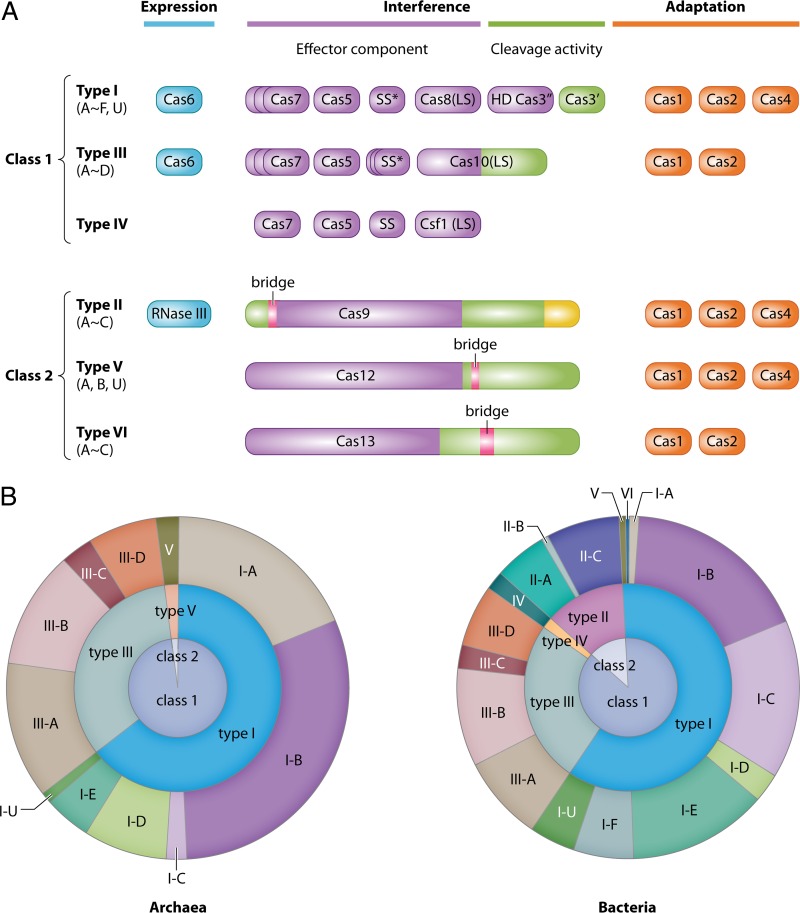
Most recent classification of CRISPR-Cas immune systems. (A) Based on the detailed sequence analyses and gene organization of the Cas proteins, CRISPR-Cas was classified into two major classes depending on whether the effector is a complex composed of multiple Cas proteins or a single effector. In addition to the conventional types I, II, and III, the types IV and V were added to classes 1 and 2, respectively. Types IV and V are those which do not have Cas1 and Cas2, necessary for adaptation process, in the same CRISPR loci. Type VI was added most recently to class 2. (B) Chart showing the proportions of identified CRISPR-cas loci in the total genomes of bacteria and archaea referred from the literature (51, 53). The proportions of loci that encode incomplete systems or that could not be classified unambiguously are not included.
FIG 7
FIG 7
Cleavage mechanism of target DNA by crRNA-tracrRNA-Cas9. The Cas9-crRNA-tracrRNA complex binds to foreign DNA containing PAM, where Cas9 binds and starts to unwind the double strand of the foreign DNA to induce duplex formation of crRNA and foreign DNA. Cas9 consists of two regions, called the REC (recognition) lobe and the NUC (nuclease) lobe. The REC lobe is responsible for nucleic acid recognition. The NUC lobe contains the HNH and RuvC nuclease domains and a C-terminal region containing a PAM-interacting (PI) domain. The HNH domain and the RuvC domain cleave the DNA strand, forming a duplex with crRNA and the other DNA strand, respectively, so that double-strand break occurs in the target DNA.
None
None
None

References

    1. Ishino Y, Shinagawa H, Makino K, Amemura M, Nakata A. 1987. Nucleotide sequence of the iap gene, responsible for alkaline phosphatase isozyme conversion in Escherichia coli, and identification of the gene product. J Bacteriol 169:5429–5433. doi: 10.1128/jb.169.12.5429-5433.1987. - DOI - PMC - PubMed
    1. Mojica MJ, Juez G, Rodríguez-Valera F. 1993. Transcription at different salinities of Haloferax mediterranei sequences adjacent to partially modified PstI sites. Mol Microbiol 9:613–621. doi: 10.1111/j.1365-2958.1993.tb01721.x. - DOI - PubMed
    1. Mojica FJM, Díez-Villaseñor C, García-Martínez J, Soria E. 2005. Intervening sequences of regularly spaced prokaryotic repeats derive from foreign genetic elements. J Mol Evol 60:174–182. doi: 10.1007/s00239-004-0046-3. - DOI - PubMed
    1. Pourcel C, Salvignol G, Vergnaud G. 2005. CRISPR elements in Yersinia pestis acquire new repeats by preferential uptake of bacteriophage DNA, and provide additional tools for evolutionary studies. Microbiology 151:653–663. doi: 10.1099/mic.0.27437-0. - DOI - PubMed
    1. Bolotin A, Quinquis B, Sorokin A, Ehrlich SD. 2005. Clustered regularly interspaced short palindrome repeats (CRISPRs) have spacers of extrachromosomal origin. Microbiology 151:2551–2561. doi: 10.1099/mic.0.28048-0. - DOI - PubMed