


Comment
doi: 10.3389/fphys.2017.01116.
eCollection 2017.
Commentary: Human Pathophysiological Adaptations to the Space Environment
Affiliations
- PMID: 29358922
- PMCID: PMC5766677
- DOI: 10.3389/fphys.2017.01116
Item in Clipboard
Comment
Commentary: Human Pathophysiological Adaptations to the Space Environment
Front Physiol.
.
No abstract available
Keywords: adaptation; adaptive response; astronauts; cosmic radiation; space radiation.
Figures
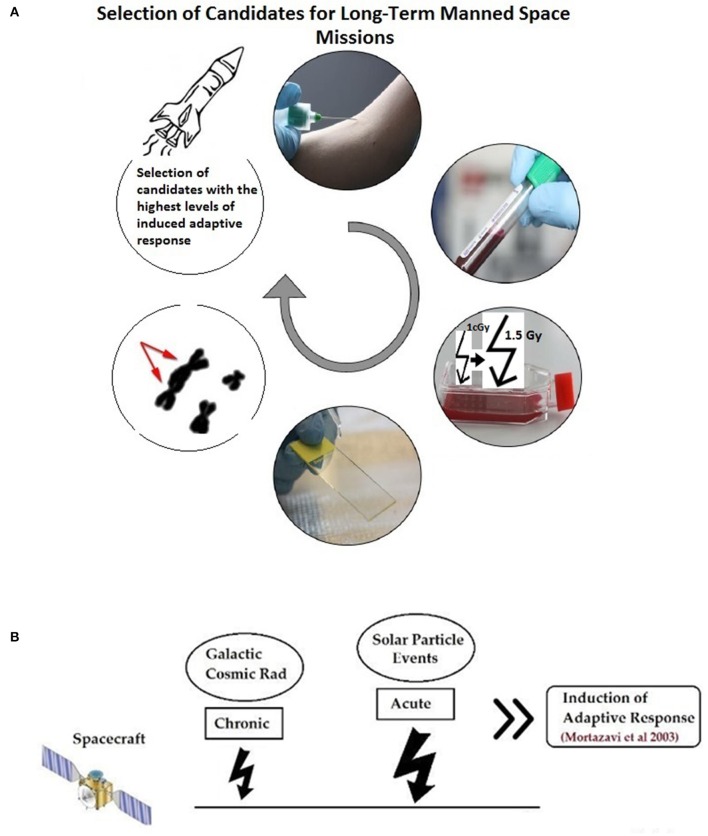
(A) An in vitro adaptive response study help choosing good candidates for deep manned space missions. (B) During space mission, the selected astronauts will be adapted to radiation by exposure to chronic galactic cosmic radiation (GCR) and will better tolerate sudden high doses due to solar particle events (SPE). (Figure is based on: Mortazavi et al., 2003b).
Comment on
-
Human Pathophysiological Adaptations to the Space Environment.Front Physiol. 2017 Aug 2;8:547. doi: 10.3389/fphys.2017.00547. eCollection 2017. Front Physiol. 2017. PMID: 28824446 Free PMC article. Review.
References
-
- Bevelacqua J. J. (2017). Radiation protection consequences of the emerging space tourism industry. J J Earth Science 1, 1–11.
-
- Bhattacharjee D., Ito A. (2001). Deceleration of carcinogenic potential by adaptation with low dose gamma irradiation. In Vivo 15, 87–92. - PubMed
Publication types
LinkOut - more resources
Full Text Sources
Other Literature Sources
