


Molecular basis of hepatocellular carcinoma induced by hepatitis C virus infection
- PMID: 29359013
- PMCID: PMC5756719
- DOI: 10.4254/wjh.v9.i36.1305
Molecular basis of hepatocellular carcinoma induced by hepatitis C virus infection
Abstract
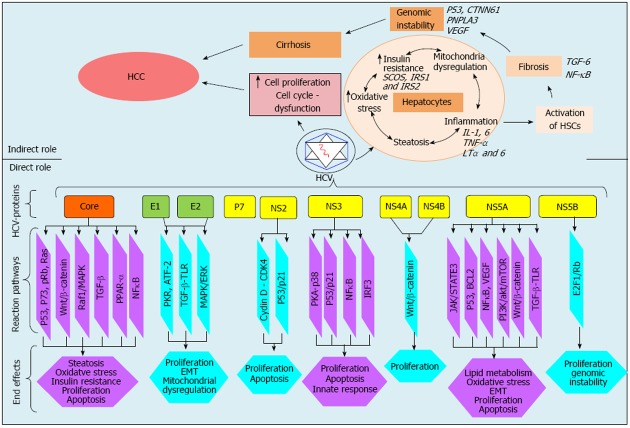
Present study outlines a comprehensive view of published information about the underlying mechanisms operational for progression of chronic hepatitis C virus (HCV) infection to development of hepatocellular carcinoma (HCC). These reports are based on the results of animal experiments and human based studies. Although, the exact delineated mechanism is not yet established, there are evidences available to emphasize the involvement of HCV induced chronic inflammation, oxidative stress, insulin resistance, endoplasmic reticulum stress, hepato steatosis and liver fibrosis in the progression of HCV chronic disease to HCC. Persistent infection with replicating HCV not only initiates several liver alterations but also creates an environment for development of liver cancer. Various studies have reported that HCV acts both directly as well as indirectly in promoting this process. Whereas HCV related proteins, like HCV core, E1, E2, NS3 and NS5A, modulate signal pathways dysregulating cell cycle and cell metabolism, the chronic infection produces similar changes in an indirect way. HCV is an RNA virus and does not integrate with host genome and therefore, HCV induced hepatocarcinogenesis pursues a totally different mechanism causing imbalance between suppressors and proto-oncogenes and genomic integrity. However, the exact mechanism of HCC inducement still needs a full understanding of various steps involved in this process.
Keywords: Core; Fibrosis; Hepatitis C virus; Hepatocellular carcinoma; Inflammation; NS5A.
Conflict of interest statement
Conflict-of-interest statement: The authors declare here that there is no conflict of interest related to this study among them.
Figures
References
-
- Choo QL, Kuo G, Weiner AJ, Overby LR, Bradley DW, Houghton M. Isolation of a cDNA clone derived from a blood-borne non-A, non-B viral hepatitis genome. Science. 1989;244:359–362. - PubMed
-
- Kuo G, Choo QL, Alter HJ, Gitnick GL, Redeker AG, Purcell RH, Miyamura T, Dienstag JL, Alter MJ, Stevens CE. An assay for circulating antibodies to a major etiologic virus of human non-A, non-B hepatitis. Science. 1989;244:362–364. - PubMed
-
- Global surveillance and control of hepatitis C. Report of a WHO Consultation organized in collaboration with the Viral Hepatitis Prevention Board, Antwerp, Belgium. J Viral Hepat. 1999;6:35–47. - PubMed
-
- Yoshida H, Shiratori Y, Moriyama M, Arakawa Y, Ide T, Sata M, Inoue O, Yano M, Tanaka M, Fujiyama S, et al. Interferon therapy reduces the risk for hepatocellular carcinoma: national surveillance program of cirrhotic and noncirrhotic patients with chronic hepatitis C in Japan. IHIT Study Group. Inhibition of Hepatocarcinogenesis by Interferon Therapy. Ann Intern Med. 1999;131:174–181. - PubMed
Publication types
LinkOut - more resources
Full Text Sources
Other Literature Sources
