Review
. 2018 Jan 8:4:231.
doi: 10.3389/fmed.2017.00231. eCollection 2017.

Techniques for Non-Invasive Monitoring of Arterial Blood Pressure

Affiliations
Review

Techniques for Non-Invasive Monitoring of Arterial Blood Pressure

Agnes S Meidert et al. Front Med (Lausanne). .

Abstract

Since both, hypotension and hypertension, can potentially impair the function of vital organs such as heart, brain, or kidneys, monitoring of arterial blood pressure (BP) is a mainstay of hemodynamic monitoring in acutely or critically ill patients. Arterial BP can either be obtained invasively via an arterial catheter or non-invasively. Non-invasive BP measurement provides either intermittent or continuous readings. Most commonly, an occluding upper arm cuff is used for intermittent non-invasive monitoring. BP values are then obtained either manually (by auscultation of Korotkoff sounds or palpation) or automatically (e.g., by oscillometry). For continuous non-invasive BP monitoring, the volume clamp method or arterial applanation tonometry can be used. Both techniques enable the arterial waveform and BP values to be obtained continuously. This article describes the different techniques for non-invasive BP measurement, their advantages and limitations, and their clinical applicability.

Keywords: applanation tonometry; arterial pressure; blood pressure monitoring; non-invasive blood pressure; oscillometry; perioperative monitoring; vascular unloading technique.


Figures

Figure 1
Figure 1
Non-invasive blood pressure monitoring techniques.
Figure 2
Figure 2
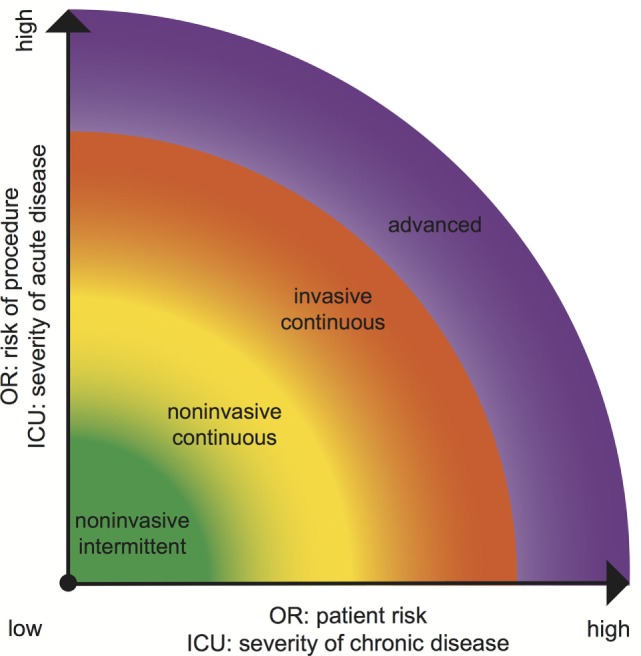
Choice of adequate blood pressure monitoring equipment in ICU and OR according to patient and procedural risk (OR) (45) or chronic and acute disease (ICU).

References

    1. Bijker JB, Persoon S, Peelen LM, Moons KG, Kalkman CJ, Kappelle LJ, et al. Intraoperative hypotension and perioperative ischemic stroke after general surgery: a nested case-control study. Anesthesiology (2012) 116:658–64. 10.1097/ALN.0b013e3182472320 - DOI - PubMed
    1. van Waes JA, van Klei WA, Wijeysundera DN, van Wolfswinkel L, Lindsay TF, Beattie WS. Association between intraoperative hypotension and myocardial injury after vascular surgery. Anesthesiology (2016) 124:35–44. 10.1097/ALN.0000000000000922 - DOI - PubMed
    1. Walsh M, Devereaux PJ, Garg AX, Kurz A, Turan A, Rodseth RN, et al. Relationship between intraoperative mean arterial pressure and clinical outcomes after noncardiac surgery: toward an empirical definition of hypotension. Anesthesiology (2013) 119:507–15. 10.1097/ALN.0b013e3182a10e26 - DOI - PubMed
    1. Scheer B, Perel A, Pfeiffer UJ. Clinical review: complications and risk factors of peripheral arterial catheters used for haemodynamic monitoring in anaesthesia and intensive care medicine. Crit Care (2002) 6:199–204. 10.1186/cc1489 - DOI - PMC - PubMed
    1. Petrie JC, O’Brien ET, Littler WA, de Swiet M. Recommendations on blood pressure measurement. Br Med J (1986) 293:611–5. 10.1136/bmj.293.6547.611 - DOI - PMC - PubMed

LinkOut - more resources