


Antimicrobial Resistance: Its Surveillance, Impact, and Alternative Management Strategies in Dairy Animals
- PMID: 29359135
- PMCID: PMC5766636
- DOI: 10.3389/fvets.2017.00237
Antimicrobial Resistance: Its Surveillance, Impact, and Alternative Management Strategies in Dairy Animals
Abstract
Antimicrobial resistance (AMR), one among the most common priority areas identified by both national and international agencies, is mushrooming as a silent pandemic. The advancement in public health care through introduction of antibiotics against infectious agents is now being threatened by global development of multidrug-resistant strains. These strains are product of both continuous evolution and un-checked antimicrobial usage (AMU). Though antibiotic application in livestock has largely contributed toward health and productivity, it has also played significant role in evolution of resistant strains. Although, a significant emphasis has been given to AMR in humans, trends in animals, on other hand, are not much emphasized. Dairy farming involves surplus use of antibiotics as prophylactic and growth promoting agents. This non-therapeutic application of antibiotics, their dosage, and withdrawal period needs to be re-evaluated and rationally defined. A dairy animal also poses a serious risk of transmission of resistant strains to humans and environment. Outlining the scope of the problem is necessary for formulating and monitoring an active response to AMR. Effective and commendably connected surveillance programs at multidisciplinary level can contribute to better understand and minimize the emergence of resistance. Besides, it requires a renewed emphasis on investments into research for finding alternate, safe, cost effective, and innovative strategies, parallel to discovery of new antibiotics. Nevertheless, numerous direct or indirect novel approaches based on host-microbial interaction and molecular mechanisms of pathogens are also being developed and corroborated by researchers to combat the threat of resistance. This review places a concerted effort to club the current outline of AMU and AMR in dairy animals; ongoing global surveillance and monitoring programs; its impact at animal human interface; and strategies for combating resistance with an extensive overview on possible alternates to current day antibiotics that could be implemented in livestock sector.
Keywords: alternative treatment strategies; antimicrobial resistance; antimicrobial usage; dairy farming; multidrug resistance; surveillance.
Figures
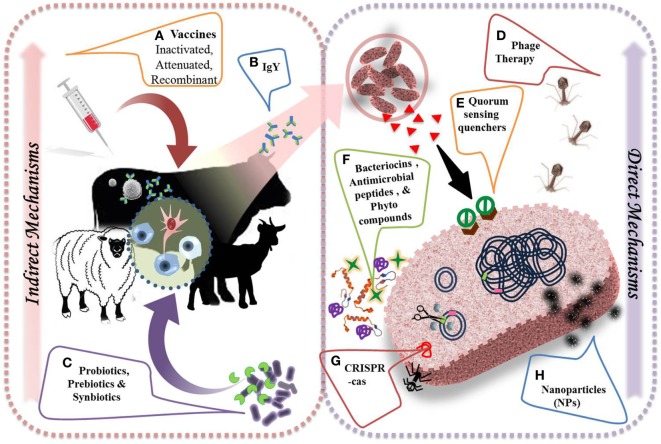
 , T cells
  ) to develop an adaptive immunity by producing specific antibodies (
 ) against important pathogens. (B) Chicken egg yolk antibodies provide effective treatment approach against several viral and bacterial diseases. (C) Probiotics (
 ), prebiotics (
 ), and synbiotics improve general health by selectively stimulating innate immune cells (
 ). (D) Lytic bacteriophage or their purified gene products could be used to treat sepsis and few bacterial infections. (E) Quorum sensing quenchers (
 ) could control virulence of pathogens by inhibiting the binding of auto-inducers (
 ) to respective receptors. (F) Antimicrobial peptides (
 ), bacteriocins (
 ), and phytocompounds (
 ) directly inhibit the bacterial growth by acting on bacterial cell membrane. (G) Modified CRISPR-Cas approach targets resistance genes in pathogens and reverse the selective pressure of resistance. (H) Metal-based nanoparticles (
 ) help in blockage of enzyme pathways, alteration of cell wall, and nucleic material pathways.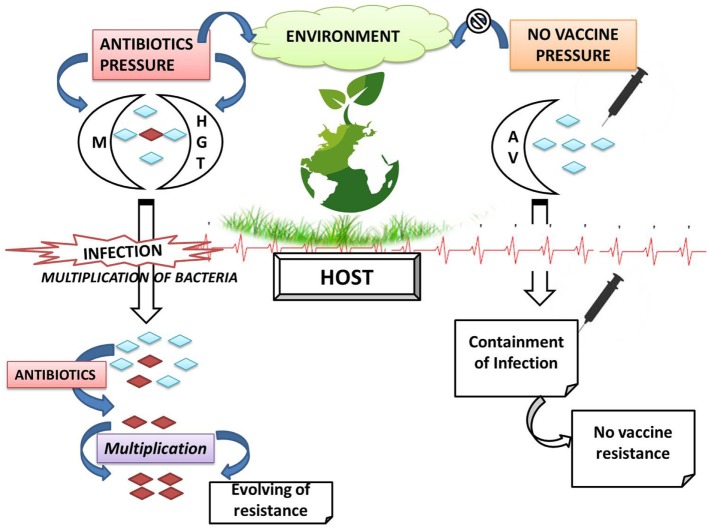
 , antibiotic-resistant bacteria;
  antibiotic-sensitive bacteria).
References
-
- Thakur N, Rokana N, Panwar H. Probiotics: selection criteria, safety and role in health and disease. J Inno Biol (2016) 3(1):259–70.
-
- Kumar A. Role of microbes in food and industrial microbiology. J Food Ind Microbiol (2016) 2:e101.10.4172/2572-4134.1000e101 - DOI
-
- Abraham EP, Chain E. An enzyme from bacteria able to destroy penicillin. Rev Infect Dis (1940) 10:677–8. - PubMed
Publication types
LinkOut - more resources
Full Text Sources
Other Literature Sources
Molecular Biology Databases
