


Direct α-C-H bond functionalization of unprotected cyclic amines
- PMID: 29359746
- PMCID: PMC5942596
- DOI: 10.1038/nchem.2871
Direct α-C-H bond functionalization of unprotected cyclic amines
Abstract
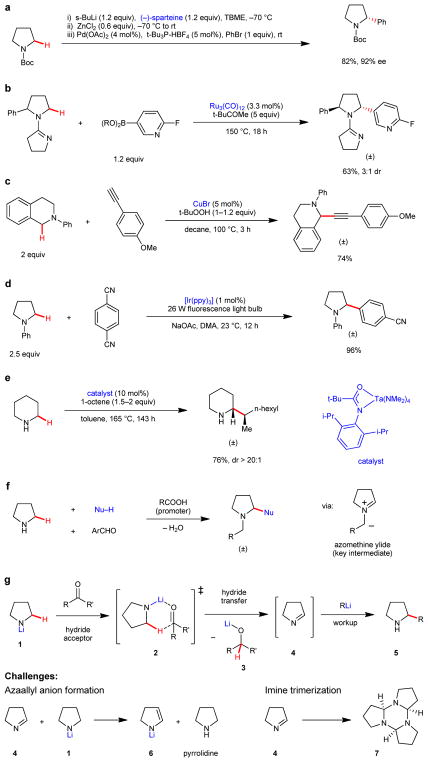
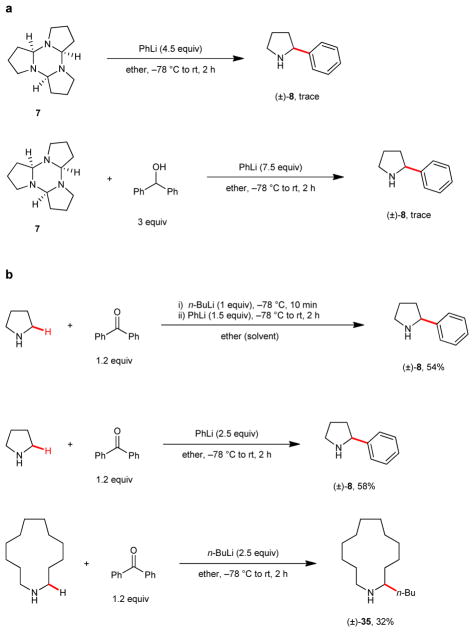
Cyclic amines are ubiquitous core structures of bioactive natural products and pharmaceutical drugs. Although the site-selective abstraction of C-H bonds is an attractive strategy for preparing valuable functionalized amines from their readily available parent heterocycles, this approach has largely been limited to substrates that require protection of the amine nitrogen atom. In addition, most methods rely on transition metals and are incompatible with the presence of amine N-H bonds. Here we introduce a protecting-group-free approach for the α-functionalization of cyclic secondary amines. An operationally simple one-pot procedure generates products via a process that involves intermolecular hydride transfer to generate an imine intermediate that is subsequently captured by a nucleophile, such as an alkyl or aryl lithium compound. Reactions are regioselective and stereospecific and enable the rapid preparation of bioactive amines, as exemplified by the facile synthesis of anabasine and (-)-solenopsin A.
Conflict of interest statement
The authors declare no competing financial interests.
Figures
References
-
- Vitaku E, Smith DT, Njardarson JT. Analysis of the Structural Diversity, Substitution Patterns, and Frequency of Nitrogen Heterocycles among U.S. FDA Approved Pharmaceuticals. J Med Chem. 2014;57:10257–10274. - PubMed
-
- Vo CVT, Bode JW. Synthesis of Saturated N-Heterocycles. J Org Chem. 2014;79:2809–2815. - PubMed
-
- Campos KR. Direct sp(3) C-H bond activation adjacent to nitrogen in heterocycles. Chem Soc Rev. 2007;36:1069–1084. - PubMed
-
- Mitchell EA, Peschiulli A, Lefevre N, Meerpoel L, Maes BUW. Direct alpha-Functionalization of Saturated Cyclic Amines. Chem Eur J. 2012;18:10092–10142. - PubMed
-
- Beak P, Lee WK. α-Lithioamine synthetic equivalents from dipole-stabilized carbanions: The t-Boc group as an activator for α-lithiation of carbamates. Tetrahedron Lett. 1989;30:1197–1200.
Publication types
MeSH terms
Substances
Associated data
- PubChem-Substance/346398052
- PubChem-Substance/346398056
- PubChem-Substance/346398053
- PubChem-Substance/346398011
- PubChem-Substance/346398012
- PubChem-Substance/346398013
- PubChem-Substance/346398014
- PubChem-Substance/346398015
- PubChem-Substance/346398016
- PubChem-Substance/346398017
- PubChem-Substance/346398018
- PubChem-Substance/346398019
- PubChem-Substance/346398020
- PubChem-Substance/346398021
- PubChem-Substance/346398022
- PubChem-Substance/346398023
- PubChem-Substance/346398024
- PubChem-Substance/346398025
- PubChem-Substance/346398026
- PubChem-Substance/346398027
- PubChem-Substance/346398028
- PubChem-Substance/346398029
- PubChem-Substance/346398030
- PubChem-Substance/346398031
- PubChem-Substance/346398032
- PubChem-Substance/346398033
- PubChem-Substance/346398034
- PubChem-Substance/346398035
- PubChem-Substance/346398036
- PubChem-Substance/346398054
- PubChem-Substance/346398059
- PubChem-Substance/346398037
- PubChem-Substance/346398038
- PubChem-Substance/346398039
- PubChem-Substance/346398057
- PubChem-Substance/346398040
- PubChem-Substance/346398041
- PubChem-Substance/346398042
- PubChem-Substance/346398043
- PubChem-Substance/346398044
- PubChem-Substance/346398045
- PubChem-Substance/346398046
- PubChem-Substance/346398047
- PubChem-Substance/346398055
- PubChem-Substance/346398058
- PubChem-Substance/346398048
- PubChem-Substance/346398049
- PubChem-Substance/346398050
- PubChem-Substance/346398051
Grants and funding
LinkOut - more resources
Full Text Sources
Other Literature Sources
