Case Reports
. 2018 Jul;68(1):113-126.
doi: 10.1002/hep.29789. Epub 2018 May 9.

cHCC-CCA: Consensus terminology for primary liver carcinomas with both hepatocytic and cholangiocytic differentation

Affiliations
Case Reports

cHCC-CCA: Consensus terminology for primary liver carcinomas with both hepatocytic and cholangiocytic differentation

Elizabeth Brunt et al. Hepatology. 2018 Jul.

Abstract

Primary liver carcinomas with both hepatocytic and cholangiocytic differentiation have been referred to as "combined (or mixed) hepatocellular-cholangiocarcinoma." These tumors, although described over 100 years ago, have attracted greater attention recently because of interest in possible stem cell origin and perhaps because of greater frequency and clinical recognition. Currently, because of a lack of common terminology in the literature, effective treatment and predictable outcome data have been challenging to accrue. This article represents a consensus document from an international community of pathologists, radiologists, and clinicians who have studied and reported on these tumors and recommends a working terminology for diagnostic and research approaches for further study and evaluation.

Conclusion: It is recommended that diagnosis is based on routine histopathology with hematoxylin and eosin (H&E); immunostains are supportive, but not essential for diagnosis. (Hepatology 2018;68:113-126).


Conflict of interest statement

Potential conflict of interest: Dr. Sirlin is on the speakers’ bureau for and received grants from GE. He is on the speakers’ bureau for Bayer. He received grants from Siemens. Dr. Kagen consults for and is on the speakers’ bureau for Bayer.

Figures
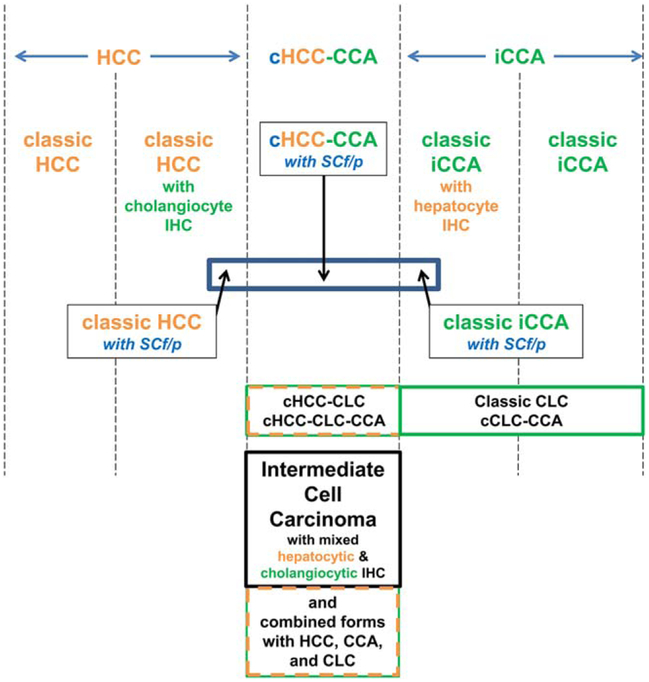
FIG. 1.
FIG. 1.
Differentiative and histological relationships between PLCs. PLCs show an array of differentiative states from hepatocytic (left) through combined types (middle) to cholangiocytic (right). Thus, there are classic HCCs that are morphologically only hepatocytic, some of which, however, display immunophenotypes, including cholangiocytic marker antigens (e.g., K19). There are also classic iCCAs that are morphologically pure adenocarcinomas, some of which may display immunophenotypes of hepatocytic marker antigens or mRNA. In the middle are the cHCC-CCAs—these are histologically partly morphological HCC and partly morphologically iCCA; immunophenotyping of such lesions can be helpful in confirming the histological impression, but morphology remains the primary criterion. CLC is a separate form of generally lower-grade biliary malignancy. CLC, as indicated, may be found in combination with any of the other forms of PLC in the diagram. Intermediate cell carcinoma is also distinctive: For this tumor, the morphology is neither that of HCC nor that of iCCA, but the mixture of cholangiocytic and hepatocytic features is observed on a cell-by-cell basis on the basis of immunophenotyping. Thus, for this tumor type alone, morphology requires confirmatory immunophenotyping to demonstrate the mixture of differentiation markers.
FIG. 2.
FIG. 2.
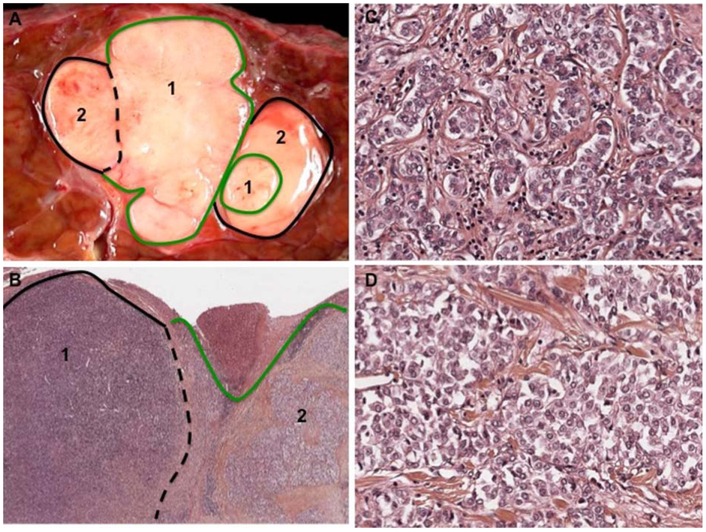
Combined HCC-CCA, defined by histochemical staining. A 67-year-old man with chronic hepatitis B and cirrhosis. Imaging diagnosis of a 3-cm hypervascular nodule in segment VII resulted in the segmentectomy specimen illustrated. (A) Gross evaluation shows a well-demarcated, lobulated tumor with two grossly distinct areas, labeled {1} and {2}. {1} is whiter and firmer while {2} is smoother and more yellow. (B) At low magnification, H&E evaluation shows that {1} is densely packed basophilic cells and {2} has more apparent nests of tumor cells within a fibrous stroma. (H&E, ×10). (C) Higher magnification of component {1} shows small tumoral cells arranged in glandular structures consistent with cholangiocytic differentiation. (D) is a higher magnification of component {2}, which is composed of nests of larger, eosinophilic cells with round nuclei and focally prominent nucleoli consistent with hepatocellular differentiation (C,D; H&E, ×20). IHC was positive for K7 and EpCAM in both tumor components. Positive K19, Glypican 3, and AFP staining were primarily in component {2}. Around 10% of cells were CD56 positive, preferentially in component{1}.
FIG. 3.
FIG. 3.
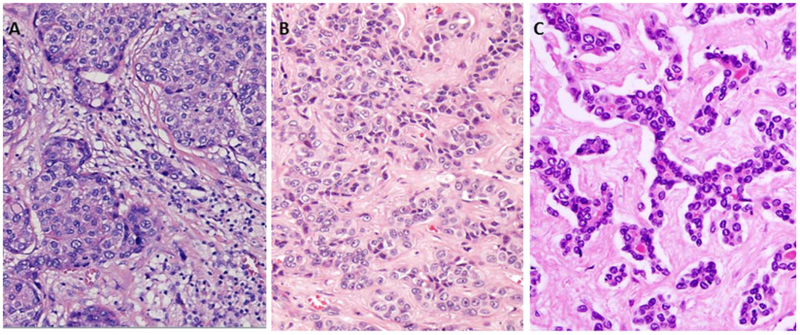
Morphological variants of stem/progenitor cell features. (A) HCC with stem cell/progenitor cell features. Nests of obvious hepatocytic tumor (often with little atypia) surrounded by stroma at the interface within which there are small cells with dark nuclei and high nuclear: cytoplasmic ratio (H&E, ×20). (B) Intermediate cell carcinoma with cords and trabeculae of cells with “intermediate” size between hepatocytes and cholangiocytes, without clear gland formation, often in a desmoplastic stroma. This tumor may be mistaken for iCCA. (H&E, ×20). (C) CLC in which slender, malignant ductules are present in a tubular, cord-like, anastomosing (“antler-like”) pattern within a dense stroma (H&E, ×20).
FIG. 4.
FIG. 4.
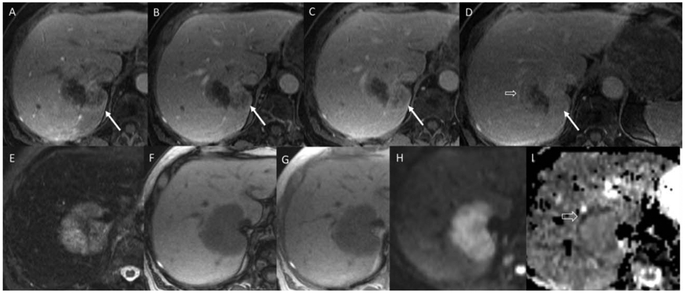
A 73-year-old woman with abdominal pain and lesion detected on imaging. Arterial phase, portal venous, and early and late delayed phase postcontrast magnetic resonance images (A-D) show a large mass in the central liver encasing the inferior vena cava (IVC; arrows). Note the progressive enhancement on the dynamic postcontrast images using an extracellular contrast agent. There are some regions of peripheral washout on the second delayed image (open arrow). The lesion shows T2 hyperintensity (E), no intralesional lipid or blood (F,G), and target appearance on diffusion weighted imaging/apparent diffusion coefficient (H,I, open arrow). The overall pattern is most compatible with a non-HCC malignancy, such as iCCA. The patient’s tumor markers were elevated (AFP-37,197 ng/mL and CA19-9-2168). Resection of the mass showed fairly uniform population of large tumor cells with abundant cytoplasm and large nuclei and nucleoli and brisk mitotic activity. The cells were arranged in solid nests and within lymphovascular spaces with no glandular formation. The IHC showed heterogeneous cell populations. AFP highlighted a majority of tumor cells whereas the hepatocyte-specific antigen showed only scattered positivity. Further IHC showed canalicular pCEA, diffuse K7 and K19 positivity, thyroid transcription factor-1, and K20 negativity.
FIG. 5.
FIG. 5.
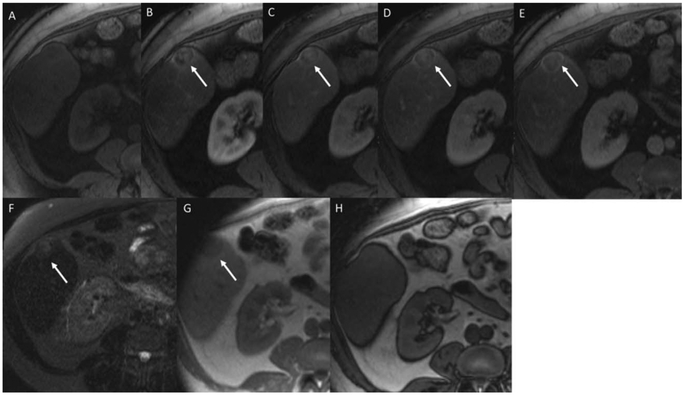
A 66-year-old woman at risk for HCC, with lesion detected on surveillance imaging. Precontrast, arterial phase, portal venous phase, and early and late delayed phase magnetic resonance images show a segment 5 hepatic lesion with mild central nodular arterial phase hyperenhancement followed by washout and capsule appearance on the delayed images using an extracellular contrast agent (arrows). This is a pattern most compatible with HCC. The lesion is mildly T2 hyperintense (F) and shows no intralesional fat or blood products (G,H). Tumor markers were negative. Biopsy of the lesion demonstrated moderately differentiated HCC with central hemorrhage and necrosis. Several tumor nodules were embedded fibrous stroma and IHC showed diffuse K7 and K19, weak nuclear p53, and canalicular pCEA.
FIG. 6.
FIG. 6.
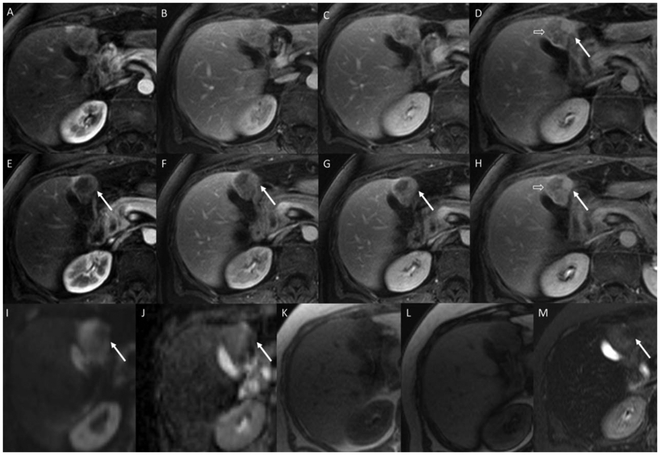
A 77-year-old woman with incidentally detected liver lesion. Arterial, portal venous, and early and late delayed magnetic resonance images obtained with an extracellular contrast agent at two slice positions (A-D and E-H) demonstrate a mixed enhancement pattern with features of both HCC and other malignancy. Arrows indicate a region of progressive enhancement along the medial border, which would be more compatible with iCCA. Open arrows indicate a region demonstrating washout and capsule appearance as observed in HCC. Diffusion weighted, apparent diffusion coefficient, in-phase, opposed phase, and fat suppressed T2 weighted images (I-M) also show a mixed picture. The arrows indicate a region of T2 hypointensity and different diffusion pattern. The in- and opposed-phase images demonstrate no intralesional blood products or fat. The overall picture would be indeterminate by imaging, not meeting algorithmic criteria for HCC. Tumor markers were all negative. Biopsy of the mass demonstrated a moderately differentiated primary liver carcinoma with morphological features of HCC (cells with abundant eosinophilic cytoplasm) and gland forming iCCA. IHC stains showed positivity for K7 and K19 and canalicular pCEA.

References

    1. Wells HG. Primary carcinoma of the liver. Am J M Sc 1903; 126:403–417.
    1. European Association for the Study of the Liver. EASL-EORTC clinical practice guidelines: management of hepatocellular carcinoma. J Hepatol 2012;56:908–943. - PubMed
    1. Edmondson HA, Steiner PE. Primary carcinoma of the liver: a study of 100 cases among 48,900 necropsies. Cancer 1954;7:462–503. - PubMed
    1. Goodman ZD, Ishak KG, Langloss JM, Sesterhenn IA, Rabin L. Combined hepatocellular-cholangiocarcinoma. A histologic and immunohistochemical study. Cancer 1985;55:124–135. - PubMed
    1. Ng IO, Shek TW, Nicholls J, Ma LT. Combined hepatocellular-cholangiocarcinoma: a clinicopathological study. J Gastroenterol Hepatol 1998;13:34–40. - PubMed

Publication types