Review
. 2018 Jan 23;19(2):230.
doi: 10.3390/ijms19020230.

Melanins in Fossil Animals: Is It Possible to Infer Life History Traits from the Coloration of Extinct Species?

Affiliations
Review

Melanins in Fossil Animals: Is It Possible to Infer Life History Traits from the Coloration of Extinct Species?

Juan J Negro et al. Int J Mol Sci. .

Abstract

Paleo-colour scientists have recently made the transition from describing melanin-based colouration in fossil specimens to inferring life-history traits of the species involved. Two such cases correspond to counter-shaded dinosaurs: dark-coloured due to melanins dorsally, and light-coloured ventrally. We believe that colour reconstruction of fossils based on the shape of preserved microstructures-the majority of paleo-colour studies involve melanin granules-is not without risks. In addition, animals with contrasting dorso-ventral colouration may be under different selection pressures beyond the need for camouflage, including, for instance, visual communication or ultraviolet (UV) protection. Melanin production is costly, and animals may invest less in areas of the integument where pigments are less needed. In addition, melanocytes exposed to UV radiation produce more melanin than unexposed melanocytes. Pigment economization may thus explain the colour pattern of some counter-shaded animals, including extinct species. Even in well-studied extant species, their diversity of hues and patterns is far from being understood; inferring colours and their functions in species only known from one or few specimens from the fossil record should be exerted with special prudence.

Keywords: countershading; dinosaur; fossil; melanin; melanosome; paleo-color; pigments; skin coloration.


Conflict of interest statement

The authors declare no conflict of interest. The funding sponsors had no role in the design of the study; in the collection, analyses, or interpretation of data; in the writing of the manuscript; and in the decision to publish the results.

Figures
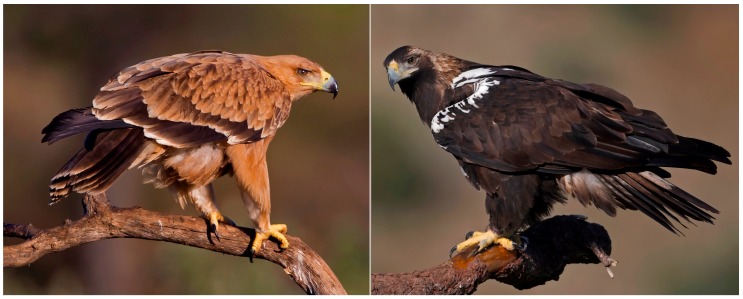
Figure 1
Figure 1
Spanish Imperial Eagles Aquila adalberti. On the left, a juvenile individual showing a light-colored plumage mainly based on the presence of pheomelanin. On the right, an individual showing the much darker full adult plumage (with white “shoulders”), based on eumelanin. This eagle species presents delayed plumage maturation, and the adult plumage is typically attained when individuals are 4 years old. Photographs by Stewart Finlayson, Gibraltar Museum.
Figure 2
Figure 2
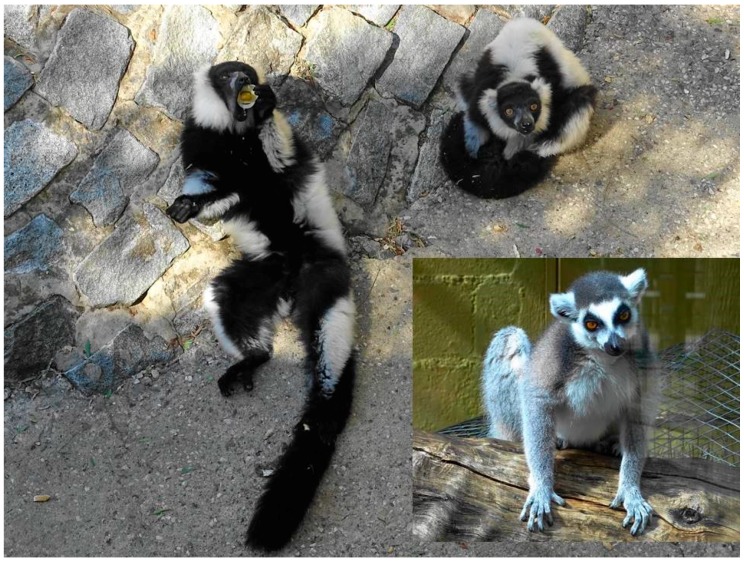
Two black-and-white ruffed lemurs Varecia variegata, one showing the black ventral area including the insides of the legs (left), and the other one showing the white dorsal area (top-right). These lemurs are arboreal, diurnal, and live in the rainforests of eastern Madagascar. In the lower right, a ring-tailed lemur Lemur catta showing a typical countershaded coloration, darker on top and white below. The ring-tailed lemur is the most terrestrial of all lemurs. It lives in forests and scrubland in southern Madagascar. Photographs taken at Zoobotánico Jerez (Spain) by Juan J. Negro.
Figure 3
Figure 3
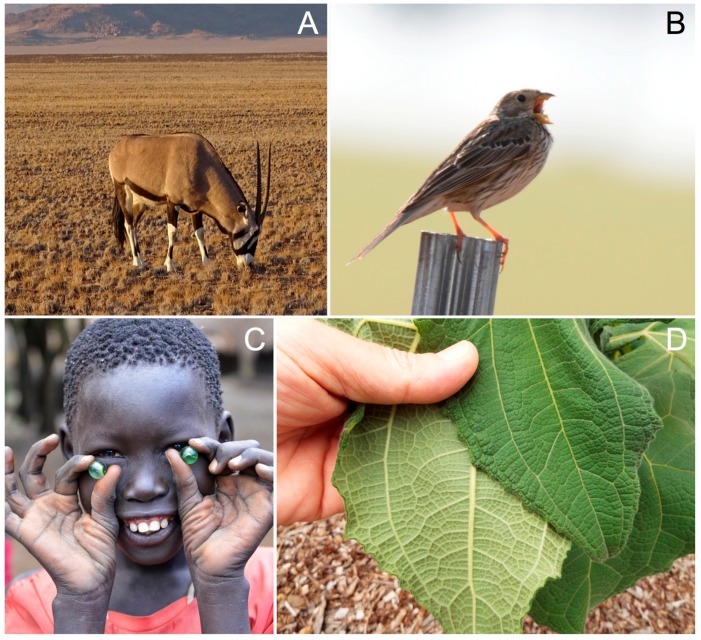
Different examples of contrasting coloration. (A) Gemsbok Oryx gazella from Namibia. Grey dorsally, white ventrally (Photograh by Juan J. Negro). (B) Corn bunting Emberiza calandra, a brown bird with a light belly (Photograph by Ismael Galván). (C) Dark-skinned person showing lighter coloration in the palms of the hands (credit and link: Rod Waddington; Available online: https://flic.kr/p/i3CAuX; covered by a CC BY-SA license (Available online, site last accessed 22/01/2018: https://creativecommons.org/licenses/by-sa/2.0/). (D) Yacón Smallanthus sonchifolius with a high color contrast between the upper side and underside of the leaves (credit and link: Forest and Kim Starr; https://flic.kr/p/DtS3hR; covered by a CC BY license (Available online, site last accessed 22/01/2018: https://creativecommons.org/licenses/by/2.0/).

References

    1. Clarke J.A., Ksepka D.T., Salas-Gismondi R., Altamirano A.J., Shawkey M.D., D’Alba L., Vinther J., DeVries T.J., Baby P. Fossil evidence for evolution of the shape and color of penguin feathers. Science. 2010;330:954–957. doi: 10.1126/science.1193604. - DOI - PubMed
    1. Zhang F., Kearns S.L., Orr P.J., Benton M.J., Zhou Z., Johnson D., Xu X., Wang X. Fossilized melanosomes and the colour of Cretaceous dinosaurs and birds. Nature. 2010;463:1075–1078. doi: 10.1038/nature08740. - DOI - PubMed
    1. Carney R.M., Vinther J., Shawkey M.D., D’Alba L., Ackermann J. New evidence on the colour and nature of the isolated Archaeopteryx feather. Nat. Commun. 2012;3:637. doi: 10.1038/ncomms1642. - DOI - PubMed
    1. Li Q., Clarke J.A., Gao K.Q., Zhou C.F., Meng Q., Li D., D’Alba L., Shawkey M.D. Melanosome evolution indicates a key physiological shift within feathered dinosaurs. Nature. 2014;507:350–353. doi: 10.1038/nature12973. - DOI - PubMed
    1. McNamara M.E., Orr P.J., Kearns S.L., Alcalá L., Anadón P., Peñalver E. Reconstructing carotenoid-based and structural coloration in fossil skin. Curr. Biol. 2016;26:1075–1082. doi: 10.1016/j.cub.2016.02.038. - DOI - PubMed

LinkOut - more resources