. 2018 Jan 23;9(2):35.
doi: 10.3390/genes9020035.

Genome-Wide Characterization of Heat-Shock Protein 70s from Chenopodium quinoa and Expression Analyses of Cqhsp70s in Response to Drought Stress

Affiliations

Genome-Wide Characterization of Heat-Shock Protein 70s from Chenopodium quinoa and Expression Analyses of Cqhsp70s in Response to Drought Stress

Jianxia Liu et al. Genes (Basel). .

Abstract

Heat-shock proteins (HSPs) are ubiquitous proteins with important roles in response to biotic and abiotic stress. The 70-kDa heat-shock genes (Hsp70s) encode a group of conserved chaperone proteins that play central roles in cellular networks of molecular chaperones and folding catalysts across all the studied organisms including bacteria, plants and animals. Several Hsp70s involved in drought tolerance have been well characterized in various plants, whereas no research on Chenopodium quinoa HSPs has been completed. Here, we analyzed the genome of C. quinoa and identified sixteen Hsp70 members in quinoa genome. Phylogenetic analysis revealed the independent origination of those Hsp70 members, with eight paralogous pairs comprising the Hsp70 family in quinoa. While the gene structure and motif analysis showed high conservation of those paralogous pairs, the synteny analysis of those paralogous pairs provided evidence for expansion coming from the polyploidy event. With several subcellular localization signals detected in CqHSP70 protein paralogous pairs, some of the paralogous proteins lost the localization information, indicating the diversity of both subcellular localizations and potential functionalities of those HSP70s. Further gene expression analyses revealed by quantitative polymerase chain reaction (qPCR) analysis illustrated the significant variations of Cqhsp70s in response to drought stress. In conclusion, the sixteen Cqhsp70s undergo lineage-specific expansions and might play important and varied roles in response to drought stress.

Keywords: Chenopodium quinoa; drought stress; heat-shock proteins; phylogenetic analysis; synteny analysis.


Conflict of interest statement

The authors declare no conflict of interest.

Figures
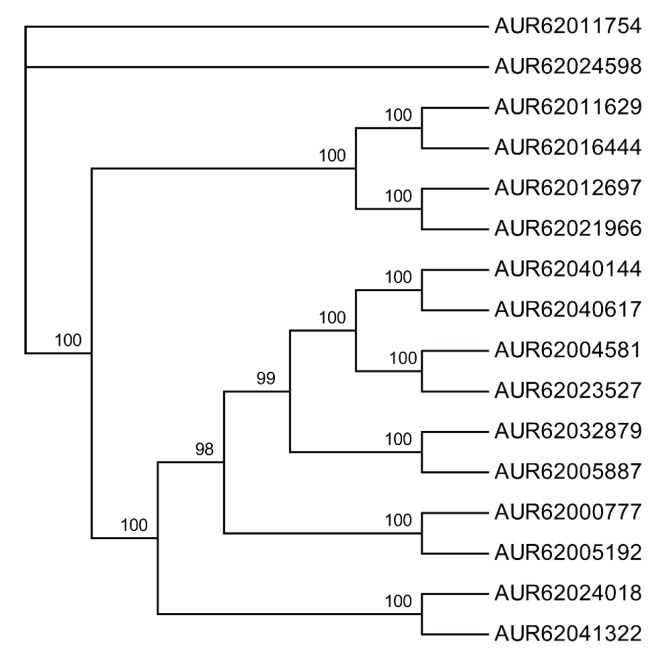
Figure 1
Figure 1
Phylogenetic tree of HSP70 in quinoa. Sixteen HSP70 homologs were identified in the proteome database of quinoa. Unrooted phylogenetic tree was constructed based on multiply-aligned sequences of the sixteen CqHSP70 protein homologs via PhyML using JTT substitution model with 1000 bootstrap replications as described in the method. Bootstrap values are indicated (in percentage) at the base of each node. With high bootstraps in each subclade, CqHSP70 members were classified as eight potential paralogous pairs.
Figure 2
Figure 2
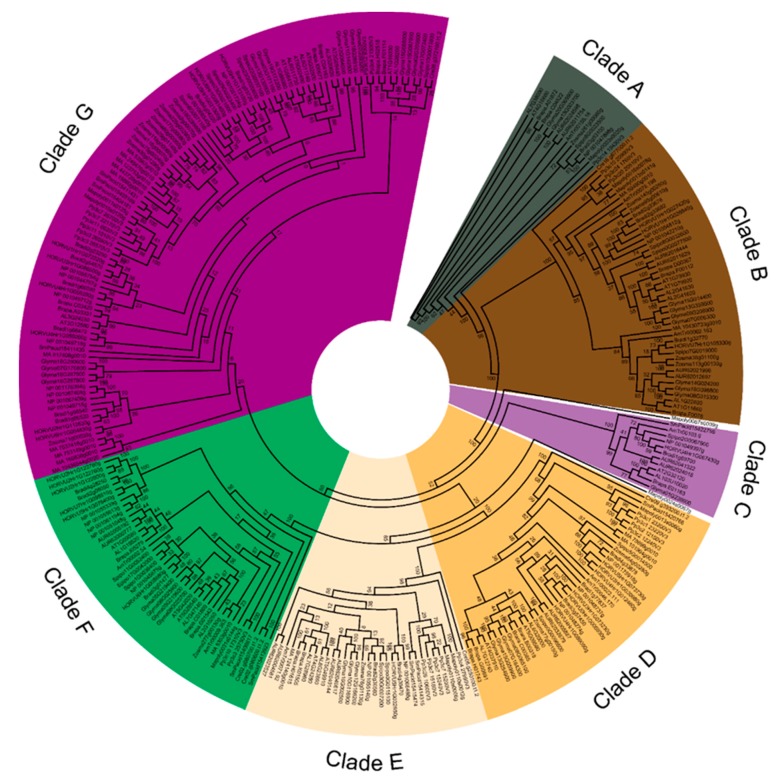
Phylogenetic tree of HSP70s in different plant species. Based on the total identified 293 HSP70 homologs in 16 plant species, an unrooted phylogenetic tree was calculated with the Maximum-Likelihood method, using JTT modeling with gamma-distributed rates and 1000 bootstrap replications. Bootstrap values are indicated at the base of each clade. The color region is associated with seven groups of proteins, i.e., Clades A to G.
Figure 3
Figure 3
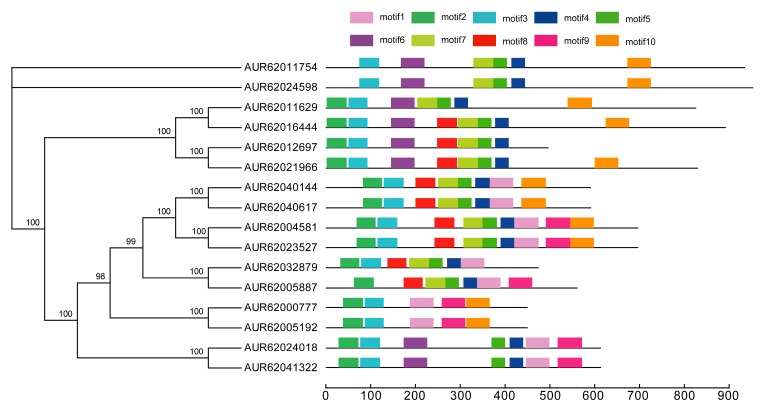
Conserved motifs across all CqHSP70s. Ten conserved motifs in all CqHSP70s were identified through the multiple EM for motif elicitation (MEME) analysis. Schematic representation shows conserved motifs and each motif is represented by a colored box numbered at the top. Scale bar indicates number of amino acids (aa).
Figure 4
Figure 4
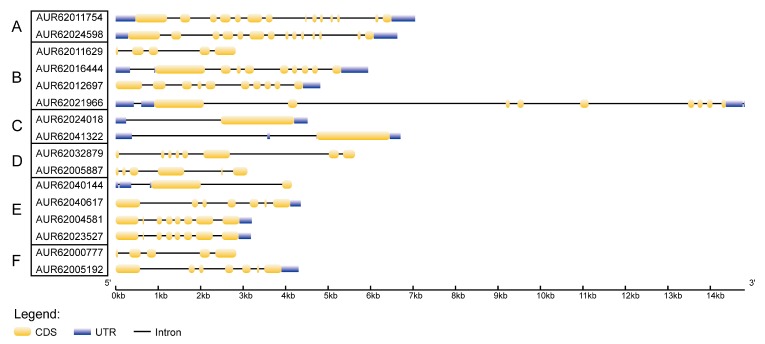
Conservation and diversity of gene structures of the Hsp70 paralogous pairs in quinoa. This figure shows a schematic representation of gene structures of Hsp70s in quinoa. The yellow boxes represent exons, black lines represent introns and blue boxes represent untranslated region (UTR) region. The HSP70 Clades A–F (AF) are indicated on the left. Scale bar indicates number of base pair (bp).
Figure 5
Figure 5
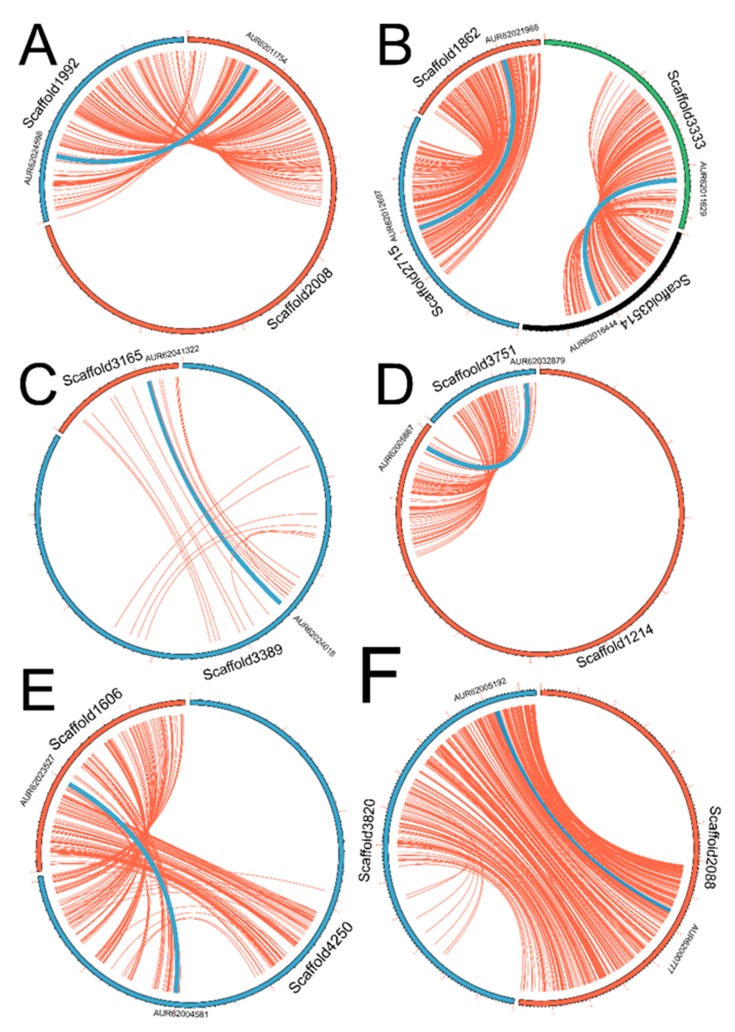
Synteny analysis of Cqhsp70. The synteny and collinearity regions of the Cqhsp70 paralogous pairs in their scaffold were performed with MCScanX [29]. Seven out of the eight pairs were used except the AUR62040144–AUR620440617 pairs whose scaffolds are too short to investigate the synteny region. The Cqhsp70 paralogous pairs were indicated by the blue lines while the red lines represented the conserved region in scaffolds. Note: (A)–(F) in this figure are consistent with the clade source of those paralogous pairs in Figure 2.
Figure 6
Figure 6
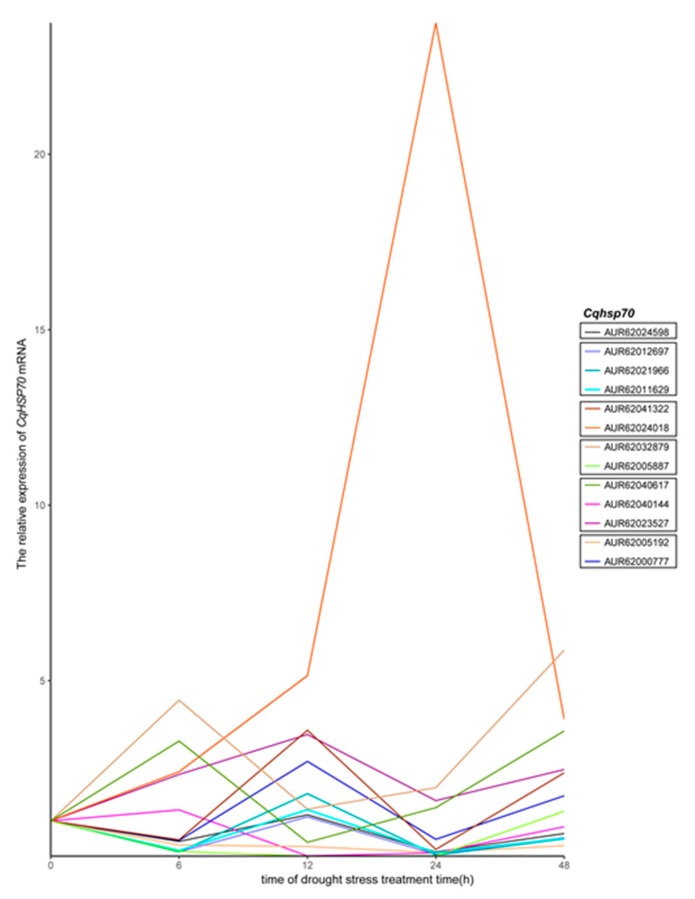
Cqhsp70s gene expression profiles in response to drought treatment. Two-week-old quinoa seedlings were irrigated with 25% PEG6000 (w/v) for drought stress. Above-ground tissues were collected at five time points (0, 6, 12, 24, and 48 h) during the treatments. Quantitative polymerase chain reaction (qPCR) assays were performed with different batches of treated plants and one representative data was shown.
Figure 7
Figure 7
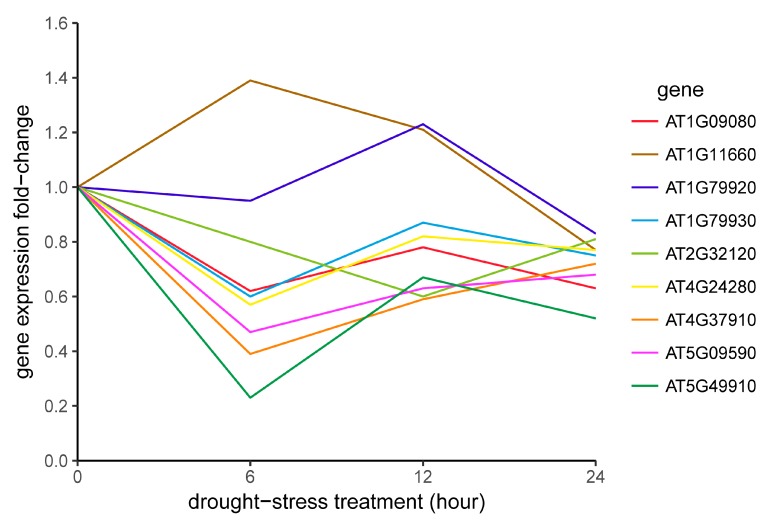
Athsp70 gene expression profiles in response to drought treatment. The preliminary data were retrieved from the published transcriptomics data [21].

References

    1. Wang W.X., Vinocur B., Altman A. Plant responses to drought, salinity and extreme temperatures: Towards genetic engineering for stress tolerance. Planta. 2003;218:1–14. doi: 10.1007/s00425-003-1105-5. - DOI - PubMed
    1. Lindquist S. The heat-shock response. Annu. Rev. Biochem. 1986;55:1151–1191. doi: 10.1146/annurev.bi.55.070186.005443. - DOI - PubMed
    1. Moser D., Doumbo O., Klinkert M.Q. The humoral response to heat-shock protein-70 in human and Murine schistosomiasis-mansoni. Parasite Immunol. 1990;12:341–352. doi: 10.1111/j.1365-3024.1990.tb00973.x. - DOI - PubMed
    1. Vierling E. The roles of heat-shock proteins in plants. Annu. Rev. Plant Phys. 1991;42:579–620. doi: 10.1146/annurev.pp.42.060191.003051. - DOI
    1. Tripp J., Mishra S.K., Scharf K.D. Functional dissection of the cytosolic chaperone network in tomato mesophyll protoplasts. Plant Cell Environ. 2009;32:123–133. doi: 10.1111/j.1365-3040.2008.01902.x. - DOI - PubMed

LinkOut - more resources