


Faecal Pathogen Flows and Their Public Health Risks in Urban Environments: A Proposed Approach to Inform Sanitation Planning
- PMID: 29360775
- PMCID: PMC5858256
- DOI: 10.3390/ijerph15020181
Faecal Pathogen Flows and Their Public Health Risks in Urban Environments: A Proposed Approach to Inform Sanitation Planning
Abstract
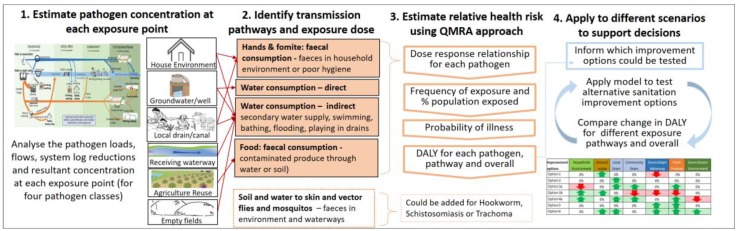
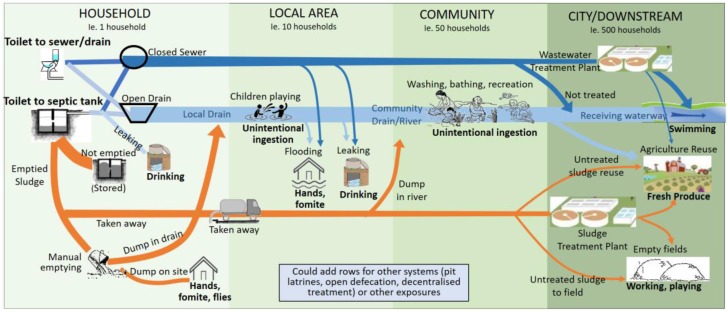
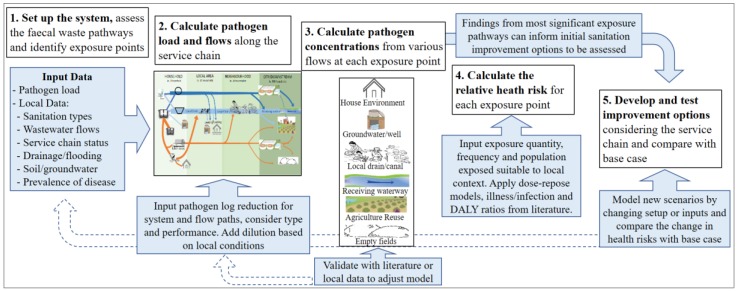
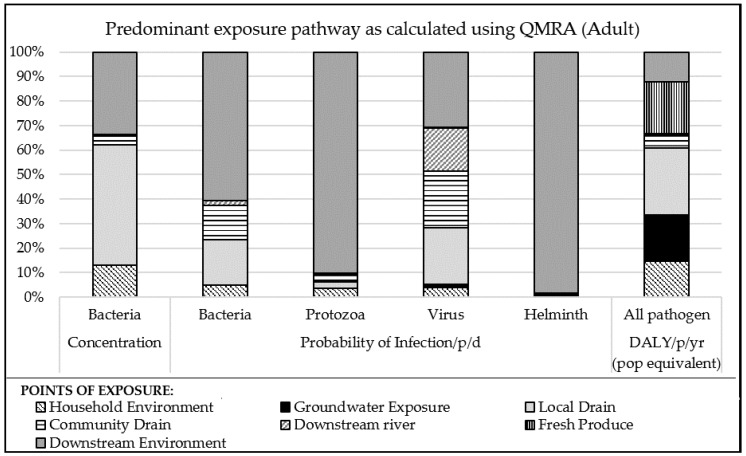
Public health benefits are often a key political driver of urban sanitation investment in developing countries, however, pathogen flows are rarely taken systematically into account in sanitation investment choices. While several tools and approaches on sanitation and health risks have recently been developed, this research identified gaps in their ability to predict faecal pathogen flows, to relate exposure risks to the existing sanitation services, and to compare expected impacts of improvements. This paper outlines a conceptual approach that links faecal waste discharge patterns with potential pathogen exposure pathways to quantitatively compare urban sanitation improvement options. An illustrative application of the approach is presented, using a spreadsheet-based model to compare the relative effect on disability-adjusted life years of six sanitation improvement options for a hypothetical urban situation. The approach includes consideration of the persistence or removal of different pathogen classes in different environments; recognition of multiple interconnected sludge and effluent pathways, and of multiple potential sites for exposure; and use of quantitative microbial risk assessment to support prediction of relative health risks for each option. This research provides a step forward in applying current knowledge to better consider public health, alongside environmental and other objectives, in urban sanitation decision making. Further empirical research in specific locations is now required to refine the approach and address data gaps.
Keywords: decision making; faecal waste; options assessment; pathogens; public health; risk assessment; urban sanitation; wastewater.
Conflict of interest statement
The authors declare no conflict of interest.
Figures
References
-
- Tilley E., Lüthi C., Morel A., Zurbrügg C., Schertenleib R. Compendium of Sanitation Systems and Technologies. Swiss Federal Institute of Aquatic Science and Technology (Eawag); Dubendorf, Switzerland: 2008.
-
- Satterthwaite D. Editorial: Why is urban health so poor even in many successful cities? Environ. Urban. 2011;23:5–11. doi: 10.1177/0956247811401521. - DOI
-
- Mitchell C., Abeysuriya K., Ross K. Making pathogen hazards visible: A new heuristic to improve sanitation investment efficacy. Waterlines. 2016;35:163–181. doi: 10.3362/1756-3488.2016.014. - DOI
-
- Freeman M., Garn J.V., Sclar G.D., Boisson S., Medlicott K., Alexander K.T., Penakalapati G., Anderson D., Mahtani A.G., Grimes J.E.T., et al. The impact of sanitation on infectious disease and nutritional status: A systematic review and meta-analysis. Int. J. Hyg. Environ. Health. 2017;220:928–949. doi: 10.1016/j.ijheh.2017.05.007. - DOI - PubMed
Publication types
MeSH terms
Substances
LinkOut - more resources
Full Text Sources
Other Literature Sources
Medical
