


Estrogen and Androgen Blockade for Advanced Prostate Cancer in the Era of Precision Medicine
- PMID: 29360794
- PMCID: PMC5836061
- DOI: 10.3390/cancers10020029
Estrogen and Androgen Blockade for Advanced Prostate Cancer in the Era of Precision Medicine
Abstract
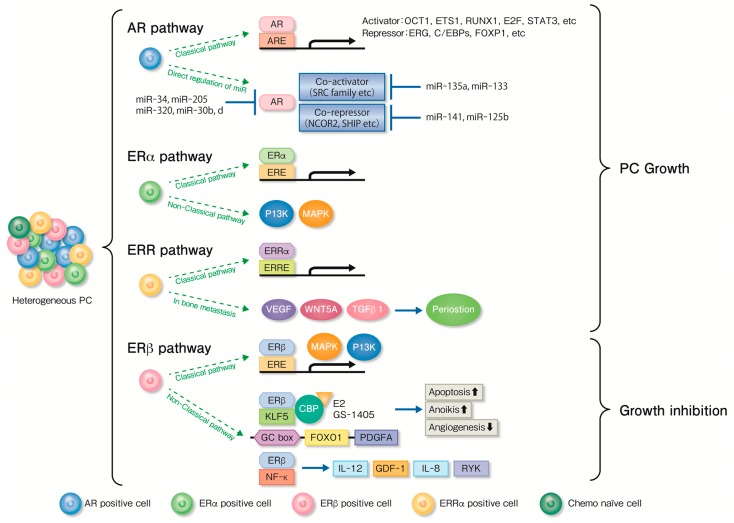
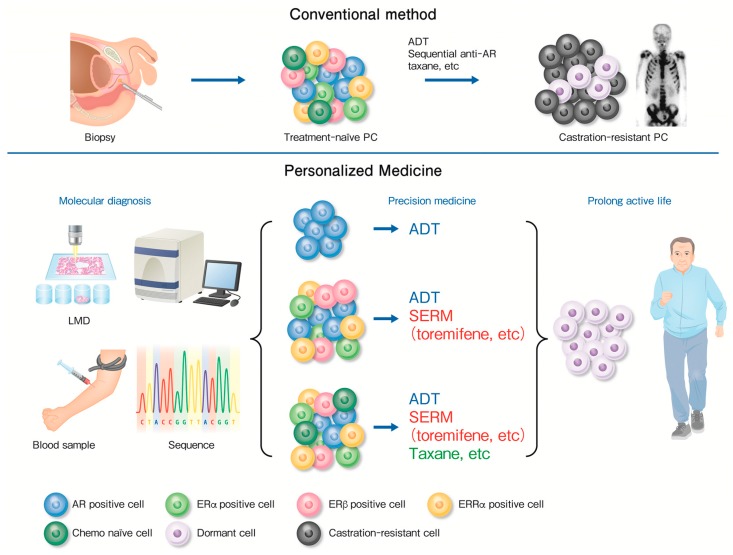
Androgen deprivation therapy (ADT) has been widely prescribed for patients with advanced prostate cancer (PC) to control key signaling pathways via androgen receptor (AR) and AR-collaborative transcriptional factors; however, PC gradually acquires a lethal phenotype and results in castration-resistant PC (CRPC) during ADT. Therefore, new therapeutic strategies are required in clinical practice. In addition, ARs; estrogen receptors (ERs; ERα and ERβ); and estrogen-related receptors (ERRs; ERRα, ERRβ, and ERRγ) have been reported to be involved in the development or regulation of PC. Recent investigations have revealed the role of associated molecules, such as KLF5, FOXO1, PDGFA, VEGF-A, WNT5A, TGFβ1, and micro-RNA 135a of PC, via ERs and ERRs. Selective ER modulators (SERMs) have been developed. Recently, estrogen and androgen blockade (EAB) using a combination of toremifene and ADT has been demonstrated to improve biochemical recurrence rate in treatment-naïve bone metastatic PC. In the future, the suitability of ADT alone or EAB for individuals may be evaluated by making clinical decisions on the basis of information obtained from RT-PCR, gene-panel, or liquid biopsy to create a "personalized medicine" or "precision medicine". In this review, we summarize ER and ERR signaling pathways, molecular diagnosis, and SERMs as candidates for advanced PC treatment.
Keywords: androgen deprivation therapy (ADT); androgen receptor; estrogen-related receptor; personalized medicine; precision medicine; prostate cancer; selective estrogen receptor modulators (SERMs); stem cell.
Conflict of interest statement
The authors declare no conflicts of interest.
Figures
References
-
- Gillessen S., Attard G., Beer T.M., Beltran H., Bossi A., Bristow R., Carver B., Castellano D., Chung B.H., Clarke N., et al. Management of Patients with Advanced Prostate Cancer: The Report of the Advanced Prostate Cancer Consensus Conference APCCC 2017. Eur. Urol. 2017;73:178–211. doi: 10.1016/j.eururo.2017.06.002. - DOI - PubMed
Publication types
LinkOut - more resources
Full Text Sources
Other Literature Sources
Research Materials
Miscellaneous
