


Intraoperative Brief Electrical Stimulation of the Spinal Accessory Nerve (BEST SPIN) for prevention of shoulder dysfunction after oncologic neck dissection: a double-blinded, randomized controlled trial
- PMID: 29361981
- PMCID: PMC5781293
- DOI: 10.1186/s40463-017-0244-9
Intraoperative Brief Electrical Stimulation of the Spinal Accessory Nerve (BEST SPIN) for prevention of shoulder dysfunction after oncologic neck dissection: a double-blinded, randomized controlled trial
Abstract
Background: Shoulder dysfunction is common after neck dissection for head and neck cancer (HNC). Brief electrical stimulation (BES) is a novel technique that has been shown to enhance neuronal regeneration after nerve injury by modulating the brain-derived neurotrophic growth factor (BDNF) pathways. The objective of this study was to evaluate the effect of BES on postoperative shoulder function following oncologic neck dissection.
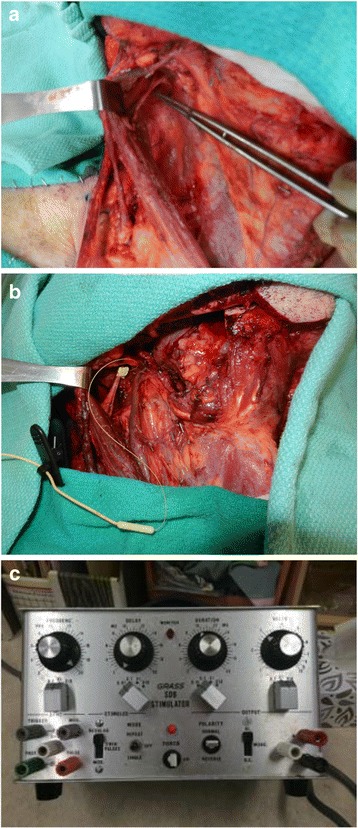
Methods: Adult participants with a new diagnosis of HNC undergoing Level IIb +/- V neck dissection were recruited. Those in the treatment group received intraoperative BES applied to the spinal accessory nerve (SAN) after completion of neck dissection for 60 min of continuous 20 Hz stimulation at 3-5 V of 0.1 msec balanced biphasic pulses, while those in the control group received no stimulation (NS). The primary outcome measured was the Constant-Murley Shoulder (CMS) Score, comparing changes from baseline to 12 months post-neck dissection. Secondary outcomes included the change in the Neck Dissection Impairment Index (ΔNDII) score and the change in compound muscle action potential amplitude (ΔCMAP) over the same period.
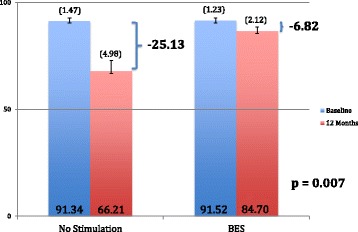
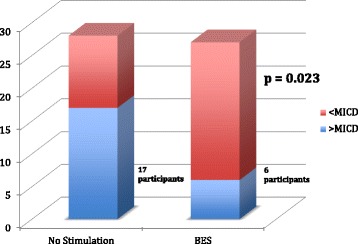
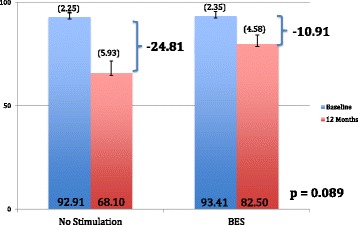
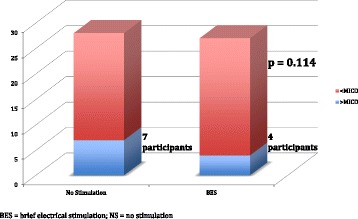
Results: Fifty-four patients were randomized to the treatment or control group with a 1:1 allocation scheme. No differences in demographics, tumor characteristics, or neck dissection types were found between groups. Significantly lower ΔCMS scores were observed in the BES group at 12 months, indicating better preservation of shoulder function (p = 0.007). Only four in the BES group compared to 17 patients in the NS groups saw decreases greater than the minimally important clinical difference (MICD) of the CMS (p = 0.023). However, NDII scores (p = 0.089) and CMAP amplitudes (p = 0.067) between the groups did not reach statistical significance at 12 months. BES participants with Level IIb + V neck dissections had significantly better ΔCMS and ΔCMAP scores at 12 months (p = 0.048 and p = 0.025, respectively).
Conclusions: Application of BES to the SAN may help reduce impaired shoulder function in patients undergoing oncologic neck dissection, and may be considered a viable adjunct to functional rehabilitation therapies.
Trial registration: Clinicaltrials.gov ( NCT02268344 , October 17, 2014).
Keywords: Axonal regeneration; Electrical stimulation; Head neck cancer; Neck dissection; Nerve regeneration; Spinal accessory nerve.
Conflict of interest statement
Ethics approval and consent to participate
Institutional ethical approval was obtained from the Human Research Ethics Board (HREB) (Pro00046671) at the University of Alberta.
Consent for publication
All patients provided written informed consent prior to participation and provided consent for publication of data.
Competing interests
DAO is a paid consultant for Medtronic Canada. The other authors declare that they have no competing interests.
Publisher’s Note
Springer Nature remains neutral with regard to jurisdictional claims in published maps and institutional affiliations.
Figures


References
-
- Biron VL, Mohamed A, Hendzel MJ, Alan Underhill D, Seikaly H. Epigenetic differences between human papillomavirus-positive and -negative oropharyngeal squamous cell carcinomas. J Otolaryngol Head Neck Surg. 2012;41(Suppl 1):S65–S70. - PubMed
-
- Umeda M, Shigeta T, Takahashi H, Oguni A, Kataoka T, Minamikawa T, et al. Shoulder mobility after spinal accessory nerve-sparing modified radical neck dissection in oral cancer patients. Oral Surg Oral Med Oral Pathol Oral Radiol Endod. 2010;109(6):820–824. doi: 10.1016/j.tripleo.2009.11.027. - DOI - PubMed
Publication types
MeSH terms
Associated data
Grants and funding
LinkOut - more resources
Full Text Sources
Other Literature Sources
Medical
Miscellaneous
