. 2018 Jan 23;8(1):1462.
doi: 10.1038/s41598-018-19780-6.

New rapid one-step PCR diagnostic assay for Plasmodium falciparum infective mosquitoes

Affiliations

New rapid one-step PCR diagnostic assay for Plasmodium falciparum infective mosquitoes

Mary Kefi et al. Sci Rep. .

Abstract

An essential component of malaria vector control programmes is the detection of Plasmodium falciparum within its mosquito vectors, particularly in the salivary glands where the infective sporozoites reside. Several protocols have been developed for this purpose; however they require dissection of mosquito specimens prior to analysis. Here, a novel one-step RT-qPCR TaqMan diagnostic assay was developed for mosquitoes with infective Plasmodium falciparum sporozoites in the salivary glands. It is based on detection of the sporozoite-specific Pfslarp and Pfplp1 gene transcripts. These transcripts were chosen based on bioinformatics analysis, and experimentally verified to be overexpressed in the salivary gland sporozoite stage of the parasite compared to other mosquito parasite stages. The proof of principle and the performance of the assay were demonstrated using RNAlater preserved mosquito samples. Tests of analytical sensitivity showed the novel TaqMan assay to be 100% accurate, although its performance in the field needs to be further demonstrated. This method has no requirement for dissection and post-PCR processing and thus is simple and rapid to perform in individual mosquitoes or mosquito pools. It can be used in single or multiplex formats also targeting additional markers expressed in different tissues, such as detoxification enzymes associated with insecticide resistance.


Conflict of interest statement

The authors declare that they have no competing interests.

Figures
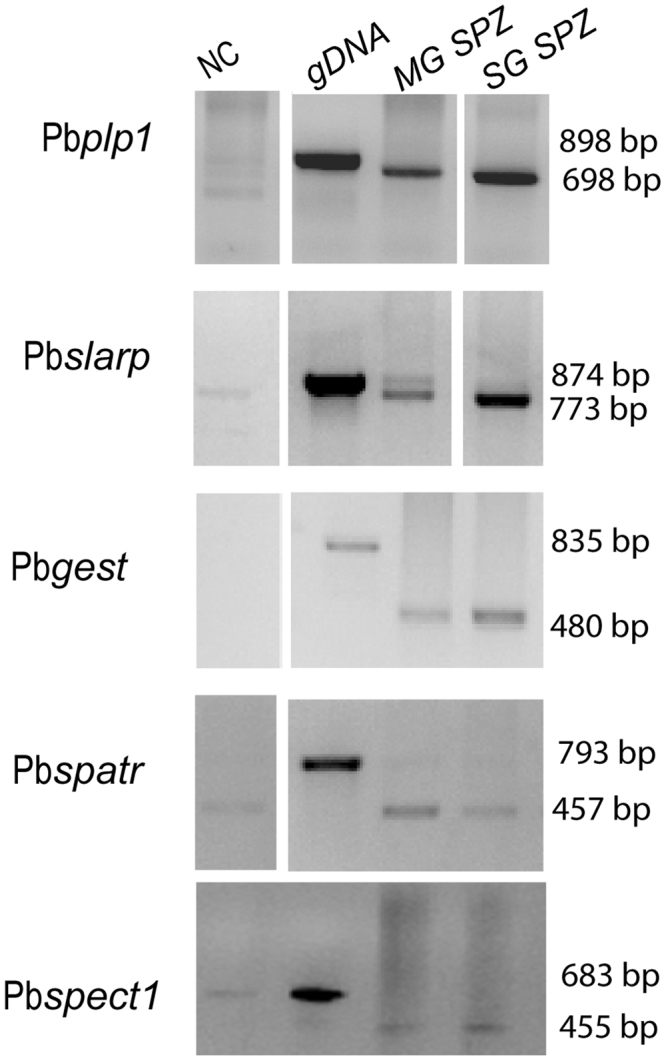
Figure 1
Figure 1
RT-PCR analysis of P.berghei Pbplp1, Pbgest, PbspectI, Pbspatr and Pbslarp transcripts. Templates were derived from gDNA (lane 2), dissected midguts at 11 d pbm (post blood meal) midgut sporozoites (lane 3, MG SPZ) and dissected salivary gland sporozoites at 21 d pbm (lane 4 SG SPZ). Lane 1 is the negative control without template (NC). The samples were amplified for 35 cycles. Molecular weight of the amplified fragments is indicated to the right. Unprocessed images of the agarose gels are shown in Supplementary Fig. S4a.
Figure 2
Figure 2
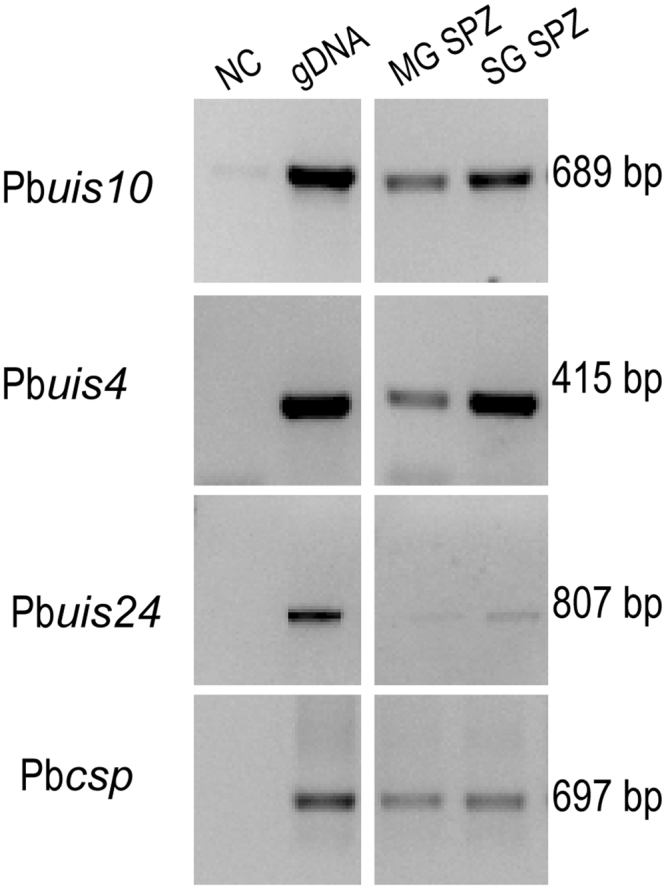
RT-PCR analysis of P.berghei Pbuis4, Pbuis10, Pbuis24 and Pbcsp transcripts. Templates were derived from gDNA (lane 2), dissected midguts at 11 d pbm sporozoites (lane 3, MG SPZ) and from dissected salivary glands at 21 d pbm (lane 4 SG SPZ). Lane 1 is the negative control without template (NC). The samples were amplified for 35 cycles. Molecular weight of the amplified fragments is indicated to the right. Unprocessed images of the agarose gels are shown in Supplementary Fig. S4b.
Figure 3
Figure 3
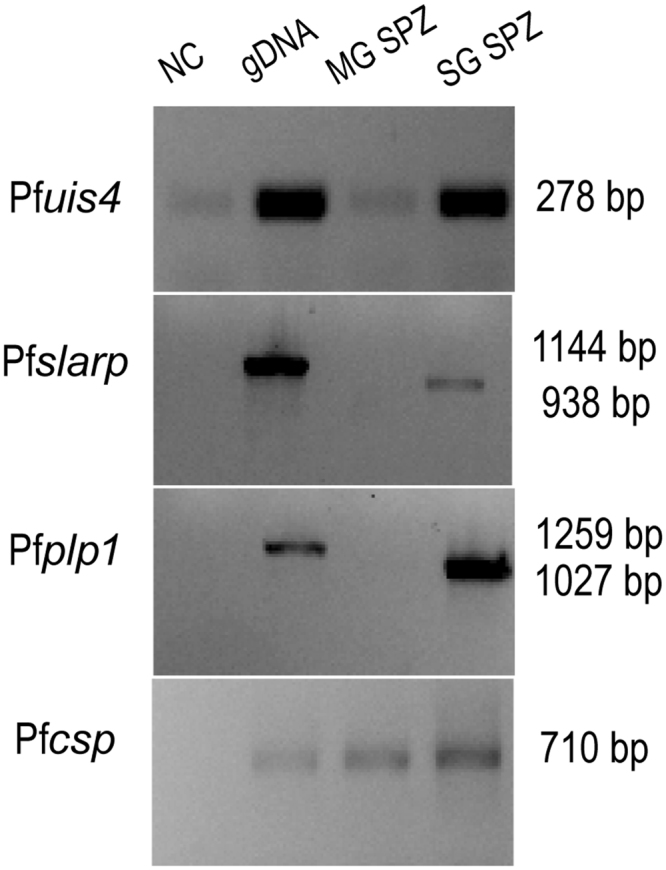
RT-PCR analysis of P. falciparum Pfuis4, Pfslarp, Pfplp1and Pfcsp transcripts. Templates were derived from gDNA (lane 2), dissected midguts at 12 d pbm sporozoites (lane 3, MG SPZ) and dissected salivary glands at 21 d pbm (lane 4 SG SPZ). Lane 1 is the negative control without template (NC). The samples were amplified for 35 cycles. Molecular weight of the amplified fragments is indicated to the right. Unprocessed images of the agarose gels are shown in Supplementary Fig. S4c.
Figure 4
Figure 4
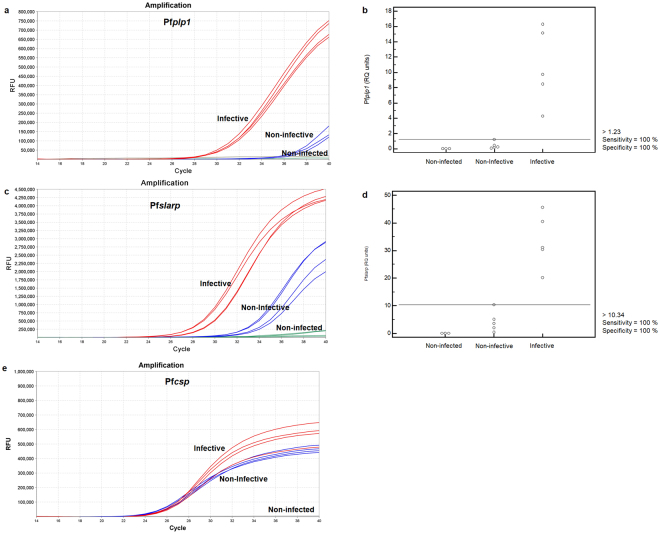
Differential diagnostic value of Pfplp1 and Pfslarp expression. (a,c,e) TaqMan amplification curves for Pfplp1, Pfslarp and Pfcsp genes in infective (red color), non-infective (blue color) and non-infected (green color) samples. Four independent biological replicates are shown with two technical replicates for each curve. (b,d) Expression levels of Pfslarp and Pfplp1 in infective, non-infective and non-infected pools.

References

    1. WHO. World Health Organization. World Malaria Report 2016 (2016).
    1. White NJ, et al. Malaria. Lancet (London, England) 2014;383:723–735. doi: 10.1016/S0140-6736(13)60024-0. - DOI - PubMed
    1. Miller LH, Ackerman HC, Su XZ, Wellems TE. Malaria biology and disease pathogenesis: insights for new treatments. Nature medicine. 2013;19:156–167. doi: 10.1038/nm.3073. - DOI - PMC - PubMed
    1. de Koning-Ward TF, Gilson PR, Crabb BS. Advances in molecular genetic systems in malaria. Nature reviews. Microbiology. 2015;13:373–387. doi: 10.1038/nrmicro3450. - DOI - PubMed
    1. Whitten MM, Shiao SH, Levashina EA. Mosquito midguts and malaria: cell biology, compartmentalization and immunology. Parasite immunology. 2006;28:121–130. doi: 10.1111/j.1365-3024.2006.00804.x. - DOI - PubMed

Publication types

MeSH terms

Substances

LinkOut - more resources