Meta-Analysis
. 2018 Jan 23;8(1):1439.
doi: 10.1038/s41598-018-19949-z.

A systematic review and meta-analysis: Association between MGMT hypermethylation and the clinicopathological characteristics of non-small-cell lung carcinoma

Affiliations
Meta-Analysis

A systematic review and meta-analysis: Association between MGMT hypermethylation and the clinicopathological characteristics of non-small-cell lung carcinoma

Lin Chen et al. Sci Rep. .

Abstract

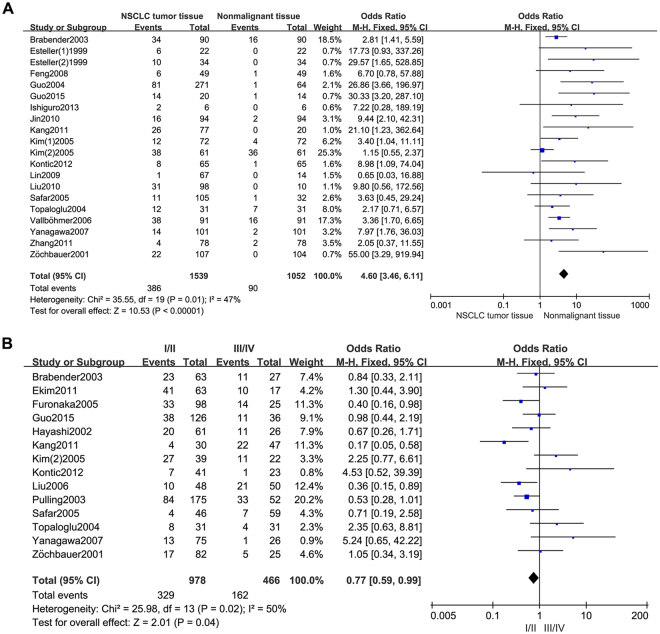
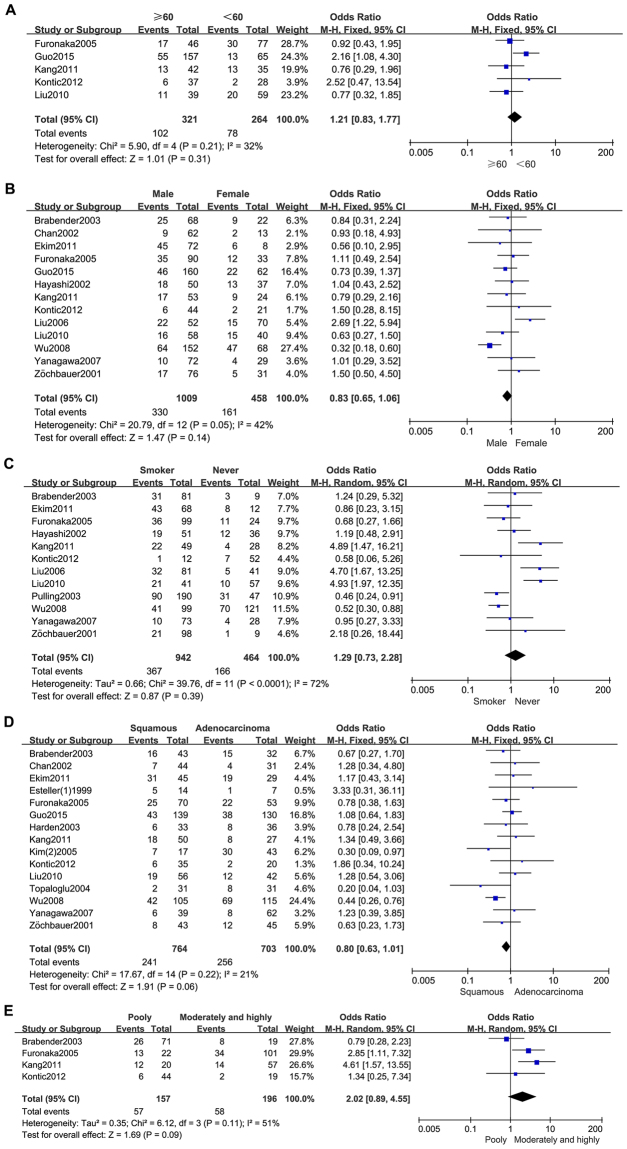
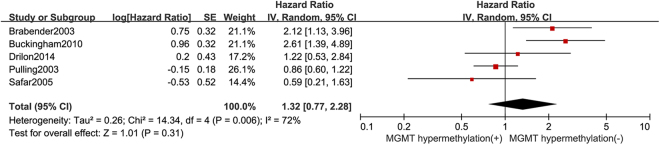
The relationship between O-6-methylguanine-DNA methyltransferase (MGMT) promoter methylation and clinicopathological characteristics of non-small-cell lung carcinoma (NSCLC) has remained controversial and unclear. Therefore, in this study we have undertaken a systematic review and meta-analysis of relevant studies to quantitatively investigate this association. We identified 30 eligible studies investigating 2714 NSCLC patients. The relationship between MGMT hypermethylation and NSCLC was identified based on 20 studies, including 1539 NSCLC patient tissue and 1052 normal and adjacent tissue samples (OR = 4.60, 95% CI = 3.46~6.11, p < 0.00001). MGMT methylation varied with ethnicity (caucasian: OR = 4.56, 95% CI = 2.63~7.92, p < 0.00001; asian: OR = 5.18, 95% CI = 2.03~13.22, p = 0.0006) and control style (autologous: OR = 4.44, 95% CI = 3.32~5.92, p < 0.00001; heterogeneous: OR = 9.05, 95% CI = 1.79~45.71, p = 0.008). In addition, MGMT methylation was observed to be specifically associated with NSCLC clinical stage, and not with age, sex, smoking, pathological types, and differentiation status. Also MGMT methylation did not impact NSCLC patients survival (HR = 1.32, 95% CI = 0.77~2.28, p = 0.31). Our study provided clear evidence about the association of MGMT hypermethylation with increased risk of NSCLC.


Conflict of interest statement

The authors declare that they have no competing interests.

Figures
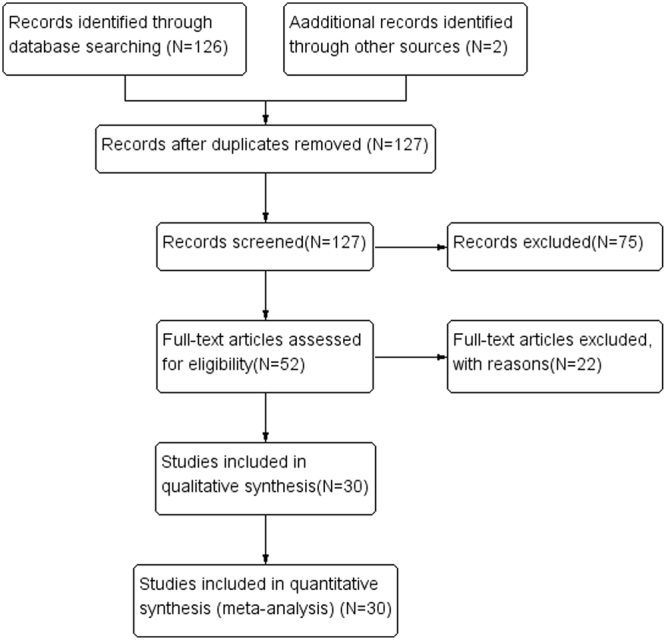
Figure 1
Figure 1
Flow chart depicting the study selection criteria.
Figure 2
Figure 2
Forest plot representing the meta-analysis of MGMT methylation in NSCLC and clinical stage. (A) Forest plot of MGMT methylation in NSCLC tissues verse normal tissues. (B) Forest plot showing association of MGMT methylation with clinical stage of NSCLC patients.
Figure 3
Figure 3
Forest plot representing the meta-analysis of MGMT methylation in clinicopathological features of NSCLC patients. (A) Forest plot showing association of MGMT methylation with age status of NSCLC patients. (B) Forest plot showing association of MGMT methylation with sex status of NSCLC patients. (C) Forest plot showing association of MGMT methylation with smoking status of NSCLC patients. (D) Forest plot showing association of MGMT methylation with different pathological types of NSCLC. (E) Forest plot showing association of MGMT methylation with differentiation status of NSCLC patients.
Figure 4
Figure 4
Forest plot showing association of MGMT methylation with overall survival of NSCLC patients.
Figure 5
Figure 5
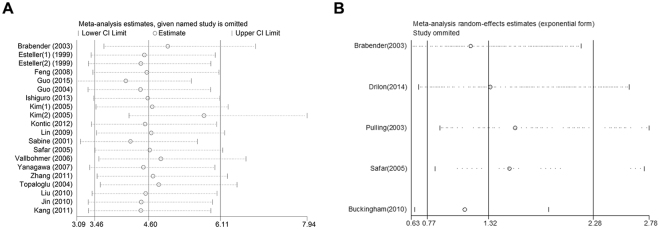
Sensitivity analysis by omitting a single study. (A) Sensitivity analysis of the OR coefficients for the association between MGMT methylation and risk of NSCLC. (B) Sensitivity analysis of the HR coefficients for the association between MGMT methylation and overall survival of NSCLC patients.
Figure 6
Figure 6
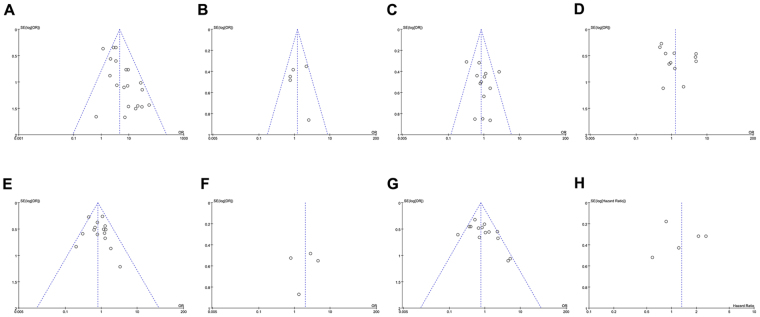
Funnel plots analyses to assess the publication bias between MGMT methylation and different NSCLC clinicopathological characteristics; (A) Overall funnel plot from pooled 20 studies, (B) Funnel plot based on age, (C) Funnel plot based on sex status, (D) Funnel plot based on smoking status, (E) Funnel plot based on pathological types, (F) Funnel plot based on differentiation status, (G) Funnel plot based on clinical stage status, and (H) Funnel plot based on NSCLC overall survival.
Figure 7
Figure 7
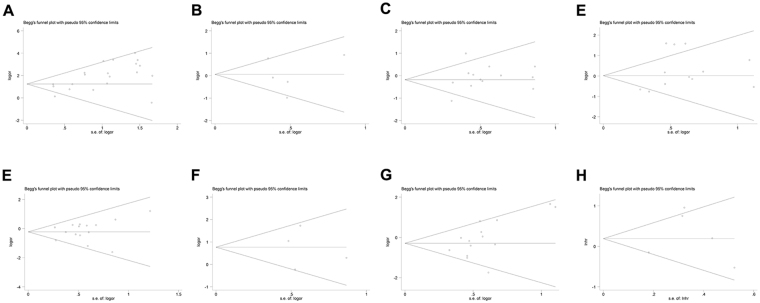
Begg’s funnel plot analyses to assess the publication bias between MGMT methylation and different NSCLC clinicopathological characteristics; (A) Overall funnel plot from pooled 20 studies, (B) Funnel plot based on age, (C) Funnel plot based on sex status, (D) Funnel plot based on smoking status, (E) Funnel plot based on pathological types, (F) Funnel plot based on differentiation status, (G) Funnel plot based on clinical stage status, and (H) Funnel plot based on NSCLC overall survival.

References

    1. Jemal A, et al. Cancer statistics, 2009. CA Cancer J Clin. 2009;59:225–249. doi: 10.3322/caac.20006. - DOI - PubMed
    1. Chen W, et al. Report of cancer incidence and mortality in China, 2010. Ann Transl Med. 2014;2:61. - PMC - PubMed
    1. Siegel R, et al. Cancer treatment and survivorship statistics. CA Cancer J Clin. 2012;62:220–241. doi: 10.3322/caac.21149. - DOI - PubMed
    1. Si LB, et al. Potential use of microRNA-200c as a prognostic marker in non-small cell lung cancer. Oncol Lett. 2017;14:4325–4330. doi: 10.3892/ol.2017.6667. - DOI - PMC - PubMed
    1. Risch A, Plass C. Lung cancer epigenetics and genetics. Int J Cancer. 2008;123:1–7. doi: 10.1002/ijc.23605. - DOI - PubMed

Publication types