Conservation, evolution, and regulation of splicing during prefrontal cortex development in humans, chimpanzees, and macaques
- PMID: 29363555
- PMCID: PMC5855957
- DOI: 10.1261/rna.064931.117
Conservation, evolution, and regulation of splicing during prefrontal cortex development in humans, chimpanzees, and macaques
Abstract
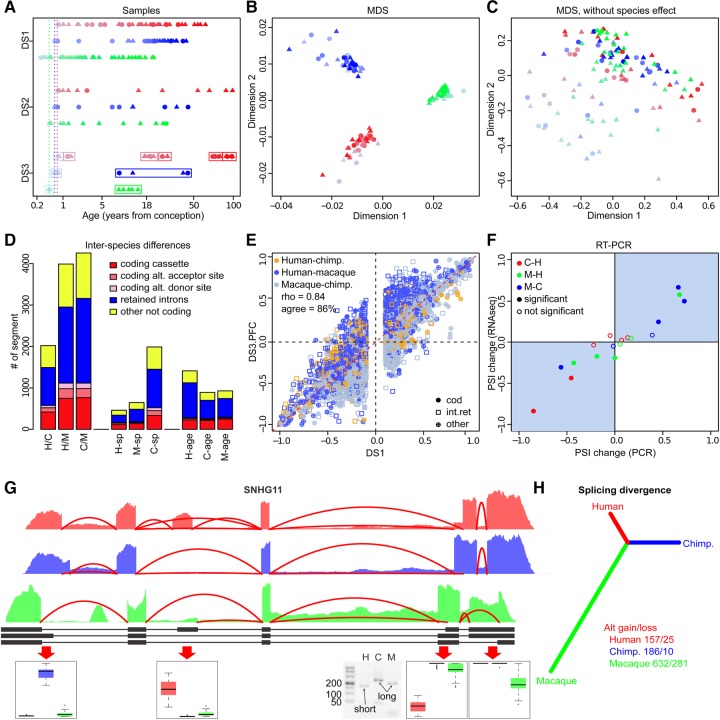
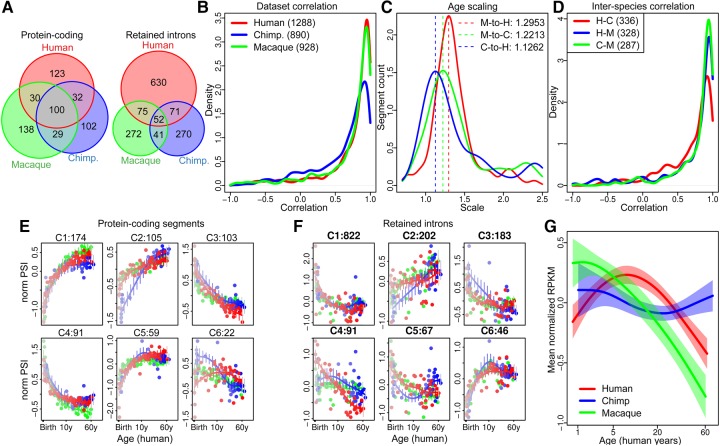
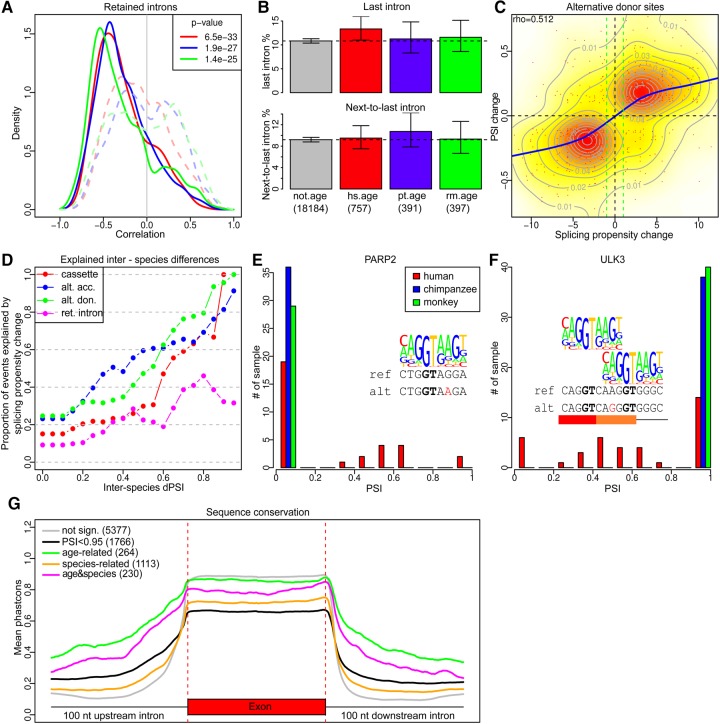
Changes in splicing are known to affect the function and regulation of genes. We analyzed splicing events that take place during the postnatal development of the prefrontal cortex in humans, chimpanzees, and rhesus macaques based on data obtained from 168 individuals. Our study revealed that among the 38,822 quantified alternative exons, 15% are differentially spliced among species, and more than 6% splice differently at different ages. Mutations in splicing acceptor and/or donor sites might explain more than 14% of all splicing differences among species and up to 64% of high-amplitude differences. A reconstructed trans-regulatory network containing 21 RNA-binding proteins explains a further 4% of splicing variations within species. While most age-dependent splicing patterns are conserved among the three species, developmental changes in intron retention are substantially more pronounced in humans.
Keywords: RNA-seq; alternative splicing; brain development; transcriptomics.
© 2018 Mazin et al.; Published by Cold Spring Harbor Laboratory Press for the RNA Society.
Figures
References
-
- Barbosa-Morais NL, Irimia M, Pan Q, Xiong HY, Gueroussov S, Lee LJ, Slobodeniuc V, Kutter C, Watt S, Colak R, et al. 2012. The evolutionary landscape of alternative splicing in vertebrate species. Science 338: 1587–1593. - PubMed
-
- Black DL. 2003. Mechanisms of alternative pre-messenger RNA splicing. Annu Rev Biochem 72: 291–336. - PubMed
-
- Chang YF, Imam JS, Wilkinson MF. 2007. The nonsense-mediated decay RNA surveillance pathway. Annu Rev Biochem 76: 51–74. - PubMed
Publication types
MeSH terms
Substances
LinkOut - more resources
Full Text Sources
Other Literature Sources