. 2018 Feb 6;115(6):1382-1387.
doi: 10.1073/pnas.1718670115. Epub 2018 Jan 23.

Nitrate modulates stem cell dynamics in Arabidopsis shoot meristems through cytokinins

Affiliations

Nitrate modulates stem cell dynamics in Arabidopsis shoot meristems through cytokinins

Benoit Landrein et al. Proc Natl Acad Sci U S A. .

Abstract

The shoot apical meristem (SAM) is responsible for the generation of all the aerial parts of plants. Given its critical role, dynamical changes in SAM activity should play a central role in the adaptation of plant architecture to the environment. Using quantitative microscopy, grafting experiments, and genetic perturbations, we connect the plant environment to the SAM by describing the molecular mechanism by which cytokinins signal the level of nutrient availability to the SAM. We show that a systemic signal of cytokinin precursors mediates the adaptation of SAM size and organogenesis rate to the availability of mineral nutrients by modulating the expression of WUSCHEL, a key regulator of stem cell homeostasis. In time-lapse experiments, we further show that this mechanism allows meristems to adapt to rapid changes in nitrate concentration, and thereby modulate their rate of organ production to the availability of mineral nutrients within a few days. Our work sheds light on the role of the stem cell regulatory network by showing that it not only maintains meristem homeostasis but also allows plants to adapt to rapid changes in the environment.

Keywords: Arabidopsis; cytokinin hormones; plant development; plant nutrition; shoot apical meristem.


Conflict of interest statement

The authors declare no conflict of interest.

Figures
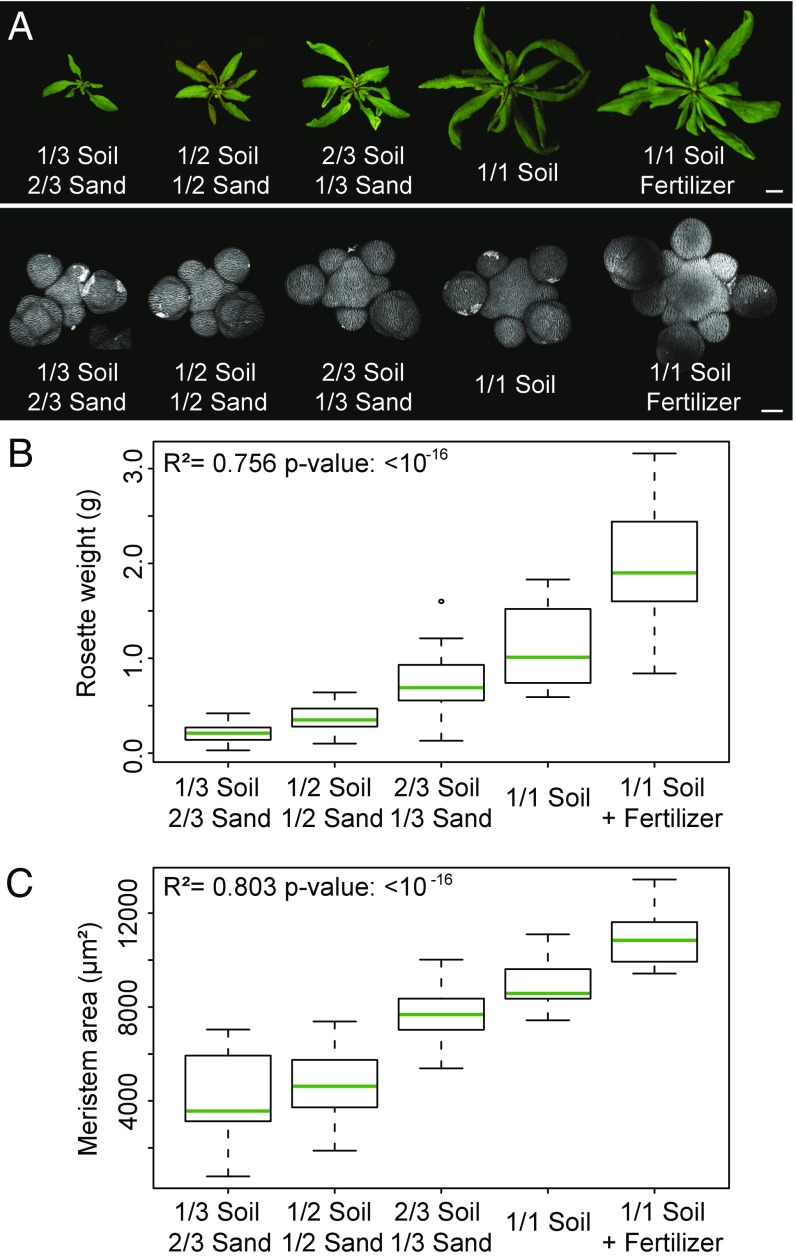
Fig. 1.
Fig. 1.
Plant nutritional status influences meristem function. (A) Morphology of the rosette (Top) and of the SAM (Bottom) of representative WT plants grown on soils of different nutritive quality. (Scale bar, Top, 1 cm; Bottom, 50 µm.) (B and C) Rosette weight (B) and meristem size (C) of WT plants grown on soils of different nutritive quality (1/3 soil 2/3 sand: n = 17; 1/2 soil 1/2 sand: n = 22; 2/3 soil 1/3 sand: n = 23; 1/1 soil: n = 21; 1/1 soil + fertilizer: n = 26, pool of two independent experiments). Error bars correspond to the mean ± SD. Data were compared using linear models.
Fig. 2.
Fig. 2.
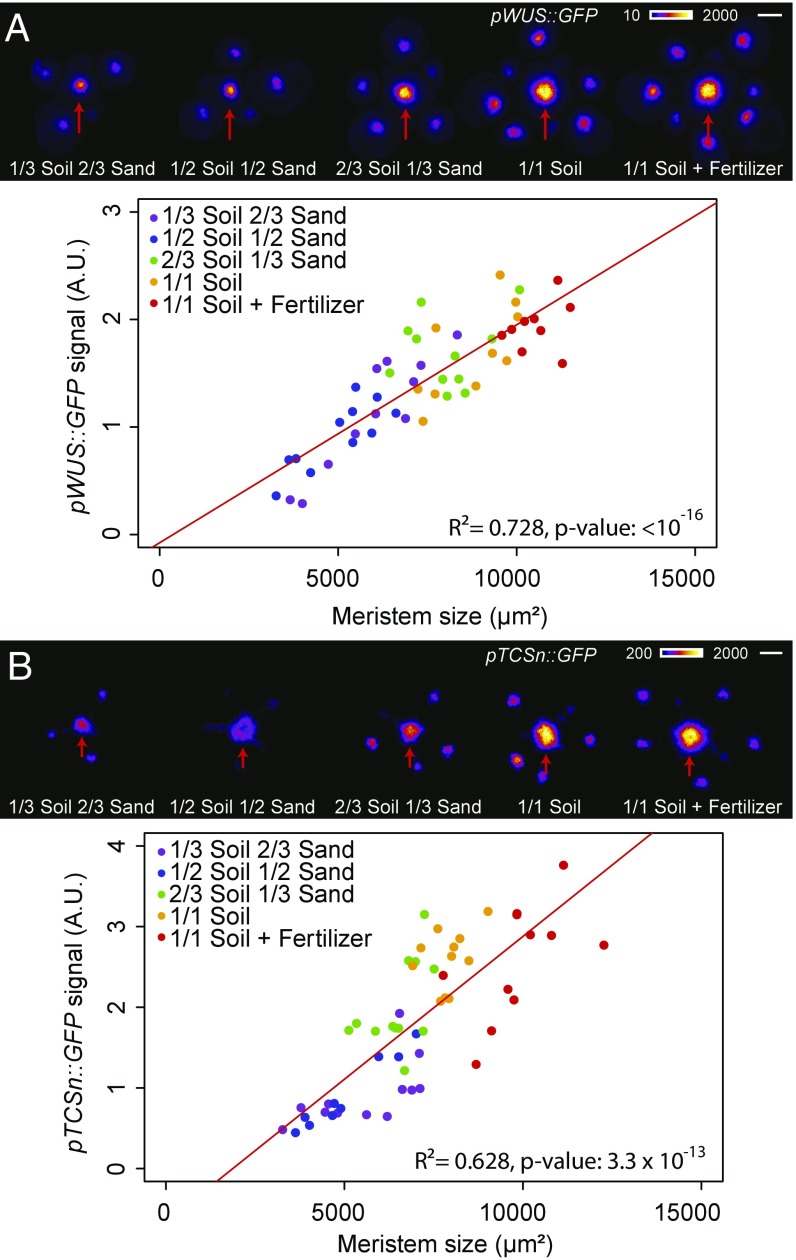
Plant nutritional status influences stem cell homeostasis in the SAM. Expression of pWUS::GFP (A) and pTCSn::GFP (B) in WT plants grown on soils of different nutritive quality [n = 55 (A) and n = 57 (B)]. (Top) Representative plants. (Scale bars: 50 µm.) Red arrows point to the center of the inflorescence meristem. (Bottom) Total fluorescence signal in the inflorescence meristem vs. meristem size (SI Appendix, SI Material and Methods). Data were fitted using linear models.
Fig. 3.
Fig. 3.
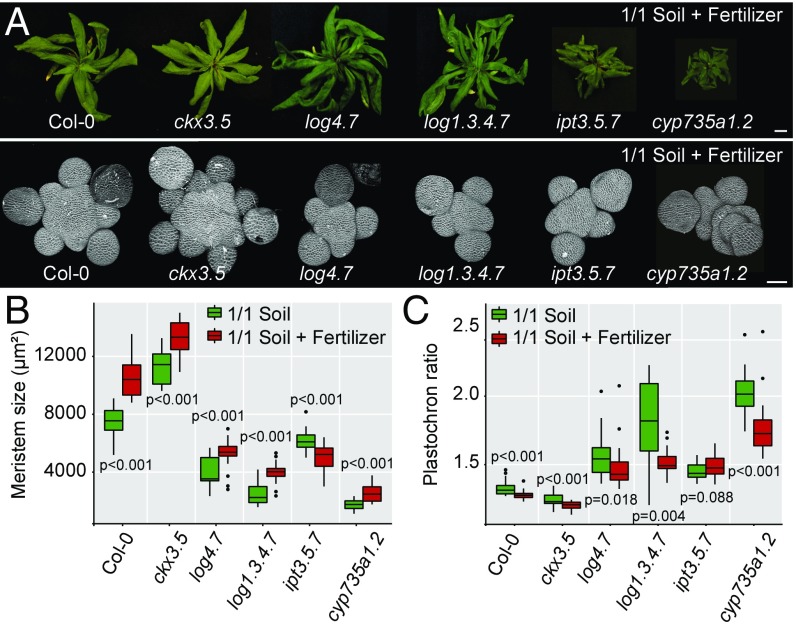
Cytokinins allow the adaptation of meristem function to plant nutritional status. (A) Morphology of the rosette (Top) and of the SAM (Bottom) of representative WT and CK-associated mutant plants. (Scale bar, Top, 1 cm; Bottom, 50 µm.) (B and C) Meristem size (B) and plastochron ratio (C) of WT and CK-associated mutant plants grown on soil either without fertilizer (green, g) or with fertilizer (red, r); [Col-0: n = 22 (g) and 25 (r); ckx3.5: n = 23 (g) and 27 (r); log4.7: n = 19 (g) and 24 (r); log1.3.4.7: n = 14 (g) and 25 (r); ipt3.5.7: n = 36 (g) and 20 (r); cyp735a1.2: n = 26 (g) and 20 (r), pool of two independent experiments]. Data were compared using Student’s t test. Error bars correspond to the mean ± SD.
Fig. 4.
Fig. 4.
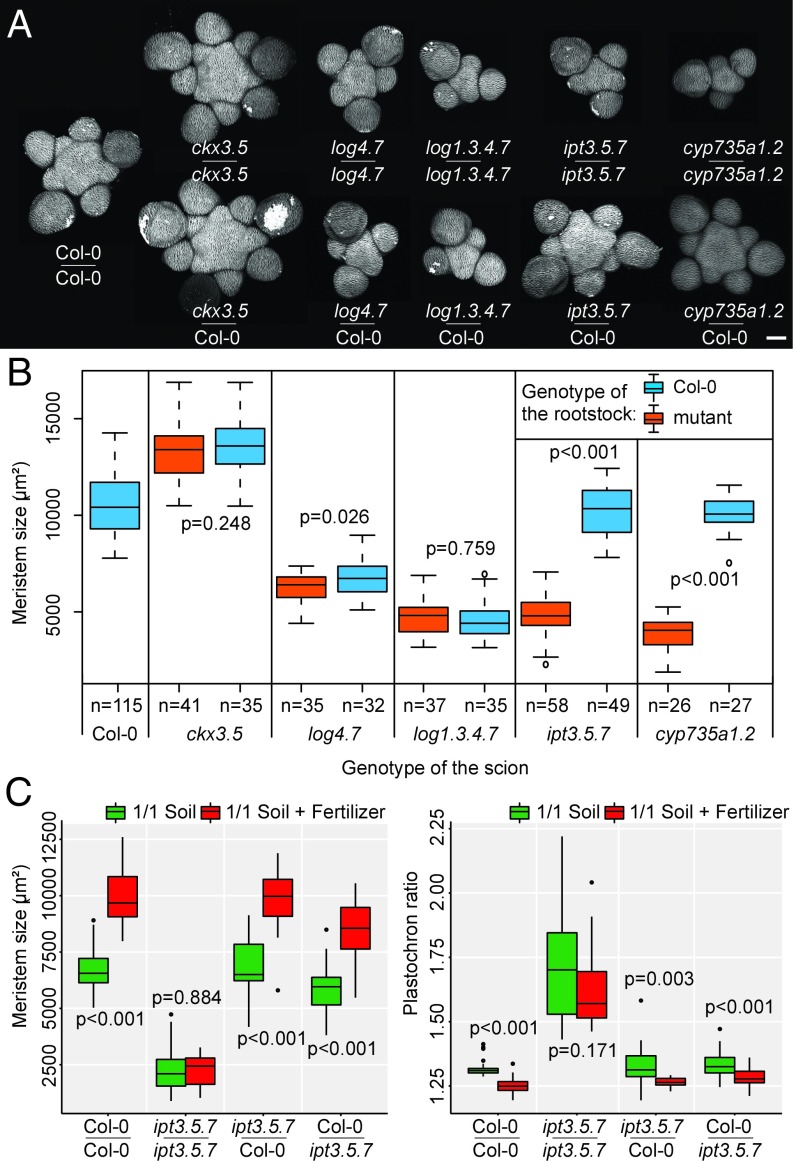
Cytokinin precursors act as long-range signals in the control of SAM homeostasis. (A) Representative meristems of WT and cytokinin-associated mutant plants self-grafted or grafted with a WT rootstock and grown on soil supplied with fertilizer. (Scale bar, 50 µm.) (B) Meristem size of WT and cytokinin-associated mutant plants self-grafted or grafted with a WT rootstock and grown on soil supplied with fertilizer (pools of two independent experiments; the numbers of biological replicates are displayed in the figure). Data were compared using Student’s t tests. Error bars correspond to the mean ± SD. (C) Meristem size (Left) and plastochron ratio (Right) of self-grafted or reciprocally grafted WT (Col-0) and ipt3.5.7 mutant plants grown on soil (green, g) or on soil supplied with fertilizer (red, r); [pools of two independent experiments; rootstock: Col-0 and scion: Col-0: n = 26 (g) and n = 22 (r); rootstock: ipt3.5.7 and scion: ipt3.5.7: n = 22 (g) and n = 15 (r); rootstock: Col-0 and scion: ipt3.5.7: n = 18 (g) and n = 21 (r); rootstock: ipt3.5.7 and scion: Col-0: n = 26 (g) and n = 28 (r)]. Data were compared using Student’s t tests. Error bars correspond to the mean ± SD.
Fig. 5.
Fig. 5.
Cytokinin precursors are sufficient to maintain meristem homeostasis in vitro. Effect of tZR and tZ application on the expression of pTCSn::GFP (A) and pWUS::GFP (B) in cut meristems grown in vitro (pools of two independent experiments, pTCSn::GFP: n = 11 for each condition, pWUS::GFP: n = 12 for each condition). (Top) Representative plants. (Scale bars, 50 µm.) Red arrows point to the center of the inflorescence meristem. (Bottom) Total fluorescence signal in the inflorescence meristem at 24h and 48h divided by the signal at 0h. Data were compared using Student’s t test. Error bars correspond to the mean ± SD.
Fig. 6.
Fig. 6.
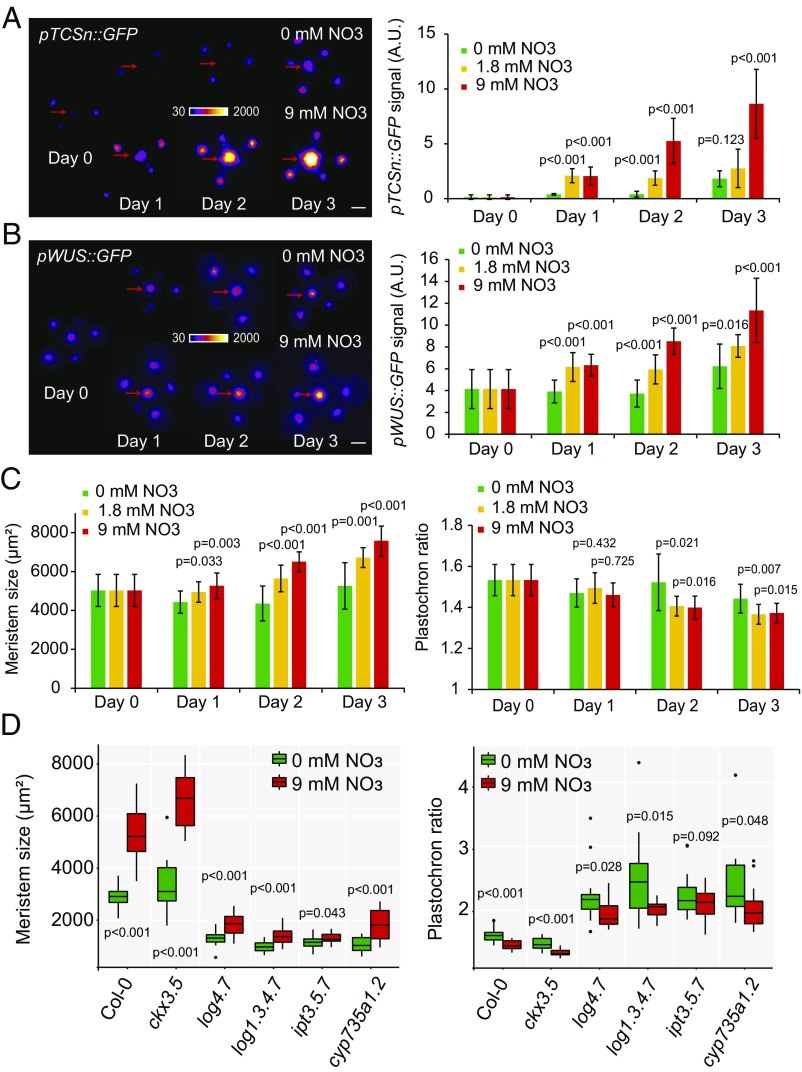
Nitrate modulates meristem homeostasis through IPTs. (AC) Effect of nitrate resupply on pTCSn::GFP expression (A), pWUS::GFP expression (B), and meristem size and plastochron ratio (C). The treatment was performed at day 0, and different meristems were dissected and imaged each day (n = 8–12). (A and B, Left) Representative plants and (Right) quantification of total florescent signal. (Scale bars, 50 µm.) Red arrows point to the center of the inflorescence meristem. Data were compared using Student’s t tests. Error bars correspond to the mean ± SD. (D) Meristem size and plastochron ratio of WT and cytokinin-associated mutants 3 d after treatment with a nutritive solution containing either 0 mM (green, g) or 9 mM NO3 (red, r); [Col-0: n = 21 (g) and 24 (r), ckx3.5: n = 13 (g) and 12 (r); log4.7: n = 17 (g) and 18 (r); log1.3.4.7: n = 13 (g) and 15 (r); ipt3.5.7: n = 18 (g) and 19 (r); cyp735a1.2: n = 14 (g) and 14 (r)]. Data were compared using Student’s t test. Error bars correspond to the mean ± SD.

Comment in

References

    1. Krouk G, et al. A framework integrating plant growth with hormones and nutrients. Trends Plant Sci. 2011;16:178–182. - PubMed
    1. Werner T, Schmülling T. Cytokinin action in plant development. Curr Opin Plant Biol. 2009;12:527–538. - PubMed
    1. Ruffel S, et al. Nitrogen economics of root foraging: Transitive closure of the nitrate-cytokinin relay and distinct systemic signaling for N supply vs. demand. Proc Natl Acad Sci USA. 2011;108:18524–18529. - PMC - PubMed
    1. Rahayu YS, et al. Root-derived cytokinins as long-distance signals for NO3–Induced stimulation of leaf growth. J Exp Bot. 2005;56:1143–1152. - PubMed
    1. Walch-Liu P, Neumann G, Bangerth F, Engels C. Rapid effects of nitrogen form on leaf morphogenesis in tobacco. J Exp Bot. 2000;51:227–237. - PubMed

Publication types

MeSH terms