


Positive Attitude Toward Math Supports Early Academic Success: Behavioral Evidence and Neurocognitive Mechanisms
- PMID: 29364780
- PMCID: PMC5854512
- DOI: 10.1177/0956797617735528
Positive Attitude Toward Math Supports Early Academic Success: Behavioral Evidence and Neurocognitive Mechanisms
Abstract
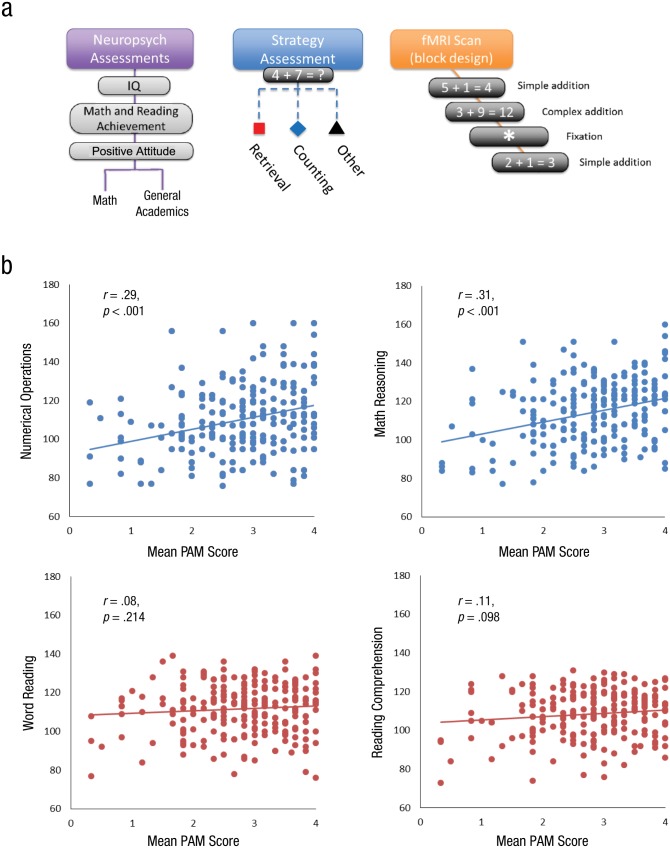
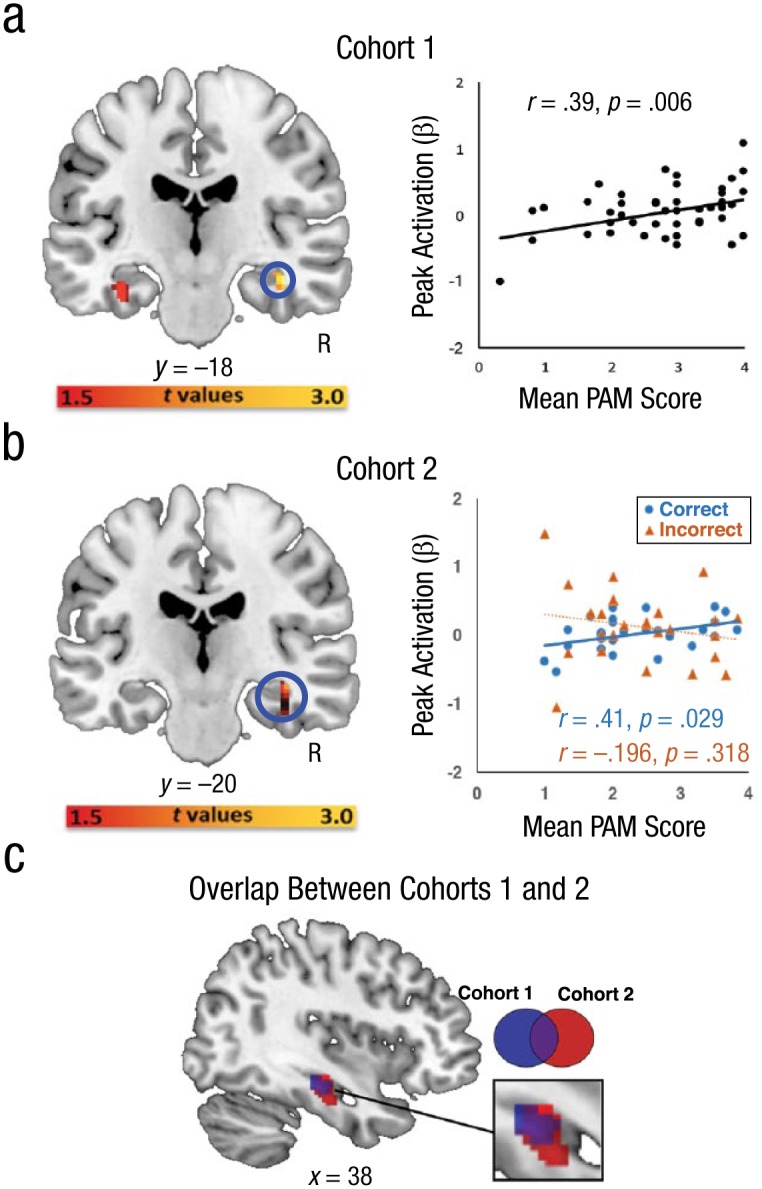
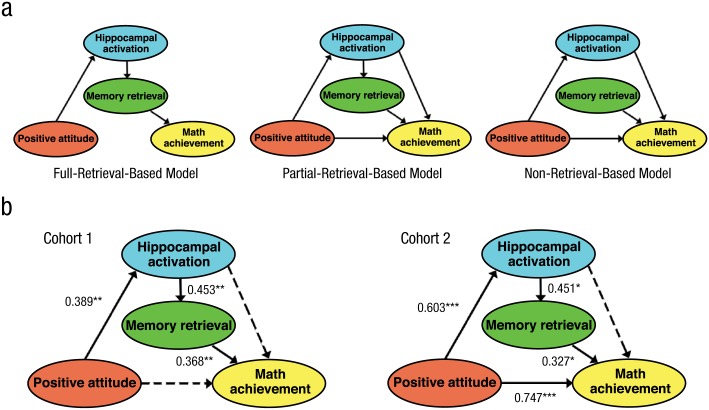
Positive attitude is thought to impact academic achievement and learning in children, but little is known about its underlying neurocognitive mechanisms. Using a large behavioral sample of 240 children, we found that positive attitude toward math uniquely predicted math achievement, even after we accounted for multiple other cognitive-affective factors. We then investigated the neural mechanisms underlying the link between positive attitude and academic achievement in two independent cohorts of children (discovery cohort: n = 47; replication cohort: n = 28) and tested competing hypotheses regarding the differential roles of affective-motivational and learning-memory systems. In both cohorts, we found that positive attitude was associated with increased engagement of the hippocampal learning-memory system. Structural equation modeling further revealed that, in both cohorts, increased hippocampal activity and more frequent use of efficient memory-based strategies mediated the relation between positive attitude and higher math achievement. Our study is the first to elucidate the neurocognitive mechanisms by which positive attitude influences learning and academic achievement.
Keywords: attitudes; brain; childhood development; learning; mathematics achievement.
Conflict of interest statement
Figures
References
-
- Achenbach T. M., Rescorla L. A. (2001). Manual for the ASEBA school-age forms and profiles. Burlington: University of Vermont Research Center for Children, Youth, and Families.
-
- Aiken L. R. (1976). Update on attitudes and other affective variables in learning mathematics. Review of Educational Research, 46, 293–311. doi:10.3102/00346543046002293 - DOI
-
- Aiken L. R., Dreger R. M. (1961). The effect of attitudes on performance in mathematics. Journal of Educational Psychology, 52(1), 19–24. doi:10.1037/h0041309 - DOI
-
- Blackwell K. L., Trzesniewski K. H., Dweck C. S. (2007). Implicit theories of intelligence predict achievement across an adolescent transition: A longitudinal study and an intervention. Child Development, 78, 246–263. - PubMed
Publication types
MeSH terms
Grants and funding
LinkOut - more resources
Full Text Sources
Other Literature Sources
