Review
. 2018 Jan 24;11(2):187.
doi: 10.3390/ma11020187.

Soft Material-Enabled, Flexible Hybrid Electronics for Medicine, Healthcare, and Human-Machine Interfaces

Affiliations
Review

Soft Material-Enabled, Flexible Hybrid Electronics for Medicine, Healthcare, and Human-Machine Interfaces

Robert Herbert et al. Materials (Basel). .

Abstract

Flexible hybrid electronics (FHE), designed in wearable and implantable configurations, have enormous applications in advanced healthcare, rapid disease diagnostics, and persistent human-machine interfaces. Soft, contoured geometries and time-dynamic deformation of the targeted tissues require high flexibility and stretchability of the integrated bioelectronics. Recent progress in developing and engineering soft materials has provided a unique opportunity to design various types of mechanically compliant and deformable systems. Here, we summarize the required properties of soft materials and their characteristics for configuring sensing and substrate components in wearable and implantable devices and systems. Details of functionality and sensitivity of the recently developed FHE are discussed with the application areas in medicine, healthcare, and machine interactions. This review concludes with a discussion on limitations of current materials, key requirements for next generation materials, and new application areas.

Keywords: flexible hybrid electronics; healthcare; human-machine interfaces; medicine; soft materials; stretchable electronics; wearable electronics.


Conflict of interest statement

The authors declare no conflict of interest.

Figures
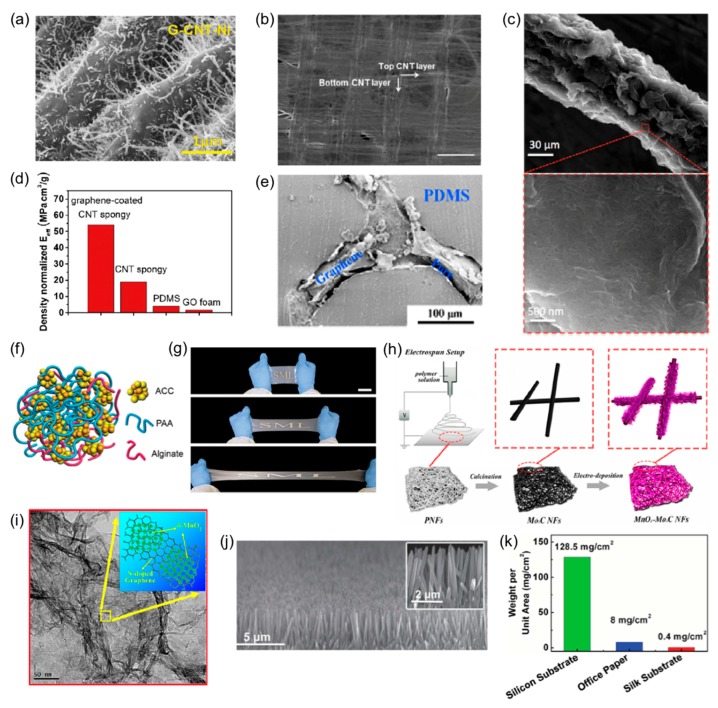
Figure 1
Figure 1
Soft functional materials. (a) Graphene-CNT-nickel hetero-nanostructure. Reprinted with permission from Reference [34], Copyright 2017, John Wiley and Sons; (b) Cross-stacked graphene-CNT (carbon nanotube) films. Reprinted from Reference [2], Copyright (2017), with permission from Elsevier; (c) SWCNT-based nanowire. Reproduced from Reference [35] with permission of The Royal Society of Chemistry; (d) Graphene oxide foam with low-effective elastic modulus for high sensitivity. Reprinted from Reference [36], Copyright (2017), with permission from Elsevier; (e) Graphene network embedded in PDMS. Reprinted with permission from Reference [37], Copyright 2016 American Chemical Society; (f) Schematic of mineral hydrogel. Reprinted with permission from Reference [38], Copyright 2017, John Wiley and Sons; (g) Elongation of 0%, 250%, and 500% of dielectric, liquid metal embedded elastomer. Reprinted with permission from Reference [39], Copyright 2016, John Wiley and Sons; (h) Process of developing MnO2-Mo2C nanofiber film. Reprinted with permission from Reference [40], Copyright 2016 American Chemical Society; (i) Nitrogen-doped graphene-MnO2 nanosheet composite. Reprinted with permission from Reference [41], Copyright 2016 American Chemical Society; (j) Cross-sectional view of aligned NW array. Reprinted with permission from Reference [42], Copyright 2016, John Wiley and Sons; (k) Chart indicating silk fibroin as an ultra-lightweight substrate. Reprinted with permission from Reference [43], Copyright 2016, John Wiley and Sons.
Figure 2
Figure 2
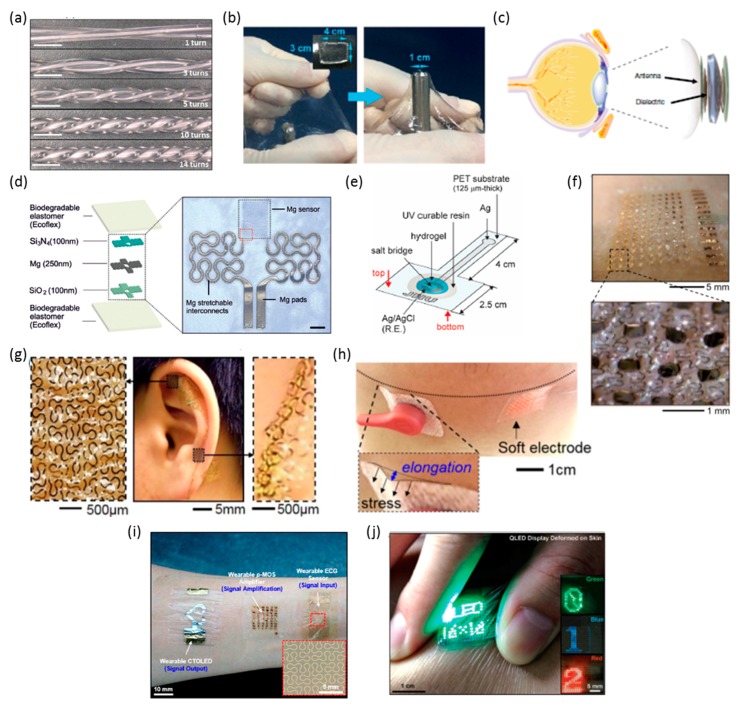
Wearable electronic systems. (a) Microtubule strain sensor and interconnect. Reprinted with permission from Reference [107]. Copyright 2017, Scientific Reports; (b) Self-healing strain sensor. Reprinted with permission from Reference [108]. Copyright 2017 American Chemical Society; (c) Wireless glucose and intraocular sensor. Reprinted with permission from Reference [29]. Copyright 2017, Nature Communications; (d) Biodegradable temperature sensor. Reprinted with permission from Reference [78], Copyright 2017, John Wiley and Sons; (e) Schematic illustration of a sweat chloride sensor. Reprinted from Reference [70], Copyright (2017), with permission from Elsevier; (f) EOG (electrooculography) electrode mounted on the skin. Reprinted from Reference [8], Copyright (2017), with permission from Elsevier; (g) EEG electrodes and interconnects on the auricle area [72]; (h) Comparison of rigid electrode with associated stress and soft material-enabled skin-like electrode. Reprinted with permission from Reference [109]. Copyright 2017, Scientific Reports; (i) Skin electrodes with amplifier. Reprinted with permission from Reference [110]. Copyright 2017 American Chemical Society; (j) QLED (quantum dot light-emitting diode) display on the human skin. Reprinted with permission from Reference [111], Copyright 2017, John Wiley and Sons.
Figure 3
Figure 3
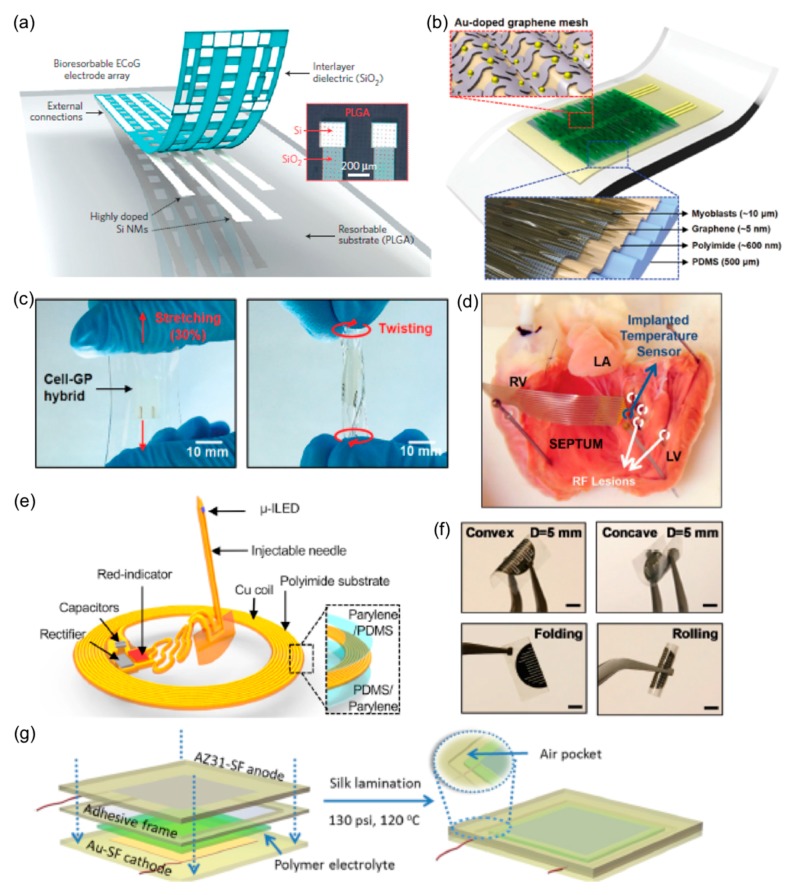
Implantable electronic systems. (a) Bioresorbable ECoG electrodes. Reprinted with permission from Macmillan Publishers Ltd.: Nature Materials [10]; (b) EMG electrode with Au-doped graphene mesh. Reprinted with permission from Reference [147], Copyright 2016, John Wiley and Sons; (c) Stretchability and flexibility of the serpentine-structured electrode in (b). Reprinted with permission from Reference [147], Copyright 2016, John Wiley and Sons; (d) Implantable cardiac sensor for monitoring temperature, thermal conductivity, and heat capacity. Reprinted from Reference [148], Copyright (2017), with permission from Elsevier; (e) Optogenetic device for wireless light delivery. Reprinted with permission from Reference [149], Copyright 2017, John Wiley and Sons; (f) Mechanically flexible, biodegradable microsupercapacitor. Reprinted with permission from Reference [49]. Copyright 2017, John Wiley and Sons; (g) Multi-layer illustration of a biodegradable battery with silk membrane. Reprinted with permission from Reference [150]. Copyright 2017 American Chemical Society.
Figure 4
Figure 4
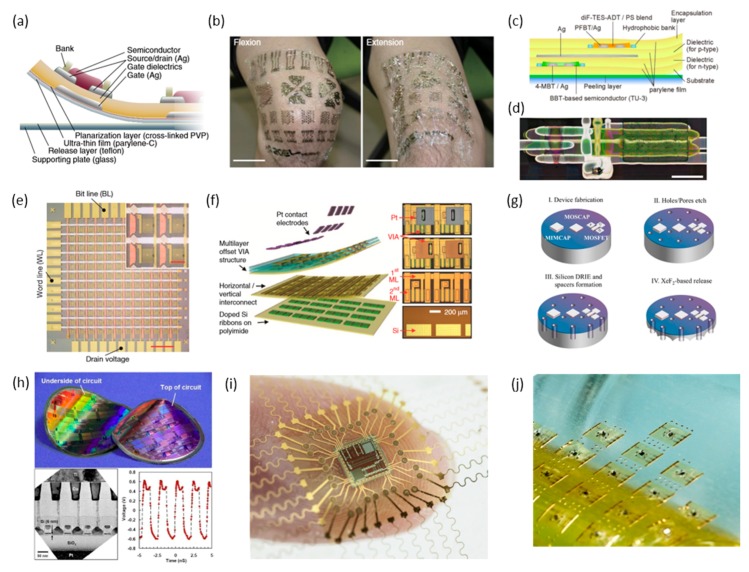
Integration strategies of electronic circuits for FHE. (a) Cross-sectional diagram of a fully-printed OTFT (organic thin-film transistors) device and (b) application of a thin organic film to a human knee. Scale bar, 4 cm. Reprinted with permission from Macmillan Publishers Ltd.: Nature Communications [164]; (c) Cross-sectional diagram and (d) photograph of an ultra-thin, fully-printed CMOS logic circuit. Scale bar, 500 µm. Reprint is in accordance with the Creative Commons Attribution 4.0 International License [165]; (e) Optical micrograph of a 12 × 12 tactile sensor array utilizing OTFTs as the switching transistors. Scale bar, 1 cm. The inset shows a magnified view of four pixels. Scale bar, 2 mm. Reprinted with permission from Macmillan Publishers Ltd.: Nature [166]; (f) Exploded view rendering of the flexible, high-density brain mapping device (left) and respective optical micrographs (right). Reprinted with permission from Macmillan Publishers Ltd.: Nature Communications [168]; (g) Process flow of XeF2-based Si exfoliation. Reprinted with permission from Reference [173]. Copyright (2014) American Chemical Society; (h) Flexible CMOS circuits formed by controlled spalling (top). Cross-section TEM image of the flexible circuit, stressor and handle layers (bottom left). Resulting voltage waveform of a 100 stage ring oscillator (bottom right). Reprint is in accordance with the Creative Commons Attribution 3.0 International License [170]; (i) Integration of a thinned die in a flexible substrate. Reprinted from Reference [171], Copyright (2015), with permission from Elsevier; (j) Scaled production of soft-adhesive electronics with surface mount chip components. Reprinted with permission from Reference [172], Copyright 2017, John Wiley and Sons.
Figure 5
Figure 5
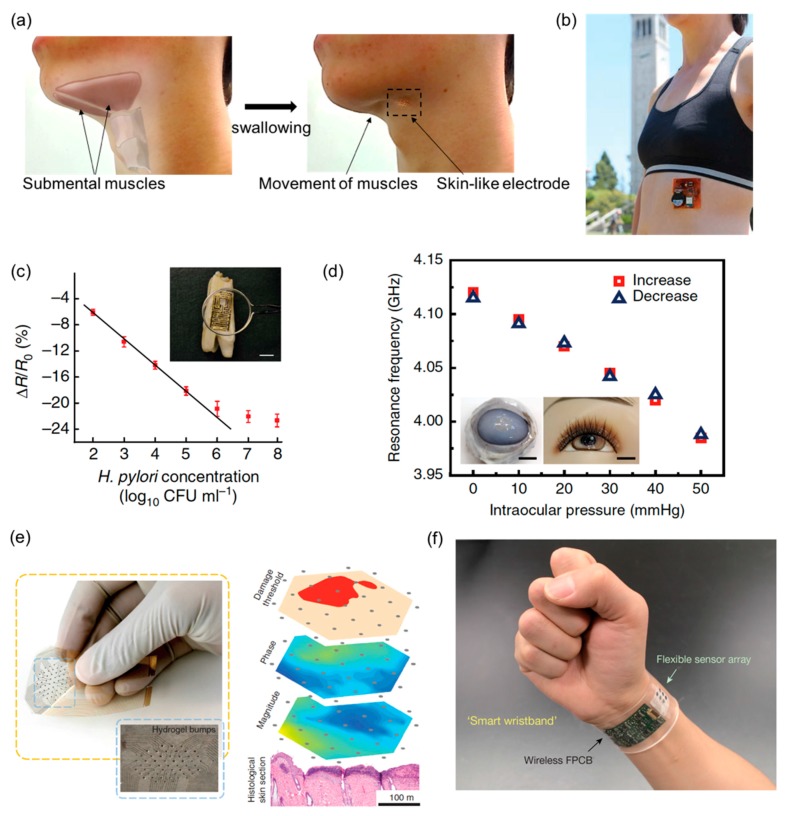
Health monitoring and disease diagnostic systems. (a) Illustration of targeted submental muscles on the chin and photos capturing the movement of the muscles upon swallowing activity. Reprinted with permission from [109], Copyright 2017, Scientific Reports; (b) Photographs of the wearable sensor patch mounted on a person’s lower left rib cage (left) and the component side of the patch (right). Reproduced from [174], Copyright 2016, John Wiley and Sons; (c) Percentage change in graphene resistance versus concentration of H. pylori cells with optical image of the graphene wireless sensor biotransferred onto the surface of a tooth (inset optical image). Reproduced from [175], Copyright 2012, Macmillan Publishers Ltd.: Nature Communications; (d) An inkjet printed array, showing the hexagonal configuration of 55 equally spaced gold electrodes; inset shows printed hydrogel bumps on the fabricated array (left). Schematic representation of the device operation for early detection of pressure ulcers (right). Reproduced from [176], Copyright 2015, Macmillan Publishers Ltd.: Nature Communications; (e) Frequency response of the sensor during a pressure cycle for ocular diagnostics. Inset shows photographs of the sensor transferred onto the contact lens worn by a bovine eyeball (left) and a mannequin eye (right). Scale bar, 1 cm. Reproduced from [29], Copyright 2017, Macmillan Publishers Ltd.: Nature Communications; (f) Photograph of a wearable flexible integrated sensing array on a subject’s writs, integrating the multiplexed sweat sensor array and the wireless flexible printed circuit board (left). Simultaneous system-level measurements (right). Reproduced from [177], Copyright 2016, Macmillan Publishers Ltd.: Nature.
Figure 6
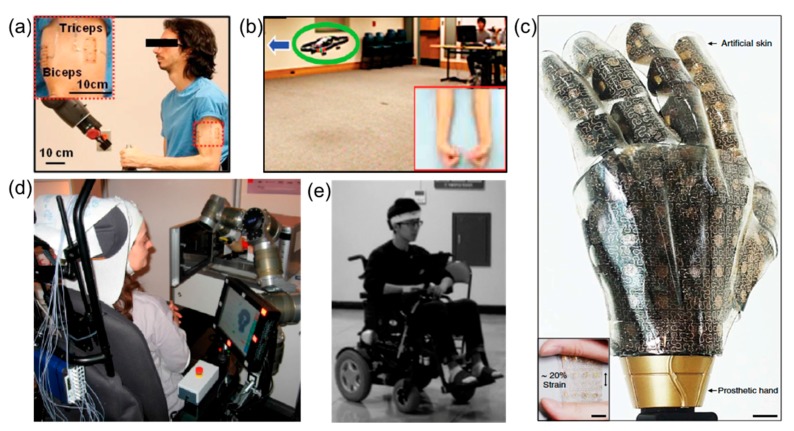
Figure 6
Flexible hybrid electronics for applications in human-machine interfaces. (a) EMG-enabled control of a humanoid robot. Reprinted with permission from Reference [178], Copyright 2016, John Wiley and Sons; (b) Bimanual gestures and their EMG signals, interfacing with a quadcopter. Reprinted with permission from Reference [7], Copyright 2013, John Wiley and Sons; (c) Sensor-laden bionic hand, instrumented with silicon nanoribbon. Reprinted with permission from Macmillan Publishers Ltd.: Nature Communications [179]; (d) Wearable headset and EEG (electroencephalogram) recording for a brain-interfaced system. Reprinted with permission from Reference [180]. Copyright 2015, MDPI; (e) Recording of EOG via a wearable forehead system for a wheelchair control. Reprinted with permission from Reference [181]. Copyright 2017, MDPI.

References

    1. Xu S., Zhang Y., Jia L., Mathewson K.E., Jang K.-I., Kim J., Fu H., Huang X., Chava P., Wang R. Soft microfluidic assemblies of sensors, circuits, and radios for the skin. Science. 2014;344:70–74. doi: 10.1126/science.1250169. - DOI - PubMed
    1. Shi J., Hu J., Dai Z., Zhao W., Liu P., Zhao L., Guo Y., Yang T., Zou L., Jiang K. Graphene welded carbon nanotube crossbars for biaxial strain sensors. Carbon. 2017;123:786–793. doi: 10.1016/j.carbon.2017.08.006. - DOI
    1. Stokes A.A., Shepherd R.F., Morin S.A., Ilievski F., Whitesides G.M. A hybrid combining hard and soft robots. Soft Robot. 2014;1:70–74. doi: 10.1089/soro.2013.0002. - DOI
    1. Valentine A.D., Busbee T.A., Boley J.W., Raney J.R., Chortos A., Kotikian A., Berrigan J.D., Durstock M.F., Lewis J.A. Hybrid 3D printing of soft electronics. Adv. Mater. 2017;29 doi: 10.1002/adma.201703817. - DOI - PubMed
    1. Chen Y., Howe C., Lee Y., Cheon S., Yeo W.-H., Chun Y. Microstructured thin film nitinol for a neurovascular flow-diverter. Sci. Rep. 2016;6:23698. doi: 10.1038/srep23698. - DOI - PMC - PubMed