Association of Heritable Cognitive Ability and Psychopathology With White Matter Properties in Children and Adolescents
- PMID: 29365026
- PMCID: PMC5885956
- DOI: 10.1001/jamapsychiatry.2017.4277
Association of Heritable Cognitive Ability and Psychopathology With White Matter Properties in Children and Adolescents
Abstract
Importance: Many mental disorders emerge during adolescence, which may reflect a cost of the potential for brain plasticity offered during this period. Brain dysconnectivity has been proposed as a common factor across diagnostic categories.
Objective: To investigate the hypothesis that brain dysconnectivity is a transdiagnostic phenotype in adolescence with increased susceptibility and symptoms of psychiatric disease.
Design, setting, and participants: We investigated clinical symptoms as well as cognitive function in 6487 individuals aged 8 to 21 years from November 1, 2009, to November 30, 2011, in the Philadelphia Neurodevelopmental Cohort and analyzed diffusion magnetic resonance imaging brain scans for 748 of the participants.
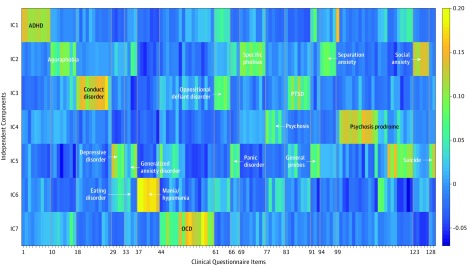
Main outcomes and measures: Independent component analysis was used to derive dimensional psychopathology scores, and genome-wide complex trait analysis was used to estimate its heritability. Multimodal fusion simultaneously modeled contributions of the diffusion magnetic resonance imaging metrics fractional anisotropy, mean diffusivity, radial diffusivity, L1 (the principal diffusion tensor imaging eigen value), mode of anisotropy, as well as dominant and secondary fiber orientations, and structural connectivity density, and their association with general psychopathology and cognition.
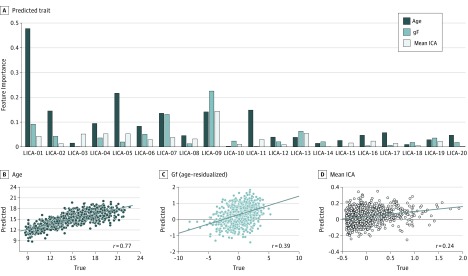
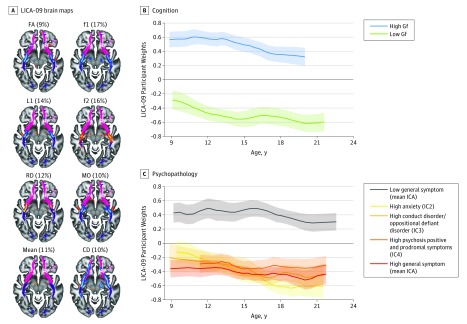
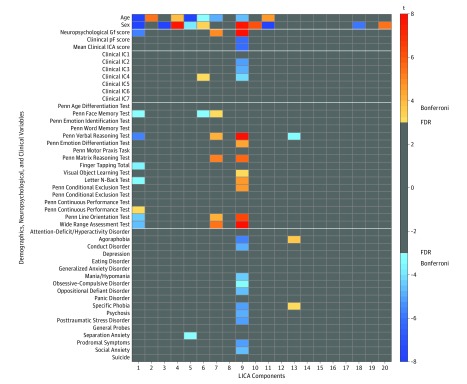
Results: Machine learning with 10-fold cross-validation and permutation testing in 729 individuals (aged 8 to 22 years; mean [SD] age, 15.1 [3.3] years; 343 females [46%]) revealed significant association with general psychopathology levels (r = 0.24, P < .001) and cognition (r = 0.39, P < .001). A brain white matter pattern reflecting frontotemporal connectivity and crossing fibers in the uncinate fasciculus was the most associated feature for both traits. Univariate analysis across a range of clinical domains and cognitive test scores confirmed its transdiagnostic importance. Both the general psychopathology (16%; SE, 0.095; P = .05) and cognitive (18%; SE, 0.09; P = .01) factor were heritable and showed a negative genetic correlation.
Conclusion and relevance: Dimensional and heritable general cognitive and psychopathology factors are associated with specific patterns of white matter properties, suggesting that dysconnectivity is a transdiagnostic brain-based phenotype in individuals with increased susceptibility and symptoms of psychiatric disorders.
Conflict of interest statement
Figures
Comment in
-
Progress Toward Elucidating Commonalities in Mental Disorders Using Brain Imaging and Publicly Available Data.JAMA Psychiatry. 2018 Mar 1;75(3):295-296. doi: 10.1001/jamapsychiatry.2017.4245. JAMA Psychiatry. 2018. PMID: 29365015 No abstract available.
References
-
- O’Donovan MC, Owen MJ. The implications of the shared genetics of psychiatric disorders. Nat Med. 2016;22(11):1214-1219. - PubMed
-
- Buckholtz JW, Meyer-Lindenberg A. Psychopathology and the human connectome: toward a transdiagnostic model of risk for mental illness. Neuron. 2012;74(6):990-1004. - PubMed
Publication types
MeSH terms
LinkOut - more resources
Full Text Sources
Other Literature Sources
Medical