


International Cognition and Cancer Task Force Recommendations for Neuroimaging Methods in the Study of Cognitive Impairment in Non-CNS Cancer Patients
- PMID: 29365201
- PMCID: PMC6658857
- DOI: 10.1093/jnci/djx285
International Cognition and Cancer Task Force Recommendations for Neuroimaging Methods in the Study of Cognitive Impairment in Non-CNS Cancer Patients
Abstract
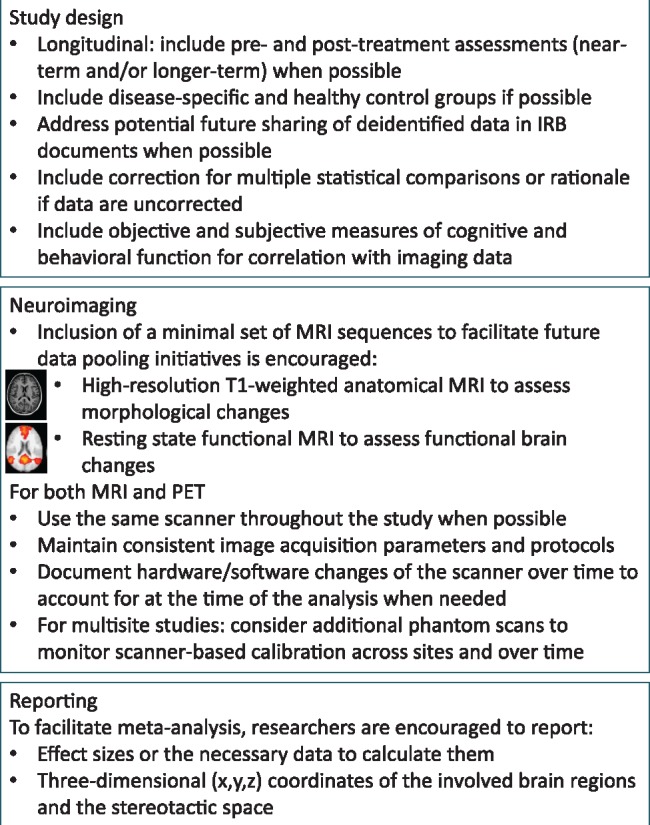
Cancer- and treatment-related cognitive changes have been a focus of increasing research since the early 1980s, with meta-analyses demonstrating poorer performance in cancer patients in cognitive domains including executive functions, processing speed, and memory. To facilitate collaborative efforts, in 2011 the International Cognition and Cancer Task Force (ICCTF) published consensus recommendations for core neuropsychological tests for studies of cancer populations. Over the past decade, studies have used neuroimaging techniques, including structural and functional magnetic resonance imaging (fMRI) and positron emission tomography, to examine the underlying brain basis for cancer- and treatment-related cognitive declines. As yet, however, there have been no consensus recommendations to guide researchers new to this field or to promote the ability to combine data sets. We first discuss important methodological issues with regard to neuroimaging study design, scanner considerations, and sequence selection, focusing on concerns relevant to cancer populations. We propose a minimum recommended set of sequences, including a high-resolution T1-weighted volume and a resting state fMRI scan. Additional advanced imaging sequences are discussed for consideration when feasible, including task-based fMRI and diffusion tensor imaging. Important image data processing and analytic considerations are also reviewed. These recommendations are offered to facilitate increased use of neuroimaging in studies of cancer- and treatment-related cognitive dysfunction. They are not intended to discourage investigator-initiated efforts to develop cutting-edge techniques, which will be helpful in advancing the state of the knowledge. Use of common imaging protocols will facilitate multicenter and data-pooling initiatives, which are needed to address critical mechanistic research questions.
Figures
References
Publication types
MeSH terms
Grants and funding
LinkOut - more resources
Full Text Sources
Other Literature Sources
Miscellaneous
