


Burden of cardiovascular disease across 29 countries and GPs' decision to treat hypertension in oldest-old
- PMID: 29366388
- PMCID: PMC5901445
- DOI: 10.1080/02813432.2018.1426142
Burden of cardiovascular disease across 29 countries and GPs' decision to treat hypertension in oldest-old
Abstract
Objectives: We previously found large variations in general practitioner (GP) hypertension treatment probability in oldest-old (>80 years) between countries. We wanted to explore whether differences in country-specific cardiovascular disease (CVD) burden and life expectancy could explain the differences.
Design: This is a survey study using case-vignettes of oldest-old patients with different comorbidities and blood pressure levels. An ecological multilevel model analysis was performed.
Setting: GP respondents from European General Practice Research Network (EGPRN) countries, Brazil and New Zeeland.
Subjects: This study included 2543 GPs from 29 countries.
Main outcome measures: GP treatment probability to start or not start antihypertensive treatment based on responses to case-vignettes; either low (<50% started treatment) or high (≥50% started treatment). CVD burden is defined as ratio of disability-adjusted life years (DALYs) lost due to ischemic heart disease and/or stroke and total DALYs lost per country; life expectancy at age 60 and prevalence of oldest-old per country.
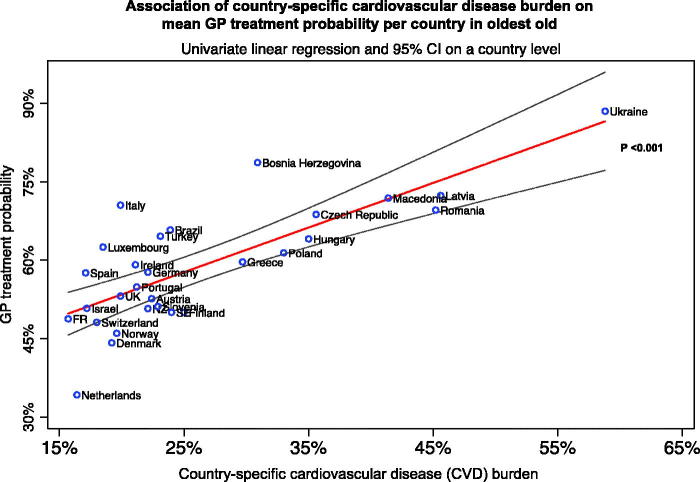
Results: Of 1947 GPs (76%) responding to all vignettes, 787 (40%) scored high treatment probability and 1160 (60%) scored low. GPs in high CVD burden countries had higher odds of treatment probability (OR 3.70; 95% confidence interval (CI) 3.00-4.57); in countries with low life expectancy at 60, CVD was associated with high treatment probability (OR 2.18, 95% CI 1.12-4.25); but not in countries with high life expectancy (OR 1.06, 95% CI 0.56-1.98).
Conclusions: GPs' choice to treat/not treat hypertension in oldest-old was explained by differences in country-specific health characteristics. GPs in countries with high CVD burden and low life expectancy at age 60 were most likely to treat hypertension in oldest-old. Key Points • General practitioners (GPs) are in a clinical dilemma when deciding whether (or not) to treat hypertension in the oldest-old (>80 years of age). • In this study including 1947 GPs from 29 countries, we found that a high country-specific cardiovascular disease (CVD) burden (i.e. myocardial infarction and/or stroke) was associated with a higher GP treatment probability in patients aged >80 years. • However, the association was modified by country-specific life expectancy at age 60. While there was a positive association for GPs in countries with a low life expectancy at age 60, there was no association in countries with a high life expectancy at age 60. • These findings help explaining some of the large variation seen in the decision as to whether or not to treat hypertension in the oldest-old.
Keywords: Oldest-old; cardiovascular disease burden; clinical decision-making; hypertension; life expectancy.
Figures
References
-
- Olsen MH, Angell SY, Asma S, et al. A call to action and a lifecourse strategy to address the global burden of raised blood pressure on current and future generations: the Lancet Commission on hypertension. Lancet. 2016;388:2665–2712. - PubMed
-
- The United Nations: world population prospects: the 2012 revision; [cited 2017 Nov 6]. Available from: http://esa.un.org/unpd/wpp.
-
- World Health Organisation (WHO) Active ageing: a policy framework; 2002; [cited 2017 Nov 7]. Available from: http://apps.who.int/iris/bitstream/10665/67215/1/WHO_NMH_NPH_02.8.pdf
-
- Materson BJ, Garcia-Estrada M, Preston RA.. Hypertension in the frail elderly. J Am Soc Hypertens. 2016;10:536–541. - PubMed
Publication types
MeSH terms
Substances
Grants and funding
LinkOut - more resources
Full Text Sources
Other Literature Sources
Medical
