. 2018 Jan 24;8(1):1472.
doi: 10.1038/s41598-018-19896-9.

Palisade cell shape affects the light-induced chloroplast movements and leaf photosynthesis

Affiliations

Palisade cell shape affects the light-induced chloroplast movements and leaf photosynthesis

Eiji Gotoh et al. Sci Rep. .

Abstract

Leaf photosynthesis is regulated by multiple factors that help the plant to adapt to fluctuating light conditions. Leaves of sun-light-grown plants are thicker and contain more columnar palisade cells than those of shade-grown plants. Light-induced chloroplast movements are also essential for efficient leaf photosynthesis and facilitate efficient light utilization in leaf cells. Previous studies have demonstrated that leaves of most of the sun-grown plants exhibited no or very weak chloroplast movements and could accomplish efficient photosynthesis under strong light. To examine the relationship between palisade cell shape, chloroplast movement and distribution, and leaf photosynthesis, we used an Arabidopsis thaliana mutant, angustifolia (an), which has thick leaves that contain columnar palisade cells similar to those in the sun-grown plants. In the highly columnar cells of an mutant leaves, chloroplast movements were restricted. Nevertheless, under white light condition (at 120 µmol m-2 s-1), the an mutant plants showed higher chlorophyll content per unit leaf area and, thus, higher light absorption by the leaves than the wild type, which resulted in enhanced photosynthesis per unit leaf area. Our findings indicate that coordinated regulation of leaf cell shape and chloroplast movement according to the light conditions is pivotal for efficient leaf photosynthesis.


Conflict of interest statement

The authors declare that they have no competing interests.

Figures
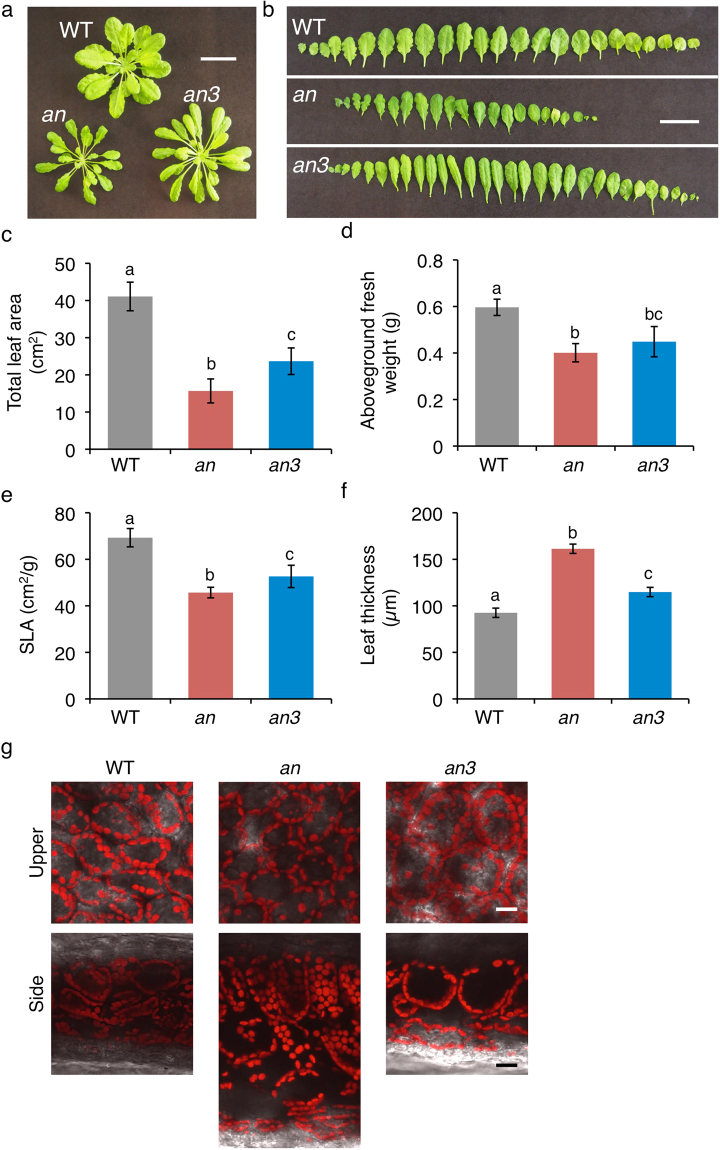
Figure 1
Figure 1
Altered leaf morphology in an and an3 mutants. (a) Photograph of 42-day-old plants. Scale bar = 2 cm. (b) Photographs of leaves detached from 42-day-old plants. The left leaf is the youngest and the right is the oldest one (it is one of the cotyledons). Scale bar = 2 cm. (ce) Total leaf area (c), aboveground fresh weight (d), and specific leaf area (SLA, projected leaf area per unit leaf fresh weight: total leaf area/aboveground fresh weight) (e) of 42-day-old wild-type (WT) and mutant plants. Data show the mean ± SEM (n = 24) of three independent experiments. Significant differences (P < 0.05, Tukey-Kramer) are indicated by different characters. (f) Thickness of leaves in the WT and mutant plants. Data show the mean ± SEM (n = 9) of three independent experiments. Significant differences (P < 0.05, Tukey-Kramer) are indicated by different characters. (g) Leaf cell morphology and chloroplast distribution in an and an3 mutants. Wild type (WT) and mutant plants were grown under white light condition (120 µmol m−2 s−1) for 42 days. Views of the upper surface of palisade tissue cells (upper panel) and cross sections (lower panel) of the leaves from the WT and the mutant plants are shown. Scale bar = 20 µm.
Figure 2
Figure 2
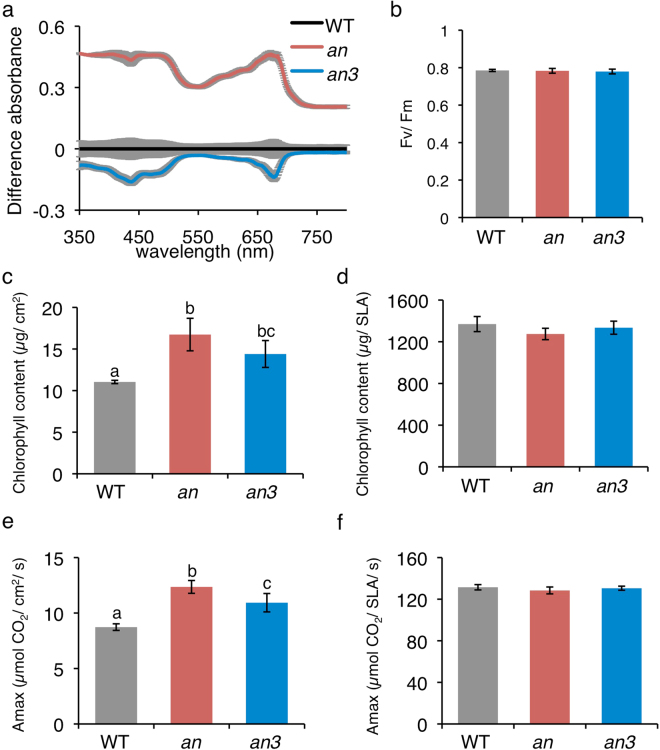
Photosynthetic performance of an and an3 mutants. (a) Difference spectra of leaf absorbance between the wild-type (WT) and mutant plants. Leaf absorbance was measured under white light (120 µmol m−2 s−1). The difference in multi-wavelength (350–800 nm) absorbance was calculated by subtracting the absorbance of each mutant from that of the WT. Data show the mean ± SEM of three independent experiments. (b) Maximum photochemical efficiency of PSII (Fv/ Fm) of the leaves in WT, an, and an3 mutant plants. After keeping the leaves in dark for at least 1 h, Fv/Fm was measured. Data show the mean ± SEM of three independent experiments. (cf) Chlorophyll content and photosynthetic capacity. (c and d) Total chlorophyll content of leaves in the WT and mutant plants. The chlorophyll content of rosette leaves of 42-day-old plants was determined. (e and f) Maximum CO2 assimilation capacity (Amax) in WT, an, and an3 mutant plants. Amax was calculated from each light saturation point. The chlorophyll content and photosynthetic capacity are expressed per leaf area (c and e) or per SLA (d and f). SLA was calculated using detached leaves. Data show the mean ± SEM of three independent experiments.
Figure 3
Figure 3
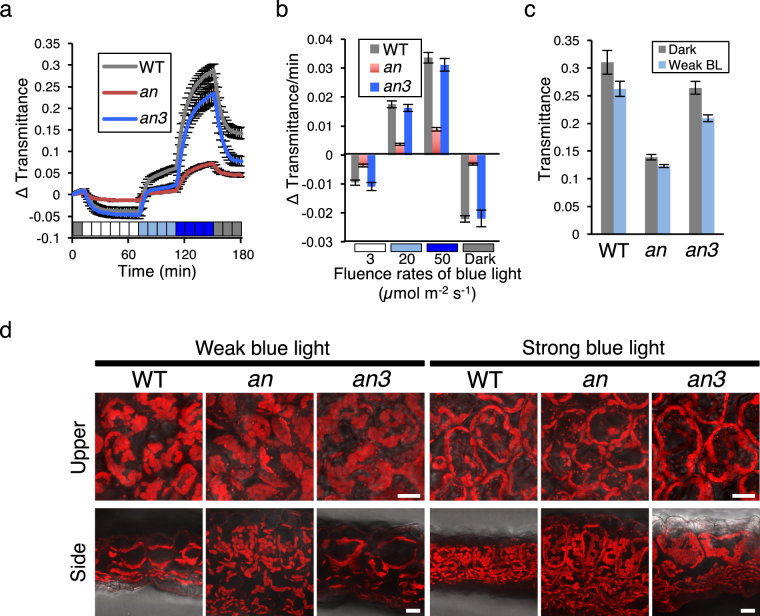
Light-induced chloroplast movements and intracellular distribution in an and an3 mutants. (a) Changes in leaf transmittance caused by light-induced chloroplast movements in wild-type (WT), an, and an3 mutant plants. Coloured boxes on the horizontal axis indicate passage of time (one box denotes 10 min) and light conditions. After 10 min exposure to darkness (indicated by black boxes), the leaves were sequentially irradiated with blue light (BL) at 3, 20, and 50 µmol m−2 s−1 for 60, 40, and 40 min (indicated by white, sky blue, and blue boxes, respectively). The light was turned off at 150 min. (b) The average of the changes in transmittance over 1 min was calculated by measuring the changes in the leaf transmittance rates for 2–6 min after changes in the light fluence rates (3, 20, and 50 µmol m−2 s−1 or dark). (c) Leaf transmittance at 0 and 70 min (i.e., 60 min after weak BL irradiation) after the onset of measurement of leaf transmittance changes. Data in a to c show the mean ± SEM of three independent experiments. (d) Chloroplast distribution in the WT and mutant plants irradiated with weak BL (3 µmol m−2 s−1) and strong BL (50 µmol m−2 s−1) for 3 h. Views of the upper surface of palisade tissue cells (upper panel) and cross sections (lower panel) of leaves from the WT and mutant plants are shown. Scale bar = 20 µm.

References

    1. Christie JM. Phototropin blue-light receptors. Annu. Rev. Plant Biol. 2007;58:21–45. doi: 10.1146/annurev.arplant.58.032806.103951. - DOI - PubMed
    1. Suetsugu N, Wada M. Evolution of three LOV blue light receptor families in green plants and photosynthetic stramenopiles: Phototropin, ZTL/FKF1/LKP2 and aureochrome. Plant Cell Physiol. 2013;54:8–23. doi: 10.1093/pcp/pcs165. - DOI - PubMed
    1. Suetsugu, N. & Wada, M. Chloroplast photorelocation movement: A sophisticated strategy for chloroplasts to perform efficient photosynthesis in Advances in photosynthesis-Fundamental aspects (ed. Najafpour, M. M.) 215–234 (InTech, 2012).
    1. Kasahara M, et al. Chloroplast avoidance movement reduces photodamage in plants. Nature. 2002;420:829–832. doi: 10.1038/nature01213. - DOI - PubMed
    1. Terashima I, Hikosaka K. Comparative ecophysiology of leaf and canopy photosynthesis. Plant Cell Environ. 1995;18:1111–1128. doi: 10.1111/j.1365-3040.1995.tb00623.x. - DOI

Publication types