. 2018 Jan 24;8(1):1515.
doi: 10.1038/s41598-018-19894-x.

Methylphenidate regulation of osteoclasts in a dose- and sex-dependent manner adversely affects skeletal mechanical integrity

Affiliations

Methylphenidate regulation of osteoclasts in a dose- and sex-dependent manner adversely affects skeletal mechanical integrity

Sardar M Z Uddin et al. Sci Rep. .

Abstract

Methylphenidate (MP) is the most prescribed psychostimulant for ADHD patients, with clinically demonstrated detrimental effects on bone quality, potentially leading to early onset osteoporosis and higher fracture risk. The underlying mechanism for the effects of MP on bone remains elusive. This study demonstrates that sex- and dose-dependent effects of MP on bone quality and quantity are mediated by osteoclast activity. Four-week-old male and female rats were treated with low and high dose MP for 13 weeks. Bone quality and quantity were analyzed using microCT, mechanical testing, histomorphometry, and TRAP staining. Male and female rat bone marrow-derived osteoclasts were treated in a dose-dependent manner (0-1000 ng/ml) and osteoclast activity was determined at days 5, 7, and 14 using TRAP staining, as well as a pit formation assay at day 18. Animal studies showed a dose- and a sex-dependent decrease in mechanical integrity in femora and increased TRAP staining in MP-treated rats. Primary cultures revealed that MP had direct dose- and sex-dependent effects on osteoclast activity, as seen by increased differentiation, activity, and resorption. This study demonstrates for the first time that osteoclasts are differentially regulated by MP in adolescent male and female rats, resulting in sex-dependent effects on the skeleton.


Conflict of interest statement

The authors declare that they have no competing interests.

Figures
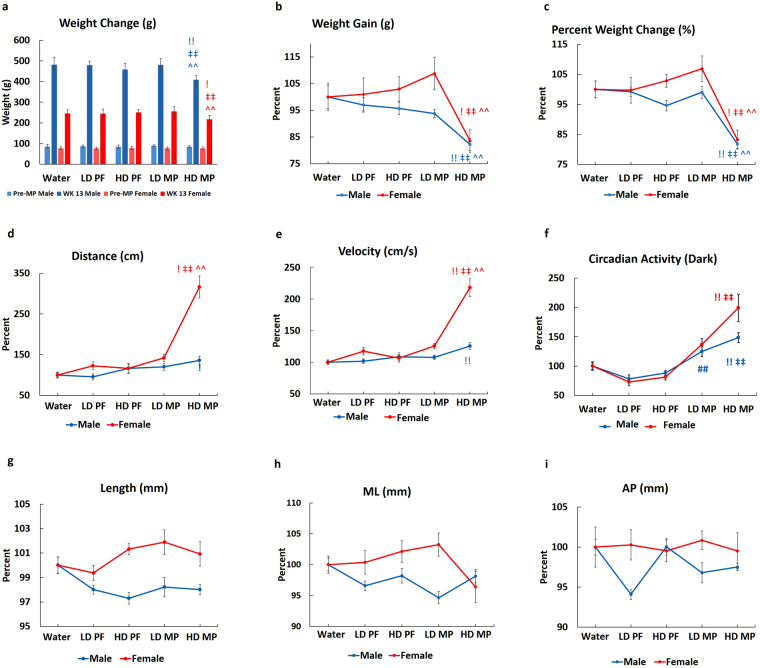
Figure 1
Figure 1
Effects of MP on weight gain and activity: (a,b,c) HD-MP male and female rats showed a significant decrease in weight gain. After 13 weeks of MP administration, HD MP male rats showed less weight gain relative to water (18%), LD PF (17.5%), HD PF (13.5%) and LD (17%) rats. Female rats showed a similar trend, with significantly less weight gain in HD MP female rats (~18%) relative to Water. MP-treated male and female rats also showed increased (d) distance traveled, (e) velocity, and (f) dark circadian activity. MP-treated females covered more distance, with increased velocity, relative to MP-treated male rats (d,e). HD MP increased circadian activity with an elevated increase in female, as compared to male rats (f). MP exposure did not affect femoral (g) length, (h) medial-lateral diameter, or (i) anterior-posterior diameter in male and female rats. (!p < 0.05 Water vs HD, !!p < 0.01 Water vs HD, p < 0.05 HD PF vs HD, ‡‡p < 0.01 HD PF vs HD, ^^p < 0.01 LD vs HD, ##p < 0.01 LD PF vs LD).
Figure 2
Figure 2
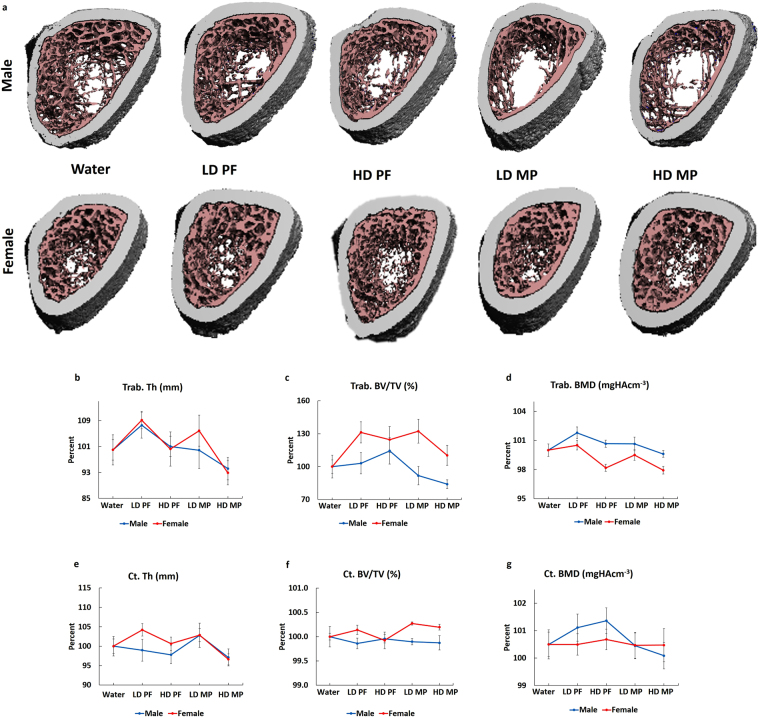
Effects of MP on bone quantity and quality: (a) MicroCT scans reveal an apparent decreasing trend in the quantity of trabecular bone in both male and female LD MP and HD MP rats. However, no significant differences were observed in (b,c,d) trabecular and (e,f,g) cortical bone parameters.
Figure 3
Figure 3
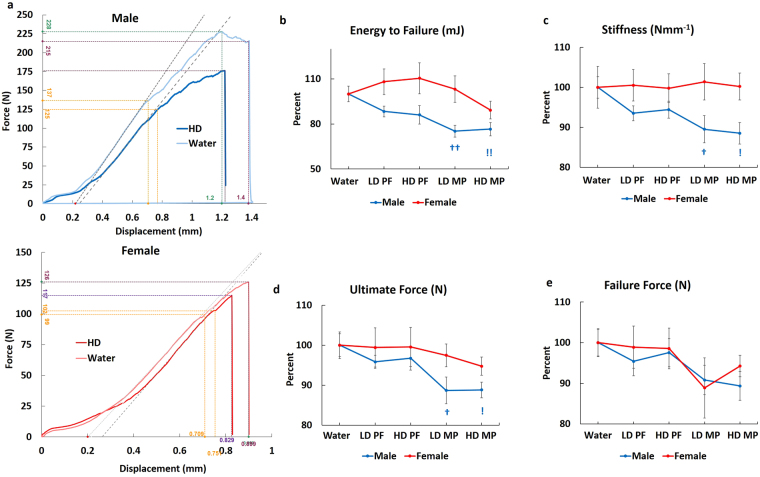
Effects of MP on bone mechanical integrity: (a) A right shift was observed in the force-displacement curves of male and female HD MP rats. Male LD and HD MP rats showed a significant decrease in (b) energy to failure, (c) stiffness, and (d) ultimate force relative to Water rats. No significant effects were observed in MP-treated female rats. (e) Failure force did not show significant differences in MP-treated male and female rats. (!p < 0.05 Water vs HD, !!p < 0.01 Water vs HD, p < 0.05 HD PF vs HD, ‡‡p < 0.01 HD PF vs HD).
Figure 4
Figure 4
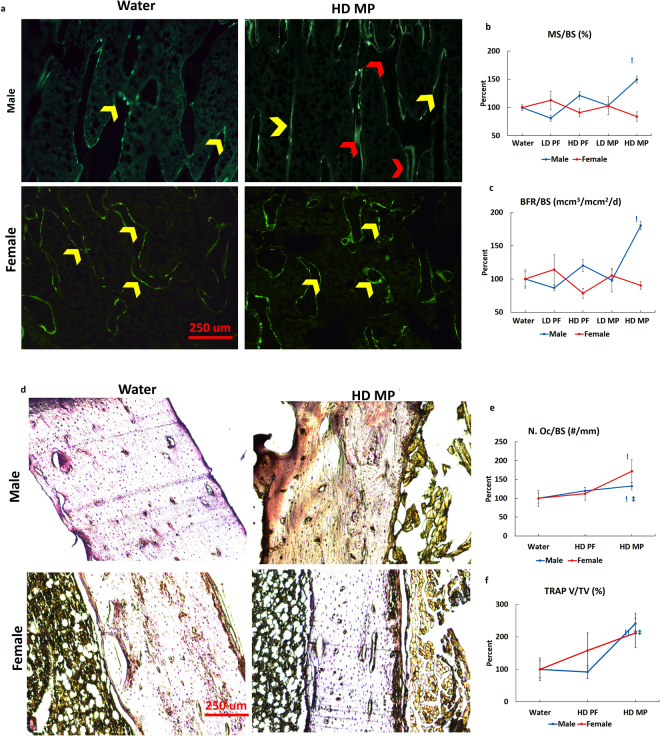
Effects of MP on Bone remodeling: (a) No apparent differences in calcein single and double labeling (yellow and red arrows, respectively) were observed in male Water, LD PF, HD PF, and LD MP groups, though male HD MP showed increased calcein labeling. No apparent differences in calcein labeling were seen in female rats. Histomorphometric quantification showed significantly increased (b) mineralized bone surface (MS/BS) and (c) bone formation rate (BFR/BS) in HD MP male rats with no significant changes in female rats. (d) TRAP activity was measured to assess osteoclast activity in cortical bone. HD MP male rats showed increased TRAP staining in cortical bone relative to Water-treated male rats, whereas female rats did not show any apparent differences between Water and HD MP. Quantification of TRAP staining showed a significant increase in (e) number of osteoclast over bone surface (N. Oc/BS) in both HD MP treated male and female rats. HD MP treated male rats showed a significant increase in (f) TRAP volume over tissue volume (TRAP V/TV) in cortical bone. (!p < 0.05 Water vs HD, !!p < 0.01 Water vs HD, p < 0.05 HD-PF vs HD, ‡‡p < 0.01 HD-PF vs HD).
Figure 5
Figure 5
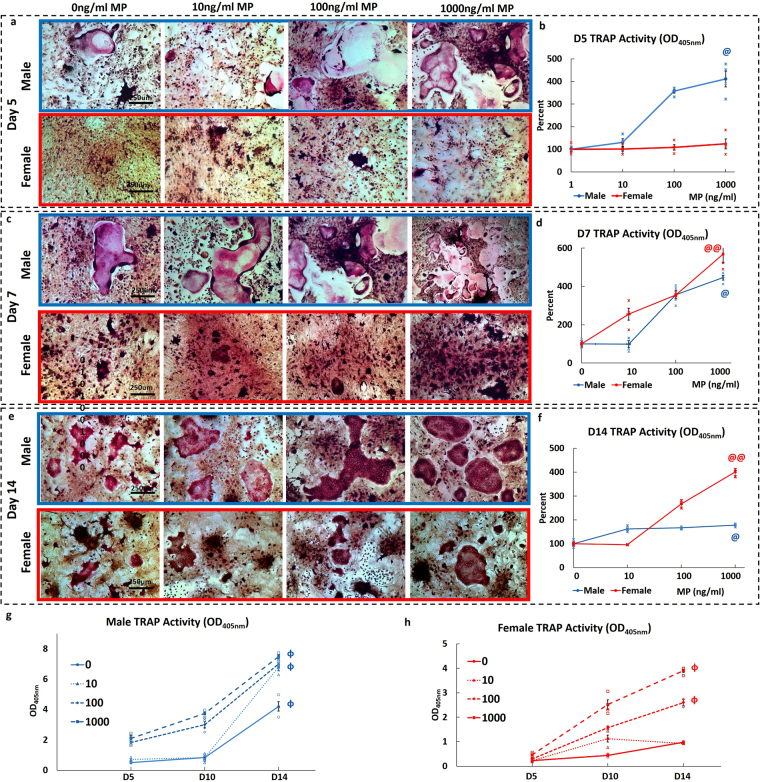
Dose- and sex-dependent effects of MP on osteoclast differentiation and activity: (a,c, e) TRAP staining shows that MP increased osteoclastic differentiation in male and female bone marrow-derived preosteoclasts in a dose- and sex-dependent manner. Males showed the formation of large osteoclasts at day (a) 5 that continued to mature at days (c) 7, and (e) 14. At all time-points, male osteoclasts showed a dose-dependent increase in the number of large osteoclasts with increasing MP concentration. Female osteoclasts also showed accelerated osteoclastogenesis in response to increasing MP concentration but were significantly slower than male cells. Day 5 female osteoclast cultures showed TRAP+ cells clusters, with no large osteoclasts. The number of TRAP+ cell clusters increased at low MP doses and some larger osteoclasts were present at high MP doses at day 7. At day 14, female osteoclasts showed the more typical morphology of mature osteoclast with increasing size and number seen in higher MP doses. (b,d,f) Male and female osteoclasts both showed a dose- and sex-dependent increase in activity, with female osteoclast activity significantly less than male at days 5, 7, and 14. (g,h) Osteoclast activity as a function of time showed significant increases in osteoclast activity observed between day 5 and 14 for both male and female osteoclasts. (@p < 0.05 0 vs 1000 ng/ml, @@p < 0.01 0 vs 1000 ng/ml, §§P < 0.01, male vs female osteoclast activity, ɸp < 0.05 Day 5 vs Day 7).
Figure 6
Figure 6
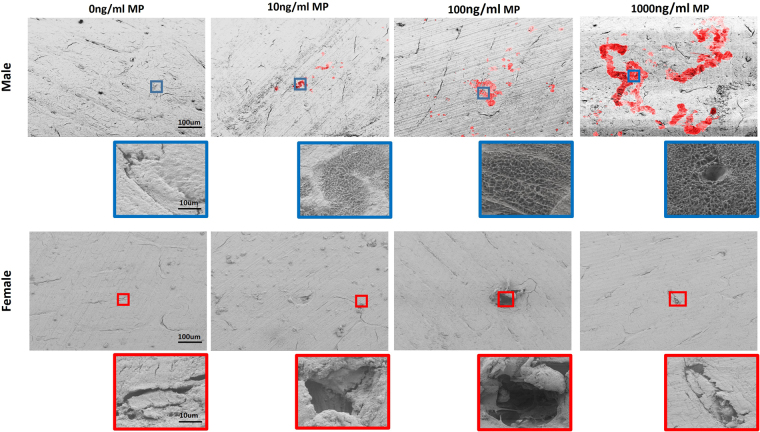
Dose and sex-dependent effects of MP on osteoclast resorption: MP-induced osteoclastic resorption was confirmed using pit assays. SEM analysis at day 18 showed a dose-dependent increase in pit and trail formation (red) in MP-treated male osteoclasts. Both the number of pits and the area covered by pits increased in association with increasing MP doses, with highest pit and trail formation observed at 1000 ng/ml. In contrast, female osteoclasts showed limited resorption, which was mostly limited to mild enlargement of pre-existing cracks. No apparent differences were seen between doses for female osteoclasts.

References

    1. Ramtekkar UP, Reiersen AM, Todorov AA, Todd RD. Sex and age differences in attention-deficit/hyperactivity disorder symptoms and diagnoses: implications for DSM-V and ICD-11. Journal of the American Academy of Child and Adolescent Psychiatry. 2010;49(217–228):e211–213. - PMC - PubMed
    1. Castells X, et al. Efficacy of methylphenidate for adults with attention-deficit hyperactivity disorder: a meta-regression analysis. CNS drugs. 2011;25:157–169. doi: 10.2165/11539440-000000000-00000. - DOI - PubMed
    1. Chai G, et al. Trends of outpatient prescription drug utilization in US children, 2002-2010. Pediatrics. 2012;130:23–31. doi: 10.1542/peds.2011-2879. - DOI - PubMed
    1. Group MTAC. National Institute of Mental Health Multimodal Treatment Study of ADHD follow-up: changes in effectiveness and growth after the end of treatment. Pediatrics. 2004;113:762–769. doi: 10.1542/peds.113.4.762. - DOI - PubMed
    1. Swanson J, et al. Stimulant-related reductions of growth rates in the PATS. Journal of the American Academy of Child and Adolescent Psychiatry. 2006;45:1304–1313. doi: 10.1097/01.chi.0000235075.25038.5a. - DOI - PubMed

Publication types

Substances