


Cost-Effectiveness of Using Standardized Patients to Assess Student-Pharmacist Communication Skills
- PMID: 29367775
- PMCID: PMC5774195
- DOI: 10.5688/ajpe6120
Cost-Effectiveness of Using Standardized Patients to Assess Student-Pharmacist Communication Skills
Abstract
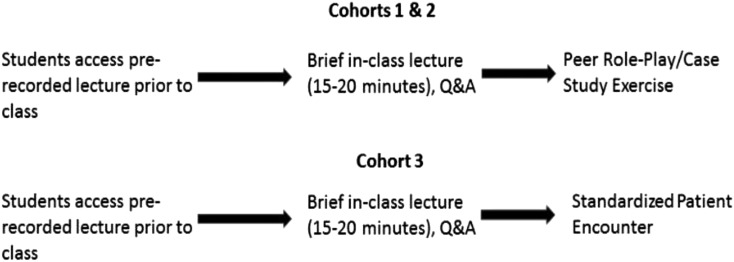
Objective. To explore the cost-effectiveness of including standardized patients (SP) in the didactic curriculum for application and assessment of students' pharmacist-patient communication skills. Methods. Five role play/case study (RP/CS) activities from a communication skills curriculum were replaced with five SP encounters. Communication was assessed using a rubric. This study developed an economic model to examine the costs and effectiveness of replacing RP/CS events with SP events in knowledge-application and communication assessment. Costs consisted of SP hourly wages for training and delivery of SP events. Outcomes examined were the incremental cost-effectiveness ratio (ICER) per student. Results. The ICER comparing SP to RP/CS was $100.93 higher per student on first-attempt pass rates and $9.04 per one-point increase in the mean score. Conclusion. SP was more effective and more costly than RP/CS. Further research into students' willingness to pay needs to occur before determining if using SPs is cost-effective in teaching communication skills.
Keywords: communication; prescription medications; standardized patients.
Figures
References
-
- Accreditation Council for Pharmacy Education. Accreditation standards and key elements for the professional program in pharmacy leading to the doctor of pharmacy degree. Standards 2016. https://www.acpe-accredit.org/pdf/Standards2016FINAL.pdf. 2015. Accessed October 21, 2016.
-
- Passiment M, Sacks H, Huang G. Medical simulation in medical education: results of an AAMC survey. https://www.aamc.org/download/259760/data. 2011. Accessed October 21, 2016.
-
- Oh PJ, Jeon KD, Koh MS. The effects of simulation-based learning utilizing standardized patients in nursing students: a meta-analysis. Nurs Educ Today. 2015;35(5):e6–e15. - PubMed
-
- Love DW, Wiese HJ, Henson RE, Parker CL. Teaching interviewing skills to pharmacy residents. Am J Health Syst Pharm. 1978;35(9):1073–1074. - PubMed
MeSH terms
LinkOut - more resources
Full Text Sources
Other Literature Sources
