


Pharmacological Inhibition of Brain Fatty Acid Binding Protein Reduces Ethanol Consumption in Mice
- PMID: 29367955
- PMCID: PMC5777574
Pharmacological Inhibition of Brain Fatty Acid Binding Protein Reduces Ethanol Consumption in Mice
Abstract
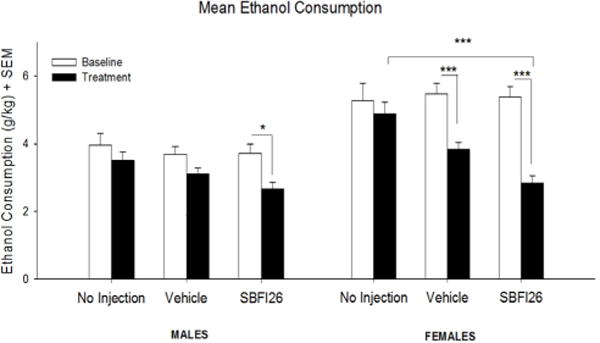
The endocannabinoid (eCB) system is involved in a wide range of behavioral disorders including alcoholism. Inhibition of fatty acid amide hydrolase (FAAH), the principal enzyme that degrades the eCB anandamide (AEA), which enhances AEA levels in the brain, significantly increases ethanol consumption and preference. In the present study, we examined whether pharmacological inhibition of fatty acid binding proteins (FABPs) 5 and 7, which blocks the transport of AEA to FAAH, and increase AEA levels in vivo also alters ethanol consumption and preference. Using a limited access two-bottle choice paradigm, we evaluated ethanol consumption in both male and female C57Bl/6 mice. Results showed a significant decrease in ethanol consumption in both males and females treated with SBFI26, an inhibitor of FABPs. Specifically, male and female mice treated with SBFI26 consumed 24% and 42% less compared to mice receiving no injections, respectively. Subsequently, corticosterone was examined to evaluate the effects FABP5/7 inhibition upon the stress response. We observed a significant elevation in corticosterone levels following restraint stress in SBFI26 treated females, with a weak effect seen in males as compared to vehicle. Based on our results, targeting of FABPs appears to play an important role in ethanol consumption that is differentially regulated in males and females, which is mediated by the stress response.
Keywords: Addiction; Endocannabinoid; Ethanol; Fatty acid binding protein; Reward; Reward deficiency syndrome.
Conflict of interest statement
Conflict of Interest Statement The authors declare that the research was conducted in the absence of any commercial or financial relationships that could be construed as a potential conflict of interest.
Figures

References
-
- Pava MJ, Woodward JJ. A review of the interactions between alcohol and the endocannabinoid system: implications for alcohol dependence and future directions for research. Alcohol. 2012;46(3):185–204. https://doi.org/10.1016/j.alcohol.2012.01.002. - DOI - PMC - PubMed
-
- Onaivi ES. An endocannabinoid hypothesis of drug reward and drug addiction. Ann N Y Acad Sci. 2008;1139:412–421. https://doi.org/10.1196/annals.1432.056. - DOI - PubMed
-
- Egertová M, Cravatt BF, Elphick MR. Comparative analysis of fatty acid amide hydrolase and cb1 cannabinoid receptor expression in the mouse brain: evidence of a widespread role for fatty acid amide hydrolase in regulation of endocannabinoid signaling. Neuroscience. 2003;119(2):481–496. https://doi.org/10.1016/S0306-4522(03)00145-3. - DOI - PubMed
-
- Haj-Dahmane S, Shen RY. Regulation of plasticity of glutamate synapses by endocannabinoids and the cyclic-AMP/protein kinase A pathway in midbrain dopamine neurons. J Physiol. 2010;588(Pt 14):2589–2604. https://doi.org/10.1113/jphysiol.2010.190066. - DOI - PMC - PubMed
-
- Ueda N, Tsuboi K. Discrimination between two endocannabinoids. Chem Biol. 2012;19(5):545–547. https://doi.org/10.1016/j.chembiol.2012.05.001. - DOI - PubMed
Grants and funding
LinkOut - more resources
Full Text Sources
Research Materials
Miscellaneous