Identifying Financially Sustainable Pricing Interventions to Promote Healthier Beverage Purchases in Small Neighborhood Stores
- PMID: 29369758
- PMCID: PMC5798217
- DOI: 10.5888/pcd15.160611
Identifying Financially Sustainable Pricing Interventions to Promote Healthier Beverage Purchases in Small Neighborhood Stores
Abstract
Introduction: Residents of low-income communities often purchase sugar-sweetened beverages (SSBs) at small, neighborhood "corner" stores. Lowering water prices and increasing SSB prices are potentially complementary public health strategies to promote more healthful beverage purchasing patterns in these stores. Sustainability, however, depends on financial feasibility. Because in-store pricing experiments are complex and require retailers to take business risks, we used a simulation approach to identify profitable pricing combinations for corner stores.
Methods: The analytic approach was based on inventory models, which are suitable for modeling business operations. We used discrete-event simulation to build inventory models that use data representing beverage inventory, wholesale costs, changes in retail prices, and consumer demand for 2 corner stores in Baltimore, Maryland. Model outputs yielded ranges for water and SSB prices that increased water demand without loss of profit from combined water and SSB sales.
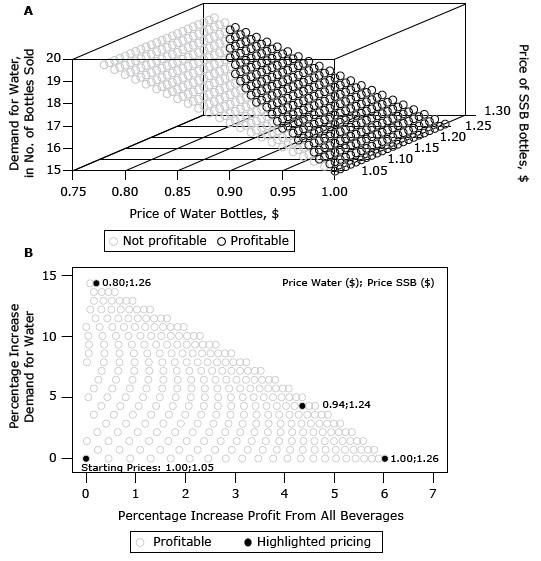
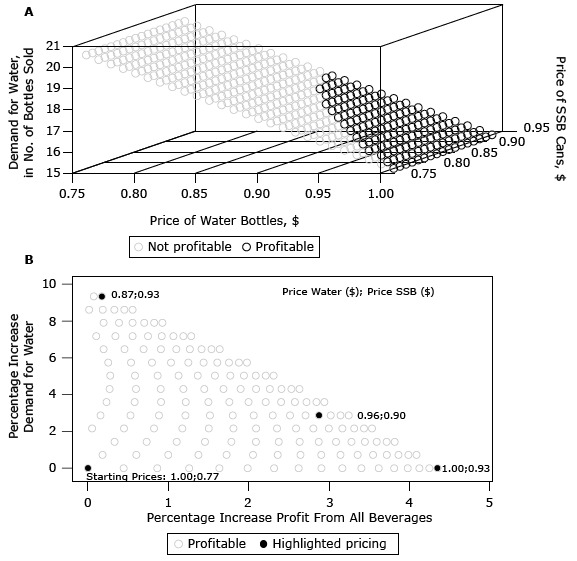
Results: A 20% SSB price increase allowed lowering water prices by up to 20% while maintaining profit and increased water demand by 9% and 14%, for stores selling SSBs in 12-oz cans and 16- to 20-oz bottles, respectively. Without changing water prices, profits could increase by 4% and 6%, respectively. Sensitivity analysis showed that stores with a higher volume of SSB sales could reduce water prices the most without loss of profit.
Conclusion: Various combinations of SSB and water prices could encourage water consumption while maintaining or increasing store owners' profits. This model is a first step in designing and implementing profitable pricing strategies in collaboration with store owners.
Figures
References
-
- Centers for Disease Control and Prevention. Rethink your drink — cutting calories. http://www.cdc.gov/healthyweight/healthy_eating/drinks.html. 2016. Accessed January 29, 2016.
-
- Tate DF, Turner-McGrievy G, Lyons E, Stevens J, Erickson K, Polzien K, et al. Replacing caloric beverages with water or diet beverages for weight loss in adults: main results of the Choose Healthy Options Consciously Everyday (CHOICE) randomized clinical trial. Am J Clin Nutr 2012;95(3):555–63. Erratum in: Am J Clin Nutr 2013;98(6):1599. 10.3945/ajcn.111.026278 - DOI - PMC - PubMed
-
- James J, Thomas P, Cavan D, Kerr D. Preventing childhood obesity by reducing consumption of carbonated drinks: cluster randomised controlled trial. BMJ 2004;328(7450):1237. Erratum in: BMJ 2004;328(7450):1236. 10.1136/bmj.38077.458438.EE - DOI - PMC - PubMed
Publication types
MeSH terms
Substances
Grants and funding
LinkOut - more resources
Full Text Sources
Other Literature Sources
Medical