


Performance of 4 definitions of childhood elevated blood pressure in predicting subclinical cardiovascular outcomes in adulthood
- PMID: 29370465
- PMCID: PMC8030891
- DOI: 10.1111/jch.13201
Performance of 4 definitions of childhood elevated blood pressure in predicting subclinical cardiovascular outcomes in adulthood
Abstract
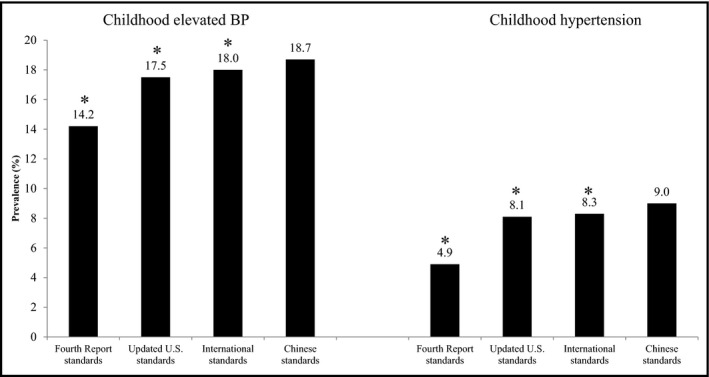
We aimed to compare the ability of the pediatric blood pressure (BP) standards issued by the US Fourth Report, the recently proposed US, Chinese, and international standards to predict adult hypertension and subclinical cardiovascular disease (CVD). 2296 children were randomly selected from Beijing at baseline. The follow-up survey was conducted among 1177 adults. Subclinical adult CVD was assessed using the carotid-femoral pulse wave velocity (cfPWV), carotid intima-media thickness (CIMT), and left ventricular mass index (LVMI). The prevalence of pediatric elevated BP was significantly higher according to the Chinese standards vs the Fourth Report, the updated US standards, and the international standards (18.7% vs 14.2%, 17.5%, and 18.0%, respectively; all Ps < .001). Children identified as elevated BP using any of the 4 standards were more likely to have adult hypertension, high cfPWV, and high LVMI than children without elevated BP. However, only the Chinese and updated US standards can predict the increased risk of adult high CIMT. Our results indicated that the Chinese standards performed equally or better compared with 3 other standards in predicting adult hypertension and subclinical CVD.
Keywords: blood pressure; cardiovascular disease; child.
©2018 Wiley Periodicals, Inc.
Conflict of interest statement
The authors have no conflicts of interest to disclose.
Figures
Comment in
-
Identifying elevated blood pressure and hypertension in children and adolescents.J Clin Hypertens (Greenwich). 2018 Mar;20(3):515-517. doi: 10.1111/jch.13222. Epub 2018 Feb 12. J Clin Hypertens (Greenwich). 2018. PMID: 29430812 Free PMC article. No abstract available.
References
-
- Ingelfinger JR. The child or adolescent with elevated blood pressure. N Engl J Med. 2014;370:2316‐2325. - PubMed
-
- Hanevold C, Waller J, Daniels S, Portman R, Sorof J. The effects of obesity, gender, and ethnic group on left ventricular hypertrophy and geometry in hypertensive children: a collaborative study of the International Pediatric Hypertension Association. Pediatrics. 2004;113:328‐333. - PubMed
-
- Daniels SR, Loggie JM, Khoury P, Kimball TR. Left ventricular geometry and severe left ventricular hypertrophy in children and adolescents with essential hypertension. Circulation. 1998;97:1907‐1911. - PubMed
-
- Aatola H, Magnussen CG, Koivistoinen T, et al. Simplified definitions of elevated pediatric blood pressure and high adult arterial stiffness. Pediatrics. 2013;132:e70‐e76. - PubMed
Publication types
MeSH terms
LinkOut - more resources
Full Text Sources
Other Literature Sources
Medical
