Review
. 2018 Jan 31;41(1):50-54.
doi: 10.14348/molcells.2018.2215. Epub 2018 Jan 23.

Biological Roles of Alternative Autophagy

Affiliations
Review

Biological Roles of Alternative Autophagy

Shigeomi Shimizu. Mol Cells. .

Abstract

Atg5 and Atg7 have long been considered as essential molecules for autophagy. However, we found that cells lacking these molecules still form autophagic vacuoles and perform autophagic protein degradation when subjected to certain stressors. During this unconventional autophagy pathway, autophagosomes appeared to be generated in a Rab9-dependent manner by the fusion of vesicles derived from the trans-Golgi and late endosomes. Therefore, mammalian autophagy can occur via at least two different pathways; the Atg5/Atg7-dependent conventional pathway and an Atg5/Atg7-independent alternative pathway.

Keywords: Atg5; Golgi membrane; alternative autophagy; erythrocyte maturation; proteolysis.


Figures
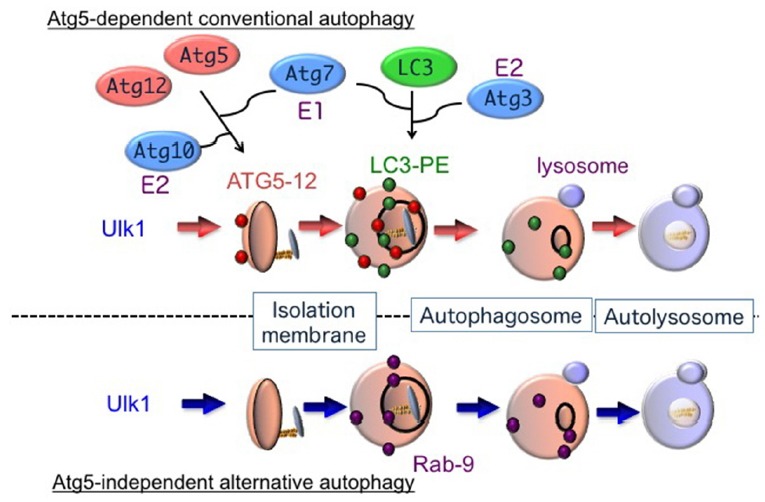
Fig. 1
Fig. 1. Hypothetical model of autophagy
There are at least two modes of macroautophagy, i.e. conventional and alternative autophagy. Conventional autophagy requires Atg5 and Atg7, is associated with LC3 modification, and is thought to originate from the ER membrane. In contrast, alternative autophagy occurs independently of Atg5 and Atg7, as well as LC3 modification. The generation of autophagic vacuoles in alternative autophagy is mediated by the fusion of isolation membranes with vesicles derived from the trans-Golgi as well as late endosomes, in a Rab9-dependent manner.
Fig. 2
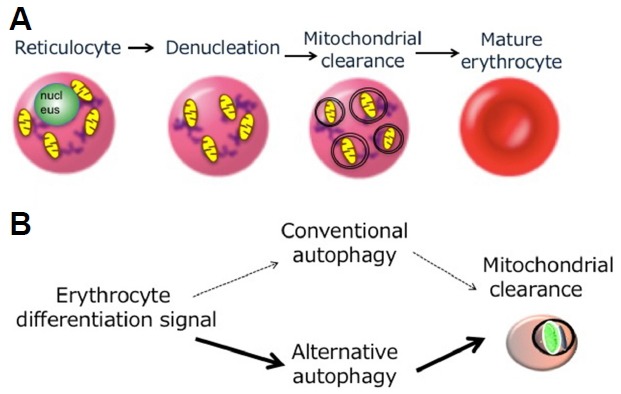
Fig. 2. Involvement of alternative autophagy in mitochondrial clearance during erythrocyte maturation
(A) The final stage of red blood cell maturation. During erythrocyte maturation, erythroblasts lose their nuclei to become reticulocytes, and reticulocytes transform into erythrocytes by the elimination of their mitochondria. Autophagy is involved in the latter process. (B) Mechanism of mitochondrial elimination during erythrocyte maturation. Mitochondrial elimination mainly occurs via Ulk1-dependent alternative autophagy and only partially via Atg5-dependent conventional autophagy.

References

    1. Egan DF, Shackelford DB, Mihaylova MM, Gelino S, Kohnz RA, Mair W, Vasquez DS, Joshi A, Gwinn DM, Taylor R, et al. Phosphorylation of ULK1 (hATG1) by AMP-activated protein kinase connects energy sensing to mitophagy. Science. 2011;331:456–461. - PMC - PubMed
    1. Goginashvili A, Zhang Z, Erbs E, Spiegelhalter C, Kessler P, Mihlan M, Pasquier A, Krupina K, Schieber N, Cinque L, et al. Insulin granules. Insulin secretory granules control autophagy in pancreatic β cells. Science. 2015;347:878–882. - PubMed
    1. Honda S, Arakawa S, Nishida Y, Yamaguchi H, Ishii E, Shimizu S. Ulk1-mediated Atg5-independent macroautophagy mediates elimination of mitochondria from embryonic reticulocytes. Nat Commun. 2014;5:4004. - PubMed
    1. Itakura E, Kishi-Itakura C, Mizushima N. The hairpin-type tail-anchored SNARE Syntaxin 17 targets to autophagosomes for fusion with endosomes/lysosomes. Cell. 2012;151:1256–1269. - PubMed
    1. Kaushik S, Cuervo AM. Chaperone-mediated autophagy: a unique way to enter the lysosome world. Trends Cell Biol. 2012;22:407–417. - PMC - PubMed

Substances

LinkOut - more resources