


Antifungal Susceptibility Testing of Fusarium: A Practical Approach
- PMID: 29371537
- PMCID: PMC5715922
- DOI: 10.3390/jof3020019
Antifungal Susceptibility Testing of Fusarium: A Practical Approach
Abstract
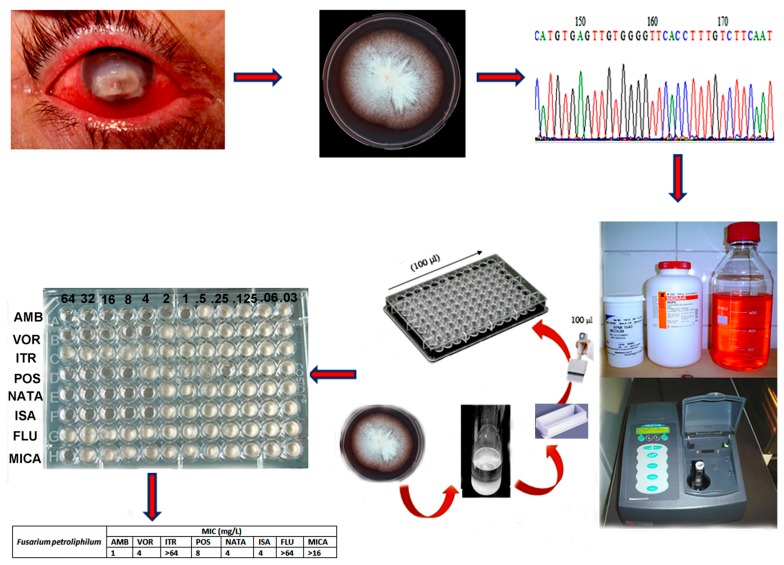
In vitro susceptibility testing of Fusarium is becoming increasingly important because of frequency and diversity of infections and because resistance profiles are species-specific. Reference methods for antifungal susceptibility testing (AFST) are those of Clinical and Laboratory Standards Institute (CLSI) and European Committee on Antimicrobial Susceptibility (EUCAST), but breakpoints (BPs) have not yet been established. One of the problems is that phylogenetic distances between Fusarium species are much smaller than between species of, e.g., Candida. Epidemiological cutoff values (ECVs) for some Fusarium species have been determined in order to differentiate wild-type from non-wild-type isolates. In clinical routine, commercially available assays such as Etest, Sensititre or others provide essential agreement with reference methods. Our objective is to summarize antifungal susceptibility testing of Fusarium genus in the clinical laboratory: how to do it, when to do it, and how to interpret it.
Keywords: CLSI; EUCAST; Etest; Fusarium; clinical laboratory; susceptibility test.
Conflict of interest statement
The authors declare no conflict of interest.
Figures
References
-
- Al-Hatmi A.M., Bonifaz A., Ranque S., de Hoog G.S., Verweij P.E., Meis J.F. Current antifungal treatment of fusariosis. Int. J. Antimicrob. Agents. 2017 in press. - PubMed
-
- Jiang Y., Al-Hatmi A.M., Xiang Y., Cao Y., van den Ende A.H., Curfs-Breuker I., Meis J.F., Lu H., de Hoog G.S. The concept of ecthyma gangrenosum illustrated by a Fusarium oxysporum infection in an immunocompetent individual. Mycopathologia. 2016;181:759–763. doi: 10.1007/s11046-016-0031-6. - DOI - PMC - PubMed
Publication types
LinkOut - more resources
Full Text Sources
Other Literature Sources
