


Casualties of peace: an analysis of casualties admitted to the intensive care unit during the negotiation of the comprehensive Colombian process of peace
- PMID: 29371879
- PMCID: PMC5769432
- DOI: 10.1186/s13017-017-0161-2
Casualties of peace: an analysis of casualties admitted to the intensive care unit during the negotiation of the comprehensive Colombian process of peace
Abstract
Background: After 52 years of war in 2012, the Colombian government began the negotiation of a process of peace, and by November 2012, a truce was agreed. We sought to analyze casualties who were admitted to the intensive care unit (ICU) before and during the period of the negotiation of the comprehensive Colombian process of peace.
Methods: Retrospective study of hostile casualties admitted to the ICU at a Level I trauma center from January 2011 to December 2016. Patients were subsequently divided into two groups: those seen before the declaration of the process of peace truce (November 2012) and those after (November 2012-December 2016). Patients were compared with respect to time periods.
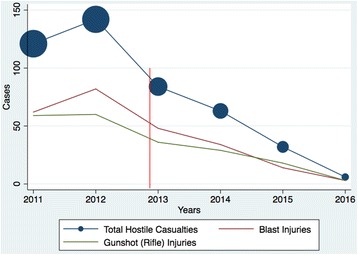
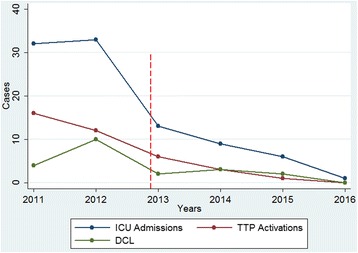
Results: Four hundred forty-eight male patients were admitted to the emergency room. Of these, 94 required ICU care. Sixty-five casualties presented before the truce and 29 during the negotiation period. Median injury severity score was significantly higher before the truce. Furthermore, the odds of presenting with severe trauma (ISS > 15) were significantly higher before the truce (OR, 5.4; (95% CI, 2.0-14.2); p < 0.01). There was a gradual decrease in the admissions to the ICU, and the performance of medical and operative procedures during the period observed.
Conclusion: We describe a series of war casualties that required ICU care in a period of peace negotiation. Despite our limitations, our study presents a decline in the occurrence, severity, and consequences of war injuries probably as a result in part of the negotiation of the process of peace. The hysteresis of these results should only be interpreted for their implications in the understanding of the peace-health relationship and must not be overinterpreted and used for any political end.
Keywords: Casualties; Critical care; Critical care outcomes; Military personnel; Peace; Trauma; Wounds and injuries.
Conflict of interest statement
The authors declare that they have no competing interests.All procedures performed in studies involving human participants were in accordance with the ethical standards of the institutional research committee and with the 1964 Helsinki declaration and its later amendments or comparable ethical standards. The Institutional Review Board of La Fundación Valle del Lili University Hospital approved the study protocol (Protocol Number: 554).Not applicableSpringer Nature remains neutral with regard to jurisdictional claims in published maps and institutional affiliations.
Figures
References
-
- RNI. Registro Único de Víctimas (Colombian Victims Registry) [Internet]. Available from: http://rni.unidadvictimas.gov.co/RUV Accessed 11 Jan 2017.
-
- BBC. Colombia: FARC declares unilateral truce at landmark talks [Internet]. BBC news. 2012 [cited 2017 Jan 11]. Available from: http://www.bbc.com/news/world-latin-america-20399152. Accessed 11 Jan 2017.
-
- Haagsma JA, Graetz N, Bolliger I, Naghavi M, Higashi H, Mullany EC, et al. The global burden of injury: incidence, mortality, disability-adjusted life years and time trends from the Global Burden of Disease study 2013. Inj Prev. 2015;22:3–18. Available from: http://injuryprevention.bmj.com/content/early/2015/10/20/injuryprev-2015... - PMC - PubMed
MeSH terms
LinkOut - more resources
Full Text Sources
Other Literature Sources
