


Early indicators of problematic grief trajectories following bereavement
- PMID: 29372008
- PMCID: PMC5774421
- DOI: 10.1080/20008198.2018.1423825
Early indicators of problematic grief trajectories following bereavement
Abstract
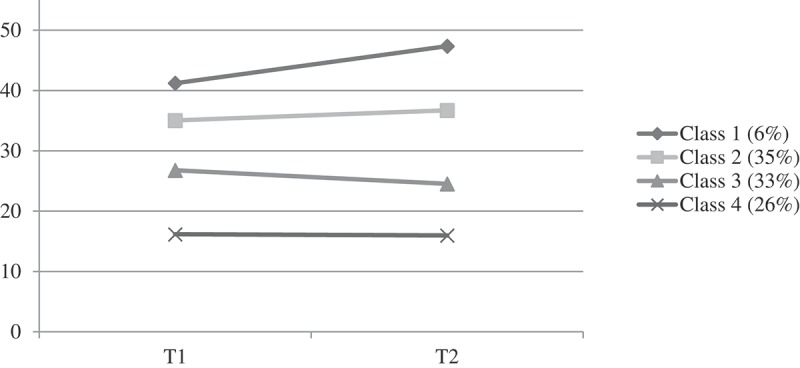
Background: Little is known about the development of Prolonged Grief Disorder (PGD) symptoms over time in adults. For clinical purposes, it would be useful to have knowledge about early indicators of a problematic grief trajectory. Objective: This study aimed to identify classes of bereaved individuals with similar trajectories of PGD symptoms and to design a provisional screening tool including symptoms predicting membership of classes with problematic grief trajectories. Method: In a Dutch sample of 166 bereaved individuals, we conducted a latent class analysis to identify classes of bereaved individuals with similar trajectories of PGD symptoms between two time points (mean of 6 and 18 months post-loss, respectively). Next, we used Receiver Operating Characteristic (ROC) analyses to examine which symptoms at baseline best predicted membership of classes with problematic grief trajectories. Results: We found four different classes: a class including individuals with persistent high PGD symptoms (class 1, 6%), a class of individuals with persistent moderate PGD symptoms (class 2, 35%), a class of individuals with slightly decreasing moderate PGD symptoms (class 3, 33%) and a class of individuals with persistent low PGD symptoms (class 4, 26%). The endorsement of symptoms 'yearning', 'stunned', 'life is empty' and 'bitterness' as present 'often' during the preceding month at baseline best-predicted membership of class 1 or 2. Conclusions: Two classes of individuals with problematic grief trajectories were identified. Four symptoms were found which could act as early indicators of these two classes in a provisional screening tool.
Contexto: Se sabe poco sobre el desarrollo en adultos de síntomas a lo largo del tiempo del llamado Trastorno de Duelo Prolongado (TDP). Por propósitos clínicos, es de utilidad tener conocimiento de indicadores precoces de una trayectoria de duelo problemática. Objetivo: Este estudio pretende identificar clases de individuos en duelo con trayectorias similares y diseñar un instrumento de discriminación provisional que incluya síntomas que predigan quiénes formaran parte de grupos con trayectorias de duelo problemáticas. Método: En una muestra holandesa de 166 personas en duelo, condujimos un análisis de clases latente cara a identificar grupos de individuos en duelo con similares trayectorias y síntomas de TDP entre dos momentos diferentes (una media de 6 y 18 meses post pérdida, respectivamente). A continuación, aplicamos análisis de características operativas de receptor (ROC) para examinar qué síntomas basales predicen mejor formar parte de un grupo con trayectorias de duelo problemáticas. Resultados: Encontramos 4 grupos diferentes: uno que incluye individuos con niveles altos y persistentes de síntomas de TDP (clase, 1.6%). Otro con síntomas persistentes moderados de TDP (clase, 2.35%), otro grupo con síntomas de TDP disminuyendo poco a poco (clase, 3.33%) y, finalmente, otro grupo con síntomas leves persistentes de TDP (clase, 4.26%). La presencia de síntomas como ‘añoranza’, ‘anonadamiento’, ‘la vida se ha vaciado de sentido’ y ‘amargura’ con presencia ‘frecuente’ durante el mes previo al momento basal, resultó ser el mejor predictor de pertenencia a las dos primeras clases más graves. Conclusiones: Se identificaron dos grupos de personas con trayectorias de duelo complicadas. Se encontraron, con un instrumento de discriminación provisional, cuatro síntomas que pueden ser considerados como indicadores precoces de estos dos grupos.
背景:关于成人延长哀伤障碍(PGD)症状随时发展的发现较少。出于临床目的,了解问题哀伤轨迹的早期指标是有用的。 目标:本研究旨在识别具有相似 PGD 症状轨迹的丧亲者的不同类别,并设计一个临时筛选工具,包含了可以预测问题哀伤轨迹类别的症状。 方法:在166名荷兰籍的丧亲者样本中,我们进行了一个潜在类别分析来识别具有相似 PGD 症状轨迹的丧亲者的类别。两次测量时间点分别在丧亲后平均6个月和18个月。然后我们使用接受者特征分析(ROC)考察哪一个基线症状可以最好地预测问题哀伤轨迹的类别。 结果:我们发现四个不同的类别:一类包括了持续的高 PGD 症状(类别1,6%),一类包括了持续中等 PGD 症状(类别2,35%),一类包括了稍微减轻的中等 PGD 症状(类别3,33%),一类包括了持续的低 PGD 症状(类别4,26%)。在基线前一月中‘经常’出现‘怀念’‘震惊’‘生活空虚’和‘感到苦涩’症状可以最优预测类别1或者2。 结论:识别了两个问题哀伤轨迹类别。发现4个症状可以作为临时筛查工具中识别这两个类别的早期指标。.
Keywords: PGD; Prolonged Grief Disorder; bereaved individual; grief; indicators; loss; screening tool; trajectory; • We found two classes with a problematic grief trajectory in adults over the first two years after a loss.• The endorsement of symptoms ‘yearning’, ‘stunned’, ‘life is empty’ and ‘bitterness’ as present ‘often’ could act as early indicators of a problematic grief trajectory..
Conflict of interest statement
No potential conflict of interest was reported by the authors.
Figures
References
-
- American Psychiatric Association (2013). Diagnostic and statistical manual of mental disorders (5th ed.). Arlington, VA: American Psychiatric Publishing.
-
- Cantor S. B., & Kattan M. W. (2000). Determining the area under the ROC curve for a binary diagnostic test. Medical Decision Making, 20(4), 468–6. - PubMed
-
- Christ G. H., Siegel K., & Christ A. E. (2002). Adolescent grief: It never really hit me… until it actually happened. JAMA, 288(10), 1269–1278. - PubMed
-
- Djelantik A. A. A. M. J., Smid G. E., Kleber R. J., & Boelen P. A. (2017). Symptoms of prolonged grief, post-traumatic stress, and depression after loss in a Dutch community sample: A latent class analysis. Psychiatry Research, 247, 276–281. - PubMed
LinkOut - more resources
Full Text Sources
Other Literature Sources
Miscellaneous
