


A randomised feasibility study to investigate the impact of education and the addition of prompts on the sedentary behaviour of office workers
- PMID: 29372071
- PMCID: PMC5769488
- DOI: 10.1186/s40814-017-0226-8
A randomised feasibility study to investigate the impact of education and the addition of prompts on the sedentary behaviour of office workers
Abstract
Background: Office workers have been identified as being at risk of accumulating high amounts of sedentary time in prolonged events during work hours, which has been associated with increased risk of a number of long-term health conditions.There is some evidence that providing advice to stand at regular intervals during the working day, and using computer-based prompts, can reduce sedentary behaviour in office workers. However, evidence of effectiveness, feasibility and acceptability for these types of intervention is currently limited.
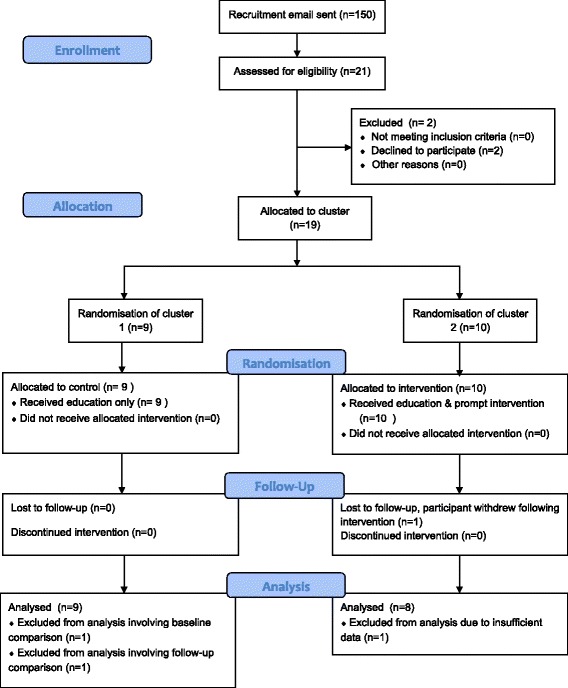
Methods: A 2-arm, parallel group, cluster-randomised feasibility trial to assess the acceptability of prompts to break up sedentary behaviour was conducted with office workers in a commercial bank (n = 21). Participants were assigned to an education only group (EG) or prompt and education group (PG). Both groups received education on reducing and breaking up sitting at work, and the PG also received hourly prompts, delivered by Microsoft Outlook over 10 weeks, reminding them to stand. Objective measurements of sedentary behaviour were made using activPAL monitors worn at three time points: baseline, in the last 2 weeks of the intervention period and 12 weeks after the intervention. Focus groups were conducted to explore the acceptability of the intervention and the motivations and barriers to changing sedentary behaviour.
Results: Randomly generated, customised prompts, delivered by Microsoft Outlook, with messages about breaking up sitting, proved to be a feasible and acceptable way of delivering prompts to office workers. Participants in both groups reduced their sitting, but changes were not maintained at follow-up. The education session seemed to increase outcome expectations of the benefits of changing sedentary behaviour and promote self-regulation of behaviour in some participants. However, low self-efficacy and a desire to conform to cultural norms were barriers to changing behaviour.
Conclusions: Prompts delivered by Microsoft Outlook were a feasible, low-cost way of prompting office workers to break up their sedentary behaviour, although further research is needed to determine whether this has an additional impact on sedentary behaviour, to education alone. The role of cultural norms, and promoting self-efficacy, should be considered in the design of future interventions.
Trial registration: This study was registered retrospectively as a clinical trial on ClinicalTrials.gov (ID no. NCT02609282) on 23 March 2015.
Keywords: Office; Prompts; Sedentary behaviour; Social cognitive theory; Workplace.
Conflict of interest statement
Ethical approval was granted by Glasgow Caledonian University School of Health & Life Sciences Ethics Committee (reference HLS/Psy/A14/083). All participants signed consent to participate and for their anonymised data to be used in publication.Not applicable.The authors declare that they have no competing interests.Springer Nature remains neutral with regard to jurisdictional claims in published maps and institutional affiliations.
Figures
References
Associated data
LinkOut - more resources
Full Text Sources
Other Literature Sources
Medical
