Toward biomass-derived renewable plastics: Production of 2,5-furandicarboxylic acid from fructose
- PMID: 29372184
- PMCID: PMC5775026
- DOI: 10.1126/sciadv.aap9722
Toward biomass-derived renewable plastics: Production of 2,5-furandicarboxylic acid from fructose
Abstract
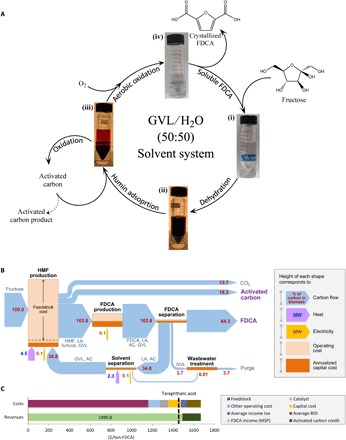
We report a process for converting fructose, at a high concentration (15 weight %), to 2,5-furandicarboxylic acid (FDCA), a monomer used in the production of polyethylene furanoate, a renewable plastic. In our process, fructose is dehydrated to hydroxymethylfurfural (HMF) at high yields (70%) using a γ-valerolactone (GVL)/H2O solvent system. HMF is subsequently oxidized to FDCA over a Pt/C catalyst with 93% yield. The advantage of our system is the higher solubility of FDCA in GVL/H2O, which allows oxidation at high concentrations using a heterogeneous catalyst that eliminates the need for a homogeneous base. In addition, FDCA can be separated from the GVL/H2O solvent system by crystallization to obtain >99% pure FDCA. Our process eliminates the use of corrosive acids, because FDCA is an effective catalyst for fructose dehydration, leading to improved economic and environmental impact of the process. Our techno-economic model indicates that the overall process is economically competitive with current terephthalic acid processes.
Figures

References
-
- D. L. Klass, Biomass for Renewable Energy, Fuels, and Chemicals (Academic Press, 1998).
-
- T. R. Boussie, E. L. Dias, Z. M. Fresco, V. J. Murphy, “Production of adipic acid and derivatives from carbohydrate-containing materials,” U.S. Patent 8,501,989 (2013).
-
- Knoop R. J. I., Vogelzang W., van Haveren J., van Es D. S., High molecular weight poly(ethylene-2,5-furanoate); critical aspects in synthesis and mechanical property determination. J. Polym. Sci. A Polym. Chem. 51, 4191–4199 (2013).
-
- Burgess S. K., Leisen J. E., Kraftschik B. E., Mubarak C. R., Kriegel R. M., Koros W. J., Chain mobility, thermal, and mechanical properties of poly(ethylene furanoate) compared to poly(ethylene terephthalate). Macromolecules 47, 1383–1391 (2014).
-
- Burgess S. K., Karvan O., Johnson J. R., Kriegel R. M., Koros W. J., Oxygen sorption and transport in amorphous poly(ethylene furanoate). Polymer 55, 4748–4756 (2014).
Publication types
LinkOut - more resources
Full Text Sources
Other Literature Sources