


The Role of Preterm Birth in the Association Between Opioid Maintenance Therapy and Neonatal Abstinence Syndrome
- PMID: 29372750
- PMCID: PMC5902412
- DOI: 10.1111/ppe.12443
The Role of Preterm Birth in the Association Between Opioid Maintenance Therapy and Neonatal Abstinence Syndrome
Abstract
Background: Pregnant women treated with methadone as opioid maintenance therapy are more likely than women treated with buprenorphine to deliver preterm. Preterm birth is associated with less risk of neonatal abstinence syndrome (NAS). We sought to assess the role of preterm birth as a mediator of the relationship between in utero exposure to methadone and NAS compared with buprenorphine.
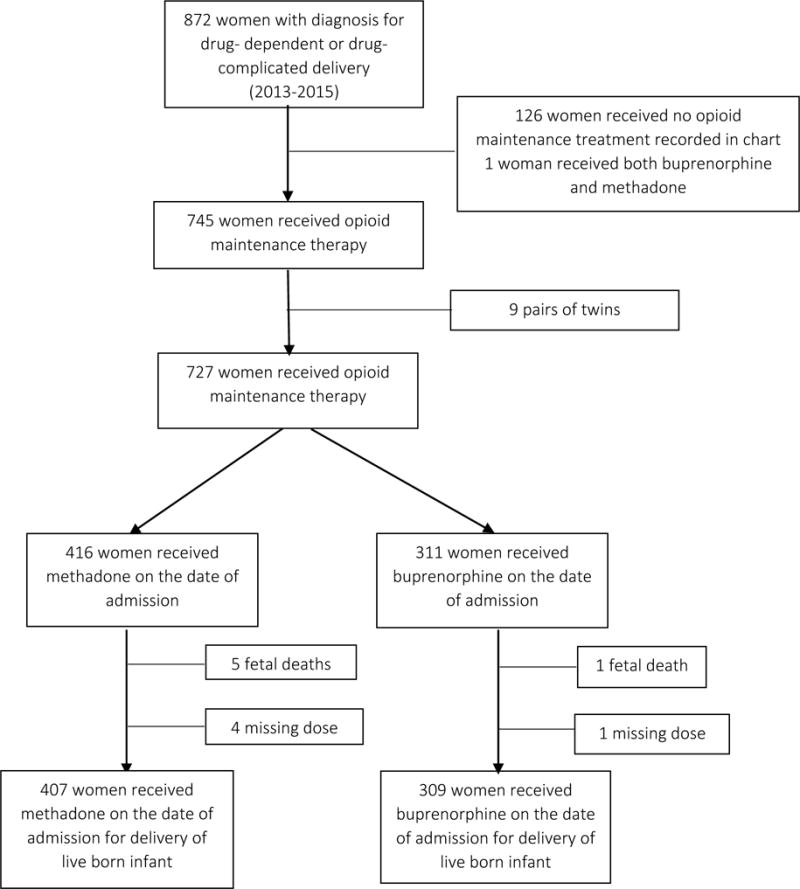
Methods: We studied 716 women receiving methadone or buprenorphine and delivering liveborn infants at Magee-Womens Hospital, Pittsburgh, Pennsylvania (2013-15). We implemented inverse probability weighted marginal structural models to isolate the role of preterm birth (<37 weeks' gestation). Weights accounted for confounding by maternal age, race, insurance, parity, delivery year, marital, employment, hepatitis C, and smoking status.
Results: Approximately 57% of the cohort were treated with methadone. Preterm birth was more common in methadone-exposed pregnancies (25% versus 14%). The incidence of NAS treatment was higher in methadone compared with buprenorphine-exposed infants (65% vs 49%), and term compared with preterm births (64% vs 36%). For every 100 infants liveborn to mothers treated for opioid dependence, there were 13 excess cases of NAS among infants exposed to methadone compared with buprenorphine (adjusted risk difference [RD] 13.3, 95% confidence interval [CI] 5.7, 20.9). Among term births, this increased to 17 excess cases of NAS in methadone- compared with buprenorphine-exposed (RD 16.7, 95% CI 9.3, 24.0).
Conclusion: The further increased risk of NAS associated with methadone use vs buprenorphine in term deliveries emphasises the utility of buprenorphine in clinical settings aimed at decreasing NAS.
Keywords: buprenorphine; mediation analysis; methadone; neonatal abstinence syndrome; preterm birth.
© 2018 John Wiley & Sons Ltd.
Figures
Comment in
-
Causal Analysis in Evaluating Complex Health Interventions: Identifying the Optimal Treatment for Opioid Abuse in Pregnancy.Paediatr Perinat Epidemiol. 2018 Mar;32(2):223-224. doi: 10.1111/ppe.12464. Epub 2018 Mar 23. Paediatr Perinat Epidemiol. 2018. PMID: 29572908 No abstract available.
References
-
- Patrick SW, Schumacher RE, Benneyworth BD, Krans EE, McAllister JM, Davis MM. Neonatal abstinence syndrome and associated health care expenditures: United States, 2000-2009. Journal of the American Medical Association. 2012;307(18):1934–40. - PubMed
-
- Maguire DJ, Taylor S, Armstrong K, Shaffer-Hudkins E, Germain AM, Brooks SS, et al. Long-term outcomes of infants with neonatal abstinence syndrome. Neonatal Network. 2016;35(5):277–86. - PubMed
-
- Maeda A, Bateman BT, Clancy CR, Creanga AA, Leffert LR. Opioid abuse and dependence during pregnancy: temporal trends and obstetrical outcomes. Anesthesiology. 2014;121(6):1158–65. - PubMed
-
- ACOG Committee Opinion No. 524: Opioid abuse, dependence, and addiction in pregnancy. Obstetrics and Gynecology. 2012;119(5):1070–6. - PubMed
Publication types
MeSH terms
Substances
Grants and funding
LinkOut - more resources
Full Text Sources
Other Literature Sources
Miscellaneous
