


Hospitalizations due to unintentional transport injuries among Aboriginal population of British Columbia, Canada: Incidence, changes over time and ecological analysis of risk markers
- PMID: 29373595
- PMCID: PMC5786298
- DOI: 10.1371/journal.pone.0191384
Hospitalizations due to unintentional transport injuries among Aboriginal population of British Columbia, Canada: Incidence, changes over time and ecological analysis of risk markers
Erratum in
-
Correction: Hospitalizations due to unintentional transport injuries among Aboriginal population of British Columbia, Canada: Incidence, changes over time and ecological analysis of risk markers.PLoS One. 2018 Feb 15;13(2):e0193218. doi: 10.1371/journal.pone.0193218. eCollection 2018. PLoS One. 2018. PMID: 29447270 Free PMC article.
Abstract
Background: Worldwide, Indigenous people have disproportionately higher rates of transport injuries. We examined disparities in injury-related hospitalizations resulting from transport incidents for three population groups in British Columbia (BC): total population, Aboriginal off-reserve, and Aboriginal on-reserve populations. We also examined sociodemographic, geographic and ethnic risk markers for disparities.
Methods: We identified Aboriginal people through BC's universal health care insurance plan insurance premium group and birth and death record notations. We calculated crude incidence rate and Standardized Relative Risk (SRR) of hospitalization for unintentional transport injury, standardized for age, gender and Health Service Delivery Area (HSDA), relative to the total population of BC. We tested hypothesized associations of geographic, socio-economic, and employment-related characteristics of Aboriginal communities with SRR of transport injury by multivariable linear regression.
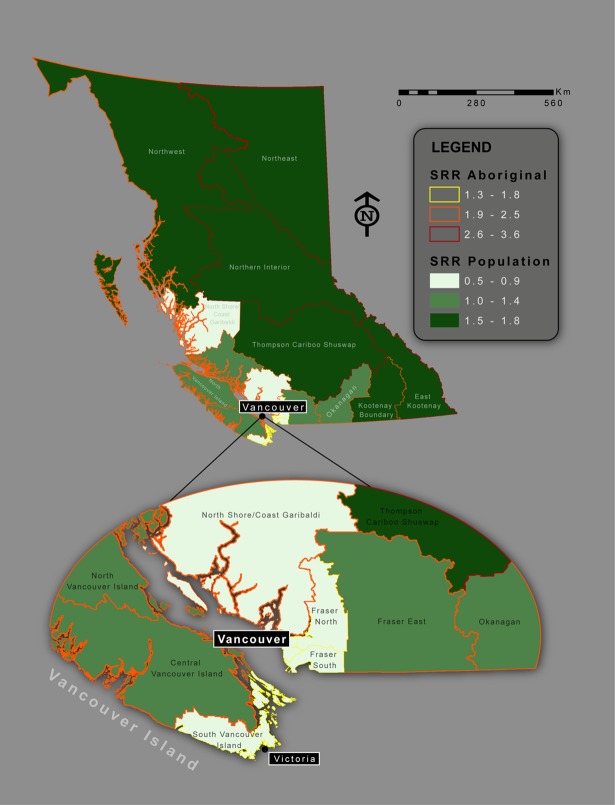
Results: During the period 1991-2010, the SRR for the off-reserve Aboriginal population was 1.77 (95% CI: 1.71 to 1.83); and 2.00 (95% CI: 1.93 to 2.07) among those living on-reserve. Decline in crude rate and SRRs was observed over this period among both the Aboriginal and total populations of BC, but was proportionally greater among the Aboriginal population. The best-fitting multivariable risk marker model was an excellent fit (R2 = 0.912, p<0.001), predicted SRRs very close to observed values, and retained the following terms: urban residence, population per room, proportion of the population with a high school certificate, proportion of the population employed; and multiplicative interactions of Aboriginal ethnicity with population per room and proportion of the population employed.
Conclusions: Disparities in risk of hospitalization due to unintentional transport injury have narrowed. Aboriginal ethnicity modifies the effects of socioeconomic risk factors. Continued improvement of socioeconomic conditions and implementation of culturally relevant injury prevention interventions are needed.
Conflict of interest statement
Figures
References
-
- World Health Organization. Global status report on road safety 2015. Geneva, Switzerland: World Health Organization; 2015.
-
- Parachute. The cost of injury in Canada. Toronto, ON; 2015.
-
- Rajabali F, Ibrahimova A, Barnett B, Pike I. Economic burden of injury in British Columbia. Vancouver, B.C.; 2015.
-
- Pan SW, Hsu C-T, Brussoni M, Pike I. Indigenous ethnicity as a social determinant of exposure to riskier modes of transport: A survey study in Taiwan. J Transp Heal. 2015;2: 595–601. doi: 10.1016/j.jth.2015.09.003 - DOI
-
- Clapham K, Senserrick T, Ivers R, Lyford M, Stevenson M. Understanding the extent and impact of Indigenous road trauma. Injury. 2008;39 Suppl 5: S19–23. doi: 10.1016/S0020-1383(08)70025-1 - DOI - PubMed
Publication types
MeSH terms
LinkOut - more resources
Full Text Sources
Other Literature Sources
