


Global Trends in CD4 Cell Count at the Start of Antiretroviral Therapy: Collaborative Study of Treatment Programs
- PMID: 29373672
- PMCID: PMC5848308
- DOI: 10.1093/cid/cix915
Global Trends in CD4 Cell Count at the Start of Antiretroviral Therapy: Collaborative Study of Treatment Programs
Abstract
Background: Early initiation of combination antiretroviral therapy (cART), at higher CD4 cell counts, prevents disease progression and reduces sexual transmission of human immunodeficiency virus (HIV). We describe the temporal trends in CD4 cell counts at the start of cART in adults from low-income, lower-middle-income, upper-middle-income, and high-income countries (LICs, LMICs, UMICs, and HICs, respectively).
Methods: We included HIV-infected individuals aged ≥16 years who started cART between 2002 and 2015 in a clinic participating in the International epidemiology Databases to Evaluate AIDS (IeDEA) or the Collaboration of Observational HIV Epidemiological Research in Europe (COHERE). Missing CD4 cell counts at the start of cART were estimated through multiple imputation. Weighted mixed-effect models were used to smooth trends in median CD4 cell counts.
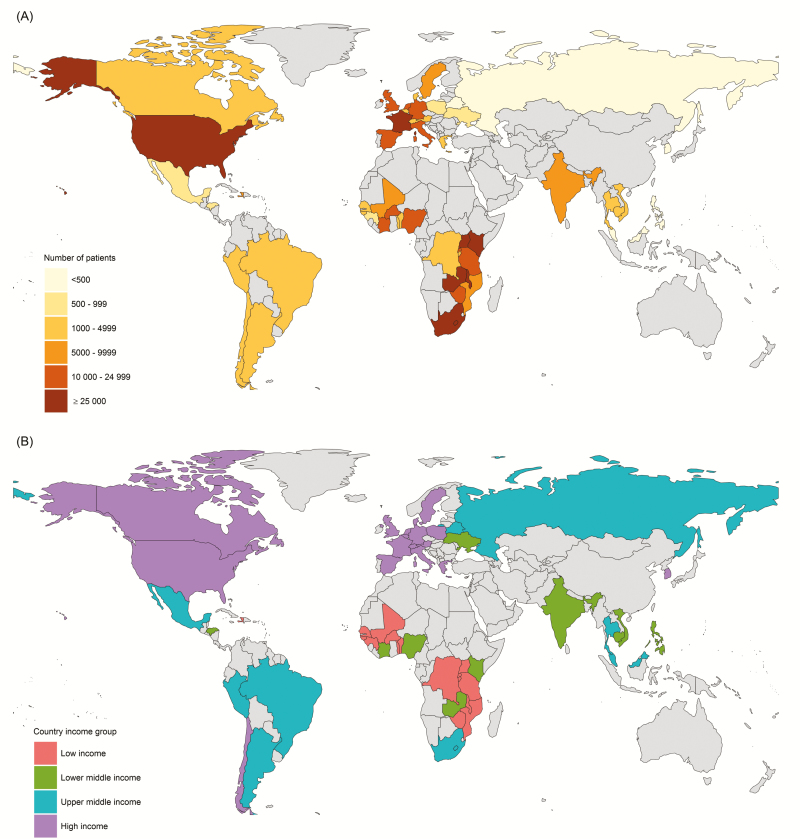
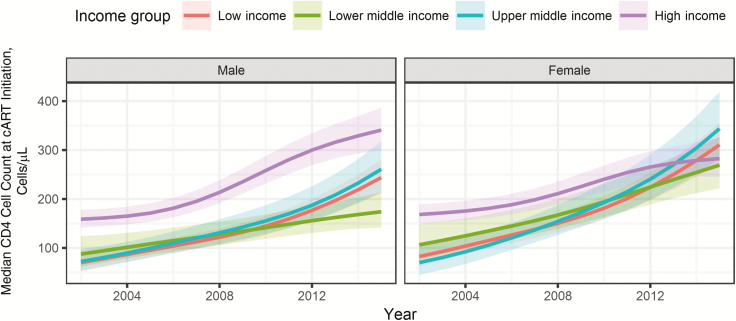
Results: A total of 951855 adults from 16 LICs, 11 LMICs, 9 UMICs, and 19 HICs were included. Overall, the modeled median CD4 cell count at the start of cART increased from 2002 to 2015, from 78/µL (95% confidence interval, 58-104/µL) to 287/µL (250-328/µL) in LICs, from 99/µL (71-140/µL) to 234/µL (192-285/µL) in LMICs, from 71/µL (49-104/µL) to 311/µL (255-379/µL) in UMICs, and from 161/µL (143-181/µL) to 327/µL (286-372/µL) in HICs. In LICs, LMICs, and UMICs, the increase was more pronounced in women; in HICs, the opposite was observed.
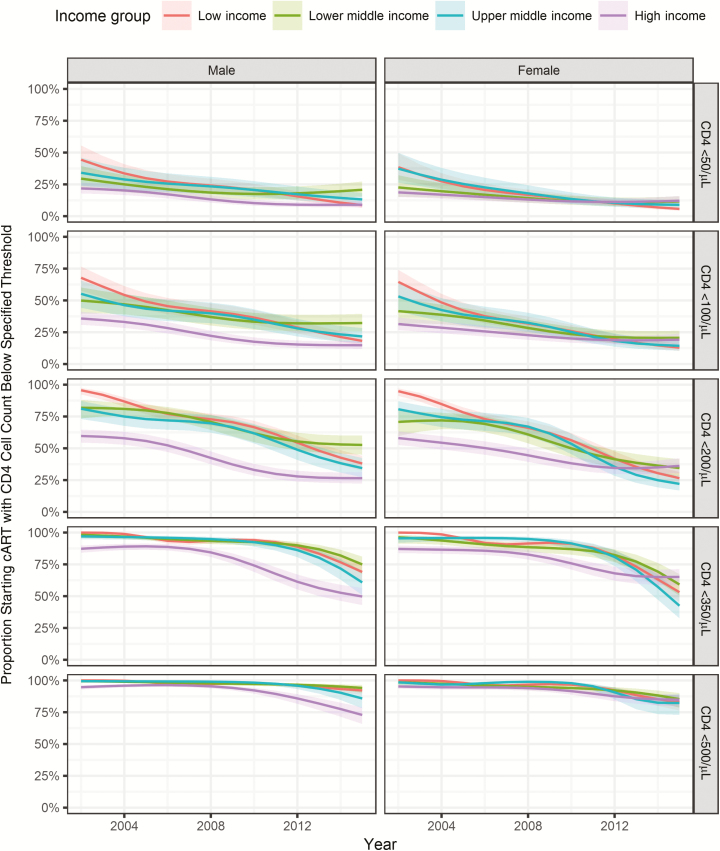
Conclusions: Median CD4 cell counts at the start of cART increased in all income groups, but generally remained below 350/μL in 2015. Substantial additional efforts and resources are required to achieve earlier diagnosis, linkage to care, and initiation of cART.
The Author(s) 2018. Published by Oxford University Press for the Infectious Diseases Society of America.
Figures
References
-
- Joint United Nations Programme on HIV/AIDS (UNAIDS). “15 by 15”—A global target achieved 2015. Available at: http://www.unaids.org/en/resources/documents/2015/15_by_15_a_global_targ.... Accessed 1 May 2016. - PubMed
-
- Joint United Nations Programme on HIV/AIDS (UNAIDS). 90-90-90: An ambitious treatment target to help end the AIDS epidemic 2014. Available at: http://www.unaids.org/sites/default/files/media_asset/90-90-90_en_0.pdf. Accessed 5 April 2015. - PubMed
-
- World Health Organization. Consolidated guidelines on the use of antiretroviral drugs for treating and preventing HIV infection: recommendations for a public health approach. 2nd ed 2016. Geneva, Switzerland: World Health Organization, 2016. - PubMed
Publication types
MeSH terms
Substances
Grants and funding
- U01 AI035039/AI/NIAID NIH HHS/United States
- HCP-97105/CIHR/Canada
- U01 AI031834/AI/NIAID NIH HHS/United States
- U01 AI103397/AI/NIAID NIH HHS/United States
- KL2 TR000421/TR/NCATS NIH HHS/United States
- U01 AI037984/AI/NIAID NIH HHS/United States
- R01 DA012568/DA/NIDA NIH HHS/United States
- U01 AA020790/AA/NIAAA NIH HHS/United States
- MC_UU_12023/17/MRC_/Medical Research Council/United Kingdom
- R01 CA165937/CA/NCI NIH HHS/United States
- U01 AI037613/AI/NIAID NIH HHS/United States
- MR/M004236/1/MRC_/Medical Research Council/United Kingdom
- U01 AI068636/AI/NIAID NIH HHS/United States
- U01 AI035040/AI/NIAID NIH HHS/United States
- F31 DA037788/DA/NIDA NIH HHS/United States
- Z01 CP010176/CP/NCI NIH HHS/United States
- U10 EY008057/EY/NEI NIH HHS/United States
- TGF-96118/CIHR/Canada
- U01 AI096299/AI/NIAID NIH HHS/United States
- U01 AI035041/AI/NIAID NIH HHS/United States
- U01 AI103390/AI/NIAID NIH HHS/United States
- U01 AI038855/AI/NIAID NIH HHS/United States
- P30 AI050410/AI/NIAID NIH HHS/United States
- U01 AI069432/AI/NIAID NIH HHS/United States
- R01 AG053100/AG/NIA NIH HHS/United States
- U24 AA020794/AA/NIAAA NIH HHS/United States
- G12 MD007583/MD/NIMHD NIH HHS/United States
- U10 EY008052/EY/NEI NIH HHS/United States
- U01 HD032632/HD/NICHD NIH HHS/United States
- CBR-94036/CIHR/Canada
- U01 DA036935/DA/NIDA NIH HHS/United States
- U01 AA013566/AA/NIAAA NIH HHS/United States
- K24 DA000432/DA/NIDA NIH HHS/United States
- MC_UU_12023/26/MRC_/Medical Research Council/United Kingdom
- U10 EY008067/EY/NEI NIH HHS/United States
- K01 AI093197/AI/NIAID NIH HHS/United States
- U54 MD007587/MD/NIMHD NIH HHS/United States
- P30 AI027767/AI/NIAID NIH HHS/United States
- U01 AI069923/AI/NIAID NIH HHS/United States
- U01 AI103401/AI/NIAID NIH HHS/United States
- U01 AI038858/AI/NIAID NIH HHS/United States
- R01 DA011602/DA/NIDA NIH HHS/United States
- U01 AI035042/AI/NIAID NIH HHS/United States
- K24 AI065298/AI/NIAID NIH HHS/United States
- P30 AI027757/AI/NIAID NIH HHS/United States
- U01 AI103408/AI/NIAID NIH HHS/United States
- K24 AI118591/AI/NIAID NIH HHS/United States
- P30 AI110527/AI/NIAID NIH HHS/United States
- U01 DA036297/DA/NIDA NIH HHS/United States
- U01 AI034989/AI/NIAID NIH HHS/United States
- UL1 TR000454/TR/NCATS NIH HHS/United States
- U01 AI034993/AI/NIAID NIH HHS/United States
- U01 AI069434/AI/NIAID NIH HHS/United States
- U01 AI068634/AI/NIAID NIH HHS/United States
- U01 AI069911/AI/NIAID NIH HHS/United States
- UL1 TR000083/TR/NCATS NIH HHS/United States
- P30 AI027763/AI/NIAID NIH HHS/United States
- R01 AA016893/AA/NIAAA NIH HHS/United States
- M01 RR000052/RR/NCRR NIH HHS/United States
- U01 AI069919/AI/NIAID NIH HHS/United States
- U01 AI042590/AI/NIAID NIH HHS/United States
- U01 AI069918/AI/NIAID NIH HHS/United States
- UL1 TR002378/TR/NCATS NIH HHS/United States
- CBR-86906/CIHR/Canada
- U01 AI069907/AI/NIAID NIH HHS/United States
- UL1 RR024131/RR/NCRR NIH HHS/United States
- U01 AI034994/AI/NIAID NIH HHS/United States
- UM1 AI035043/AI/NIAID NIH HHS/United States
- K23 EY013707/EY/NEI NIH HHS/United States
- P30 AI094189/AI/NIAID NIH HHS/United States
- UL1 TR000004/TR/NCATS NIH HHS/United States
- U01 AI035004/AI/NIAID NIH HHS/United States
- U01 AI069924/AI/NIAID NIH HHS/United States
- P30 AI036219/AI/NIAID NIH HHS/United States
- R24 AI067039/AI/NIAID NIH HHS/United States
LinkOut - more resources
Full Text Sources
Other Literature Sources
Medical
Research Materials
