


Trajectories of Acute Diabetes-Specific Stress in Adolescents With Type 1 Diabetes and Their Caregivers Within the First Year of Diagnosis
- PMID: 29373703
- PMCID: PMC6005102
- DOI: 10.1093/jpepsy/jsy003
Trajectories of Acute Diabetes-Specific Stress in Adolescents With Type 1 Diabetes and Their Caregivers Within the First Year of Diagnosis
Abstract
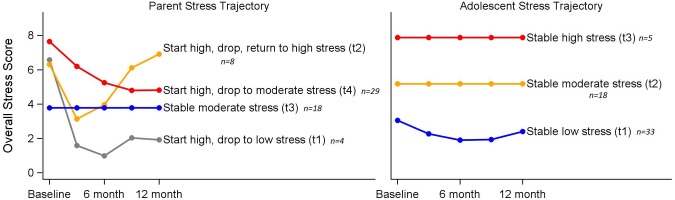
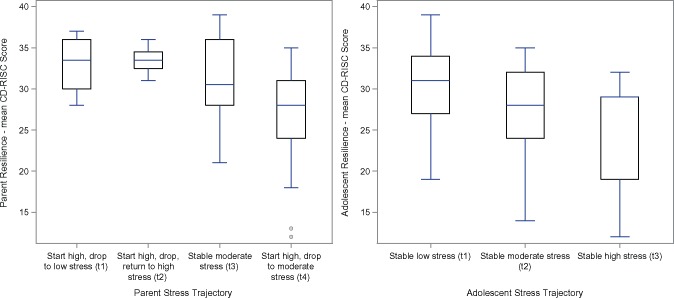
Objectives: Our aims were to describe stress trajectories for newly diagnosed type 1 diabetes (T1D) in adolescents and their parents, explore whether resilience is associated with stress trajectories, and to examine the effects of stress trajectories on diabetes-specific outcomes.
Methods: Fifty-nine youth aged 10-18 years with newly diagnosed T1D and a primary caregiver were followed for 12 months. Stress and resilience were assessed using questionnaires every 3 months, and diabetes-specific outcomes (self-care, quality of life, and hemoglobin A1C) at 6 and 12 months. Parent and adolescent stress trajectories were identified using semiparametric group-based modeling.
Results: Four stress trajectories emerged for parents and three emerged for adolescents. Adolescent trajectories were stable throughout the 12 months, and those with stable low stress had the highest levels of resilience. Further, the stable low stress group had higher quality of life scores at 12-month postdiagnosis. In contrast, stress for parents changed considerably over the 12-month period, and trajectory groups did not associate with 12-month outcomes.
Conclusions: Distinct patterns of stress emerged for both the adolescent and parent cohorts. Resilience at the time of diagnosis was particularly protective for adolescents. These results suggest that stress-reducing and resilience-promoting interventions for newly diagnosed adolescents with T1D may have potential to improve longer-term outcomes.
Figures
References
-
- Basch E. (2017). Patient-reported outcomes—harnessing patients’ voices to improve clinical care. New England Journal of Medicine, 376, 105–108. - PubMed
-
- Bonanno G. A., Westphal M., Mancini A. D. (2011). Resilience to loss and potential trauma. Annual Review of Clinical Psychology, 7, 511–535. - PubMed
-
- Campbell-Sills L., Cohan S. L., Stein M. B. (2006). Relationship of resilience to personality, coping, and psychiatric symptoms in young adults. Behavior Research and Therapy, 44, 585–599.http://dx.doi.org/10.1016/j.brat.2005.05.001 - DOI - PubMed
-
- Campbell-Sills L., Stein M. B. (2007). Psychometric analysis and refinement of the Connor-Davidson Resilience Scale (CD-RISC): Validation of a 10-item measure of resilience. Journal of Traumatic Stress, 20, 1019–1028.http://dx.doi.org/10.1002/jts.20271 - DOI - PubMed
-
- Connor K. M., Davidson J. R. (2003). Development of a new resilience scale: The Connor-Davidson Resilience Scale (CD-RISC). Depression and Anxiety, 18, 76–82.http://dx.doi.org/10.1002/da.10113 - DOI - PubMed
Publication types
MeSH terms
Grants and funding
LinkOut - more resources
Full Text Sources
Other Literature Sources
Medical
