


The Sister Study Cohort: Baseline Methods and Participant Characteristics
- PMID: 29373861
- PMCID: PMC5963586
- DOI: 10.1289/EHP1923
The Sister Study Cohort: Baseline Methods and Participant Characteristics
Abstract
Background: The Sister Study was designed to address gaps in the study of environment and breast cancer by taking advantage of more frequent breast cancer diagnoses among women with a sister history of breast cancer and the presumed enrichment of shared environmental and genetic exposures.
Objective: The Sister Study sought a large cohort of women never diagnosed with breast cancer but who had a sister (full or half) diagnosed with breast cancer.
Methods: A multifaceted national effort employed novel strategies to recruit a diverse cohort, and collected biological and environmental samples and extensive data on potential breast cancer risk factors.
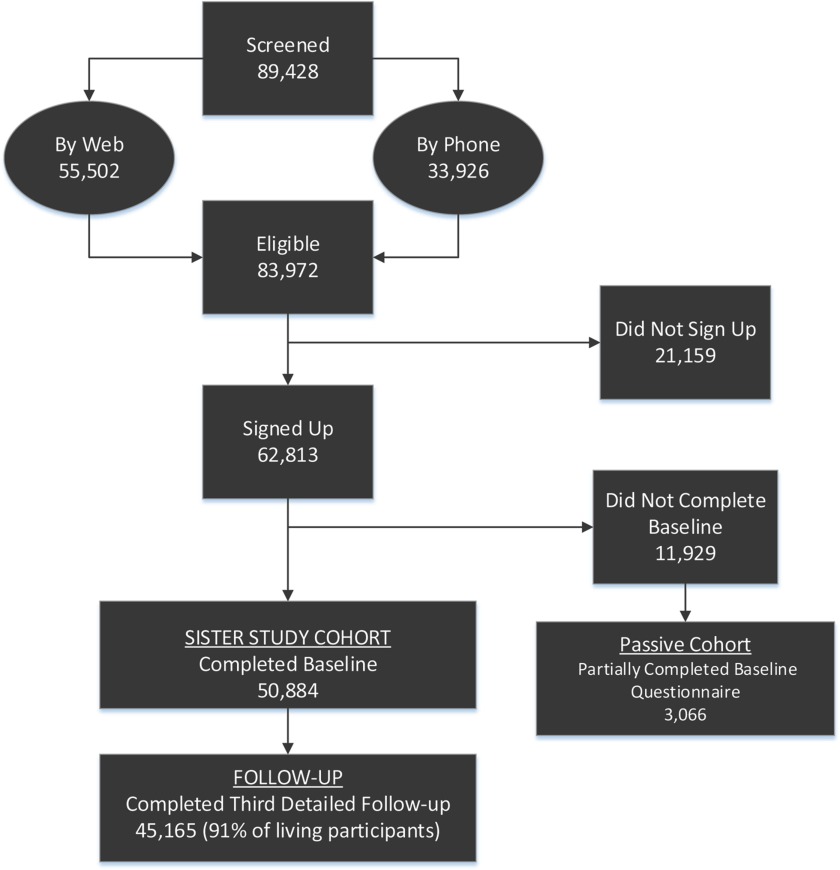
Results: The Sister Study enrolled 50,884 U.S. and Puerto Rican women 35-74y of age (median 56 y). Although the majority were non-Hispanic white, well educated, and economically well off, substantial numbers of harder-to-recruit women also enrolled (race/ethnicity other than non-Hispanic white: 16%; no college degree: 35%; household income <$50,000: 26%). Although all had a biologic sister with breast cancer, 16.5% had average or lower risk of breast cancer according to the Breast Cancer Risk Assessment Tool (Gail score). Most were postmenopausal (66%), parous with a first full-term pregnancy <30y of age (79%), never-smokers (56%) with body mass indexes (BMIs) of <29.9 kg/m2 (70%). Few (5%) reported any cancer prior to enrollment.
Conclusions: The Sister Study is a unique cohort designed to efficiently study environmental and genetic risk factors for breast cancer. Extensive exposure data over the life-course and baseline specimens provide important opportunities for studying breast cancer and other health outcomes in women. Collaborations are welcome. https://doi.org/10.1289/EHP1923.
Figures
References
-
- American Cancer Society. 2016. http://www.cancer.org/cancer/breastcancer/moreinformation/breastcancerea....
-
- Belanger CF, Hennekens CH, Rosner B, Speizer FE. 1978. The Nurses’ Health Study. Am J Nurs 78(6):1039–1040, PMID: 248266. - PubMed
-
- Bennett LM, Davis BJ. 2002. Identification of mammary carcinogens in rodent bioassays. Environ Mol Mutagen 39(2–3):150–157, PMID: 11921183. - PubMed
-
- CDC (Centers for Disease Control and Prevention). 1999. Achievements in Public Health, 1900-1999: Family Planning. MMWR Morb Mortal Wkly Rep 48(47):1073–1080. https://www.cdc.gov/MMWR/preview/mmwrhtml/mm4847a1.htm [accessed 16 November 2017].
Publication types
MeSH terms
Grants and funding
LinkOut - more resources
Full Text Sources
Other Literature Sources
Medical