


Beyond genomics: understanding exposotypes through metabolomics
- PMID: 29373992
- PMCID: PMC5787293
- DOI: 10.1186/s40246-018-0134-x
Beyond genomics: understanding exposotypes through metabolomics
Abstract
Background: Over the past 20 years, advances in genomic technology have enabled unparalleled access to the information contained within the human genome. However, the multiple genetic variants associated with various diseases typically account for only a small fraction of the disease risk. This may be due to the multifactorial nature of disease mechanisms, the strong impact of the environment, and the complexity of gene-environment interactions. Metabolomics is the quantification of small molecules produced by metabolic processes within a biological sample. Metabolomics datasets contain a wealth of information that reflect the disease state and are consequent to both genetic variation and environment. Thus, metabolomics is being widely adopted for epidemiologic research to identify disease risk traits. In this review, we discuss the evolution and challenges of metabolomics in epidemiologic research, particularly for assessing environmental exposures and providing insights into gene-environment interactions, and mechanism of biological impact.
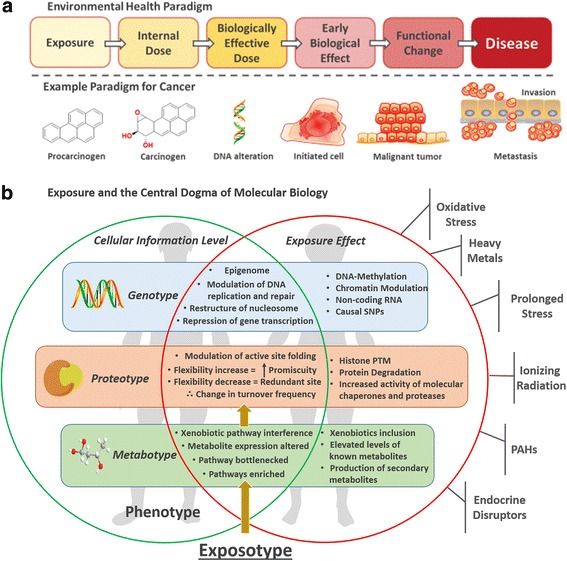
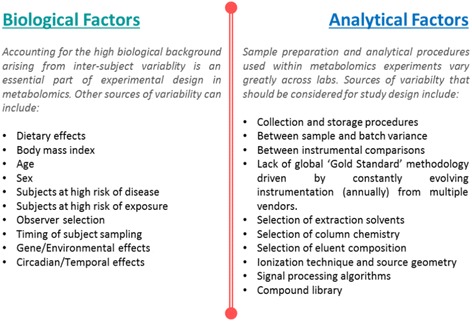
Main text: Metabolomics can be used to measure the complex global modulating effect that an exposure event has on an individual phenotype. Combining information derived from all levels of protein synthesis and subsequent enzymatic action on metabolite production can reveal the individual exposotype. We discuss some of the methodological and statistical challenges in dealing with this type of high-dimensional data, such as the impact of study design, analytical biases, and biological variance. We show examples of disease risk inference from metabolic traits using metabolome-wide association studies. We also evaluate how these studies may drive precision medicine approaches, and pharmacogenomics, which have up to now been inefficient. Finally, we discuss how to promote transparency and open science to improve reproducibility and credibility in metabolomics.
Conclusions: Comparison of exposotypes at the human population level may help understanding how environmental exposures affect biology at the systems level to determine cause, effect, and susceptibilities. Juxtaposition and integration of genomics and metabolomics information may offer additional insights. Clinical utility of this information for single individuals and populations has yet to be routinely demonstrated, but hopefully, recent advances to improve the robustness of large-scale metabolomics will facilitate clinical translation.
Keywords: Chemometrics; Exposome; Exposotype; Genetic epidemiology; Genomics; Metabolomics.
Conflict of interest statement
Ethics approval and consent to participate
Not applicable.
Consent for publication
Not applicable.
Competing interests
JDW receives research support through Yale University from the Laura and Arnold Foundation to support the Collaboration for Research Integrity and Transparency.
Publisher’s Note
Springer Nature remains neutral with regard to jurisdictional claims in published maps and institutional affiliations.
Figures
References
-
- Neel JV, Schull WJ. Human heredity. Chicago: Chicago Press; 1954.
-
- Beaty TH, Khoury MJ. Interface of genetics and epidemiology. EpidemiolRev. 2000;22:120–125. - PubMed
-
- National Human Genome Research Institute. All about the Human Genome Project (HGP). 2014. Available from: http://www.genome.gov/10001772. Accessed 17 Jan 2018.
Publication types
MeSH terms
Grants and funding
LinkOut - more resources
Full Text Sources
Other Literature Sources
Miscellaneous
