


Rethinking Antimicrobial Prophylaxis in the Transplant Patient in the World of Emerging Resistant Organisms-Where Are We Today?
- PMID: 29374371
- PMCID: PMC6005647
- DOI: 10.1007/s11899-018-0435-0
Rethinking Antimicrobial Prophylaxis in the Transplant Patient in the World of Emerging Resistant Organisms-Where Are We Today?
Abstract
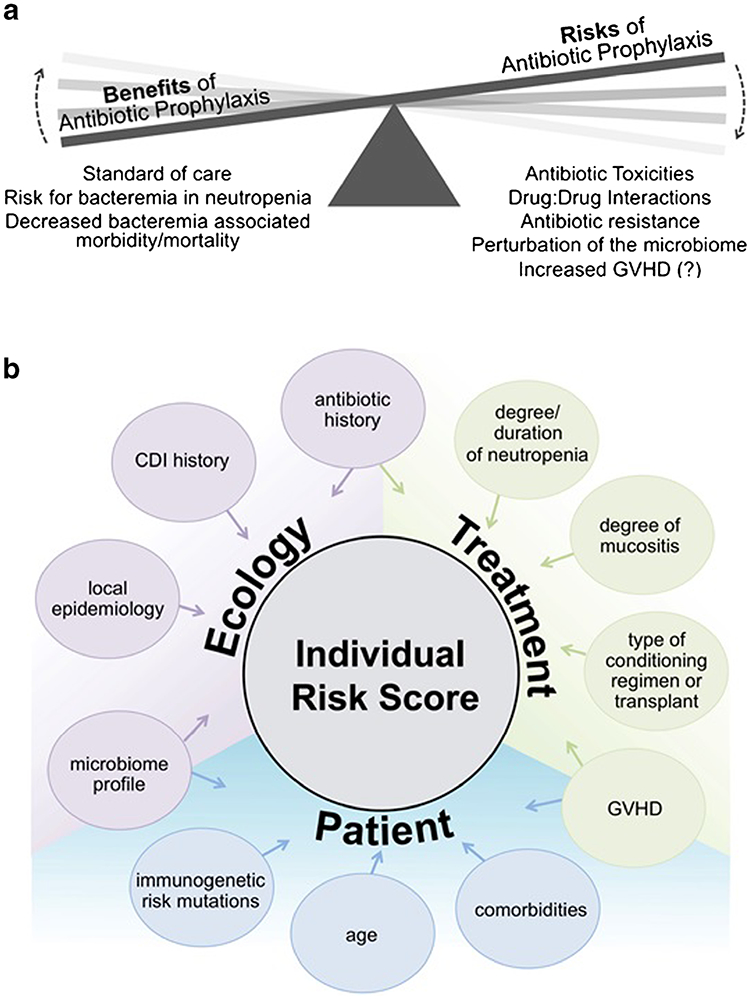
Purpose of review: The use of prophylactic antibiotics during the neutropenic period in hematopoietic stem cell transplantation has been the standard of care at most institutions for the past 20 years. We sought to review the benefits and risks of this practice.
Recent findings: Emerging data has highlighted the potential costs of antibacterial prophylaxis, from selecting for antibiotic resistance to perturbing the microbiome and contributing to increase risk for Clostridium difficile and perhaps graft-versus-host-disease, conditions which may lead to poorer outcomes. Though in many studies prophylactic antibiotics improved morbidity and mortality outcomes, the potential harms including antibiotic resistance, Clostridium difficile infection, and alterations of the gut microbiome should be considered. Future studies aimed to better risk-stratify patients and limit the use of broad-spectrum antibiotics are warranted.
Keywords: Antibiotic prophylaxis; Bone marrow transplant (BMT); Graft-versus-host-disease (GVHD), microbiome; Hematopoietic stem cell transplant (HSCT); Neutropenia.
Conflict of interest statement
Nina M. Haste reports that spouse (Brandon Taylor, PhD) is employed by Novartis.
Randy A. Taplitz is on the advisory board for Merck.
Figures
References
-
- Freifeld AG, Bow EJ, Sepkowitz KA, Boeckh MJ, Ito JI, Mullen CA, et al. Clinical practice guideline for the use of antimicrobial agents in neutropenic patients with cancer: 2010 update by the infectious diseases society of america. Clin Infect Dis. 2011;52(4):e56–93. 10.1093/cid/cir073. - DOI - PubMed
-
- Schimpff SC. Empiric antibiotic therapy for granulocytopenic cancer patients. Am J Med. 1986;80(5C):13–20. - PubMed
Publication types
MeSH terms
Substances
Grants and funding
LinkOut - more resources
Full Text Sources
Other Literature Sources
Medical
Research Materials
Miscellaneous
