


Guillain-Barré syndrome, transverse myelitis and infectious diseases
- PMID: 29375121
- PMCID: PMC6079071
- DOI: 10.1038/cmi.2017.142
Guillain-Barré syndrome, transverse myelitis and infectious diseases
Abstract
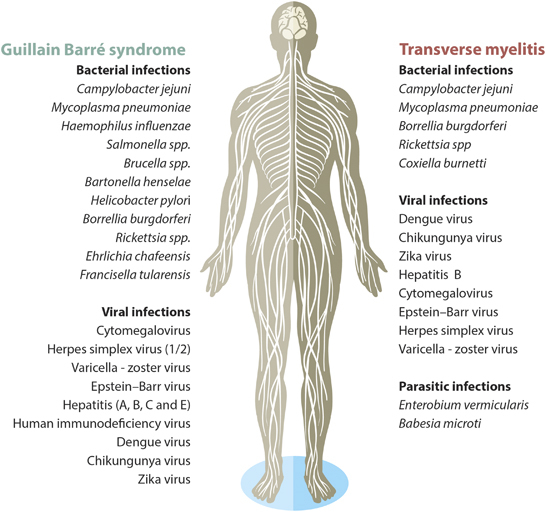
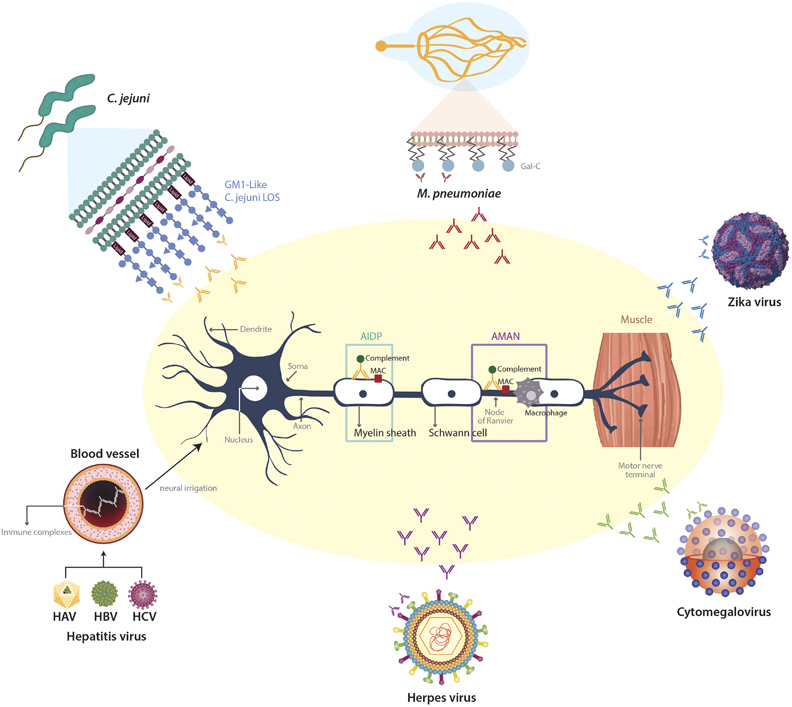
Guillain-Barré syndrome (GBS) and transverse myelitis (TM) both represent immunologically mediated polyneuropathies of major clinical importance. Both are thought to have a genetic predisposition, but as of yet no specific genetic risk loci have been clearly defined. Both are considered autoimmune, but again the etiologies remain enigmatic. Both may be induced via molecular mimicry, particularly from infectious agents and vaccines, but clearly host factor and co-founding host responses will modulate disease susceptibility and natural history. GBS is an acute inflammatory immune-mediated polyradiculoneuropathy characterized by tingling, progressive weakness, autonomic dysfunction, and pain. Immune injury specifically takes place at the myelin sheath and related Schwann-cell components in acute inflammatory demyelinating polyneuropathy, whereas in acute motor axonal neuropathy membranes on the nerve axon (the axolemma) are the primary target for immune-related injury. Outbreaks of GBS have been reported, most frequently related to Campylobacter jejuni infection, however, other agents such as Zika Virus have been strongly associated. Patients with GBS related to infections frequently produce antibodies against human peripheral nerve gangliosides. In contrast, TM is an inflammatory disorder characterized by acute or subacute motor, sensory, and autonomic spinal cord dysfunction. There is interruption of ascending and descending neuroanatomical pathways on the transverse plane of the spinal cord similar to GBS. It has been suggested to be triggered by infectious agents and molecular mimicry. In this review, we will focus on the putative role of infectious agents as triggering factors of GBS and TM.
Conflict of interest statement
The authors declare no conflict of interest.
Figures
References
-
- Wijdicks EF, Klein CJ. Guillain–Barré Syndrome. Mayo Clin Proc. 2017;92:467–479. - PubMed
-
- Anandan C, Khuder SA, Koffman BM. Prevalence of autonomic dysfunction in hospitalized patients with Guillain-Barré syndrome. Muscle Nerve. 2017;56:331–333. - PubMed
-
- Willison HJ, Jacobs BC, van Doorn PA. Guillain-Barré syndrome. Lancet. 2016;388:717–727. - PubMed
-
- Heikema AP, Islam Z, Horst-Kreft D, Huizinga R, Jacobs BC, Wagenaar JA, et al. Campylobacter jejuni capsular genotypes are related to Guillain-Barré syndrome. Clin Microbiol Infect. 2015;21:1–24. - PubMed
Publication types
MeSH terms
LinkOut - more resources
Full Text Sources
Other Literature Sources
Medical
