


Differences in safety training among smaller and larger construction firms with non-native workers: Evidence of overlapping vulnerabilities
- PMID: 29375194
- PMCID: PMC5784209
- DOI: 10.1016/j.ssci.2017.11.011
Differences in safety training among smaller and larger construction firms with non-native workers: Evidence of overlapping vulnerabilities
Abstract
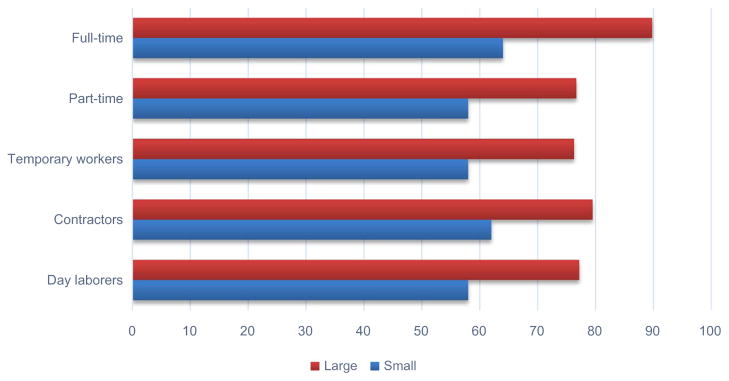
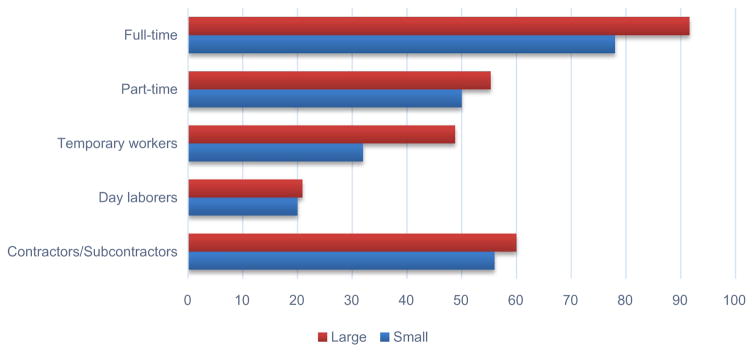
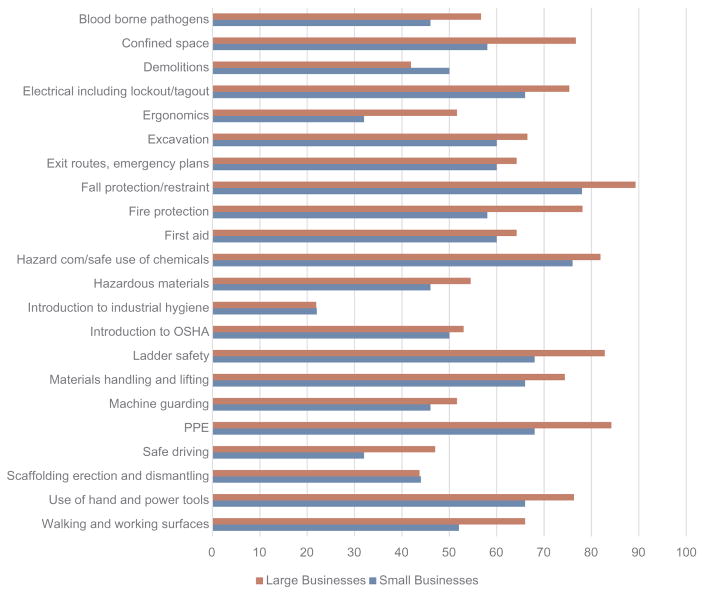
Collaborative efforts between the National Institute for Occupational Safety and Health (NIOSH) and the American Society of Safety Engineers (ASSE) led to a report focusing on overlapping occupational vulnerabilities, specifically small construction businesses employing young, non-native workers. Following the report, an online survey was conducted by ASSE with construction business representatives focusing on training experiences of non-native workers. Results were grouped by business size (50 or fewer employees or more than 50 employees). Smaller businesses were less likely to employ a supervisor who speaks the same language as immigrant workers (p < .001). Non-native workers in small businesses received fewer hours of both initial safety training (p = .005) and monthly ongoing safety training (p = .042). Immigrant workers in smaller businesses were less likely to receive every type of safety training identified in the survey (including pre-work safety orientation [p < .001], job-specific training [p < .001], OSHA 10-hour training [p = .001], and federal/state required training [p < .001]). The results highlight some of the challenges a vulnerable worker population faces in a small business, and can be used to better focus intervention efforts. Among businesses represented in this sample, there are deflcits in the amount, frequency, and format of workplace safety and health training provided to non-native workers in smaller construction businesses compared to those in larger businesses. The types of training conducted for non-native workers in small business were less likely to take into account the language and literacy issues faced by these workers. The findings suggest the need for a targeted approach in providing occupational safety and health training to non-native workers employed by smaller construction businesses.
Figures
References
-
- Benjamini Y, Hochberg Y. Controlling the false discovery rate: a practical and powerful approach to multiple testing. J Roy Stat Soc B. 1995;57(1):289–300.
-
- Bureau of Labor Statistics (BLS) Census of Fatal Occupational Injuries. 2016a Retrieved from. https://www.bls.gov/iif/oshwc/cfoi/cfch0014.pdf. - PubMed
-
- Bureau of Labor Statistics (BLS) Incidence rates of total recordable cases of nonfatal occupational injuries and illnesses by quartile distribution and employment size, 2015. 2016b Retrieved from https://www.bls.gov/iif/oshwc/osh/os/ostb4748.pdf.
-
- Bureau of Labor Statistics (BLS) Union members: 2015. 2016c Retrieved from. https://www.bls.gov/news.release/union2.nr0.htm.
-
- Breslin FC, Polzer J, MacEachen E, Morrongiello B, Shannon H. Workplace injury or “part of the job?: towards a gendered understanding of injuries and complaints among young workers. Soc Sci Med. 2007;64(4):782–793. - PubMed
Grants and funding
LinkOut - more resources
Full Text Sources
Other Literature Sources