


TIMI and GRACE Risk Scores Predict Both Short-Term and Long-Term Outcomes in Chinese Patients with Acute Myocardial Infarction
- PMID: 29375219
- PMCID: PMC5777938
- DOI: 10.6515/ACS.201801_34(1).20170730B
TIMI and GRACE Risk Scores Predict Both Short-Term and Long-Term Outcomes in Chinese Patients with Acute Myocardial Infarction
Abstract
Background: Little is known about the long-term prognostic values of both thrombolysis in myocardial infarction (TIMI) and Global Registry of Acute Cardiac Events (GRACE) risk scores (RSs) to the Asian ethnicity. The purpose of this study is to compare the usefulness of these two scores in risk stratification and prediction of long-term (up to 3 years) outcomes for Chinese patients with myocardial infarction (MI).
Methods: We calculated the TIMI and GRACE RSs for 726 consecutive patients with MI [55.6% with ST-segment elevation (STEMI) and 44.4% with non-ST-segment elevation (NSTEMI)].
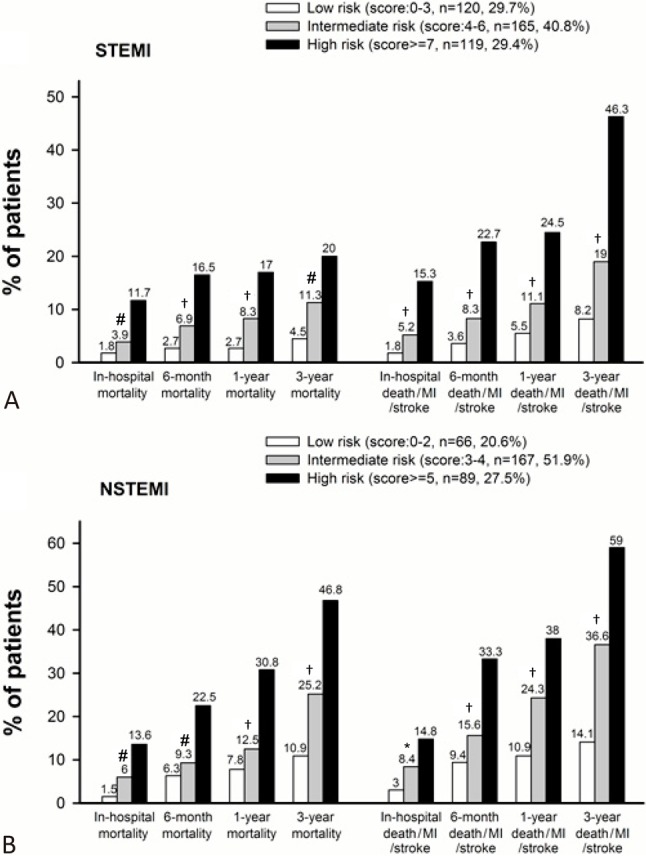
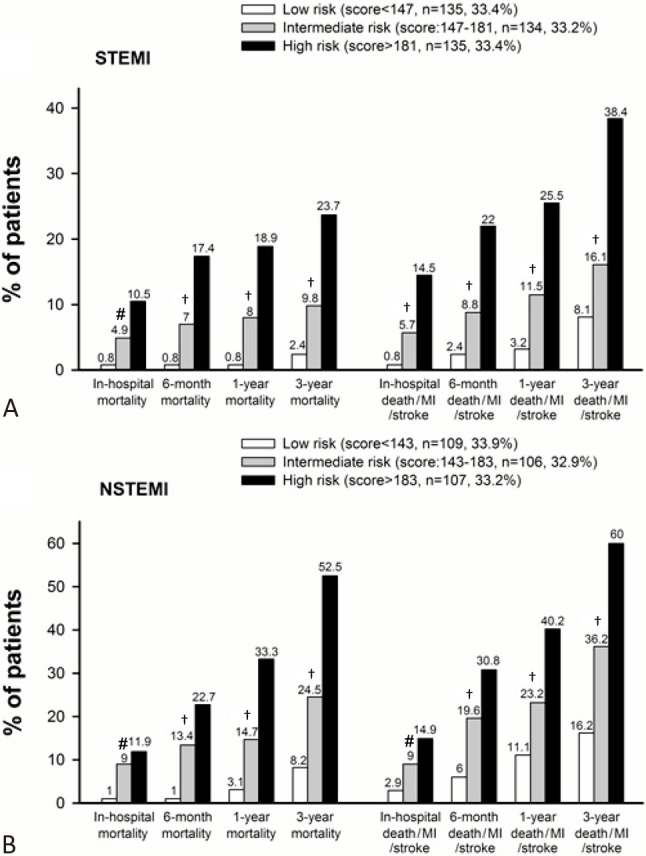
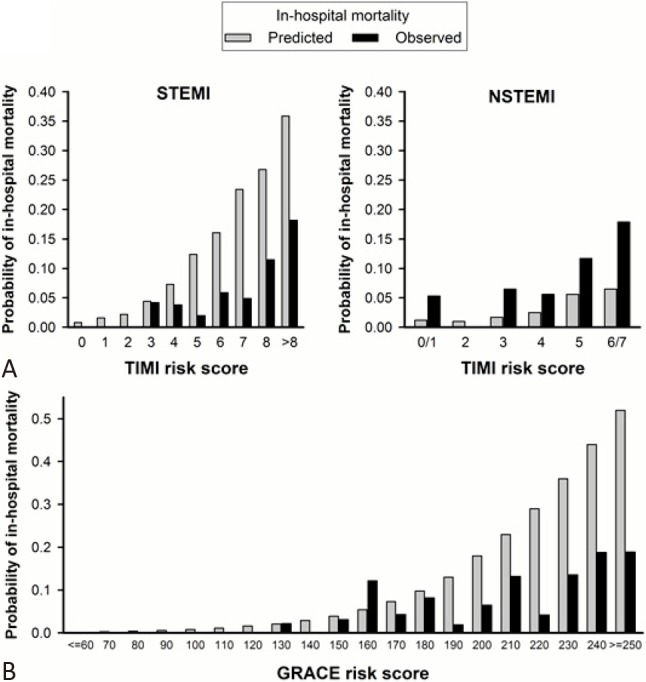
Results: Although the risk profile of our population (median TIMI score = 5 for STEMI, 4 for NSTEMI, and median GRACE score = 164) was higher, the in-hospital mortality (7.1% for NSTEMI and 6.7% for STEMI) was comparable to that predicted by GRACE RS. The GRACE RS worked well in predicting short-term and long-term death (C-statistics range 0.710 to 0.789) and triple (death, MI, and stroke) endpoints (C-statistics range 0.695 to 0.764) in both subsets of MI. GRACE RS performed significantly better than the TIMIRS in predicting 3-year mortality in NSTEMI (p = 0.035) and 1-year and 3-year mortality in STEMI (p = 0.028 and 0.009, respectively). Stratification by tertiles of GRACERS furnished greater prognostic information versus risk assessment by the TIMI RS.
Conclusions: The use of RSs revealed a fair to good discriminatory accuracy in predicting both short-term and long-term major adverse cardiac events in Asian patients with MI. Compared with the simpler TIMI RS, the GRACERS was more accurate in predicting long-term mortality.
Keywords: GRACE risk score; Myocardial infarction; Prognosis; Risk stratification; TIMI risk score.
Figures
References
-
- Bassand JP, Hamm CW, Ardissino D, et al. Guidelines for the diagnosis and treatment of non-ST-segment elevation acute coronary syndromes: the Task Force for Diagnosis and Treatment of Non-ST-Segment Elevation Acute Coronary Syndromes of European Society of Cardiology. Eur Heart J. 2007;28:1598–1560. - PubMed
-
- Kushner FG, Hand M, Smith SC, Jr., et al. 2009 focused updates: ACC/AHA guidelines for the management of patients with ST-elevation myocardial infarction (updating the 2004 guideline and 2007 focused update) and ACC/AHA/SCAI guidelines on percutaneous coronary intervention (updating the 2005 guideline and 2007 focused update) a report of the American College of Cardiology Foundation/American Heart Association Task Force on Practice Guidelines. J Am Coll Cardiol. 2009;54:2205–2241. - PubMed
-
- Antman EM, Cohen M, Bernink PJ, et al. The TIMI risk score for unstable angina/non-ST elevation MI: a method for prognostication and therapeutic decision making. JAMA. 2000;284:835–842. - PubMed
-
- Morrow DA, Antman EM, Charlesworth A, et al. TIMI risk score for ST-elevation myocardial infarction: a convenient, bedside, clinical score for risk assessment at presentation: an intravenous nPA for treatment of infarcting myocardium early II trial sub-study. Circulation. 2000;102:2031–2037. - PubMed
-
- Granger CB, Goldberg RJ, Dabbous O, et al. Global Registry of Acute Coronary Events Investigators. Predictors of hospital mortality in the global registry of acute coronary events. Arch Intern Med. 2003;163:2345–2353. - PubMed
LinkOut - more resources
Full Text Sources