Review
. 2017 Nov 15;5(1):1700322.
doi: 10.1002/advs.201700322. eCollection 2018 Jan.

Advanced Energy Storage Devices: Basic Principles, Analytical Methods, and Rational Materials Design

Affiliations
Review

Advanced Energy Storage Devices: Basic Principles, Analytical Methods, and Rational Materials Design

Jilei Liu et al. Adv Sci (Weinh). .

Abstract

Tremendous efforts have been dedicated into the development of high-performance energy storage devices with nanoscale design and hybrid approaches. The boundary between the electrochemical capacitors and batteries becomes less distinctive. The same material may display capacitive or battery-like behavior depending on the electrode design and the charge storage guest ions. Therefore, the underlying mechanisms and the electrochemical processes occurring upon charge storage may be confusing for researchers who are new to the field as well as some of the chemists and material scientists already in the field. This review provides fundamentals of the similarities and differences between electrochemical capacitors and batteries from kinetic and material point of view. Basic techniques and analysis methods to distinguish the capacitive and battery-like behavior are discussed. Furthermore, guidelines for material selection, the state-of-the-art materials, and the electrode design rules to advanced electrode are proposed.

Keywords: advanced energy storage devices; analytical methods; pseudocapacitance; rational materials design.


Figures

Figure 1
Figure 1
Classification of different types of energy storage technologies for stationary applications.
Figure 2
Figure 2
a) Ragone plot comparing the power‐energy characteristics and charge/discharge times of different energy storage devices. b) Schematic diagram comparing the fundamental mechanisms of electrochemical energy storage in double‐layer capacitors, pseudocapacitors, and batteries. Reproduced with permission.22 Copyright 2016, The Springer Nature.
Figure 3
Figure 3
Cyclic voltammograms (top) and galvanostatic charge/discharge curves for different types of electrode materials. a,b) Carbon‐based double‐layer supercapacitor. Reproduced with permission.49 Copyright 2013, Chinese Materials Research Society. c,d) Polyaniline pseudocapacitive electrode. Reproduced with permission.50 Copyright 2013, The Royal Society of Chemistry, and e,f) LiFePO4 battery electrode (vs Li). Reproduced with permission.51 Copyright 2015, The Royal Society of Chemistry. These series show a wide range of sweep rates and current densities, highlighting the unique electrochemical features of each material. A transition from (a, b) typical capacitive behavior to (e, f) typical battery behavior has been well illustrated with (c, d) pseudocapacitive behavior as an intermediate case.
Figure 4
Figure 4
Schematic diagrams of the different faradaic processes that give rise to pseudocapacitance. Here, X is the 2D site occupancy fraction for underpotential deposition, [OX]/([OX] + [Red]) for redox systems and the occupancy fraction of layer lattice for intercalation systems, respectively. Reproduced with permission.22 Copyright 2016, The Springer Nature.
Figure 5
Figure 5
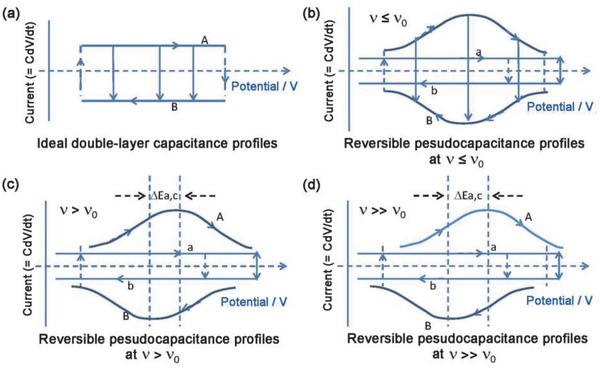
CV profiles of a) ideal double‐layer capacitor and b–d) reversible pseudocapacitors with different sweep rates v, where v 0 is the critical sweep rate.24, 83, 84 Reproduced with permission.24 Copyright 1991, The Electrochemical Society.
Figure 6
Figure 6
Typical CV profiles of: a) hydrous RuO2. Reproduced with permission.92 Copyright 2005, American Chemical Society. b) MnO2. Reproduced with permission.93 Copyright 2014, ESG. c) Polyaniline (PANI). Reproduced with permission.95 Copyright 2014, Elsevier Ltd. d) Mxene Ti3C2Tx with different sweep rates. Reproduced with permission.82 Copyright 2014, Nature Publishing Group.
Figure 7
Figure 7
a) Cyclic voltammetry curves of amorphous and crystalline mesoporous T‐Nb2O5 films in lithium (Li+) and tetrabutylammonium (TBA+) electrolytes at a sweep rate of 10 mV s−1. b) Potential‐dependent capacitance calculated from CV curves at sweep rate of 2 and 50 mV s−1. Reproduced with permission.96 Copyright 2010, American Chemical Society.
Figure 8
Figure 8
Typical CV curves of a) pseudocapacitive material and c) battery‐type material at different sweep rates, v 1 < v 2 < v 3. Note that v 3 < v 0 for a pseudocapacitor and ΔE a,c increases with increasing v for the battery. Typical experimental data for b) T‐Nb2O5. Reproduced with permission.100 Copyright 2013, Nature Publishing Group. d) LiFePO4. Reproduced with permission.101 Copyright 2011, The Electrochemical Society.
Figure 9
Figure 9
Power law dependence of the peak current on sweep rate (from Equation (12)) for capacitive materials (b = 1.0) and typical battery‐type materials (b = 0.5). The “transition” area between capacitive and battery‐type materials area is located in the range of b = 0.5–1.0.
Figure 10
Figure 10
The dependence of parameter b on: a) electrode material types pseudocapacitive T‐Nb2O5. Reproduced with permission.100 Copyright 2013, Nature Publication Group. b) Battery‐type LiFePO4. Reproduced with permission.101 Copyright 2011, The Electrochemical Society. c) Potential (10 nm TiO2 film). Reproduced with permission.103 Copyright 2007, American Chemical Society. d) Charge storage mechanism (Li+ and Na+ reactions in Li4Ti5O12). Reproduced with permission.109 Copyright 2014, American Chemical Society. The inset in (c) shows the good linear dependence of the current on the sweep rate (based on Equation (12)) at 1.60 V (b = 1.0) and cathodic peak 1.70 V (b = 0.55). The inset in (d) shows the good linear dependence of the current on the sweep rate (based on Equation (12)) measured at the cathodic peak near a potential of 0.9 V for the Na+ storage case and 1.54 V for Li+ storage case.
Figure 11
Figure 11
Two different methods for deconvoluting surface (∝v) and bulk charge (v 1/2): a1–a3) Iv or v 1/2 and b1–b3) q ∝ v 1/2 or v −1/2. CV curves at (a1) 5 and (a2) 100 mV s−1 for MnO2 (74 nm shell)‐Au (core) hierarchical structure. (a3) Dependence of surface/bulk charge ratio on sweep rate. Reproduced with permission.111 Copyright 2012, American Chemical Society. (b1) Gravimetric capacity versus v −1/2 and (b2) inverse gravimetric capacity versus v 1/2 for V2O5/Ru nanotube arrays. The intercept value in (b1) represents the surface charge (∝v). The inverse of the intercept in (b2) is the total charge. (b3) Surface/bulk charge ratio for V2O5/planar Ru and V2O5/Ru nanotube array hybrids. Reproduced with permission.112 Copyright 2014, Nature Publication Group.
Figure 12
Figure 12
The dependence of intrinsic pseudocapacitive behavior on: crystal structure a) TiO2 (B) and d) anatase TiO2. Reproduced with permission.107 Copyright 2014, Elsevier Ltd. b) a‐MoO3 and e) amorphous MoO3. Reproduced with permission.114 Copyright 2010, Nature Publication Group. and charge storage mechanism c) Na+ storage and f) Li+ storage. Reproduced with permission.109 Copyright 2014. American Chemical Society.
Figure 13
Figure 13
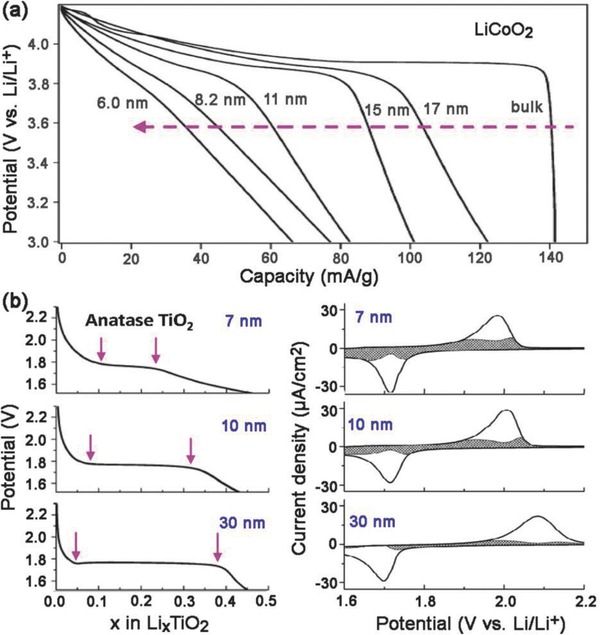
Dependence of the extrinsic pseudocapacitive behavior on crystallite size for a) LiCoO2. Reproduced with permission.152 Copyright 2007, American Chemical Society. b) Anatase TiO2. Reproduced with permission.103 Copyright 2007, American Chemical Society.
Figure 14
Figure 14
Characterization results of binary hybrids. The dependence of capacitive charge and diffusion‐controlled charge on the hybrid material a) I is V2O5/CNT and II is V2O5. Reproduced with permission.155 Copyright 2012, American Chemical Society. b) V2O5/CNT hybrids with different V2O5 mass loadings. Reproduced with permission.104 Copyright 2011, American Chemical Society. And electrolyte type c1) aqueous 1 m LiClO4 and c2) organic acetonitrile 1 m LiClO4. Reproduced with permission.116 Copyright 2013, American Chemical Society.

References

    1. Dunn B., Kamath H., Tarascon J.‐M., Science 2011, 334, 928. - PubMed
    1. Yang Z., Zhang J., Kintner‐Meyer M. C. W., Lu X., Choi D., Lemmon J. P., Liu J., Chem. Rev. 2011, 111, 3577. - PubMed
    1. Kim H., Hong J., Park K.‐Y., Kim H., Kim S.‐W., Kang K., Chem. Rev. 2014, 114, 11788. - PubMed
    1. Winter M., Brodd R. J., Chem. Rev. 2004, 104, 4245. - PubMed
    1. Desilvestro J., Haas O., J. Electrochem. Soc. 1990, 137, C5.

LinkOut - more resources