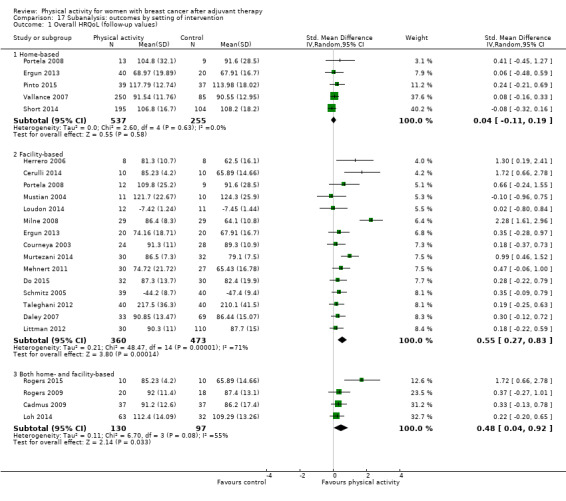
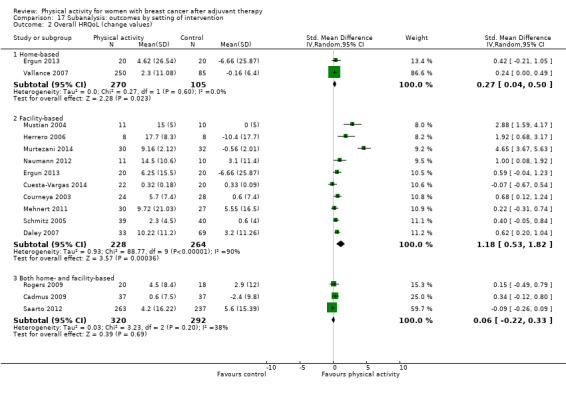
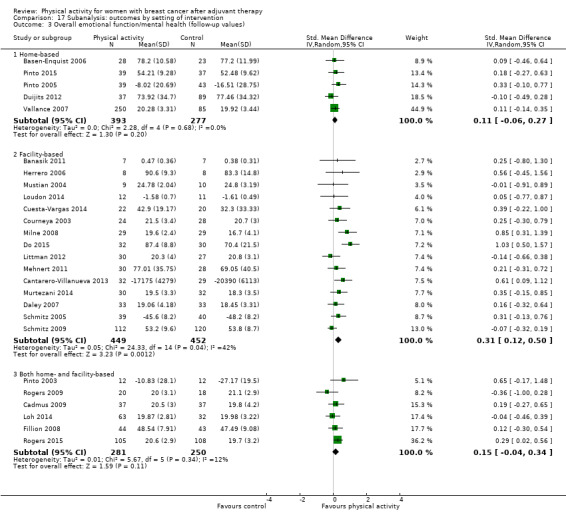
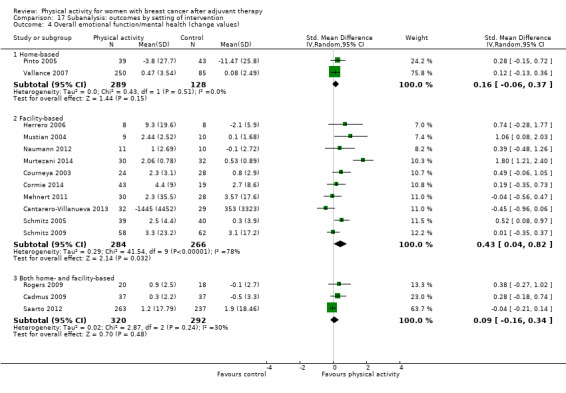
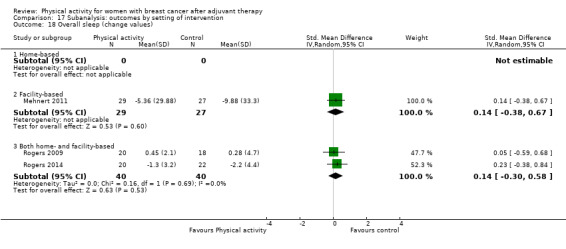
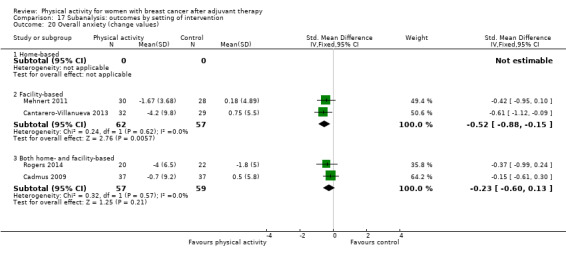
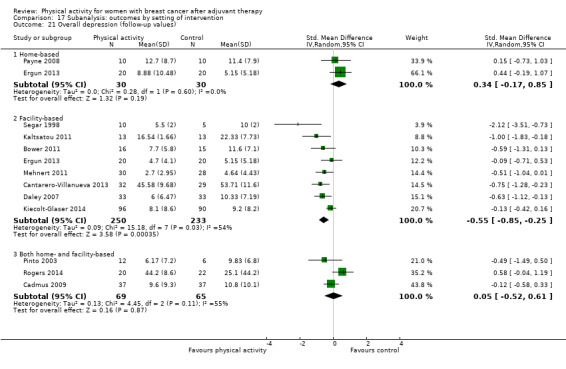
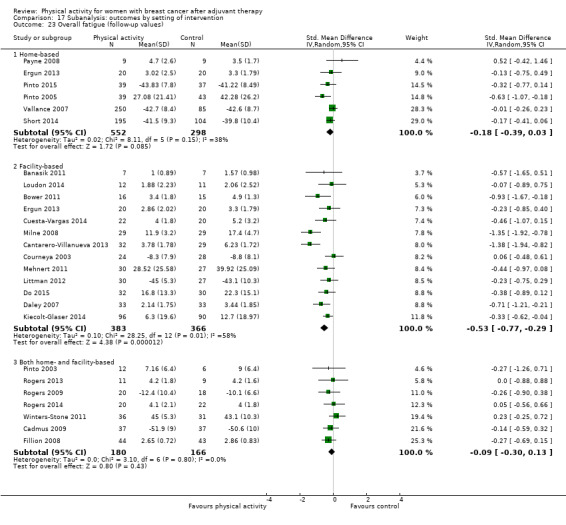
Meta-Analysis
. 2018 Jan 29;1(1):CD011292.
doi: 10.1002/14651858.CD011292.pub2.

Physical activity for women with breast cancer after adjuvant therapy

Affiliations
Meta-Analysis

Physical activity for women with breast cancer after adjuvant therapy

Ian M Lahart et al. Cochrane Database Syst Rev. .

Abstract

Background: Women with a diagnosis of breast cancer may experience short- and long-term disease and treatment-related adverse physiological and psychosocial outcomes. These outcomes can negatively impact prognosis, health-related quality of life (HRQoL), and psychosocial and physical function. Physical activity may help to improve prognosis and may alleviate the adverse effects of adjuvant therapy.

Objectives: To assess effects of physical activity interventions after adjuvant therapy for women with breast cancer.

Search methods: We searched the Cochrane Breast Cancer Group (CBCG) Specialised Registry, the Cochrane Central Register of Controlled Trials (CENTRAL), MEDLINE, Embase, the Cumulative Index to Nursing and Allied Health Literature (CINAHL), the Physiotherapy Evidence Database (PEDro), SPORTDiscus, PsycINFO, ClinicalTrials.gov, and the World Health Organization (WHO) International Clinical Trials Registry Platform, on 18 September 2015. We also searched OpenGrey and Healthcare Management Information Consortium databases.

Selection criteria: We searched for randomised and quasi-randomised trials comparing physical activity interventions versus control (e.g. usual or standard care, no physical activity, no exercise, attention control, placebo) after adjuvant therapy (i.e. after completion of chemotherapy and/or radiation therapy, but not hormone therapy) in women with breast cancer.

Data collection and analysis: Two review authors independently selected studies, assessed risk of bias, and extracted data. We contacted trial authors to ask for additional information when needed. We calculated an overall effect size with 95% confidence intervals (CIs) for each outcome and used GRADE to assess the quality of evidence for the most important outcomes.

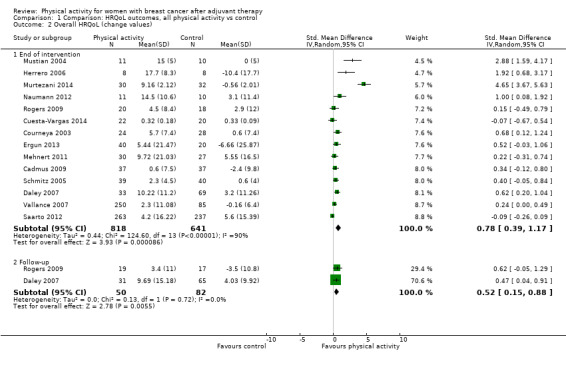
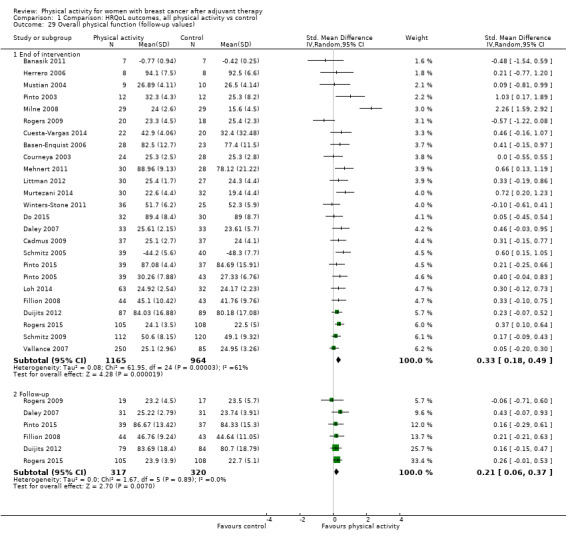
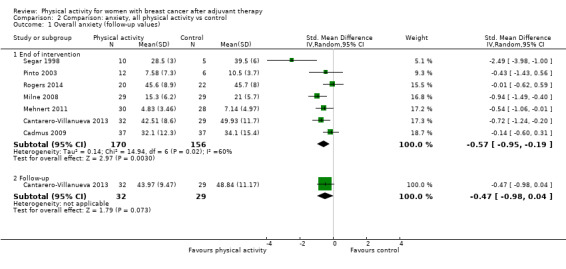
Main results: We included 63 trials that randomised 5761 women to a physical activity intervention (n = 3239) or to a control (n = 2524). The duration of interventions ranged from 4 to 24 months, with most lasting 8 or 12 weeks (37 studies). Twenty-eight studies included aerobic exercise only, 21 involved aerobic exercise and resistance training, and seven used resistance training only. Thirty studies described the comparison group as usual or standard care, no intervention, or control. One-fifth of studies reported at least 20% intervention attrition and the average physical activity adherence was approximately 77%.No data were available on effects of physical activity on breast cancer-related and all-cause mortality, or on breast cancer recurrence. Analysis of immediately postintervention follow-up values and change from baseline to end of intervention scores revealed that physical activity interventions resulted in significant small-to-moderate improvements in HRQoL (standardised mean difference (SMD) 0.39, 95% CI 0.21 to 0.57, 22 studies, 1996 women; SMD 0.78, 95% CI 0.39 to 1.17, 14 studies, 1459 women, respectively; low-quality evidence), emotional function (SMD 0.21, 95% CI 0.10 to 0.32, 26 studies, 2102 women, moderate-quality evidence; SMD 0.31, 95% CI 0.09 to 0.53, 15 studies, 1579 women, respectively; low-quality evidence), perceived physical function (SMD 0.33, 95% CI 0.18 to 0.49, 25 studies, 2129 women; SMD 0.60, 95% CI 0.23 to 0.97, 13 studies, 1433 women, respectively; moderate-quality evidence), anxiety (SMD -0.57, 95% CI -0.95 to -0.19, 7 studies, 326 women; SMD -0.37, 95% CI -0.63 to -0.12, 4 studies, 235 women, respectively; low-quality evidence), and cardiorespiratory fitness (SMD 0.44, 95% CI 0.30 to 0.58, 23 studies, 1265 women, moderate-quality evidence; SMD 0.83, 95% CI 0.40 to 1.27, 9 studies, 863 women, respectively; very low-quality evidence).Investigators reported few minor adverse events.Small improvements in physical activity interventions were sustained for three months or longer postintervention in fatigue (SMD -0.43, 95% CI -0.60 to -0.26; SMD -0.47, 95% CI -0.84 to -0.11, respectively), cardiorespiratory fitness (SMD 0.36, 95% CI 0.03 to 0.69; SMD 0.42, 95% CI 0.05 to 0.79, respectively), and self-reported physical activity (SMD 0.44, 95% CI 0.17 to 0.72; SMD 0.51, 95% CI 0.08 to 0.93, respectively) for both follow-up values and change from baseline scores.However, evidence of heterogeneity across trials was due to variation in intervention components (i.e. mode, frequency, intensity, duration of intervention and sessions) and measures used to assess outcomes. All trials reviewed were at high risk of performance bias, and most were also at high risk of detection, attrition, and selection bias. In light of the aforementioned issues, we determined that the evidence was of very low, low, or moderate quality.

Authors' conclusions: No conclusions regarding breast cancer-related and all-cause mortality or breast cancer recurrence were possible. However, physical activity interventions may have small-to-moderate beneficial effects on HRQoL, and on emotional or perceived physical and social function, anxiety, cardiorespiratory fitness, and self-reported and objectively measured physical activity. The positive results reported in the current review must be interpreted cautiously owing to very low-to-moderate quality of evidence, heterogeneity of interventions and outcome measures, imprecision of some estimates, and risk of bias in many trials. Future studies with low risk of bias are required to determine the optimal combination of physical activity modes, frequencies, intensities, and durations needed to improve specific outcomes among women who have undergone adjuvant therapy.


Conflict of interest statement

None known.

Figures
1
1
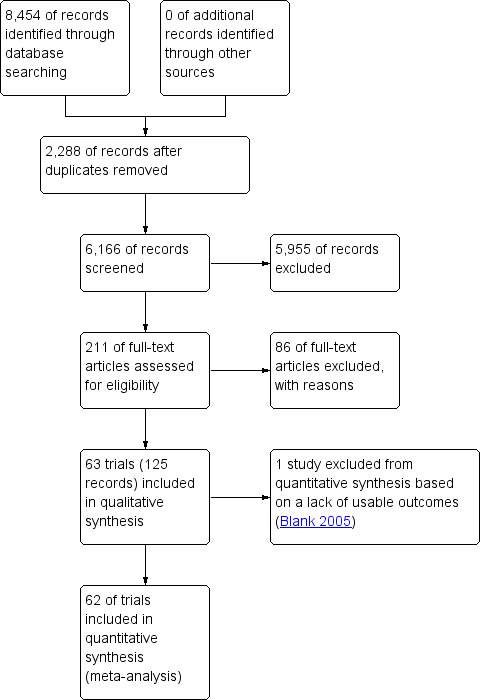
Study flow diagram.
2
2
Risk of bias summary: review authors' judgements about each risk of bias item for each included study.
3
3
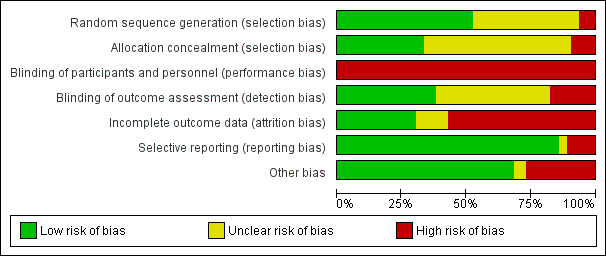
Risk of bias graph: review authors' judgements about each risk of bias item presented as percentages across all included studies.
4
4
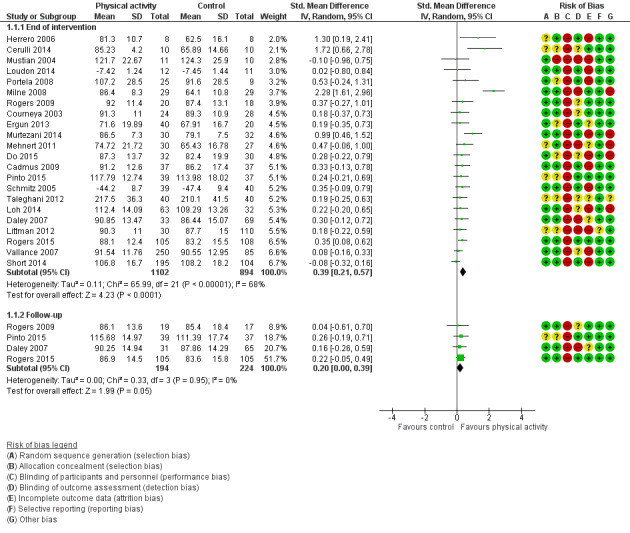
Forest plot of comparison: 1 Comparison: HRQoL outcomes, all physical activity vs control, outcome: 1.1 Overall HRQoL (follow‐up values).
5
5
Forest plot of comparison: 1 Comparison: HRQoL outcomes, all physical activity vs control, outcome: 1.2 Overall HRQoL (change values).
6
6
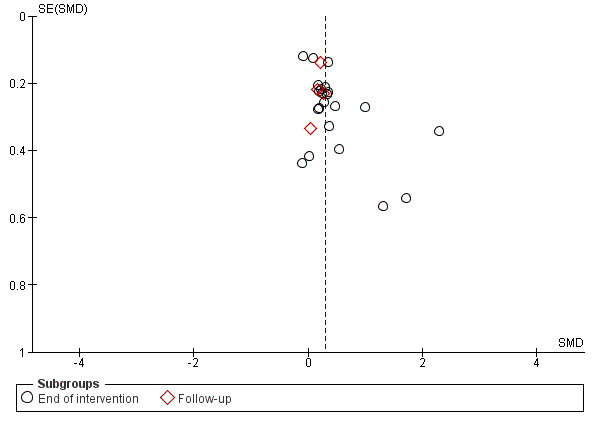
Funnel plot of comparison: 1 Comparison: HRQoL outcomes, all physical activity vs control, outcome: 1.1 Overall HRQoL (follow‐up values).
1.1
1.1. Analysis
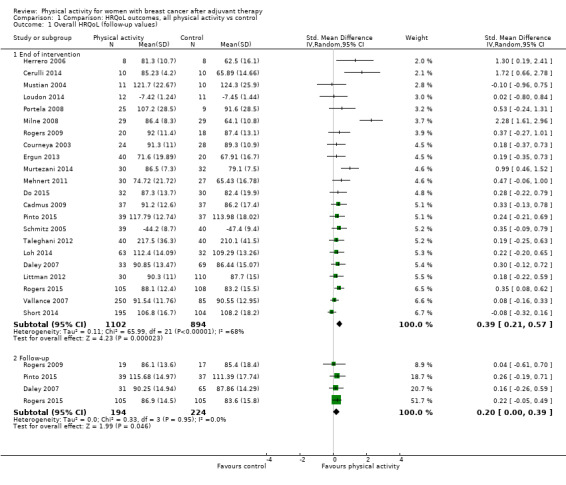
Comparison 1 Comparison: HRQoL outcomes, all physical activity vs control, Outcome 1 Overall HRQoL (follow‐up values).
1.2
1.2. Analysis
Comparison 1 Comparison: HRQoL outcomes, all physical activity vs control, Outcome 2 Overall HRQoL (change values).
1.3
1.3. Analysis
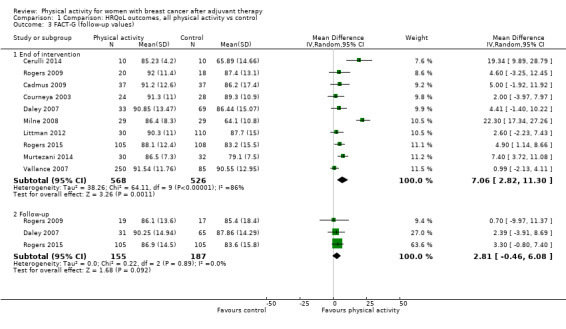
Comparison 1 Comparison: HRQoL outcomes, all physical activity vs control, Outcome 3 FACT‐G (follow‐up values).
1.4
1.4. Analysis
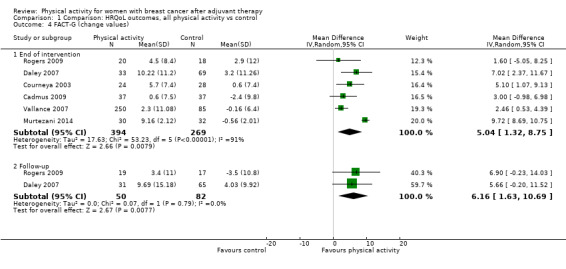
Comparison 1 Comparison: HRQoL outcomes, all physical activity vs control, Outcome 4 FACT‐G (change values).
1.5
1.5. Analysis
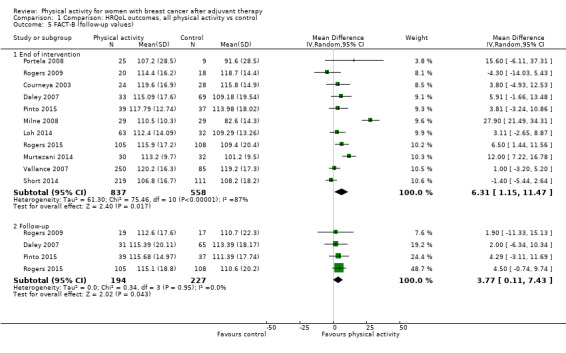
Comparison 1 Comparison: HRQoL outcomes, all physical activity vs control, Outcome 5 FACT‐B (follow‐up values).
1.6
1.6. Analysis
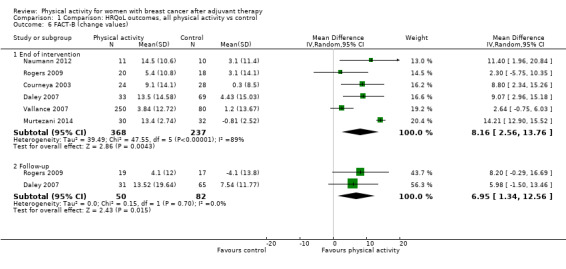
Comparison 1 Comparison: HRQoL outcomes, all physical activity vs control, Outcome 6 FACT‐B (change values).
1.7
1.7. Analysis
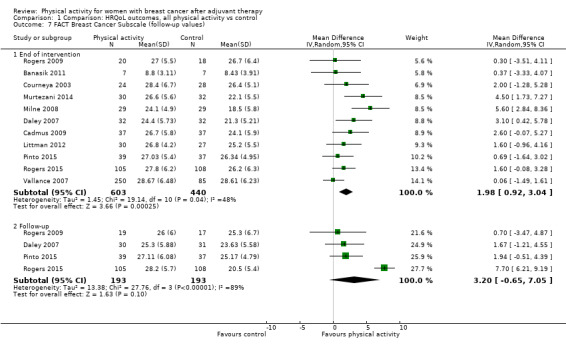
Comparison 1 Comparison: HRQoL outcomes, all physical activity vs control, Outcome 7 FACT Breast Cancer Subscale (follow‐up values).
1.8
1.8. Analysis
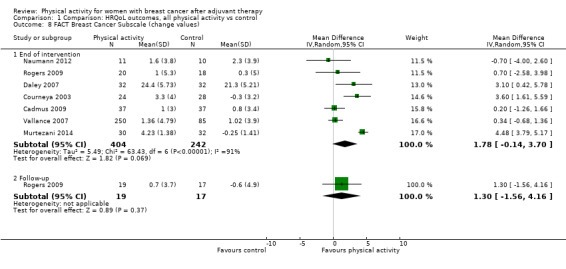
Comparison 1 Comparison: HRQoL outcomes, all physical activity vs control, Outcome 8 FACT Breast Cancer Subscale (change values).
1.9
1.9. Analysis
Comparison 1 Comparison: HRQoL outcomes, all physical activity vs control, Outcome 9 FACT Trial Outcome Index (follow‐up values).
1.10
1.10. Analysis
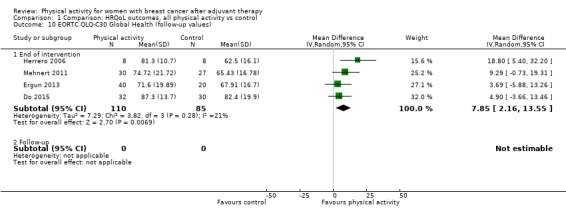
Comparison 1 Comparison: HRQoL outcomes, all physical activity vs control, Outcome 10 EORTC QLQ‐C30 Global Health (follow‐up values).
1.11
1.11. Analysis
Comparison 1 Comparison: HRQoL outcomes, all physical activity vs control, Outcome 11 EORTC QLQ‐C30 Global Health (change values).
1.12
1.12. Analysis
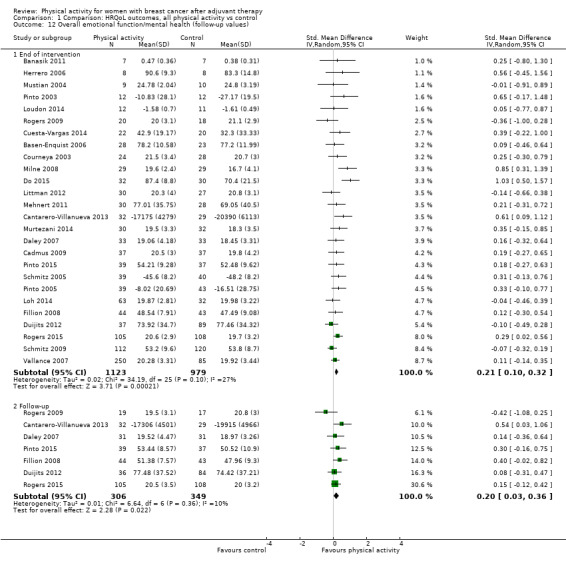
Comparison 1 Comparison: HRQoL outcomes, all physical activity vs control, Outcome 12 Overall emotional function/mental health (follow‐up values).
1.13
1.13. Analysis
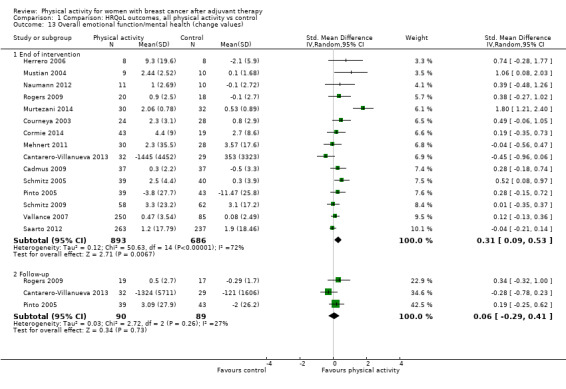
Comparison 1 Comparison: HRQoL outcomes, all physical activity vs control, Outcome 13 Overall emotional function/mental health (change values).
1.14
1.14. Analysis
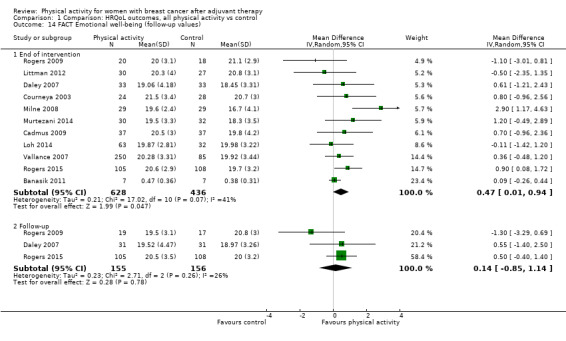
Comparison 1 Comparison: HRQoL outcomes, all physical activity vs control, Outcome 14 FACT Emotional well‐being (follow‐up values).
1.15
1.15. Analysis
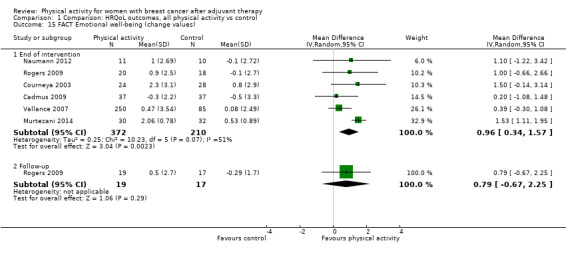
Comparison 1 Comparison: HRQoL outcomes, all physical activity vs control, Outcome 15 FACT Emotional well‐being (change values).
1.16
1.16. Analysis
Comparison 1 Comparison: HRQoL outcomes, all physical activity vs control, Outcome 16 MOS SF Mental composite (follow‐up values).
1.17
1.17. Analysis
Comparison 1 Comparison: HRQoL outcomes, all physical activity vs control, Outcome 17 MOS SF Mental composite (change values).
1.18
1.18. Analysis
Comparison 1 Comparison: HRQoL outcomes, all physical activity vs control, Outcome 18 MOS SF Mental health (follow‐up values).
1.19
1.19. Analysis
Comparison 1 Comparison: HRQoL outcomes, all physical activity vs control, Outcome 19 MOS SF Mental health (change values).
1.20
1.20. Analysis
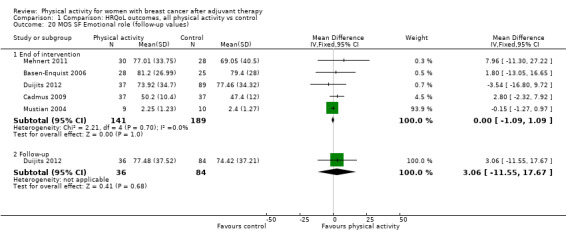
Comparison 1 Comparison: HRQoL outcomes, all physical activity vs control, Outcome 20 MOS SF Emotional role (follow‐up values).
1.21
1.21. Analysis
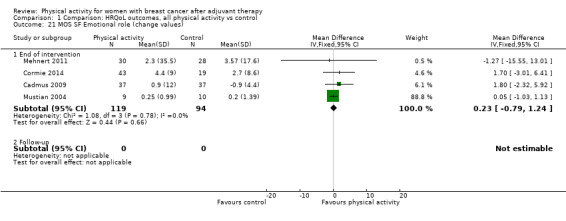
Comparison 1 Comparison: HRQoL outcomes, all physical activity vs control, Outcome 21 MOS SF Emotional role (change values).
1.22
1.22. Analysis
Comparison 1 Comparison: HRQoL outcomes, all physical activity vs control, Outcome 22 EORTC QLQ‐C30 Emotional function (follow‐up values).
1.23
1.23. Analysis
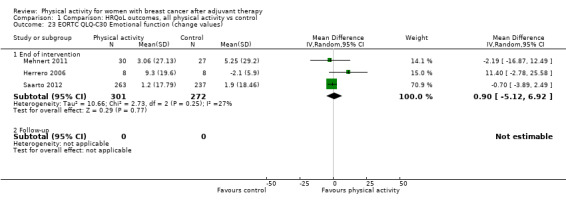
Comparison 1 Comparison: HRQoL outcomes, all physical activity vs control, Outcome 23 EORTC QLQ‐C30 Emotional function (change values).
1.24
1.24. Analysis
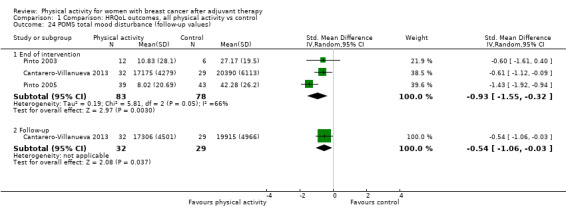
Comparison 1 Comparison: HRQoL outcomes, all physical activity vs control, Outcome 24 POMS total mood disturbance (follow‐up values).
1.25
1.25. Analysis
Comparison 1 Comparison: HRQoL outcomes, all physical activity vs control, Outcome 25 POMS total mood disturbance (change values).
1.26
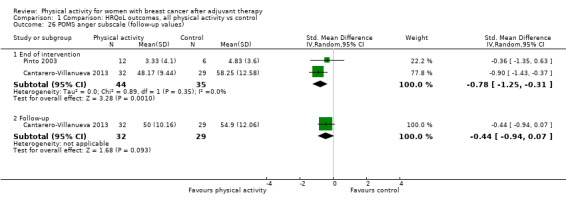
1.26. Analysis
Comparison 1 Comparison: HRQoL outcomes, all physical activity vs control, Outcome 26 POMS anger subscale (follow‐up values).
1.27
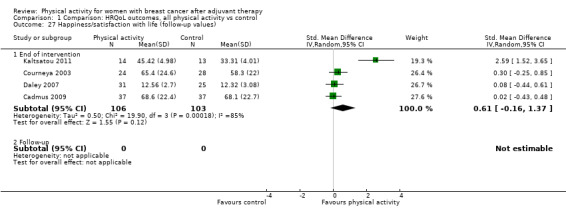
1.27. Analysis
Comparison 1 Comparison: HRQoL outcomes, all physical activity vs control, Outcome 27 Happiness/satisfaction with life (follow‐up values).
1.28
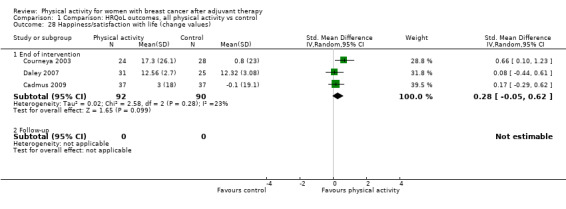
1.28. Analysis
Comparison 1 Comparison: HRQoL outcomes, all physical activity vs control, Outcome 28 Happiness/satisfaction with life (change values).
1.29
1.29. Analysis
Comparison 1 Comparison: HRQoL outcomes, all physical activity vs control, Outcome 29 Overall physical function (follow‐up values).
1.30
1.30. Analysis
Comparison 1 Comparison: HRQoL outcomes, all physical activity vs control, Outcome 30 Overall physical function (change values).
1.31
1.31. Analysis
Comparison 1 Comparison: HRQoL outcomes, all physical activity vs control, Outcome 31 FACT Physical well‐being (follow‐up values).
1.32
1.32. Analysis
Comparison 1 Comparison: HRQoL outcomes, all physical activity vs control, Outcome 32 FACT Physical well‐being (change values).
1.33
1.33. Analysis
Comparison 1 Comparison: HRQoL outcomes, all physical activity vs control, Outcome 33 MOS SF Physical composite (follow‐up values).
1.34
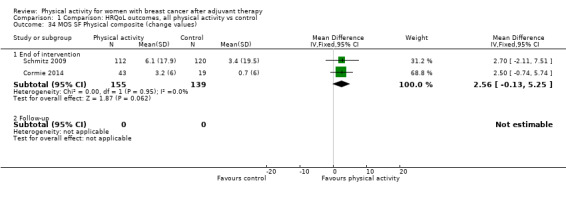
1.34. Analysis
Comparison 1 Comparison: HRQoL outcomes, all physical activity vs control, Outcome 34 MOS SF Physical composite (change values).
1.35
1.35. Analysis
Comparison 1 Comparison: HRQoL outcomes, all physical activity vs control, Outcome 35 MOS SF Physical function (follow‐up values).
1.36
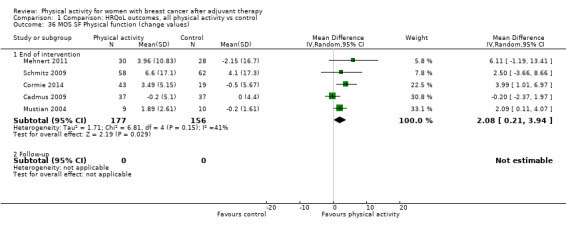
1.36. Analysis
Comparison 1 Comparison: HRQoL outcomes, all physical activity vs control, Outcome 36 MOS SF Physical function (change values).
1.37
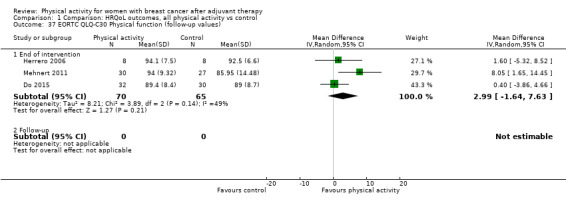
1.37. Analysis
Comparison 1 Comparison: HRQoL outcomes, all physical activity vs control, Outcome 37 EORTC QLQ‐C30 Physical function (follow‐up values).
1.38
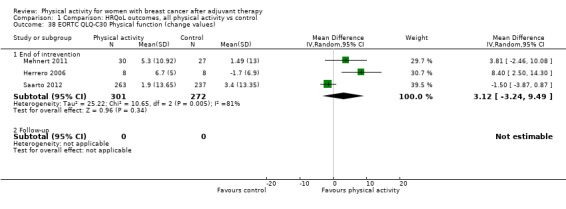
1.38. Analysis
Comparison 1 Comparison: HRQoL outcomes, all physical activity vs control, Outcome 38 EORTC QLQ‐C30 Physical function (change values).
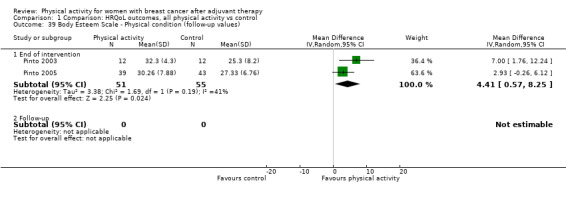
1.39
1.39. Analysis
Comparison 1 Comparison: HRQoL outcomes, all physical activity vs control, Outcome 39 Body Esteem Scale ‐ Physical condition (follow‐up values).
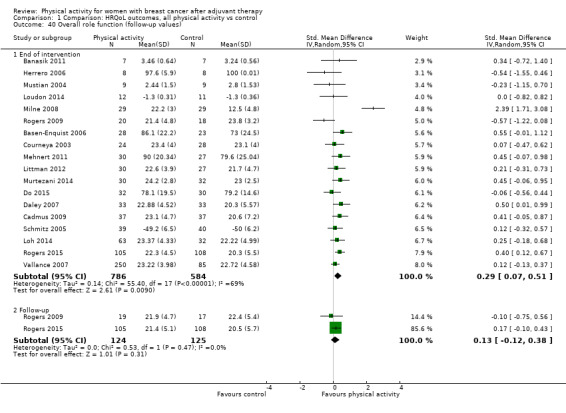
1.40
1.40. Analysis
Comparison 1 Comparison: HRQoL outcomes, all physical activity vs control, Outcome 40 Overall role function (follow‐up values).
1.41
1.41. Analysis
Comparison 1 Comparison: HRQoL outcomes, all physical activity vs control, Outcome 41 Overall role function (change values).
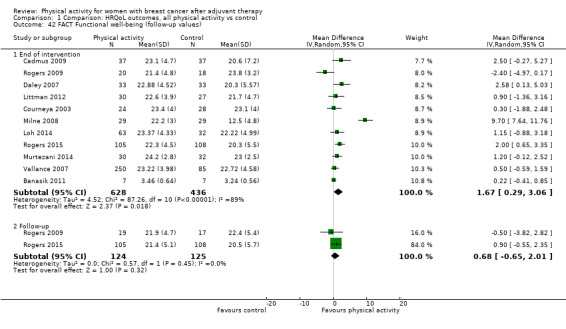
1.42
1.42. Analysis
Comparison 1 Comparison: HRQoL outcomes, all physical activity vs control, Outcome 42 FACT Functional well‐being (follow‐up values).
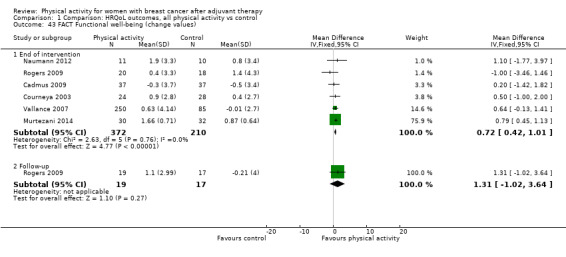
1.43
1.43. Analysis
Comparison 1 Comparison: HRQoL outcomes, all physical activity vs control, Outcome 43 FACT Functional well‐being (change values).
1.44
1.44. Analysis
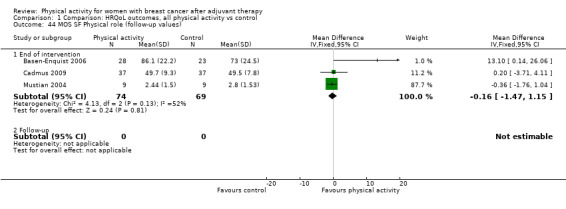
Comparison 1 Comparison: HRQoL outcomes, all physical activity vs control, Outcome 44 MOS SF Physical role (follow‐up values).
1.45
1.45. Analysis
Comparison 1 Comparison: HRQoL outcomes, all physical activity vs control, Outcome 45 MOS SF Physical role (change values).
1.46
1.46. Analysis
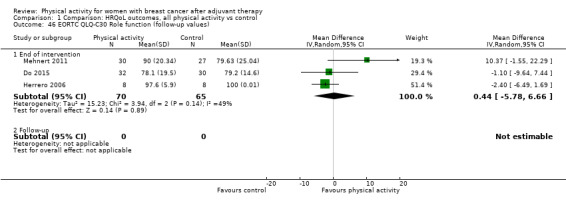
Comparison 1 Comparison: HRQoL outcomes, all physical activity vs control, Outcome 46 EORTC QLQ‐C30 Role function (follow‐up values).
1.47
1.47. Analysis
Comparison 1 Comparison: HRQoL outcomes, all physical activity vs control, Outcome 47 EORTC QLQ‐C30 Role function (change values).
1.48
1.48. Analysis
Comparison 1 Comparison: HRQoL outcomes, all physical activity vs control, Outcome 48 Overall social well‐being/function (follow‐up values).
1.49
1.49. Analysis
Comparison 1 Comparison: HRQoL outcomes, all physical activity vs control, Outcome 49 Overall social well‐being/function (change values).
1.50
1.50. Analysis
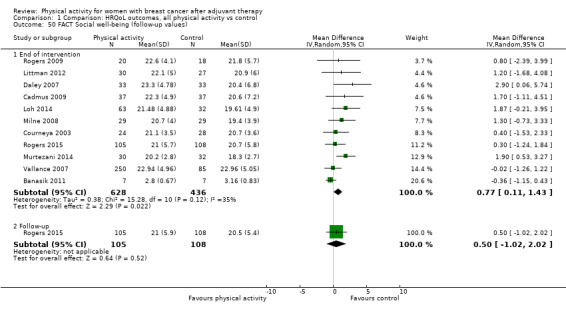
Comparison 1 Comparison: HRQoL outcomes, all physical activity vs control, Outcome 50 FACT Social well‐being (follow‐up values).
1.51
1.51. Analysis
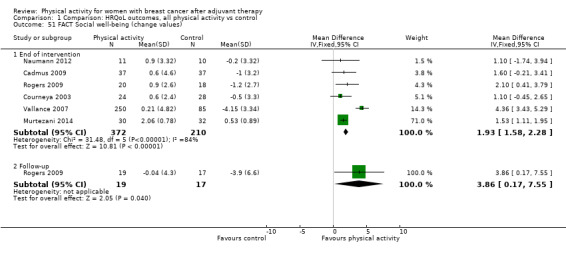
Comparison 1 Comparison: HRQoL outcomes, all physical activity vs control, Outcome 51 FACT Social well‐being (change values).
1.52
1.52. Analysis
Comparison 1 Comparison: HRQoL outcomes, all physical activity vs control, Outcome 52 MOS SF Social functioning (follow‐up values).
1.53
1.53. Analysis
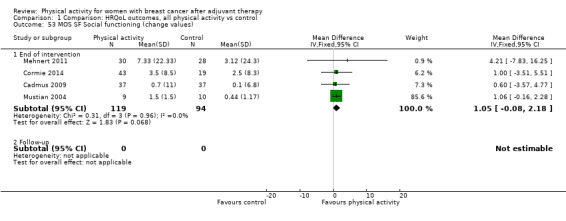
Comparison 1 Comparison: HRQoL outcomes, all physical activity vs control, Outcome 53 MOS SF Social functioning (change values).
1.54
1.54. Analysis
Comparison 1 Comparison: HRQoL outcomes, all physical activity vs control, Outcome 54 EORTC QLQ‐C30 Social function (follow‐up values).
1.55
1.55. Analysis
Comparison 1 Comparison: HRQoL outcomes, all physical activity vs control, Outcome 55 EORTC QLQ‐C30 Social function (change values).
1.56
1.56. Analysis
Comparison 1 Comparison: HRQoL outcomes, all physical activity vs control, Outcome 56 Overall cognitive function (follow‐up values).
1.57
1.57. Analysis
Comparison 1 Comparison: HRQoL outcomes, all physical activity vs control, Outcome 57 Overall cognitive function (change values).
1.58
1.58. Analysis
Comparison 1 Comparison: HRQoL outcomes, all physical activity vs control, Outcome 58 EORTC QLQ‐C30 Cognitive function (follow‐up values).
1.59
1.59. Analysis
Comparison 1 Comparison: HRQoL outcomes, all physical activity vs control, Outcome 59 EORTC QLQ‐C30 Cognitive function (change values).
1.60
1.60. Analysis
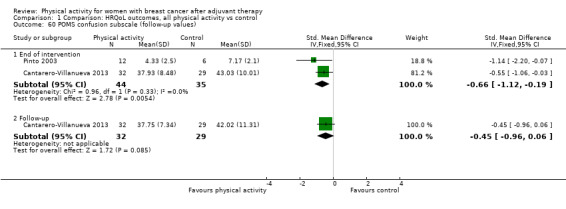
Comparison 1 Comparison: HRQoL outcomes, all physical activity vs control, Outcome 60 POMS confusion subscale (follow‐up values).
1.61
1.61. Analysis
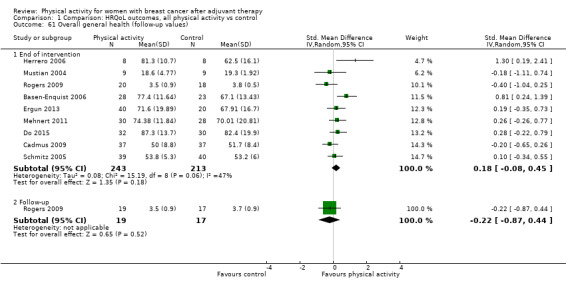
Comparison 1 Comparison: HRQoL outcomes, all physical activity vs control, Outcome 61 Overall general health (follow‐up values).
1.62
1.62. Analysis
Comparison 1 Comparison: HRQoL outcomes, all physical activity vs control, Outcome 62 Overall general health (change values).
1.63
1.63. Analysis
Comparison 1 Comparison: HRQoL outcomes, all physical activity vs control, Outcome 63 MOS SF General health (follow‐up values).
1.64
1.64. Analysis
Comparison 1 Comparison: HRQoL outcomes, all physical activity vs control, Outcome 64 MOS SF General health (change values).
1.65
1.65. Analysis
Comparison 1 Comparison: HRQoL outcomes, all physical activity vs control, Outcome 65 Overall sexual function (follow‐up values).
1.66
1.66. Analysis
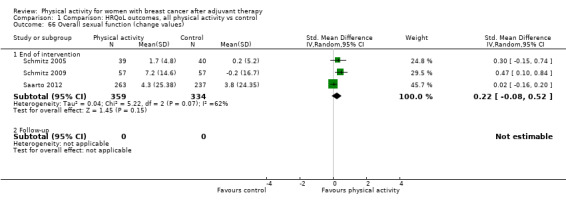
Comparison 1 Comparison: HRQoL outcomes, all physical activity vs control, Outcome 66 Overall sexual function (change values).
1.67
1.67. Analysis
Comparison 1 Comparison: HRQoL outcomes, all physical activity vs control, Outcome 67 Body Esteem Scale ‐ sexual attractiveness (follow‐up values).
1.68
1.68. Analysis
Comparison 1 Comparison: HRQoL outcomes, all physical activity vs control, Outcome 68 Overall sleep (follow‐up values).
1.69
1.69. Analysis
Comparison 1 Comparison: HRQoL outcomes, all physical activity vs control, Outcome 69 Overall sleep (change values).
1.70
1.70. Analysis
Comparison 1 Comparison: HRQoL outcomes, all physical activity vs control, Outcome 70 PSQI Global sleep score (follow‐up values).
1.71
1.71. Analysis
Comparison 1 Comparison: HRQoL outcomes, all physical activity vs control, Outcome 71 PSQI Global sleep score (change values).
1.72
1.72. Analysis
Comparison 1 Comparison: HRQoL outcomes, all physical activity vs control, Outcome 72 PSQI sleep quality (follow‐up values).
1.73
1.73. Analysis
Comparison 1 Comparison: HRQoL outcomes, all physical activity vs control, Outcome 73 PSQI sleep efficiency (follow‐up values).
1.74
1.74. Analysis
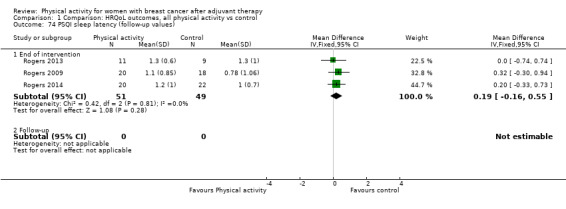
Comparison 1 Comparison: HRQoL outcomes, all physical activity vs control, Outcome 74 PSQI sleep latency (follow‐up values).
1.75
1.75. Analysis
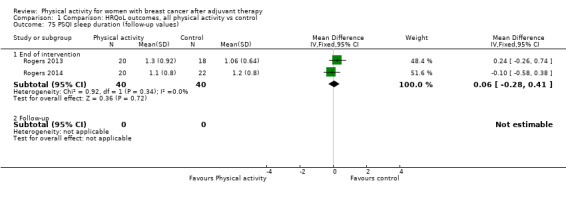
Comparison 1 Comparison: HRQoL outcomes, all physical activity vs control, Outcome 75 PSQI sleep duration (follow‐up values).
1.76
1.76. Analysis
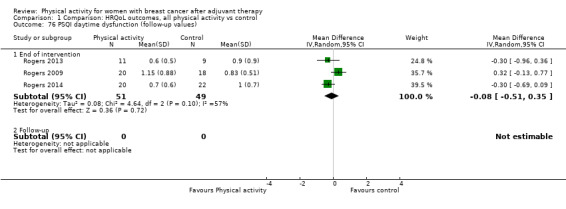
Comparison 1 Comparison: HRQoL outcomes, all physical activity vs control, Outcome 76 PSQI daytime dysfunction (follow‐up values).
1.77
1.77. Analysis
Comparison 1 Comparison: HRQoL outcomes, all physical activity vs control, Outcome 77 PSQI medication use (follow‐up values).
1.78
1.78. Analysis
Comparison 1 Comparison: HRQoL outcomes, all physical activity vs control, Outcome 78 Accelerator‐derived sleep efficiency (follow‐up values).
1.79
1.79. Analysis
Comparison 1 Comparison: HRQoL outcomes, all physical activity vs control, Outcome 79 Accelerator‐derived sleep latency (follow‐up values).
2.1
2.1. Analysis
Comparison 2 Comparison: anxiety, all physical activity vs control, Outcome 1 Overall anxiety (follow‐up values).
2.2
2.2. Analysis
Comparison 2 Comparison: anxiety, all physical activity vs control, Outcome 2 Overall anxiety (change values).
2.3
2.3. Analysis
Comparison 2 Comparison: anxiety, all physical activity vs control, Outcome 3 POMS tension ‐ anxiety (follow‐up values).
2.4
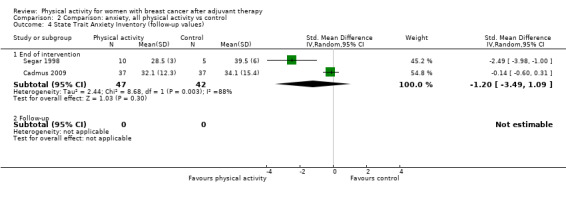
2.4. Analysis
Comparison 2 Comparison: anxiety, all physical activity vs control, Outcome 4 State Trait Anxiety Inventory (follow‐up values).
2.5
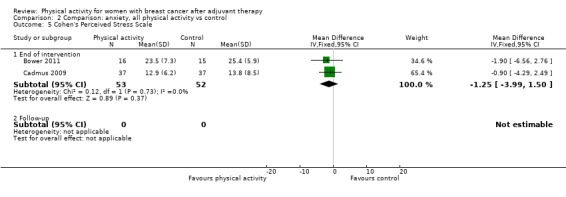
2.5. Analysis
Comparison 2 Comparison: anxiety, all physical activity vs control, Outcome 5 Cohen's Perceived Stress Scale.
3.1
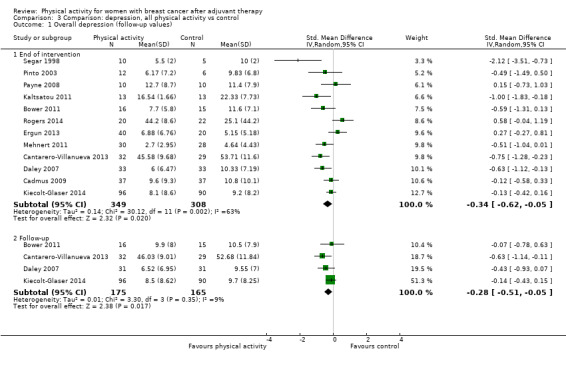
3.1. Analysis
Comparison 3 Comparison: depression, all physical activity vs control, Outcome 1 Overall depression (follow‐up values).
3.2
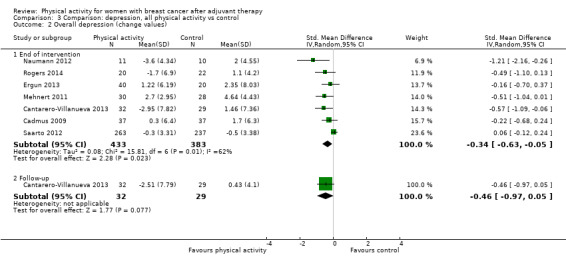
3.2. Analysis
Comparison 3 Comparison: depression, all physical activity vs control, Outcome 2 Overall depression (change values).
3.3
3.3. Analysis
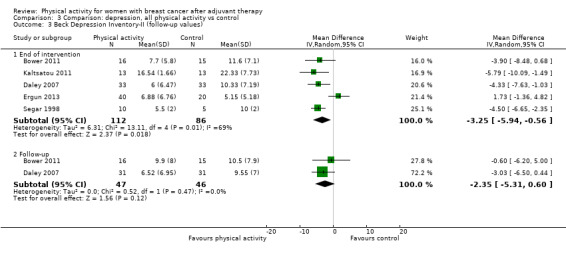
Comparison 3 Comparison: depression, all physical activity vs control, Outcome 3 Beck Depression Inventory‐II (follow‐up values).
3.4
3.4. Analysis
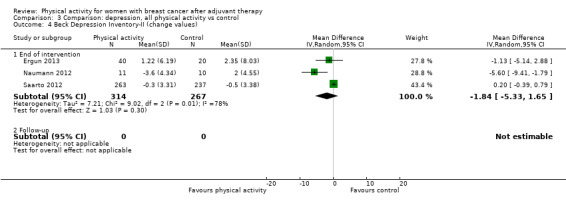
Comparison 3 Comparison: depression, all physical activity vs control, Outcome 4 Beck Depression Inventory‐II (change values).
3.5
3.5. Analysis
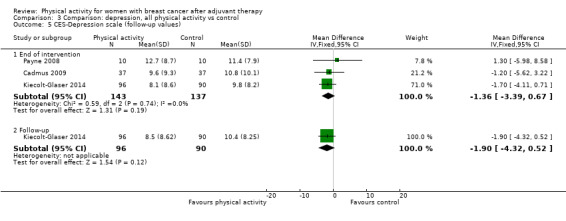
Comparison 3 Comparison: depression, all physical activity vs control, Outcome 5 CES‐Depression scale (follow‐up values).
3.6
3.6. Analysis
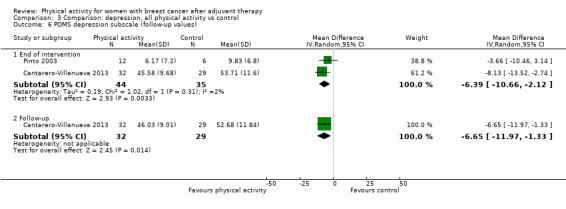
Comparison 3 Comparison: depression, all physical activity vs control, Outcome 6 POMS depression subscale (follow‐up values).
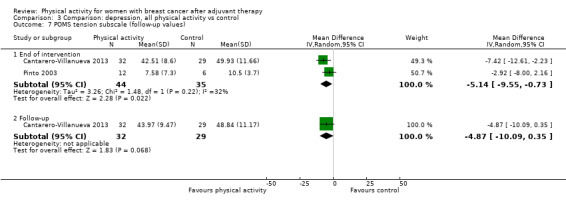
3.7
3.7. Analysis
Comparison 3 Comparison: depression, all physical activity vs control, Outcome 7 POMS tension subscale (follow‐up values).
4.1
4.1. Analysis
Comparison 4 Comparison: fatigue and vigour, all physical activity vs control, Outcome 1 Overall fatigue (follow‐up values).
4.2
4.2. Analysis
Comparison 4 Comparison: fatigue and vigour, all physical activity vs control, Outcome 2 Overall fatigue (change values).
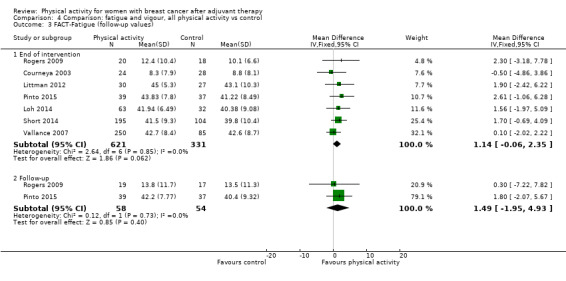
4.3
4.3. Analysis
Comparison 4 Comparison: fatigue and vigour, all physical activity vs control, Outcome 3 FACT‐Fatigue (follow‐up values).
4.4
4.4. Analysis
Comparison 4 Comparison: fatigue and vigour, all physical activity vs control, Outcome 4 FACT‐Fatigue (change values).
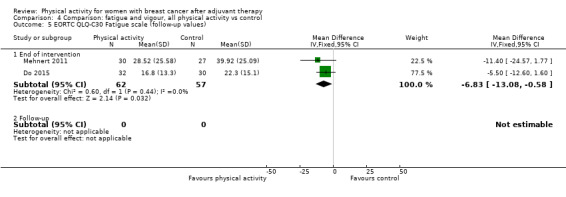
4.5
4.5. Analysis
Comparison 4 Comparison: fatigue and vigour, all physical activity vs control, Outcome 5 EORTC QLQ‐C30 Fatigue scale (follow‐up values).
4.6
4.6. Analysis
Comparison 4 Comparison: fatigue and vigour, all physical activity vs control, Outcome 6 EORTC QLQ‐C30 Fatigue scale (change values).
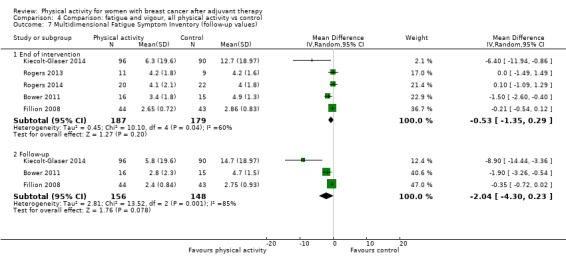
4.7
4.7. Analysis
Comparison 4 Comparison: fatigue and vigour, all physical activity vs control, Outcome 7 Multidimensional Fatigue Symptom Inventory (follow‐up values).
4.8
4.8. Analysis
Comparison 4 Comparison: fatigue and vigour, all physical activity vs control, Outcome 8 Multidimensional Fatigue Symptom Inventory ‐ interference (follow‐up values).
4.9
4.9. Analysis
Comparison 4 Comparison: fatigue and vigour, all physical activity vs control, Outcome 9 Revised Piper Fatigue Scale total fatigue (follow‐up values).
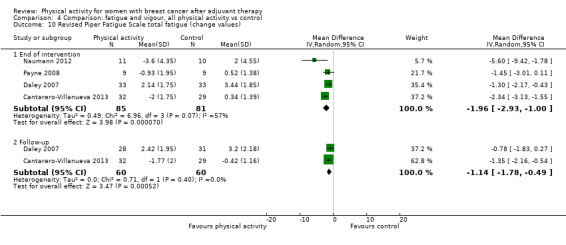
4.10
4.10. Analysis
Comparison 4 Comparison: fatigue and vigour, all physical activity vs control, Outcome 10 Revised Piper Fatigue Scale total fatigue (change values).
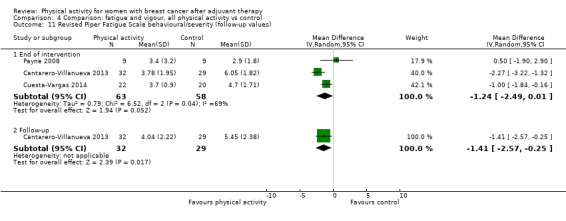
4.11
4.11. Analysis
Comparison 4 Comparison: fatigue and vigour, all physical activity vs control, Outcome 11 Revised Piper Fatigue Scale behavioural/severity (follow‐up values).
4.12
4.12. Analysis
Comparison 4 Comparison: fatigue and vigour, all physical activity vs control, Outcome 12 Revised Piper Fatigue Scale affective/meaning (follow‐up values).
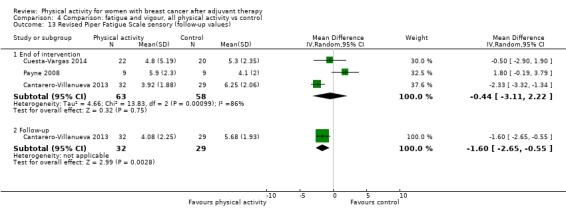
4.13
4.13. Analysis
Comparison 4 Comparison: fatigue and vigour, all physical activity vs control, Outcome 13 Revised Piper Fatigue Scale sensory (follow‐up values).
4.14
4.14. Analysis
Comparison 4 Comparison: fatigue and vigour, all physical activity vs control, Outcome 14 Revised Piper Fatigue Scale cognitive/mood (follow‐up values).
4.15
4.15. Analysis
Comparison 4 Comparison: fatigue and vigour, all physical activity vs control, Outcome 15 Schwartz Cancer Fatigue Scale (follow‐up values).
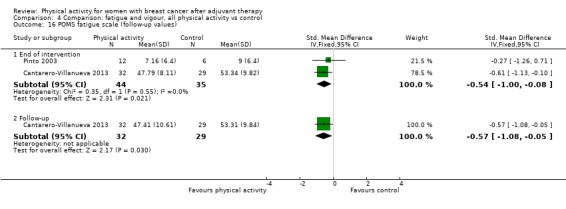
4.16
4.16. Analysis
Comparison 4 Comparison: fatigue and vigour, all physical activity vs control, Outcome 16 POMS fatigue scale (follow‐up values).
4.17
4.17. Analysis
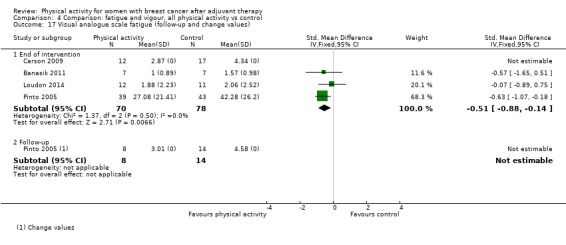
Comparison 4 Comparison: fatigue and vigour, all physical activity vs control, Outcome 17 Visual analogue scale fatigue (follow‐up and change values).
4.18
4.18. Analysis
Comparison 4 Comparison: fatigue and vigour, all physical activity vs control, Outcome 18 Overall vigour/vitality (follow‐up values).
4.19
4.19. Analysis
Comparison 4 Comparison: fatigue and vigour, all physical activity vs control, Outcome 19 Overall vigour/vitality (change values).
4.20
4.20. Analysis
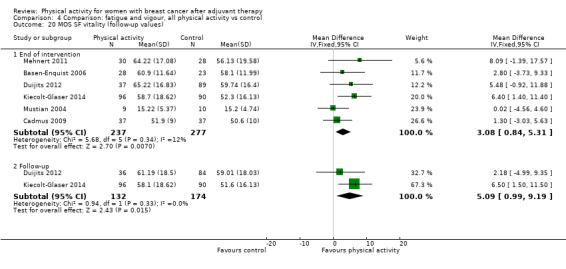
Comparison 4 Comparison: fatigue and vigour, all physical activity vs control, Outcome 20 MOS SF vitality (follow‐up values).
4.21
4.21. Analysis
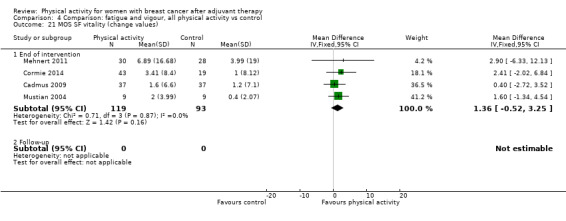
Comparison 4 Comparison: fatigue and vigour, all physical activity vs control, Outcome 21 MOS SF vitality (change values).
4.22
4.22. Analysis
Comparison 4 Comparison: fatigue and vigour, all physical activity vs control, Outcome 22 POMS vigour scale (follow‐up values).
4.23
4.23. Analysis
Comparison 4 Comparison: fatigue and vigour, all physical activity vs control, Outcome 23 POMS vigour scale (change values).
5.1
5.1. Analysis
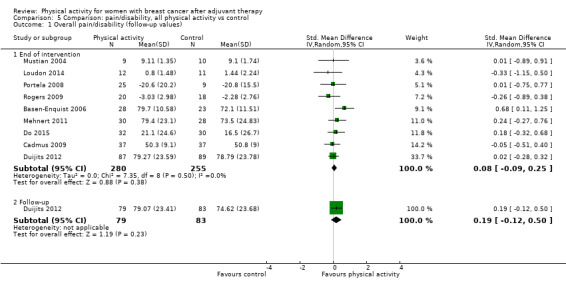
Comparison 5 Comparison: pain/disability, all physical activity vs control, Outcome 1 Overall pain/disability (follow‐up values).
5.2
5.2. Analysis
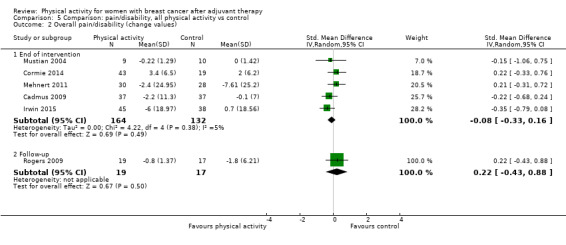
Comparison 5 Comparison: pain/disability, all physical activity vs control, Outcome 2 Overall pain/disability (change values).
5.3
5.3. Analysis
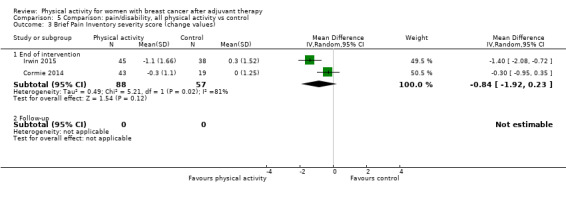
Comparison 5 Comparison: pain/disability, all physical activity vs control, Outcome 3 Brief Pain Inventory severity score (change values).
5.4
5.4. Analysis
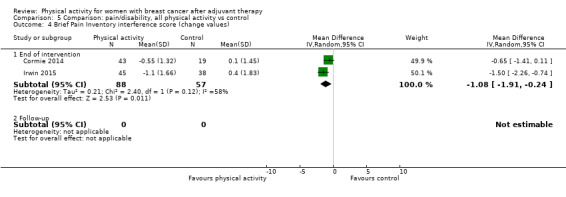
Comparison 5 Comparison: pain/disability, all physical activity vs control, Outcome 4 Brief Pain Inventory interference score (change values).
5.5
5.5. Analysis
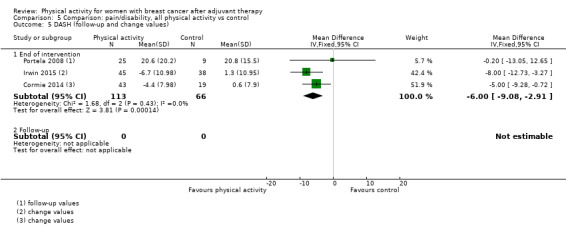
Comparison 5 Comparison: pain/disability, all physical activity vs control, Outcome 5 DASH (follow‐up and change values).
5.6
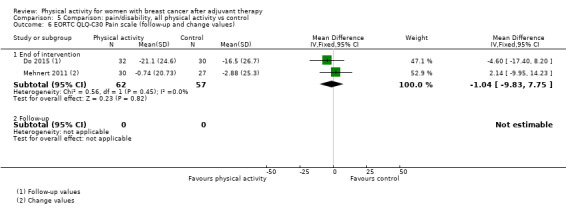
5.6. Analysis
Comparison 5 Comparison: pain/disability, all physical activity vs control, Outcome 6 EORTC QLQ‐C30 Pain scale (follow‐up and change values).
5.7
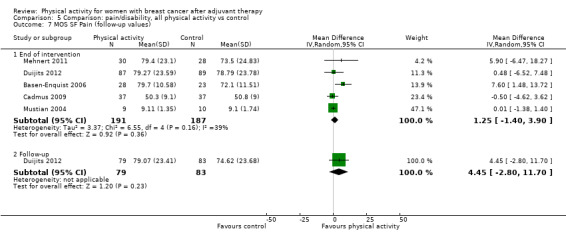
5.7. Analysis
Comparison 5 Comparison: pain/disability, all physical activity vs control, Outcome 7 MOS SF Pain (follow‐up values).
5.8
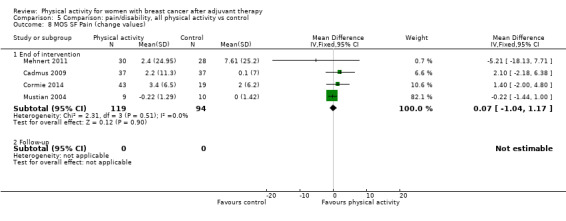
5.8. Analysis
Comparison 5 Comparison: pain/disability, all physical activity vs control, Outcome 8 MOS SF Pain (change values).
5.9
5.9. Analysis
Comparison 5 Comparison: pain/disability, all physical activity vs control, Outcome 9 WOMAC joint pain (follow‐up and change values).
5.10
5.10. Analysis
Comparison 5 Comparison: pain/disability, all physical activity vs control, Outcome 10 WOMAC physical dysfunction (follow‐up and change values).
5.11
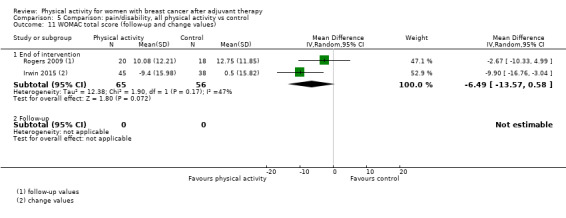
5.11. Analysis
Comparison 5 Comparison: pain/disability, all physical activity vs control, Outcome 11 WOMAC total score (follow‐up and change values).
6.1
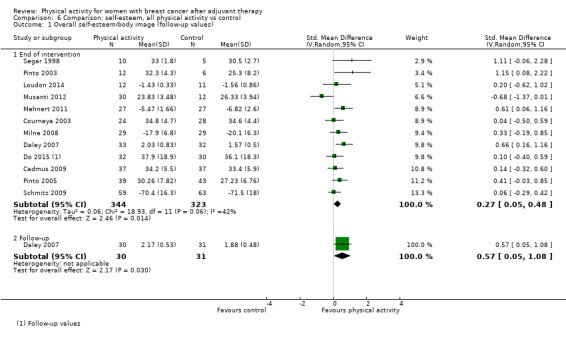
6.1. Analysis
Comparison 6 Comparison: self‐esteem, all physical activity vs control, Outcome 1 Overall self‐esteem/body image (follow‐up values).
6.2
6.2. Analysis
Comparison 6 Comparison: self‐esteem, all physical activity vs control, Outcome 2 Overall self‐esteem/body image (change values).
6.3
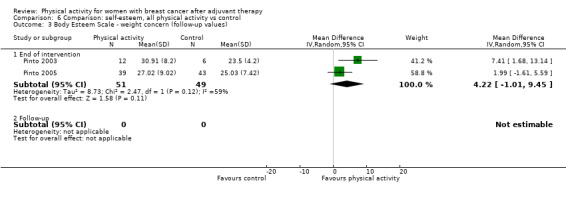
6.3. Analysis
Comparison 6 Comparison: self‐esteem, all physical activity vs control, Outcome 3 Body Esteem Scale ‐ weight concern (follow‐up values).
6.4
6.4. Analysis
Comparison 6 Comparison: self‐esteem, all physical activity vs control, Outcome 4 Physical self‐perception profile ‐ attractiveness of body (follow‐up values).
6.5
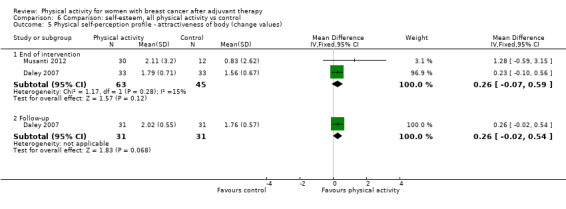
6.5. Analysis
Comparison 6 Comparison: self‐esteem, all physical activity vs control, Outcome 5 Physical self‐perception profile ‐ attractiveness of body (change values).
6.6
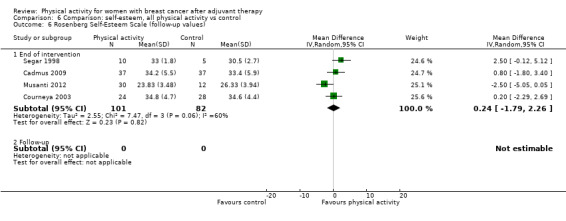
6.6. Analysis
Comparison 6 Comparison: self‐esteem, all physical activity vs control, Outcome 6 Rosenberg Self‐Esteem Scale (follow‐up values).
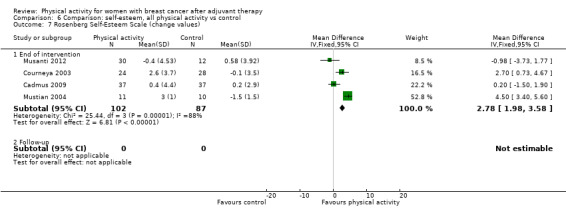
6.7
6.7. Analysis
Comparison 6 Comparison: self‐esteem, all physical activity vs control, Outcome 7 Rosenberg Self‐Esteem Scale (change values).
6.8
6.8. Analysis
Comparison 6 Comparison: self‐esteem, all physical activity vs control, Outcome 8 EORTC QLQ‐C30 Body image (follow‐up and change values).
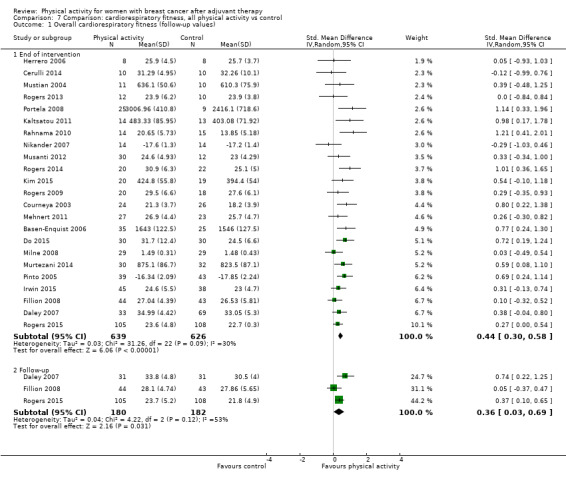
7.1
7.1. Analysis
Comparison 7 Comparison: cardiorespiratory fitness, all physical activity vs control, Outcome 1 Overall cardiorespiratory fitness (follow‐up values).
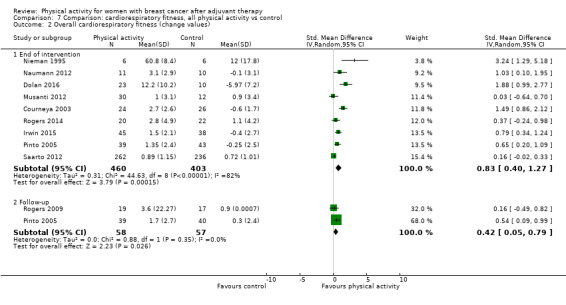
7.2
7.2. Analysis
Comparison 7 Comparison: cardiorespiratory fitness, all physical activity vs control, Outcome 2 Overall cardiorespiratory fitness (change values).
7.3
7.3. Analysis
Comparison 7 Comparison: cardiorespiratory fitness, all physical activity vs control, Outcome 3 Directly assessed VO₂max/peak (follow‐up values).
7.4
7.4. Analysis
Comparison 7 Comparison: cardiorespiratory fitness, all physical activity vs control, Outcome 4 Directly assessed VO₂max/peak (change values).
7.5
7.5. Analysis
Comparison 7 Comparison: cardiorespiratory fitness, all physical activity vs control, Outcome 5 Directly assessed VO₂max/peak ‐ treadmill (follow‐up and change values).
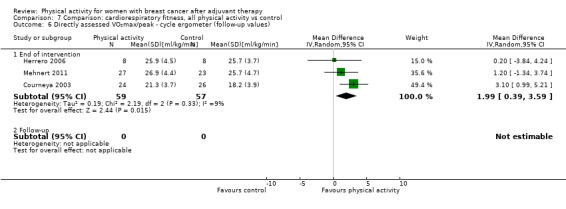
7.6
7.6. Analysis
Comparison 7 Comparison: cardiorespiratory fitness, all physical activity vs control, Outcome 6 Directly assessed VO₂max/peak ‐ cycle ergometer (follow‐up values).
7.7
7.7. Analysis
Comparison 7 Comparison: cardiorespiratory fitness, all physical activity vs control, Outcome 7 Peak Power Output ‐ cycle ergometer test (follow‐up values).
7.8
7.8. Analysis
Comparison 7 Comparison: cardiorespiratory fitness, all physical activity vs control, Outcome 8 Peak Respiratory Exchange Ratio ‐ cycle ergometer test (follow‐up values).
7.9
7.9. Analysis
Comparison 7 Comparison: cardiorespiratory fitness, all physical activity vs control, Outcome 9 Peak Heart Rate ‐ cycle ergometer test (follow‐up values).
7.10
7.10. Analysis
Comparison 7 Comparison: cardiorespiratory fitness, all physical activity vs control, Outcome 10 Ebbeling single‐stage treadmill test (follow‐up and change values).
7.11
7.11. Analysis
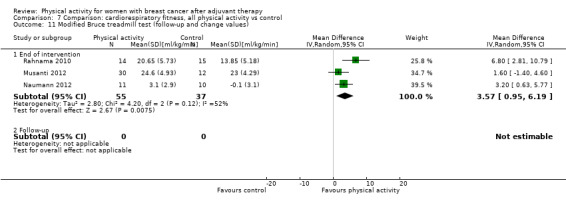
Comparison 7 Comparison: cardiorespiratory fitness, all physical activity vs control, Outcome 11 Modified Bruce treadmill test (follow‐up and change values).
7.12
7.12. Analysis
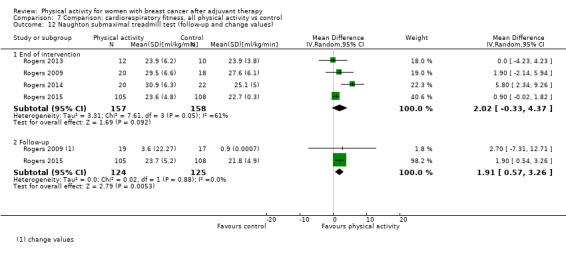
Comparison 7 Comparison: cardiorespiratory fitness, all physical activity vs control, Outcome 12 Naughton submaximal treadmill test (follow‐up and change values).
7.13
7.13. Analysis
Comparison 7 Comparison: cardiorespiratory fitness, all physical activity vs control, Outcome 13 Cardiorespiratory fitness walk tests (follow‐up values).
7.14
7.14. Analysis
Comparison 7 Comparison: cardiorespiratory fitness, all physical activity vs control, Outcome 14 Cardiorespiratory fitness walk tests (change values).
7.15
7.15. Analysis
Comparison 7 Comparison: cardiorespiratory fitness, all physical activity vs control, Outcome 15 6‐Minute walk test (follow‐up and change values).
7.16
7.16. Analysis
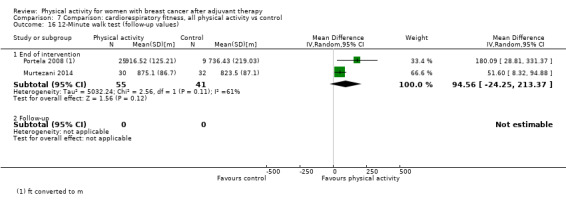
Comparison 7 Comparison: cardiorespiratory fitness, all physical activity vs control, Outcome 16 12‐Minute walk test (follow‐up values).
7.17
7.17. Analysis
Comparison 7 Comparison: cardiorespiratory fitness, all physical activity vs control, Outcome 17 2‐Kilometer walk test (follow‐up and change values).
7.18
7.18. Analysis
Comparison 7 Comparison: cardiorespiratory fitness, all physical activity vs control, Outcome 18 Resting Heart Rate (follow‐up values).
7.19
7.19. Analysis
Comparison 7 Comparison: cardiorespiratory fitness, all physical activity vs control, Outcome 19 Resting Heart Rate (change values).
7.20
7.20. Analysis
Comparison 7 Comparison: cardiorespiratory fitness, all physical activity vs control, Outcome 20 Resting Systolic Blood Pressure (follow‐up values).
7.21
7.21. Analysis
Comparison 7 Comparison: cardiorespiratory fitness, all physical activity vs control, Outcome 21 Resting Systolic Blood Pressure (change values).
7.22
7.22. Analysis
Comparison 7 Comparison: cardiorespiratory fitness, all physical activity vs control, Outcome 22 Resting Diastolic Blood Pressure (follow‐up values).
7.23
7.23. Analysis
Comparison 7 Comparison: cardiorespiratory fitness, all physical activity vs control, Outcome 23 Resting Diastolic Blood Pressure (change values).
8.1
8.1. Analysis
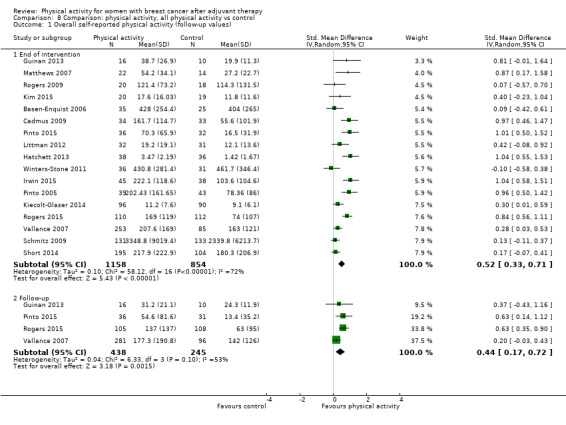
Comparison 8 Comparison: physical activity, all physical activity vs control, Outcome 1 Overall self‐reported physical activity (follow‐up values).
8.2
8.2. Analysis
Comparison 8 Comparison: physical activity, all physical activity vs control, Outcome 2 Overall self‐reported physical activity (change values).
8.3
8.3. Analysis
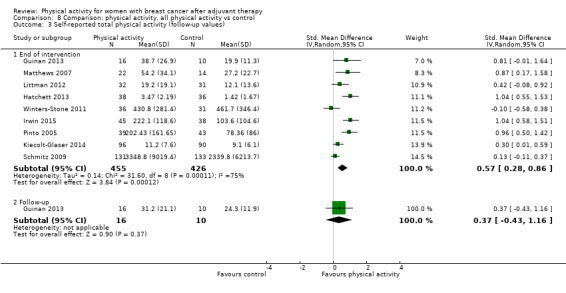
Comparison 8 Comparison: physical activity, all physical activity vs control, Outcome 3 Self‐reported total physical activity (follow‐up values).
8.4
8.4. Analysis
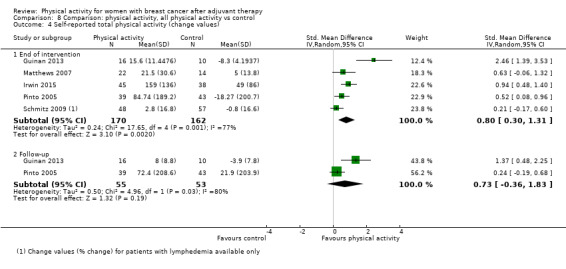
Comparison 8 Comparison: physical activity, all physical activity vs control, Outcome 4 Self‐reported total physical activity (change values).
8.5
8.5. Analysis
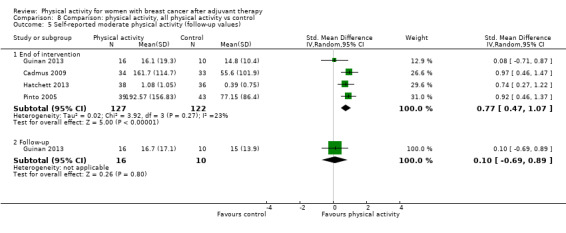
Comparison 8 Comparison: physical activity, all physical activity vs control, Outcome 5 Self‐reported moderate physical activity (follow‐up values).
8.6
8.6. Analysis
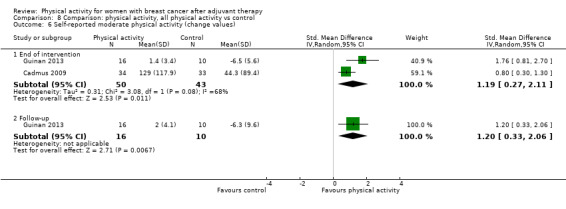
Comparison 8 Comparison: physical activity, all physical activity vs control, Outcome 6 Self‐reported moderate physical activity (change values).
8.7
8.7. Analysis
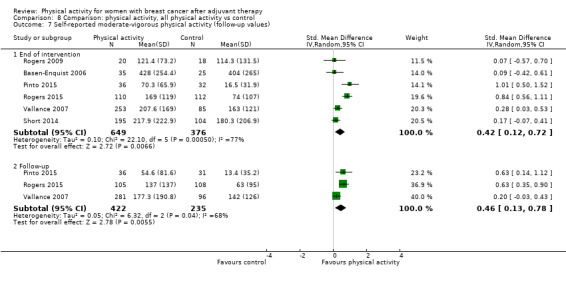
Comparison 8 Comparison: physical activity, all physical activity vs control, Outcome 7 Self‐reported moderate‐vigorous physical activity (follow‐up values).
8.8
8.8. Analysis
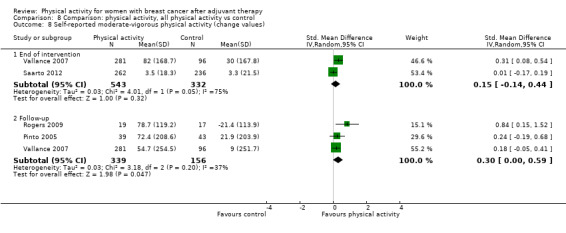
Comparison 8 Comparison: physical activity, all physical activity vs control, Outcome 8 Self‐reported moderate‐vigorous physical activity (change values).
8.9
8.9. Analysis
Comparison 8 Comparison: physical activity, all physical activity vs control, Outcome 9 Self‐reported vigorous physical activity (follow‐up values).
8.10
8.10. Analysis
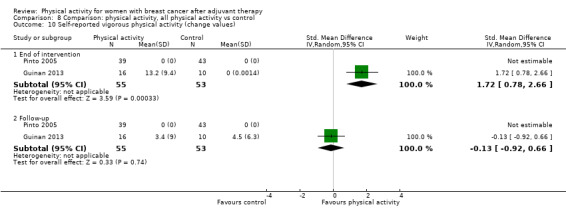
Comparison 8 Comparison: physical activity, all physical activity vs control, Outcome 10 Self‐reported vigorous physical activity (change values).
8.11
8.11. Analysis
Comparison 8 Comparison: physical activity, all physical activity vs control, Outcome 11 Self‐reported walking (follow‐up values).
8.12
8.12. Analysis
Comparison 8 Comparison: physical activity, all physical activity vs control, Outcome 12 Self‐reported walking (change values).
8.13
8.13. Analysis
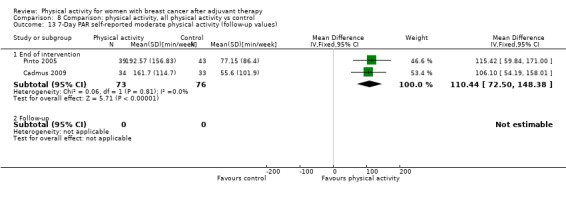
Comparison 8 Comparison: physical activity, all physical activity vs control, Outcome 13 7‐Day PAR self‐reported moderate physical activity (follow‐up values).
8.14
8.14. Analysis
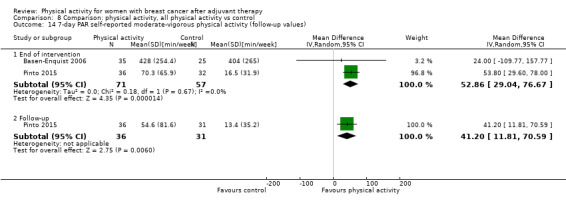
Comparison 8 Comparison: physical activity, all physical activity vs control, Outcome 14 7‐day PAR self‐reported moderate‐vigorous physical activity (follow‐up values).
8.15
8.15. Analysis
Comparison 8 Comparison: physical activity, all physical activity vs control, Outcome 15 Godin LSI self‐reported moderate‐vigorous physical activity (follow‐up values).
8.16
8.16. Analysis
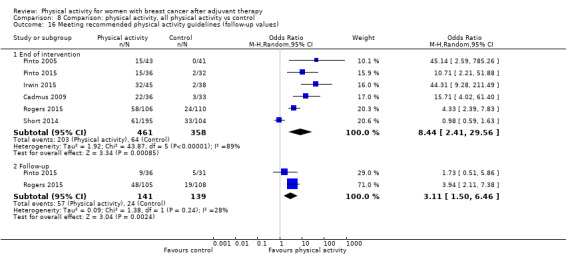
Comparison 8 Comparison: physical activity, all physical activity vs control, Outcome 16 Meeting recommended physical activity guidelines (follow‐up values).
8.17
8.17. Analysis
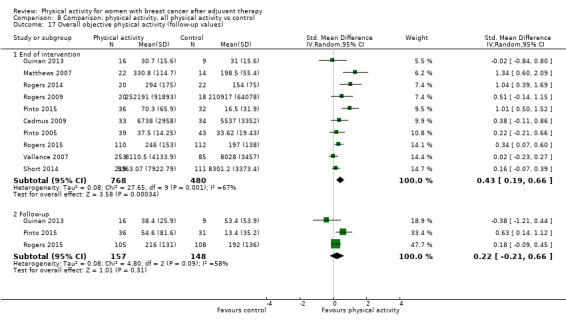
Comparison 8 Comparison: physical activity, all physical activity vs control, Outcome 17 Overall objective physical activity (follow‐up values).
8.18
8.18. Analysis
Comparison 8 Comparison: physical activity, all physical activity vs control, Outcome 18 Overall objective physical activity (change values).
8.19
8.19. Analysis
Comparison 8 Comparison: physical activity, all physical activity vs control, Outcome 19 Objective moderate‐vigorous physical activity (follow‐up values).
8.20
8.20. Analysis
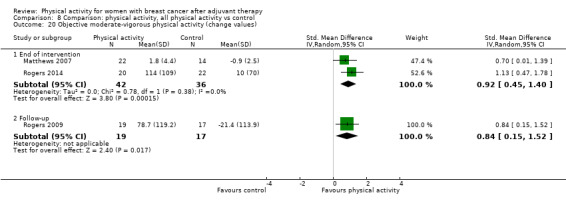
Comparison 8 Comparison: physical activity, all physical activity vs control, Outcome 20 Objective moderate‐vigorous physical activity (change values).
8.21
8.21. Analysis
Comparison 8 Comparison: physical activity, all physical activity vs control, Outcome 21 Objective vigorous physical activity (follow‐up values).
8.22
8.22. Analysis
Comparison 8 Comparison: physical activity, all physical activity vs control, Outcome 22 Accelerometer counts (follow‐up values).
8.23
8.23. Analysis
Comparison 8 Comparison: physical activity, all physical activity vs control, Outcome 23 Pedometer/accelerometer steps/d (follow‐up values).
8.24
8.24. Analysis
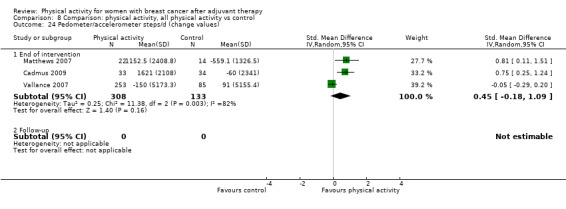
Comparison 8 Comparison: physical activity, all physical activity vs control, Outcome 24 Pedometer/accelerometer steps/d (change values).
8.25
8.25. Analysis
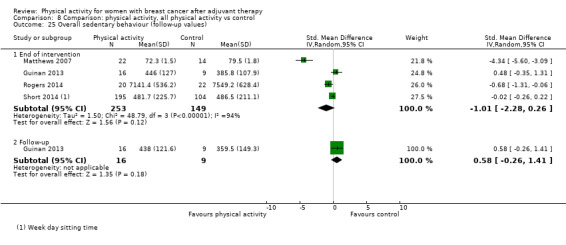
Comparison 8 Comparison: physical activity, all physical activity vs control, Outcome 25 Overall sedentary behaviour (follow‐up values).
8.26
8.26. Analysis
Comparison 8 Comparison: physical activity, all physical activity vs control, Outcome 26 Objective sedentary behaviour (follow‐up values).
8.27
8.27. Analysis
Comparison 8 Comparison: physical activity, all physical activity vs control, Outcome 27 Objective sedentary behaviour (change values).
9.1
9.1. Analysis
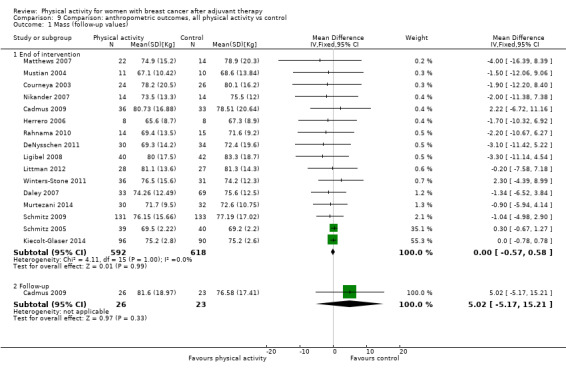
Comparison 9 Comparison: anthropometric outcomes, all physical activity vs control, Outcome 1 Mass (follow‐up values).
9.2
9.2. Analysis
Comparison 9 Comparison: anthropometric outcomes, all physical activity vs control, Outcome 2 Mass (change values).
9.3
9.3. Analysis
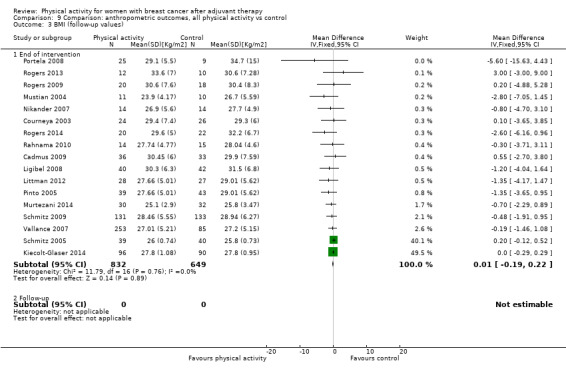
Comparison 9 Comparison: anthropometric outcomes, all physical activity vs control, Outcome 3 BMI (follow‐up values).
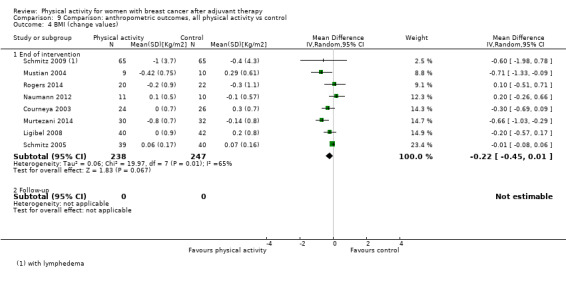
9.4
9.4. Analysis
Comparison 9 Comparison: anthropometric outcomes, all physical activity vs control, Outcome 4 BMI (change values).
9.5
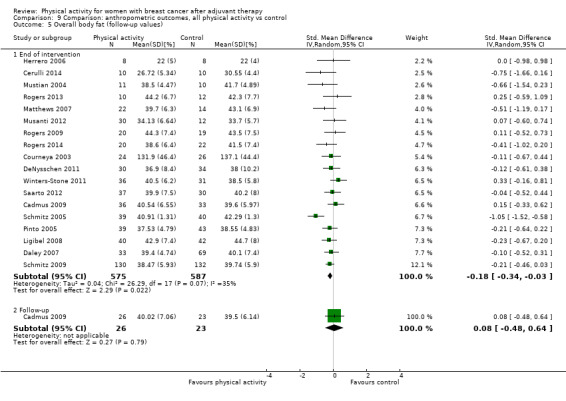
9.5. Analysis
Comparison 9 Comparison: anthropometric outcomes, all physical activity vs control, Outcome 5 Overall body fat (follow‐up values).
9.6
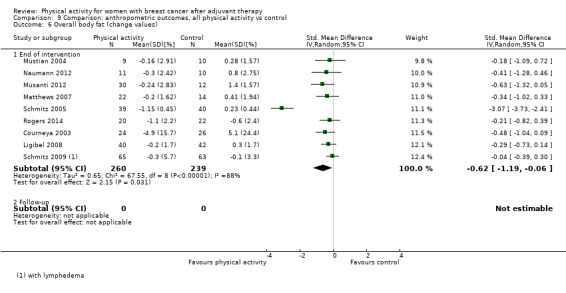
9.6. Analysis
Comparison 9 Comparison: anthropometric outcomes, all physical activity vs control, Outcome 6 Overall body fat (change values).
9.7
9.7. Analysis
Comparison 9 Comparison: anthropometric outcomes, all physical activity vs control, Outcome 7 Percentage body fat ‐ DEXA (follow‐up values).
9.8
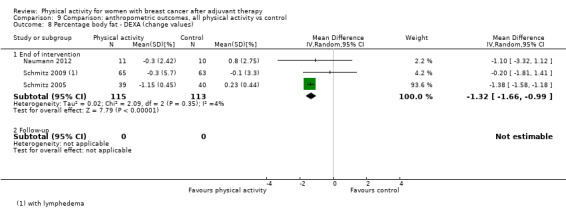
9.8. Analysis
Comparison 9 Comparison: anthropometric outcomes, all physical activity vs control, Outcome 8 Percentage body fat ‐ DEXA (change values).
9.9
9.9. Analysis
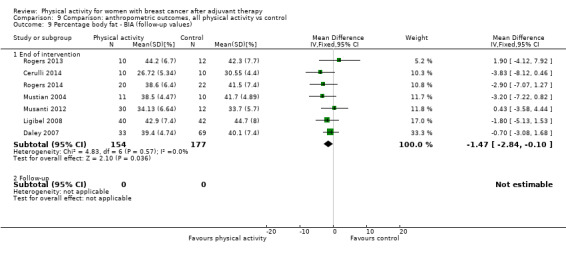
Comparison 9 Comparison: anthropometric outcomes, all physical activity vs control, Outcome 9 Percentage body fat ‐ BIA (follow‐up values).
9.10
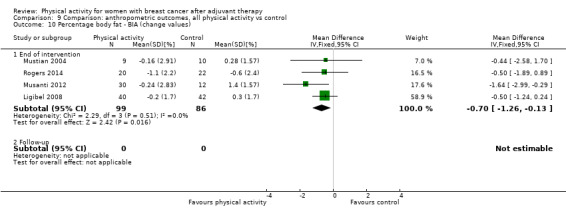
9.10. Analysis
Comparison 9 Comparison: anthropometric outcomes, all physical activity vs control, Outcome 10 Percentage body fat ‐ BIA (change values).
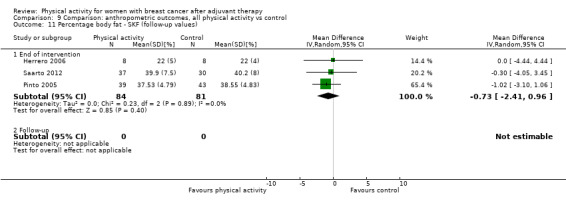
9.11
9.11. Analysis
Comparison 9 Comparison: anthropometric outcomes, all physical activity vs control, Outcome 11 Percentage body fat ‐ SKF (follow‐up values).
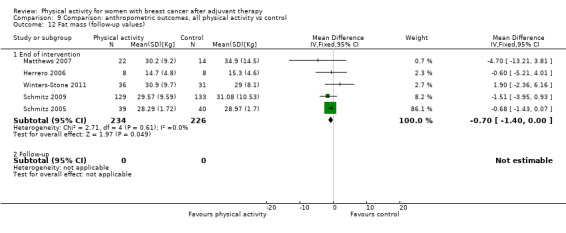
9.12
9.12. Analysis
Comparison 9 Comparison: anthropometric outcomes, all physical activity vs control, Outcome 12 Fat mass (follow‐up values).
9.13
9.13. Analysis
Comparison 9 Comparison: anthropometric outcomes, all physical activity vs control, Outcome 13 Fat mass (change values).
9.14
9.14. Analysis
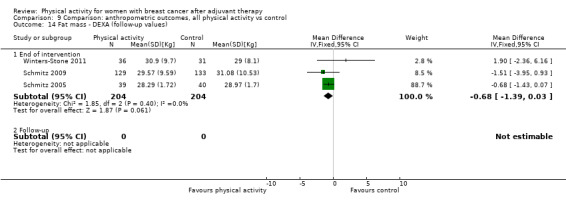
Comparison 9 Comparison: anthropometric outcomes, all physical activity vs control, Outcome 14 Fat mass ‐ DEXA (follow‐up values).
9.15
9.15. Analysis
Comparison 9 Comparison: anthropometric outcomes, all physical activity vs control, Outcome 15 Fat mass ‐ DEXA (change values).
9.16
9.16. Analysis
Comparison 9 Comparison: anthropometric outcomes, all physical activity vs control, Outcome 16 Lean mass (follow‐up values).
9.17
9.17. Analysis
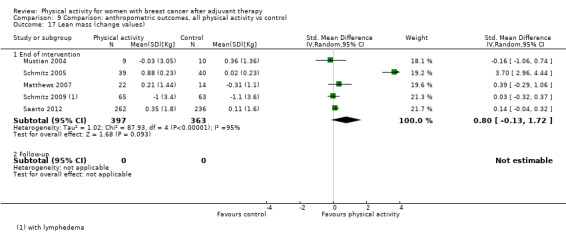
Comparison 9 Comparison: anthropometric outcomes, all physical activity vs control, Outcome 17 Lean mass (change values).
9.18
9.18. Analysis
Comparison 9 Comparison: anthropometric outcomes, all physical activity vs control, Outcome 18 Lean mass ‐ DEXA (follow‐up values).
9.19
9.19. Analysis
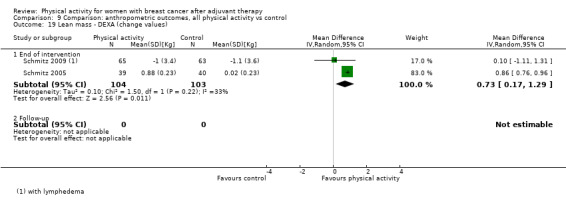
Comparison 9 Comparison: anthropometric outcomes, all physical activity vs control, Outcome 19 Lean mass ‐ DEXA (change values).
9.20
9.20. Analysis
Comparison 9 Comparison: anthropometric outcomes, all physical activity vs control, Outcome 20 Waist‐to‐hip ratio (follow‐up values).
9.21
9.21. Analysis
Comparison 9 Comparison: anthropometric outcomes, all physical activity vs control, Outcome 21 Waist‐to‐hip ratio (change values).
9.22
9.22. Analysis
Comparison 9 Comparison: anthropometric outcomes, all physical activity vs control, Outcome 22 Waist circumference (follow‐up values).
9.23
9.23. Analysis
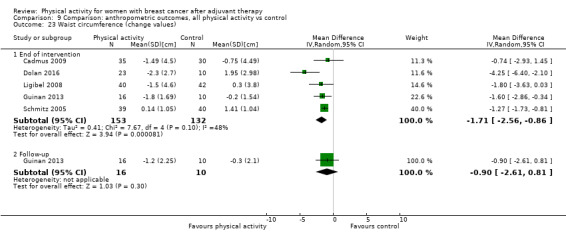
Comparison 9 Comparison: anthropometric outcomes, all physical activity vs control, Outcome 23 Waist circumference (change values).
9.24
9.24. Analysis
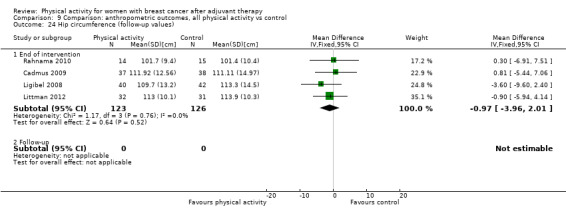
Comparison 9 Comparison: anthropometric outcomes, all physical activity vs control, Outcome 24 Hip circumference (follow‐up values).
9.25
9.25. Analysis
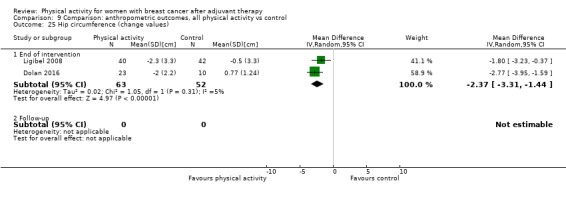
Comparison 9 Comparison: anthropometric outcomes, all physical activity vs control, Outcome 25 Hip circumference (change values).
10.1
10.1. Analysis
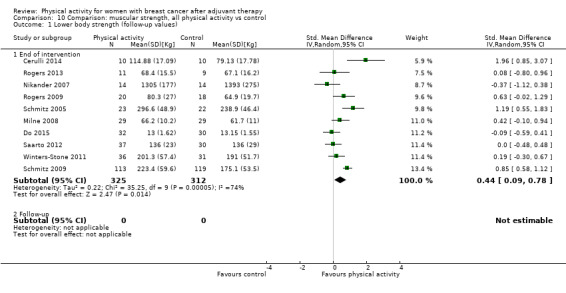
Comparison 10 Comparison: muscular strength, all physical activity vs control, Outcome 1 Lower body strength (follow‐up values).
10.2
10.2. Analysis
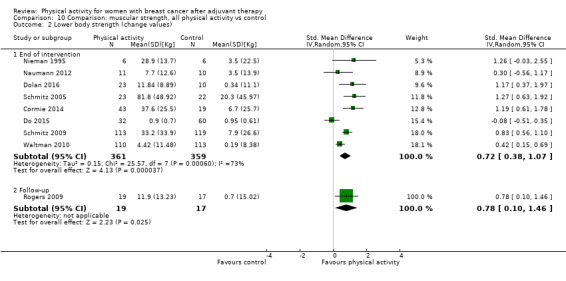
Comparison 10 Comparison: muscular strength, all physical activity vs control, Outcome 2 Lower body strength (change values).
10.3
10.3. Analysis
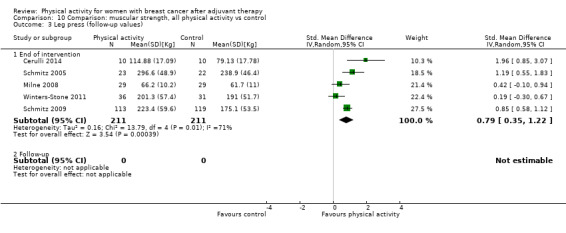
Comparison 10 Comparison: muscular strength, all physical activity vs control, Outcome 3 Leg press (follow‐up values).
10.4
10.4. Analysis
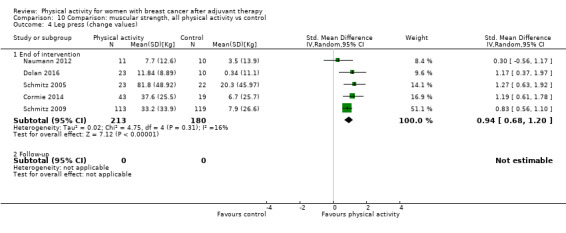
Comparison 10 Comparison: muscular strength, all physical activity vs control, Outcome 4 Leg press (change values).
10.5
10.5. Analysis
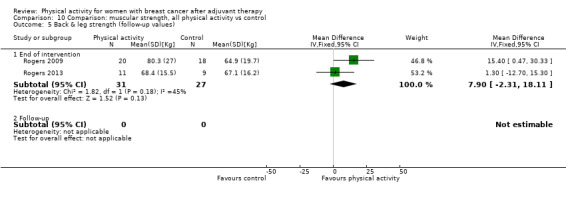
Comparison 10 Comparison: muscular strength, all physical activity vs control, Outcome 5 Back & leg strength (follow‐up values).
10.6
10.6. Analysis
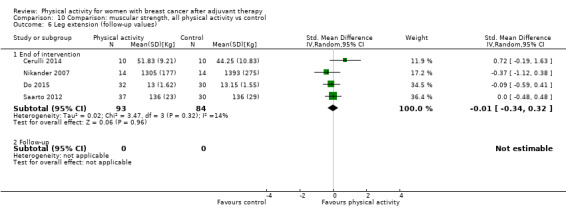
Comparison 10 Comparison: muscular strength, all physical activity vs control, Outcome 6 Leg extension (follow‐up values).
10.7
10.7. Analysis
Comparison 10 Comparison: muscular strength, all physical activity vs control, Outcome 7 Leg extension (change values).
10.8
10.8. Analysis
Comparison 10 Comparison: muscular strength, all physical activity vs control, Outcome 8 Hip extension (follow‐up values).
10.9
10.9. Analysis
Comparison 10 Comparison: muscular strength, all physical activity vs control, Outcome 9 Hip flexion (follow‐up values).
10.10
10.10. Analysis
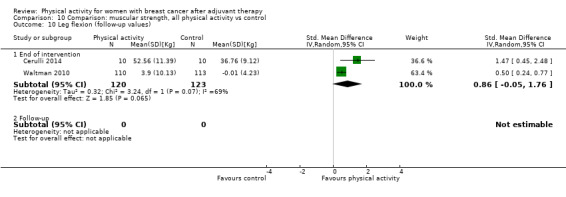
Comparison 10 Comparison: muscular strength, all physical activity vs control, Outcome 10 Leg flexion (follow‐up values).
10.11
10.11. Analysis
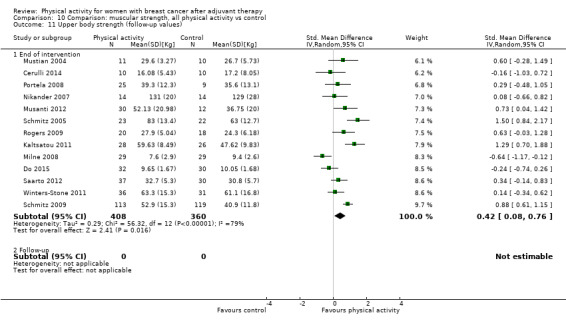
Comparison 10 Comparison: muscular strength, all physical activity vs control, Outcome 11 Upper body strength (follow‐up values).
10.12
10.12. Analysis
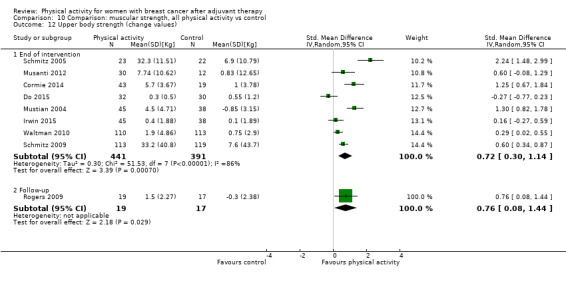
Comparison 10 Comparison: muscular strength, all physical activity vs control, Outcome 12 Upper body strength (change values).
10.13
10.13. Analysis
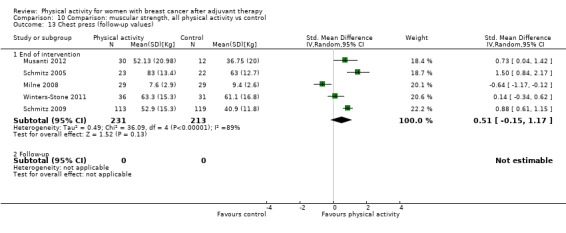
Comparison 10 Comparison: muscular strength, all physical activity vs control, Outcome 13 Chest press (follow‐up values).
10.14
10.14. Analysis
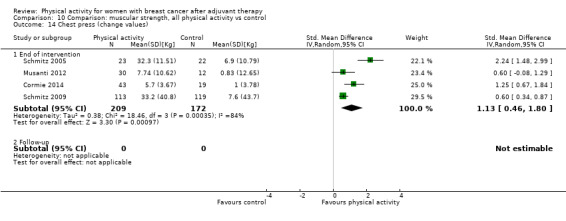
Comparison 10 Comparison: muscular strength, all physical activity vs control, Outcome 14 Chest press (change values).
10.15
10.15. Analysis
Comparison 10 Comparison: muscular strength, all physical activity vs control, Outcome 15 Grip strength (follow‐up).
10.16
10.16. Analysis
Comparison 10 Comparison: muscular strength, all physical activity vs control, Outcome 16 Grip strength (change values).
10.17
10.17. Analysis
Comparison 10 Comparison: muscular strength, all physical activity vs control, Outcome 17 Grip strength right hand (follow‐up).
10.18
10.18. Analysis
Comparison 10 Comparison: muscular strength, all physical activity vs control, Outcome 18 Grip strength left hand (follow‐up).
10.19
10.19. Analysis
Comparison 10 Comparison: muscular strength, all physical activity vs control, Outcome 19 Elbow flexion (follow‐up values).
11.1
11.1. Analysis
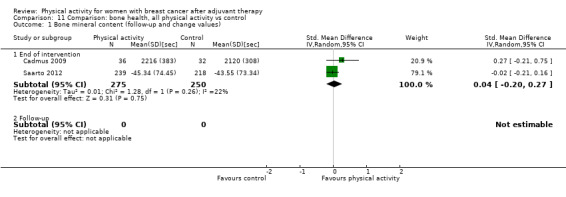
Comparison 11 Comparison: bone health, all physical activity vs control, Outcome 1 Bone mineral content (follow‐up and change values).
11.2
11.2. Analysis
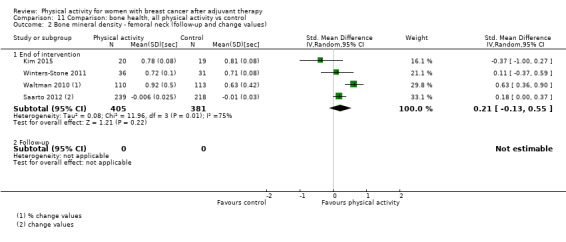
Comparison 11 Comparison: bone health, all physical activity vs control, Outcome 2 Bone mineral density ‐ femoral neck (follow‐up and change values).
11.3
11.3. Analysis
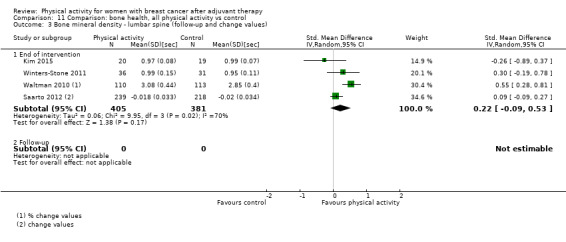
Comparison 11 Comparison: bone health, all physical activity vs control, Outcome 3 Bone mineral density ‐ lumbar spine (follow‐up and change values).
11.4
11.4. Analysis
Comparison 11 Comparison: bone health, all physical activity vs control, Outcome 4 Bone mineral density ‐ total hip (follow‐up and change values).
11.5
11.5. Analysis
Comparison 11 Comparison: bone health, all physical activity vs control, Outcome 5 Bone formation ‐ alkaline phosphatase (follow‐up and change values).
11.6
11.6. Analysis
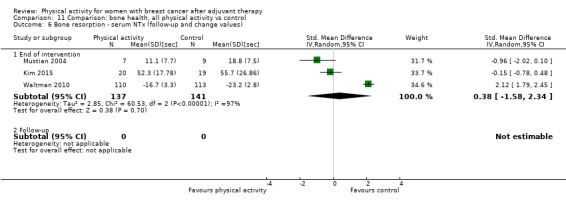
Comparison 11 Comparison: bone health, all physical activity vs control, Outcome 6 Bone resorption ‐ serum NTx (follow‐up and change values).
12.1
12.1. Analysis
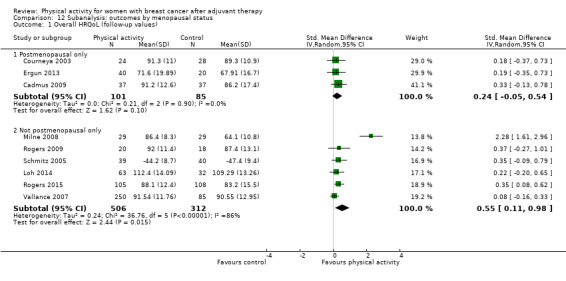
Comparison 12 Subanalysis: outcomes by menopausal status, Outcome 1 Overall HRQoL (follow‐up values).
12.2
12.2. Analysis
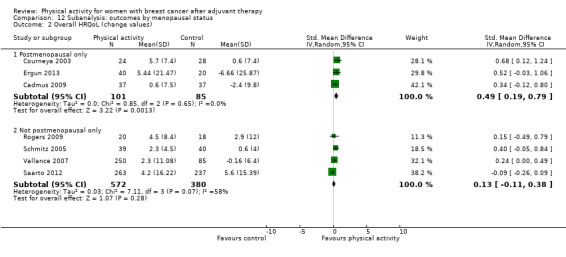
Comparison 12 Subanalysis: outcomes by menopausal status, Outcome 2 Overall HRQoL (change values).
12.3
12.3. Analysis
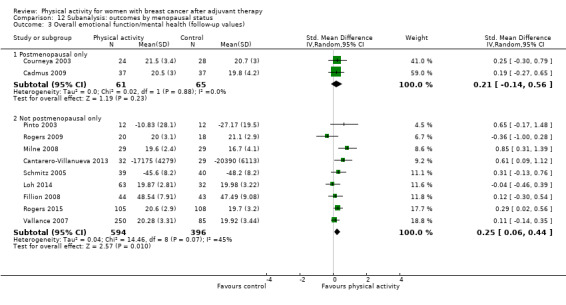
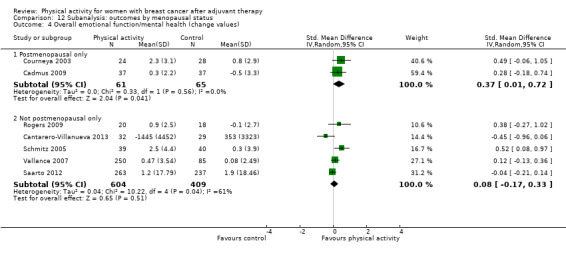
Comparison 12 Subanalysis: outcomes by menopausal status, Outcome 3 Overall emotional function/mental health (follow‐up values).
12.4
12.4. Analysis
Comparison 12 Subanalysis: outcomes by menopausal status, Outcome 4 Overall emotional function/mental health (change values).
12.5
12.5. Analysis
Comparison 12 Subanalysis: outcomes by menopausal status, Outcome 5 Overall physical function (follow‐up values).
12.6
12.6. Analysis
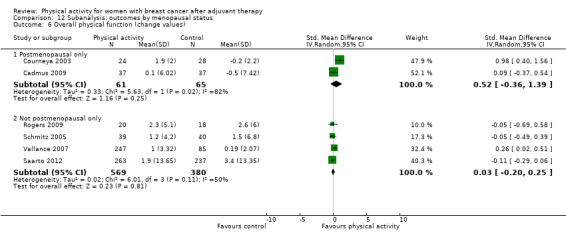
Comparison 12 Subanalysis: outcomes by menopausal status, Outcome 6 Overall physical function (change values).
12.7
12.7. Analysis
Comparison 12 Subanalysis: outcomes by menopausal status, Outcome 7 Overall role function (follow‐up values).
12.8
12.8. Analysis
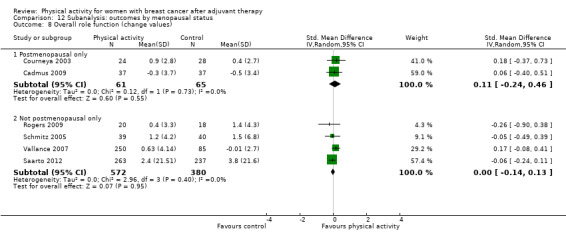
Comparison 12 Subanalysis: outcomes by menopausal status, Outcome 8 Overall role function (change values).
12.9
12.9. Analysis
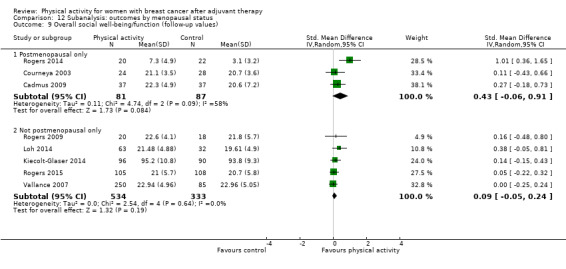
Comparison 12 Subanalysis: outcomes by menopausal status, Outcome 9 Overall social well‐being/function (follow‐up values).
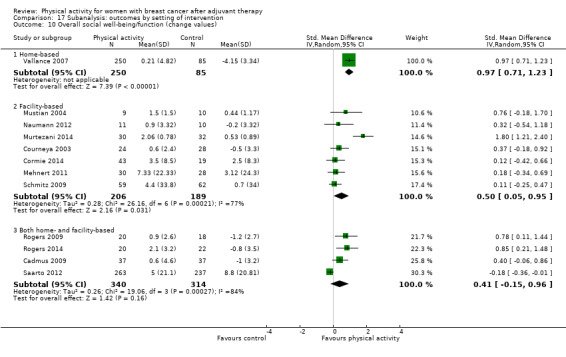
12.10
12.10. Analysis
Comparison 12 Subanalysis: outcomes by menopausal status, Outcome 10 Overall social well‐being/function (change values).
12.11
12.11. Analysis
Comparison 12 Subanalysis: outcomes by menopausal status, Outcome 11 Overall cognitive function (follow‐up values).
12.12
12.12. Analysis
Comparison 12 Subanalysis: outcomes by menopausal status, Outcome 12 Overall cognitive function (change values).
12.13
12.13. Analysis
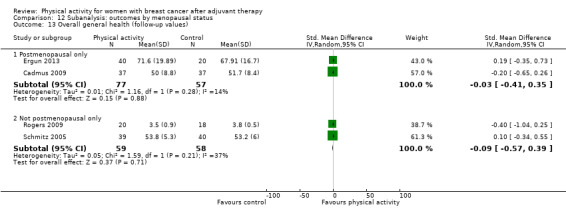
Comparison 12 Subanalysis: outcomes by menopausal status, Outcome 13 Overall general health (follow‐up values).
12.14
12.14. Analysis
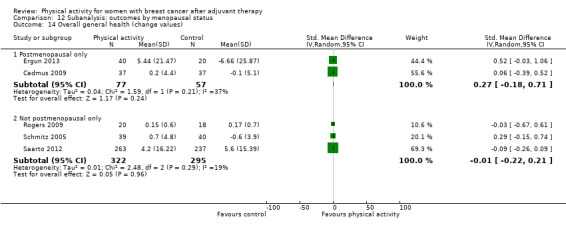
Comparison 12 Subanalysis: outcomes by menopausal status, Outcome 14 Overall general health (change values).
12.15
12.15. Analysis
Comparison 12 Subanalysis: outcomes by menopausal status, Outcome 15 Overall sexual function (follow‐up values).
12.16
12.16. Analysis
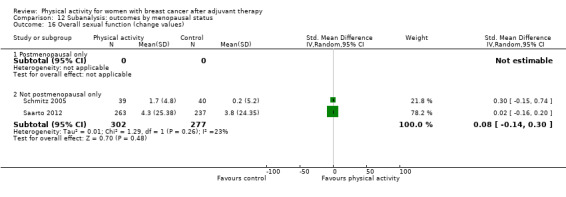
Comparison 12 Subanalysis: outcomes by menopausal status, Outcome 16 Overall sexual function (change values).
12.17
12.17. Analysis
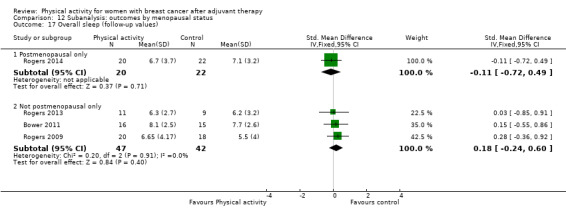
Comparison 12 Subanalysis: outcomes by menopausal status, Outcome 17 Overall sleep (follow‐up values).
12.18
12.18. Analysis
Comparison 12 Subanalysis: outcomes by menopausal status, Outcome 18 Overall sleep (change values).
12.19
12.19. Analysis
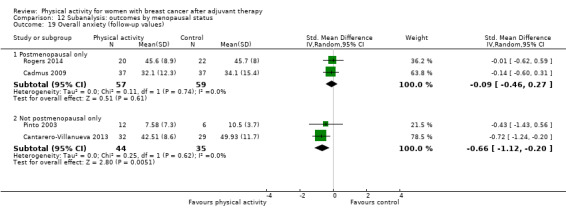
Comparison 12 Subanalysis: outcomes by menopausal status, Outcome 19 Overall anxiety (follow‐up values).
12.20
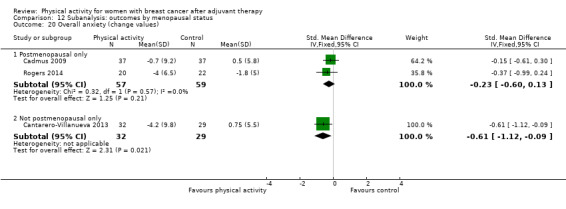
12.20. Analysis
Comparison 12 Subanalysis: outcomes by menopausal status, Outcome 20 Overall anxiety (change values).
12.21
12.21. Analysis
Comparison 12 Subanalysis: outcomes by menopausal status, Outcome 21 Overall self‐esteem/body image (follow‐up values).
12.22
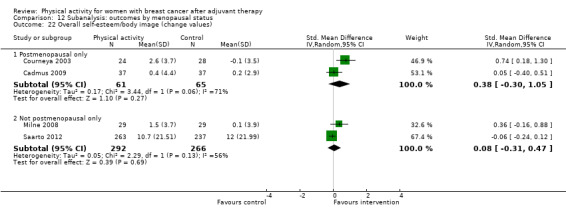
12.22. Analysis
Comparison 12 Subanalysis: outcomes by menopausal status, Outcome 22 Overall self‐esteem/body image (change values).
12.23
12.23. Analysis
Comparison 12 Subanalysis: outcomes by menopausal status, Outcome 23 Overall depression (follow‐up values).
12.24
12.24. Analysis
Comparison 12 Subanalysis: outcomes by menopausal status, Outcome 24 Overall depression (change values).
12.25
12.25. Analysis
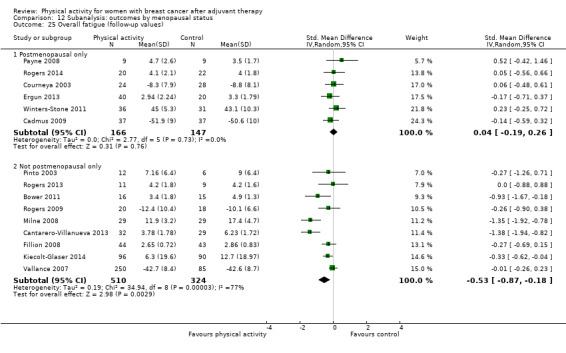
Comparison 12 Subanalysis: outcomes by menopausal status, Outcome 25 Overall fatigue (follow‐up values).
12.26
12.26. Analysis
Comparison 12 Subanalysis: outcomes by menopausal status, Outcome 26 Overall fatigue (change values).
12.27
12.27. Analysis
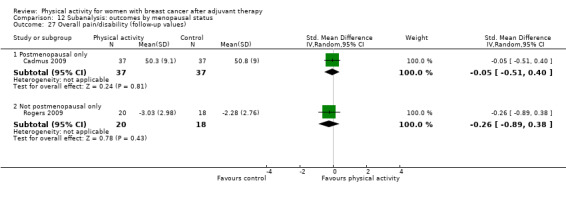
Comparison 12 Subanalysis: outcomes by menopausal status, Outcome 27 Overall pain/disability (follow‐up values).
12.28
12.28. Analysis
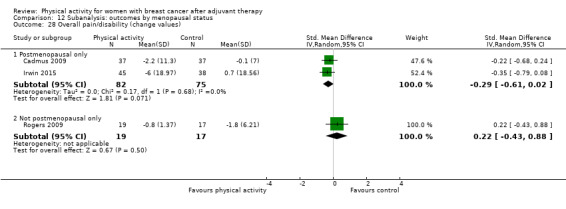
Comparison 12 Subanalysis: outcomes by menopausal status, Outcome 28 Overall pain/disability (change values).
12.29
12.29. Analysis
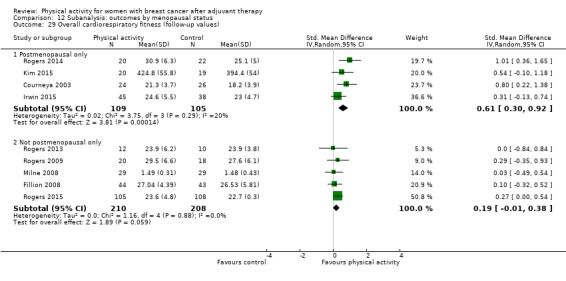
Comparison 12 Subanalysis: outcomes by menopausal status, Outcome 29 Overall cardiorespiratory fitness (follow‐up values).
12.30
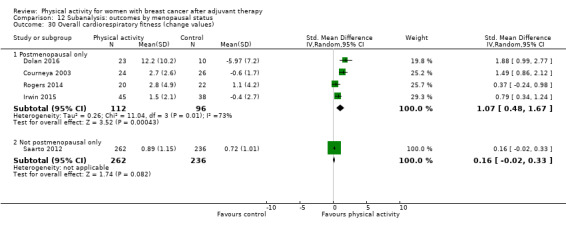
12.30. Analysis
Comparison 12 Subanalysis: outcomes by menopausal status, Outcome 30 Overall cardiorespiratory fitness (change values).
12.31
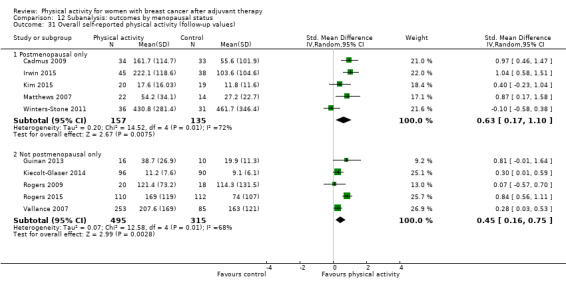
12.31. Analysis
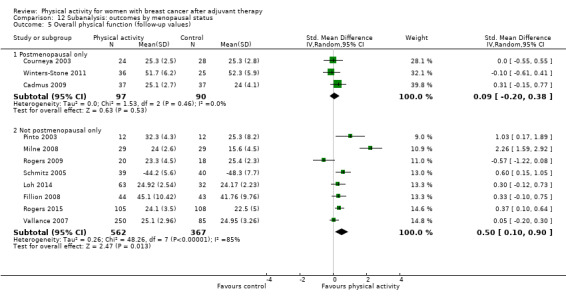
Comparison 12 Subanalysis: outcomes by menopausal status, Outcome 31 Overall self‐reported physical activity (follow‐up values).
12.32
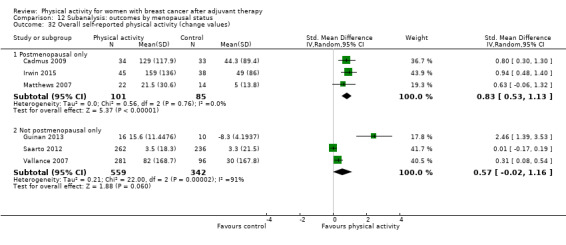
12.32. Analysis
Comparison 12 Subanalysis: outcomes by menopausal status, Outcome 32 Overall self‐reported physical activity (change values).
12.33
12.33. Analysis
Comparison 12 Subanalysis: outcomes by menopausal status, Outcome 33 Overall objective physical activity (follow‐up values).
12.34
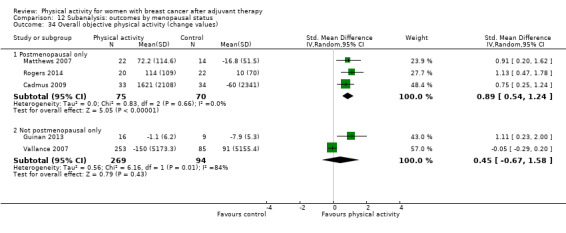
12.34. Analysis
Comparison 12 Subanalysis: outcomes by menopausal status, Outcome 34 Overall objective physical activity (change values).
12.35
12.35. Analysis
Comparison 12 Subanalysis: outcomes by menopausal status, Outcome 35 Mass (follow‐up values).
12.36
12.36. Analysis
Comparison 12 Subanalysis: outcomes by menopausal status, Outcome 36 Mass (change values).
12.37
12.37. Analysis
Comparison 12 Subanalysis: outcomes by menopausal status, Outcome 37 BMI (follow‐up values).
12.38
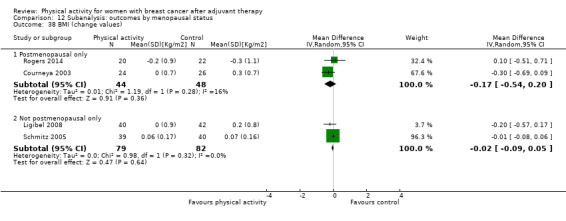
12.38. Analysis
Comparison 12 Subanalysis: outcomes by menopausal status, Outcome 38 BMI (change values).
12.39
12.39. Analysis
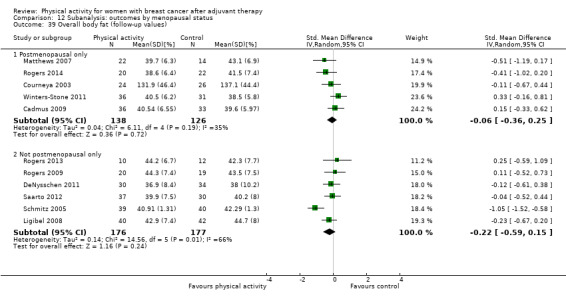
Comparison 12 Subanalysis: outcomes by menopausal status, Outcome 39 Overall body fat (follow‐up values).
12.40
12.40. Analysis
Comparison 12 Subanalysis: outcomes by menopausal status, Outcome 40 Overall body fat (change values).
12.41
12.41. Analysis
Comparison 12 Subanalysis: outcomes by menopausal status, Outcome 41 Lower body strength (follow‐up values).
12.42
12.42. Analysis
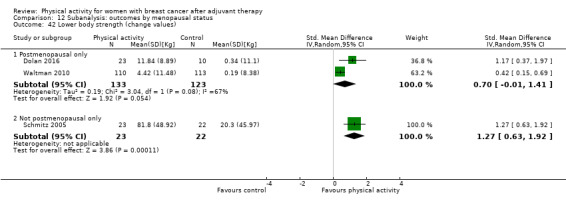
Comparison 12 Subanalysis: outcomes by menopausal status, Outcome 42 Lower body strength (change values).
12.43
12.43. Analysis
Comparison 12 Subanalysis: outcomes by menopausal status, Outcome 43 Upper body strength (follow‐up values).
12.44
12.44. Analysis
Comparison 12 Subanalysis: outcomes by menopausal status, Outcome 44 Upper body strength (change values).
12.45
12.45. Analysis
Comparison 12 Subanalysis: outcomes by menopausal status, Outcome 45 Bone mineral density ‐ femoral neck (follow‐up and change values).
12.46
12.46. Analysis
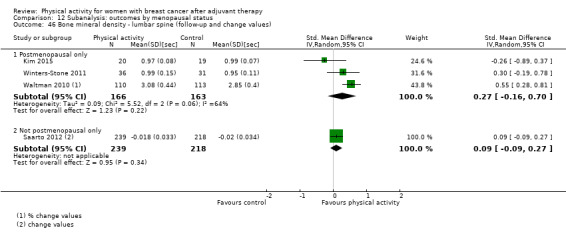
Comparison 12 Subanalysis: outcomes by menopausal status, Outcome 46 Bone mineral density ‐ lumbar spine (follow‐up and change values).
13.1
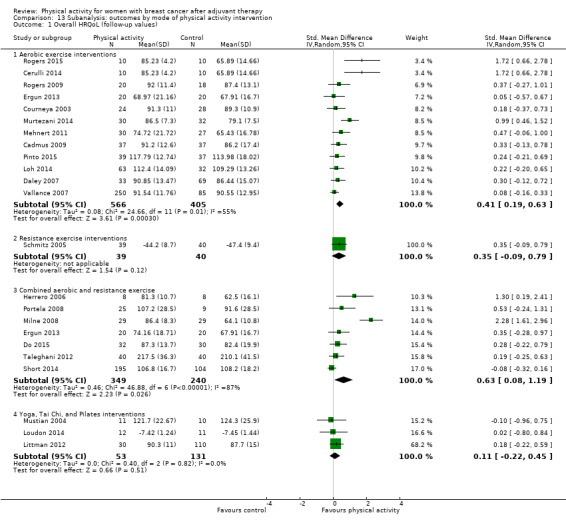
13.1. Analysis
Comparison 13 Subanalysis: outcomes by mode of physical activity intervention, Outcome 1 Overall HRQoL (follow‐up values).
13.2
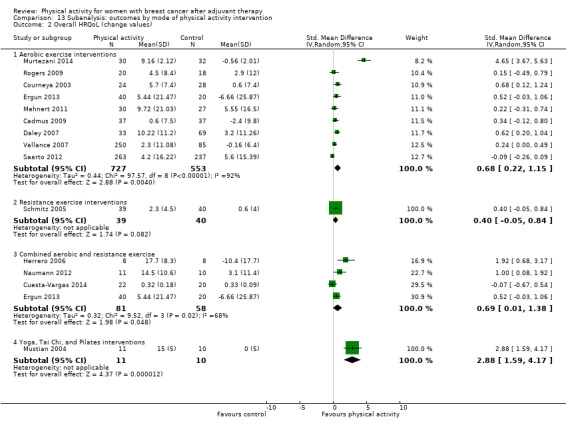
13.2. Analysis
Comparison 13 Subanalysis: outcomes by mode of physical activity intervention, Outcome 2 Overall HRQoL (change values).
13.3
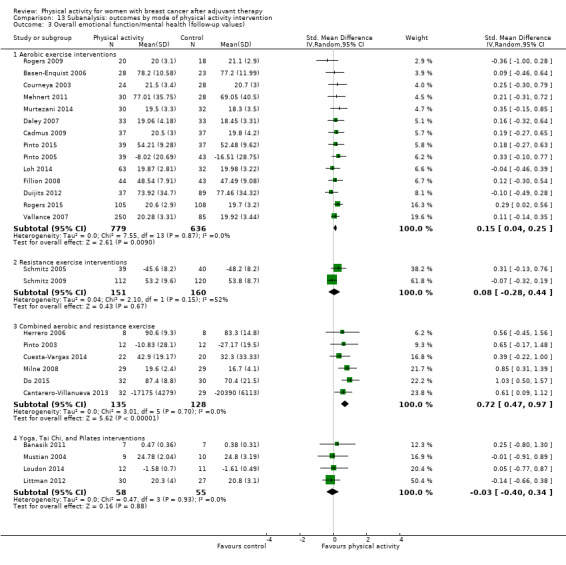
13.3. Analysis
Comparison 13 Subanalysis: outcomes by mode of physical activity intervention, Outcome 3 Overall emotional function/mental health (follow‐up values).
13.4
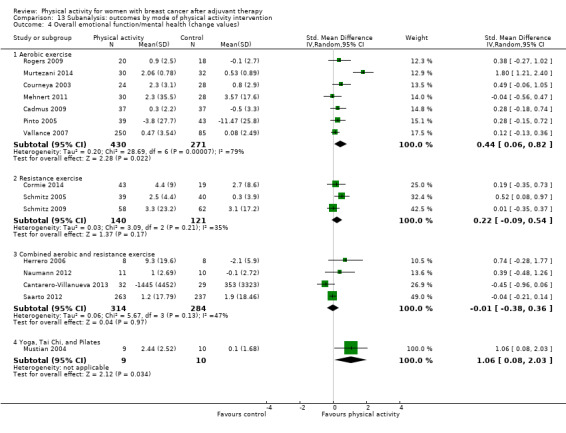
13.4. Analysis
Comparison 13 Subanalysis: outcomes by mode of physical activity intervention, Outcome 4 Overall emotional function/mental health (change values).
13.5
13.5. Analysis
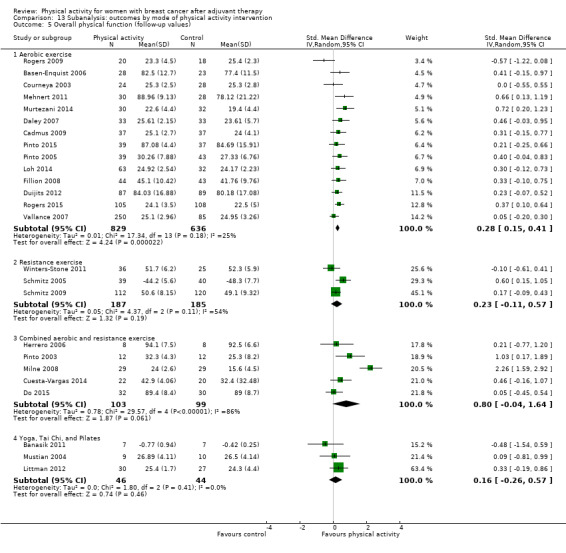
Comparison 13 Subanalysis: outcomes by mode of physical activity intervention, Outcome 5 Overall physical function (follow‐up values).
13.6
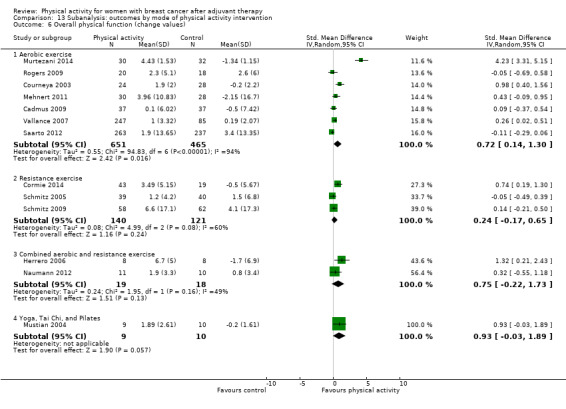
13.6. Analysis
Comparison 13 Subanalysis: outcomes by mode of physical activity intervention, Outcome 6 Overall physical function (change values).
13.7
13.7. Analysis
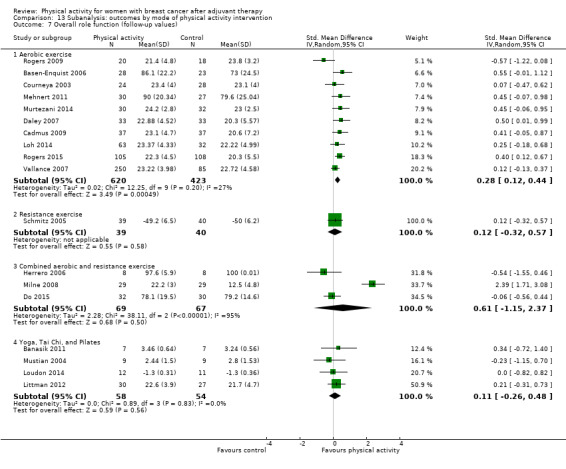
Comparison 13 Subanalysis: outcomes by mode of physical activity intervention, Outcome 7 Overall role function (follow‐up values).
13.8
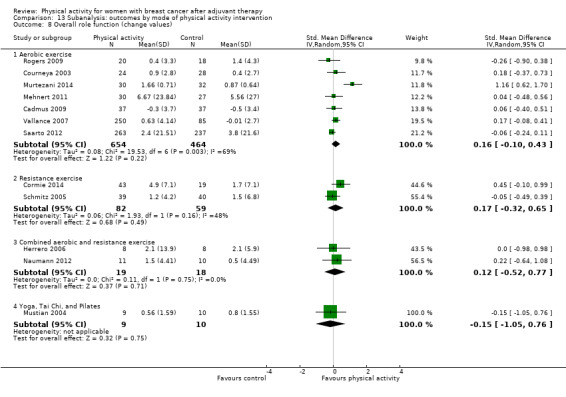
13.8. Analysis
Comparison 13 Subanalysis: outcomes by mode of physical activity intervention, Outcome 8 Overall role function (change values).
13.9
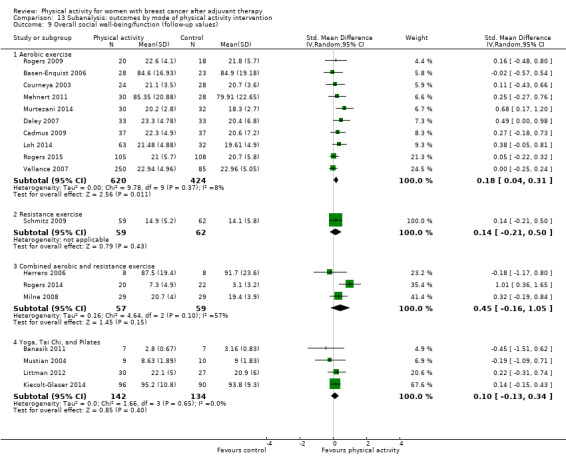
13.9. Analysis
Comparison 13 Subanalysis: outcomes by mode of physical activity intervention, Outcome 9 Overall social well‐being/function (follow‐up values).
13.10
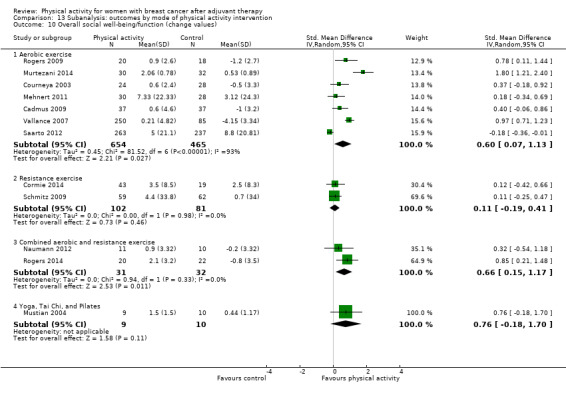
13.10. Analysis
Comparison 13 Subanalysis: outcomes by mode of physical activity intervention, Outcome 10 Overall social well‐being/function (change values).
13.11
13.11. Analysis
Comparison 13 Subanalysis: outcomes by mode of physical activity intervention, Outcome 11 Overall cognitive function (follow‐up values).
13.12
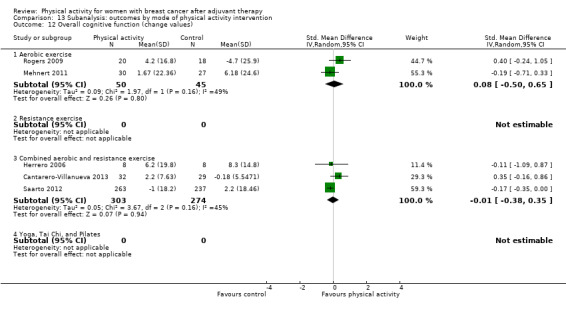
13.12. Analysis
Comparison 13 Subanalysis: outcomes by mode of physical activity intervention, Outcome 12 Overall cognitive function (change values).
13.13
13.13. Analysis
Comparison 13 Subanalysis: outcomes by mode of physical activity intervention, Outcome 13 Overall general health (follow‐up values).
13.14
13.14. Analysis
Comparison 13 Subanalysis: outcomes by mode of physical activity intervention, Outcome 14 Overall general health (change values).
13.15
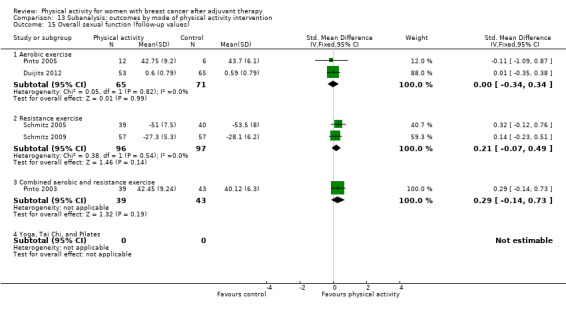
13.15. Analysis
Comparison 13 Subanalysis: outcomes by mode of physical activity intervention, Outcome 15 Overall sexual function (follow‐up values).
13.16
13.16. Analysis
Comparison 13 Subanalysis: outcomes by mode of physical activity intervention, Outcome 16 Overall sexual function (change values).
13.17
13.17. Analysis
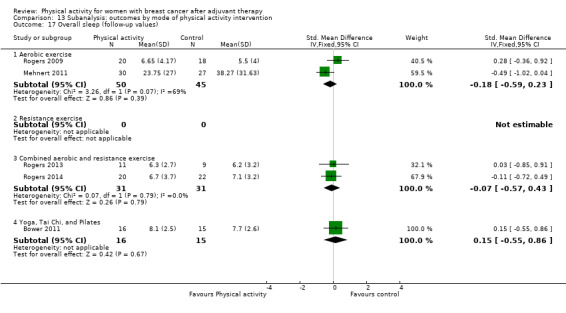
Comparison 13 Subanalysis: outcomes by mode of physical activity intervention, Outcome 17 Overall sleep (follow‐up values).
13.18
13.18. Analysis
Comparison 13 Subanalysis: outcomes by mode of physical activity intervention, Outcome 18 Overall sleep (change values).
13.19
13.19. Analysis
Comparison 13 Subanalysis: outcomes by mode of physical activity intervention, Outcome 19 Overall anxiety (follow‐up values).
13.20
13.20. Analysis
Comparison 13 Subanalysis: outcomes by mode of physical activity intervention, Outcome 20 Overall anxiety (change values).
13.21
13.21. Analysis
Comparison 13 Subanalysis: outcomes by mode of physical activity intervention, Outcome 21 Overall depression (follow‐up values).
13.22
13.22. Analysis
Comparison 13 Subanalysis: outcomes by mode of physical activity intervention, Outcome 22 Overall depression (change values).
13.23
13.23. Analysis
Comparison 13 Subanalysis: outcomes by mode of physical activity intervention, Outcome 23 Overall fatigue (follow‐up values).
13.24
13.24. Analysis
Comparison 13 Subanalysis: outcomes by mode of physical activity intervention, Outcome 24 Overall fatigue (change values).
13.25
13.25. Analysis
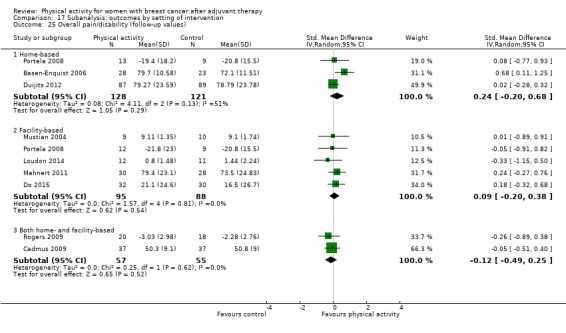
Comparison 13 Subanalysis: outcomes by mode of physical activity intervention, Outcome 25 Overall pain/disability (follow‐up values).
13.26
13.26. Analysis
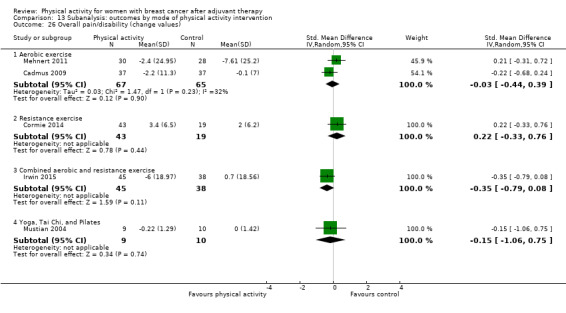
Comparison 13 Subanalysis: outcomes by mode of physical activity intervention, Outcome 26 Overall pain/disability (change values).
13.27
13.27. Analysis
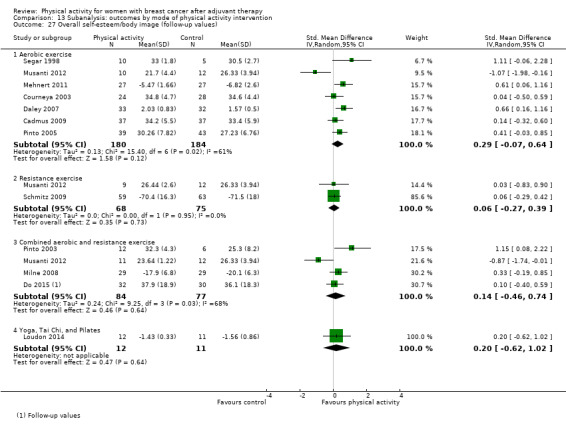
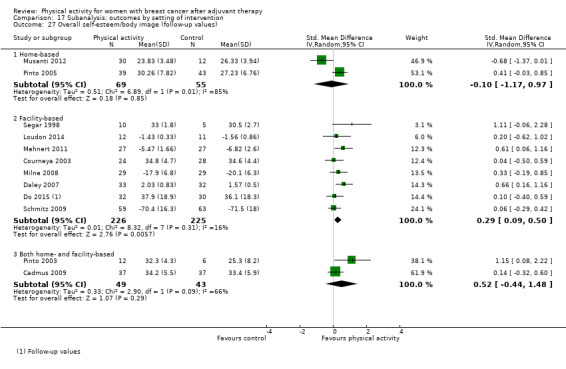
Comparison 13 Subanalysis: outcomes by mode of physical activity intervention, Outcome 27 Overall self‐esteem/body image (follow‐up values).
13.28
13.28. Analysis
Comparison 13 Subanalysis: outcomes by mode of physical activity intervention, Outcome 28 Overall self‐esteem/body image (change values).
13.29
13.29. Analysis
Comparison 13 Subanalysis: outcomes by mode of physical activity intervention, Outcome 29 Overall cardiorespiratory fitness (follow‐up values).
13.30
13.30. Analysis
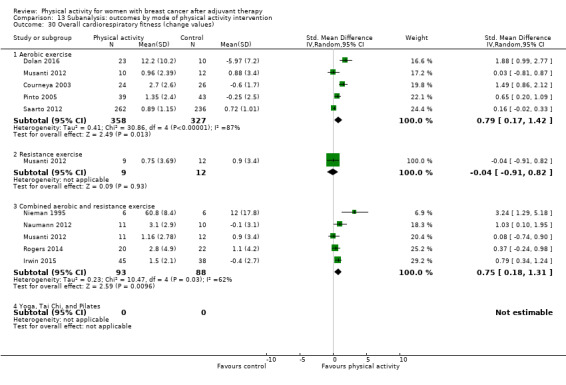
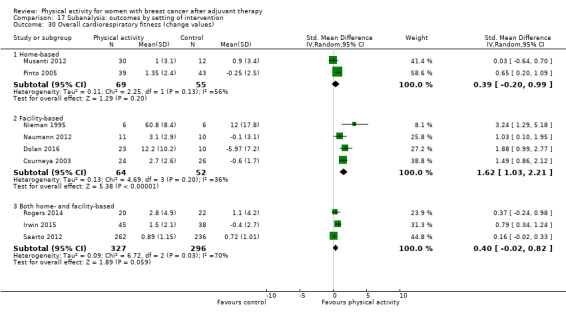
Comparison 13 Subanalysis: outcomes by mode of physical activity intervention, Outcome 30 Overall cardiorespiratory fitness (change values).
13.31
13.31. Analysis
Comparison 13 Subanalysis: outcomes by mode of physical activity intervention, Outcome 31 Overall self‐reported physical activity (follow‐up values).
13.32
13.32. Analysis
Comparison 13 Subanalysis: outcomes by mode of physical activity intervention, Outcome 32 Overall self‐reported physical activity (change values).
13.33
13.33. Analysis
Comparison 13 Subanalysis: outcomes by mode of physical activity intervention, Outcome 33 Overall objective physical activity (follow‐up values).
13.34
13.34. Analysis
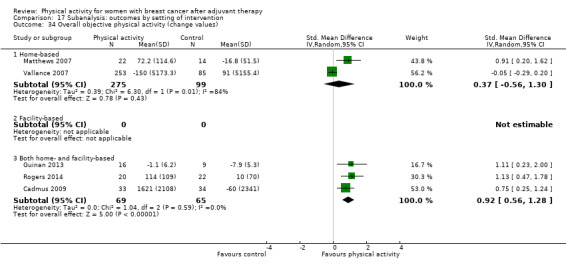
Comparison 13 Subanalysis: outcomes by mode of physical activity intervention, Outcome 34 Overall objective physical activity (change values).
13.35
13.35. Analysis
Comparison 13 Subanalysis: outcomes by mode of physical activity intervention, Outcome 35 Mass (follow‐up values).
13.36
13.36. Analysis
Comparison 13 Subanalysis: outcomes by mode of physical activity intervention, Outcome 36 Mass (change values).
13.37
13.37. Analysis
Comparison 13 Subanalysis: outcomes by mode of physical activity intervention, Outcome 37 BMI (follow‐up values).
13.38
13.38. Analysis
Comparison 13 Subanalysis: outcomes by mode of physical activity intervention, Outcome 38 BMI (change values).
13.39
13.39. Analysis
Comparison 13 Subanalysis: outcomes by mode of physical activity intervention, Outcome 39 Overall body fat (follow‐up values).
13.40
13.40. Analysis
Comparison 13 Subanalysis: outcomes by mode of physical activity intervention, Outcome 40 Overall body fat (change values).
13.41
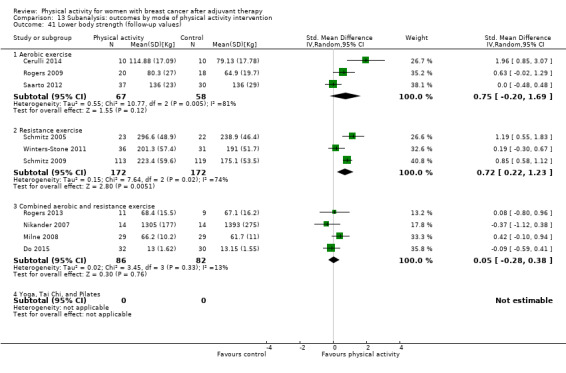
13.41. Analysis
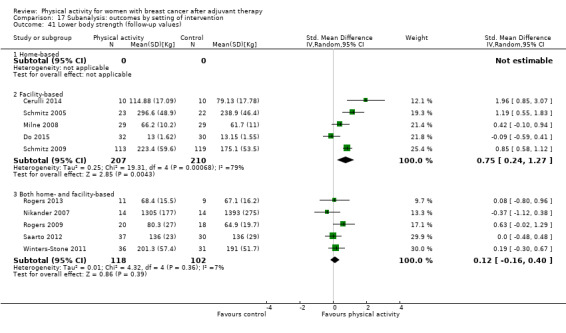
Comparison 13 Subanalysis: outcomes by mode of physical activity intervention, Outcome 41 Lower body strength (follow‐up values).
13.42
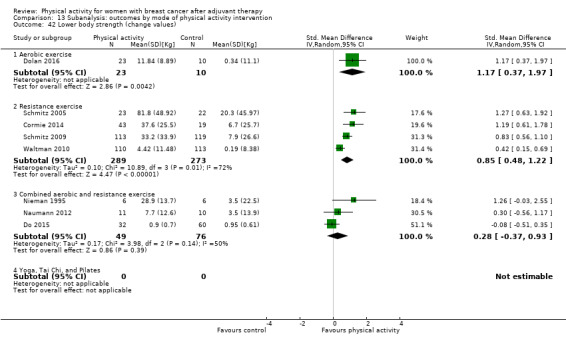
13.42. Analysis
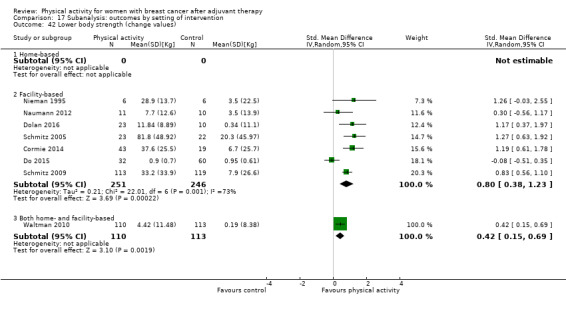
Comparison 13 Subanalysis: outcomes by mode of physical activity intervention, Outcome 42 Lower body strength (change values).
13.43
13.43. Analysis
Comparison 13 Subanalysis: outcomes by mode of physical activity intervention, Outcome 43 Upper body strength (follow‐up values).
13.44
13.44. Analysis
Comparison 13 Subanalysis: outcomes by mode of physical activity intervention, Outcome 44 Upper body strength (change values).
13.45
13.45. Analysis
Comparison 13 Subanalysis: outcomes by mode of physical activity intervention, Outcome 45 Bone mineral density ‐ femoral neck (follow‐up and change values).
13.46
13.46. Analysis
Comparison 13 Subanalysis: outcomes by mode of physical activity intervention, Outcome 46 Bone mineral density ‐ lumbar spine (follow‐up and change values).
13.47
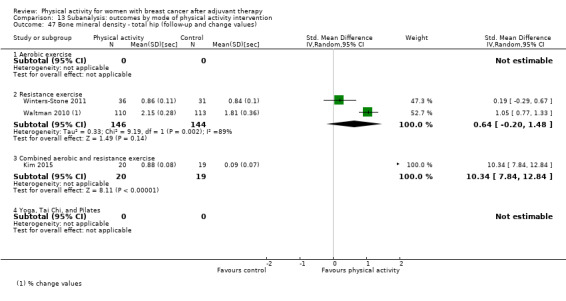
13.47. Analysis
Comparison 13 Subanalysis: outcomes by mode of physical activity intervention, Outcome 47 Bone mineral density ‐ total hip (follow‐up and change values).
14.1
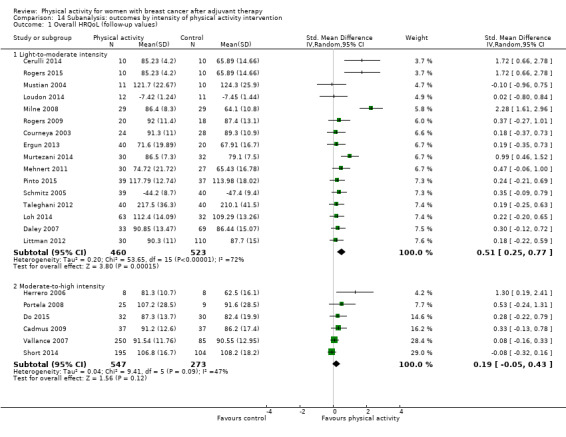
14.1. Analysis
Comparison 14 Subanalysis: outcomes by intensity of physical activity intervention, Outcome 1 Overall HRQoL (follow‐up values).
14.2
14.2. Analysis
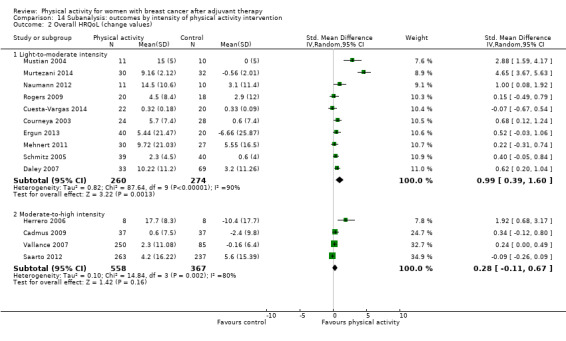
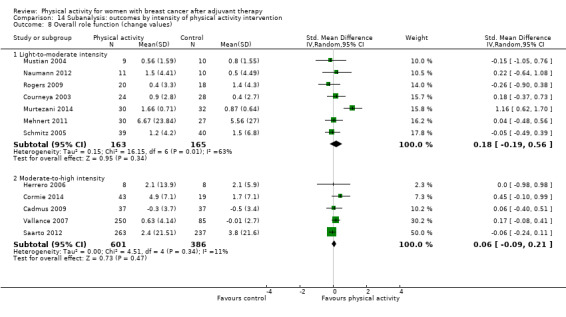
Comparison 14 Subanalysis: outcomes by intensity of physical activity intervention, Outcome 2 Overall HRQoL (change values).
14.3
14.3. Analysis
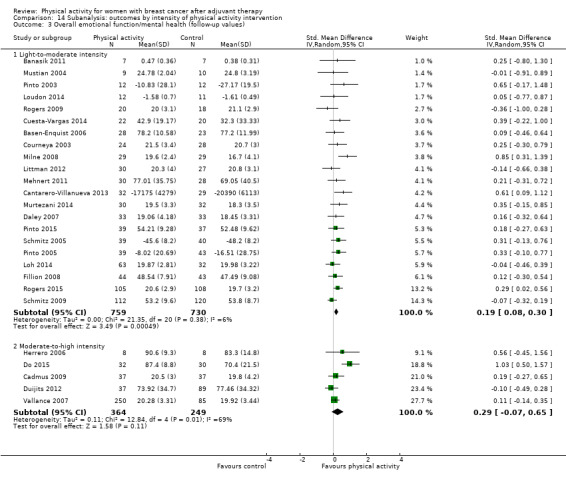
Comparison 14 Subanalysis: outcomes by intensity of physical activity intervention, Outcome 3 Overall emotional function/mental health (follow‐up values).
14.4
14.4. Analysis
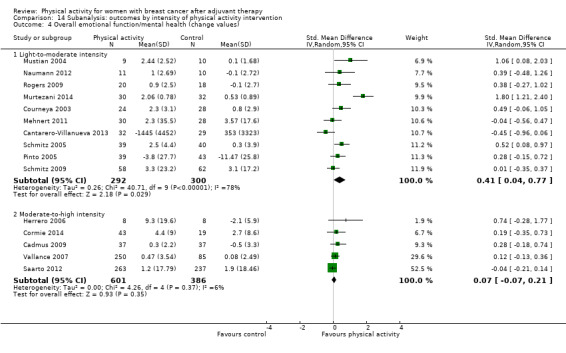
Comparison 14 Subanalysis: outcomes by intensity of physical activity intervention, Outcome 4 Overall emotional function/mental health (change values).
14.5
14.5. Analysis
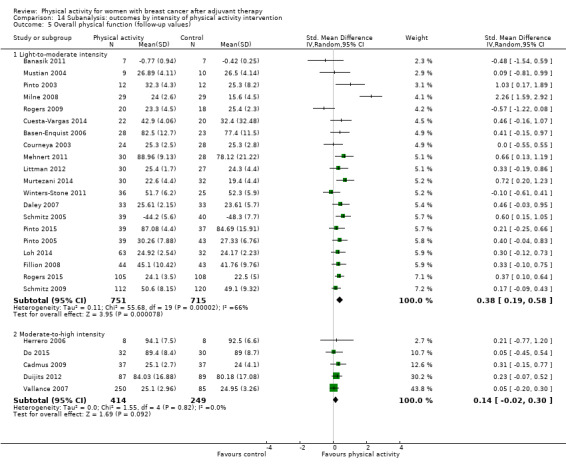
Comparison 14 Subanalysis: outcomes by intensity of physical activity intervention, Outcome 5 Overall physical function (follow‐up values).
14.6
14.6. Analysis
Comparison 14 Subanalysis: outcomes by intensity of physical activity intervention, Outcome 6 Overall physical function (change values).
14.7
14.7. Analysis
Comparison 14 Subanalysis: outcomes by intensity of physical activity intervention, Outcome 7 Overall role function (follow‐up values).
14.8
14.8. Analysis
Comparison 14 Subanalysis: outcomes by intensity of physical activity intervention, Outcome 8 Overall role function (change values).
14.9
14.9. Analysis
Comparison 14 Subanalysis: outcomes by intensity of physical activity intervention, Outcome 9 Overall social well‐being/function (follow‐up values).
14.10
14.10. Analysis
Comparison 14 Subanalysis: outcomes by intensity of physical activity intervention, Outcome 10 Overall social well‐being/function (change values).
14.11
14.11. Analysis
Comparison 14 Subanalysis: outcomes by intensity of physical activity intervention, Outcome 11 Overall cognitive function (follow‐up values).
14.12
14.12. Analysis
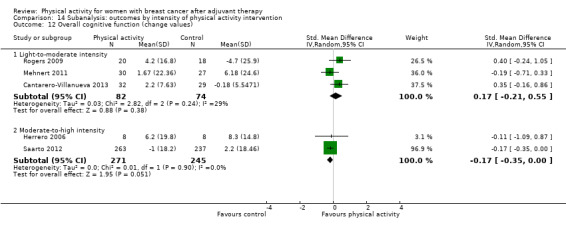
Comparison 14 Subanalysis: outcomes by intensity of physical activity intervention, Outcome 12 Overall cognitive function (change values).
14.13
14.13. Analysis
Comparison 14 Subanalysis: outcomes by intensity of physical activity intervention, Outcome 13 Overall general health (follow‐up values).
14.14
14.14. Analysis
Comparison 14 Subanalysis: outcomes by intensity of physical activity intervention, Outcome 14 Overall general health (change values).
14.15
14.15. Analysis
Comparison 14 Subanalysis: outcomes by intensity of physical activity intervention, Outcome 15 Overall sexual function (follow‐up values).
14.16
14.16. Analysis
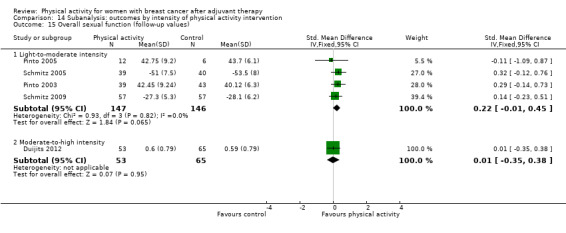
Comparison 14 Subanalysis: outcomes by intensity of physical activity intervention, Outcome 16 Overall sexual function (change values).
14.17
14.17. Analysis
Comparison 14 Subanalysis: outcomes by intensity of physical activity intervention, Outcome 17 Overall anxiety (follow‐up values).
14.18
14.18. Analysis
Comparison 14 Subanalysis: outcomes by intensity of physical activity intervention, Outcome 18 Overall anxiety (change values).
14.19
14.19. Analysis
Comparison 14 Subanalysis: outcomes by intensity of physical activity intervention, Outcome 19 Overall depression (follow‐up values).
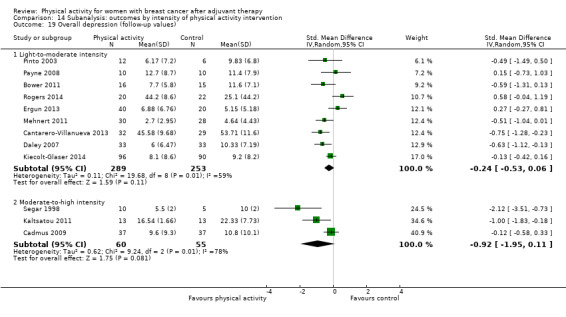
14.20
14.20. Analysis
Comparison 14 Subanalysis: outcomes by intensity of physical activity intervention, Outcome 20 Overall depression (change values).
14.21
14.21. Analysis
Comparison 14 Subanalysis: outcomes by intensity of physical activity intervention, Outcome 21 Overall fatigue (follow‐up values).
14.22
14.22. Analysis
Comparison 14 Subanalysis: outcomes by intensity of physical activity intervention, Outcome 22 Overall fatigue (change values).
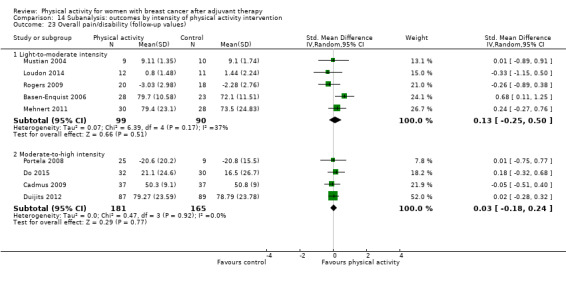
14.23
14.23. Analysis
Comparison 14 Subanalysis: outcomes by intensity of physical activity intervention, Outcome 23 Overall pain/disability (follow‐up values).
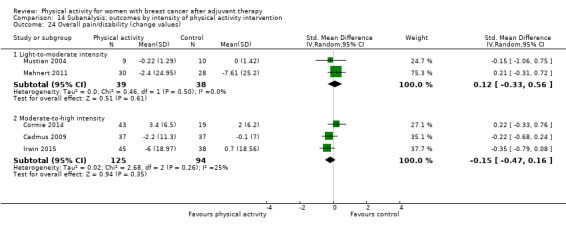
14.24
14.24. Analysis
Comparison 14 Subanalysis: outcomes by intensity of physical activity intervention, Outcome 24 Overall pain/disability (change values).
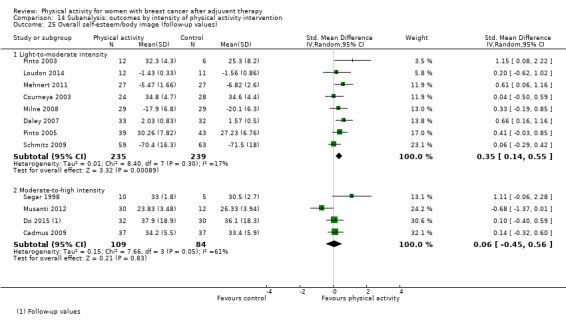
14.25
14.25. Analysis
Comparison 14 Subanalysis: outcomes by intensity of physical activity intervention, Outcome 25 Overall self‐esteem/body image (follow‐up values).
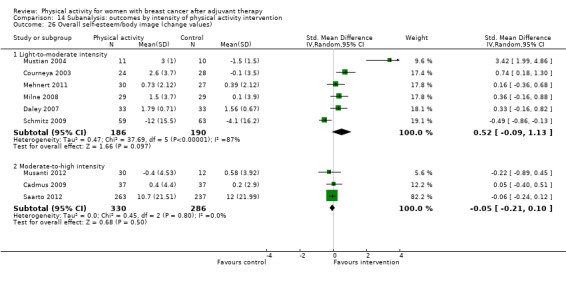
14.26
14.26. Analysis
Comparison 14 Subanalysis: outcomes by intensity of physical activity intervention, Outcome 26 Overall self‐esteem/body image (change values).
14.27
14.27. Analysis
Comparison 14 Subanalysis: outcomes by intensity of physical activity intervention, Outcome 27 Overall cardiorespiratory fitness (follow‐up values).
14.28
14.28. Analysis
Comparison 14 Subanalysis: outcomes by intensity of physical activity intervention, Outcome 28 Overall cardiorespiratory fitness (change values).
14.29
14.29. Analysis
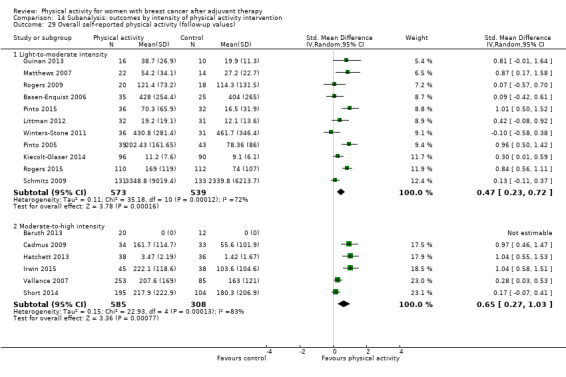
Comparison 14 Subanalysis: outcomes by intensity of physical activity intervention, Outcome 29 Overall self‐reported physical activity (follow‐up values).
14.30
14.30. Analysis
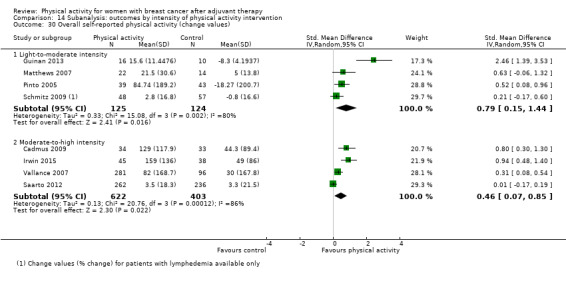
Comparison 14 Subanalysis: outcomes by intensity of physical activity intervention, Outcome 30 Overall self‐reported physical activity (change values).
14.31
14.31. Analysis
Comparison 14 Subanalysis: outcomes by intensity of physical activity intervention, Outcome 31 Overall objective physical activity (follow‐up values).
14.32
14.32. Analysis
Comparison 14 Subanalysis: outcomes by intensity of physical activity intervention, Outcome 32 Overall objective physical activity (change values).
14.33
14.33. Analysis
Comparison 14 Subanalysis: outcomes by intensity of physical activity intervention, Outcome 33 Mass (follow‐up values).
14.34
14.34. Analysis
Comparison 14 Subanalysis: outcomes by intensity of physical activity intervention, Outcome 34 Mass (change values).
14.35
14.35. Analysis
Comparison 14 Subanalysis: outcomes by intensity of physical activity intervention, Outcome 35 BMI (follow‐up values).
14.36
14.36. Analysis
Comparison 14 Subanalysis: outcomes by intensity of physical activity intervention, Outcome 36 BMI (change values).
14.37
14.37. Analysis
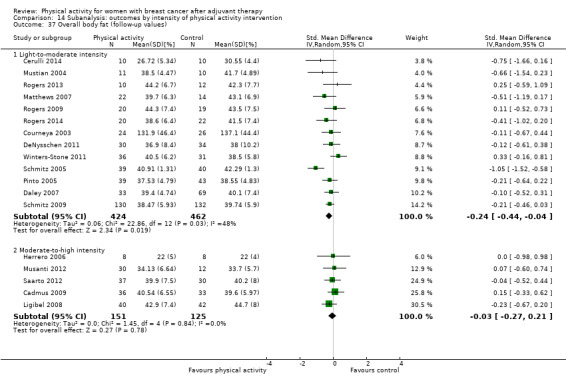
Comparison 14 Subanalysis: outcomes by intensity of physical activity intervention, Outcome 37 Overall body fat (follow‐up values).
14.38
14.38. Analysis
Comparison 14 Subanalysis: outcomes by intensity of physical activity intervention, Outcome 38 Overall body fat (change values).
14.39
14.39. Analysis
Comparison 14 Subanalysis: outcomes by intensity of physical activity intervention, Outcome 39 Lower body strength (follow‐up values).
14.40
14.40. Analysis
Comparison 14 Subanalysis: outcomes by intensity of physical activity intervention, Outcome 40 Lower body strength (change values).
14.41
14.41. Analysis
Comparison 14 Subanalysis: outcomes by intensity of physical activity intervention, Outcome 41 Upper body strength (follow‐up values).
14.42
14.42. Analysis
Comparison 14 Subanalysis: outcomes by intensity of physical activity intervention, Outcome 42 Upper body strength (change values).
14.43
14.43. Analysis
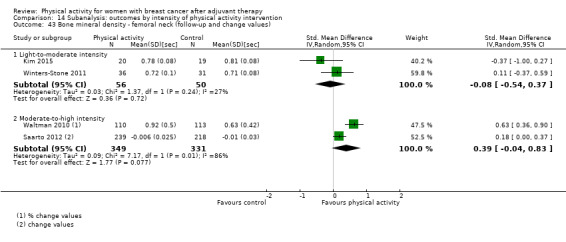
Comparison 14 Subanalysis: outcomes by intensity of physical activity intervention, Outcome 43 Bone mineral density ‐ femoral neck (follow‐up and change values).
14.44
14.44. Analysis
Comparison 14 Subanalysis: outcomes by intensity of physical activity intervention, Outcome 44 Bone mineral density ‐ lumbar spine (follow‐up and change values).
14.45
14.45. Analysis
Comparison 14 Subanalysis: outcomes by intensity of physical activity intervention, Outcome 45 Bone mineral density ‐ total hip (follow‐up and change values).
15.1
15.1. Analysis
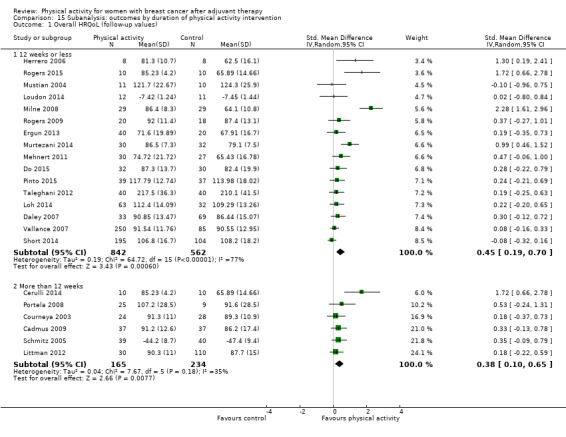
Comparison 15 Subanalysis: outcomes by duration of physical activity intervention, Outcome 1 Overall HRQoL (follow‐up values).
15.2
15.2. Analysis
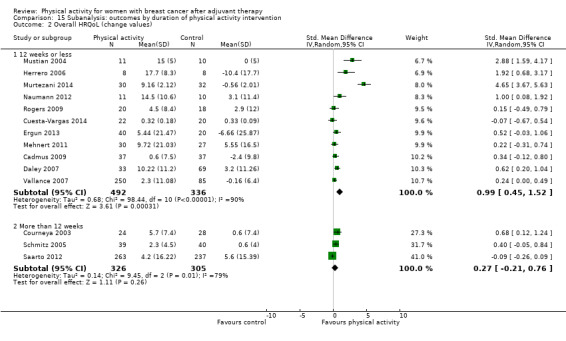
Comparison 15 Subanalysis: outcomes by duration of physical activity intervention, Outcome 2 Overall HRQoL (change values).
15.3
15.3. Analysis
Comparison 15 Subanalysis: outcomes by duration of physical activity intervention, Outcome 3 Overall emotional function/mental health (follow‐up values).
15.4
15.4. Analysis
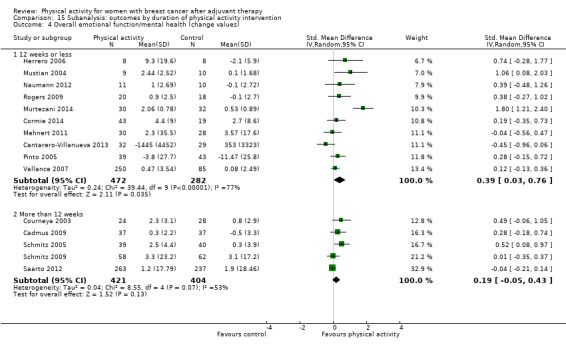
Comparison 15 Subanalysis: outcomes by duration of physical activity intervention, Outcome 4 Overall emotional function/mental health (change values).
15.5
15.5. Analysis
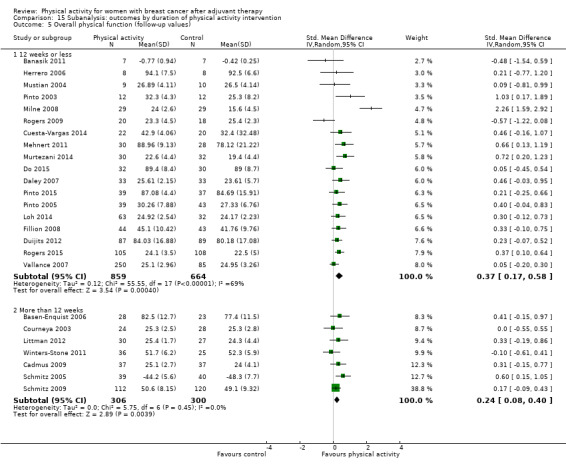
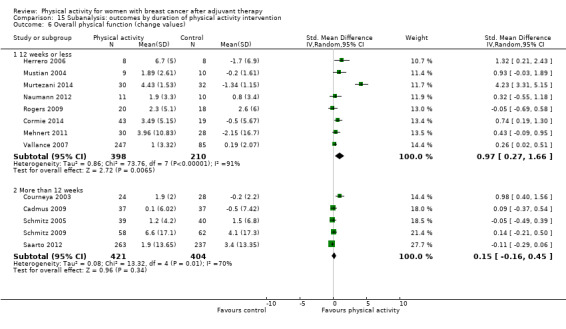
Comparison 15 Subanalysis: outcomes by duration of physical activity intervention, Outcome 5 Overall physical function (follow‐up values).
15.6
15.6. Analysis
Comparison 15 Subanalysis: outcomes by duration of physical activity intervention, Outcome 6 Overall physical function (change values).
15.7
15.7. Analysis
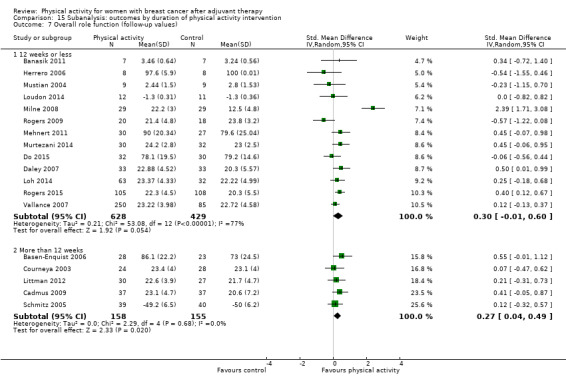
Comparison 15 Subanalysis: outcomes by duration of physical activity intervention, Outcome 7 Overall role function (follow‐up values).
15.8
15.8. Analysis
Comparison 15 Subanalysis: outcomes by duration of physical activity intervention, Outcome 8 Overall role function (change values).
15.9
15.9. Analysis
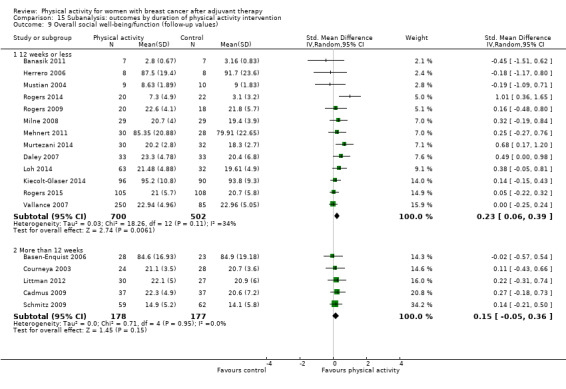
Comparison 15 Subanalysis: outcomes by duration of physical activity intervention, Outcome 9 Overall social well‐being/function (follow‐up values).
15.10
15.10. Analysis
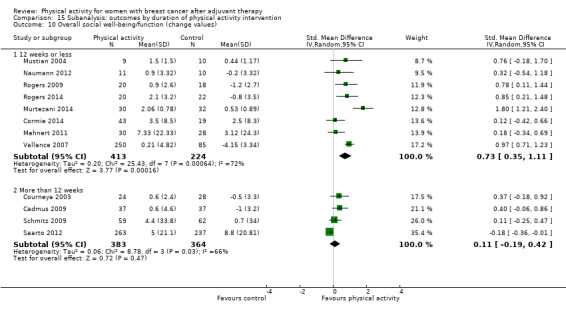
Comparison 15 Subanalysis: outcomes by duration of physical activity intervention, Outcome 10 Overall social well‐being/function (change values).
15.11
15.11. Analysis
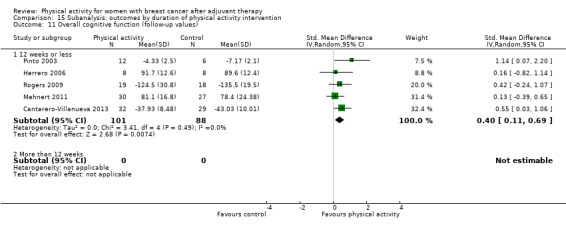
Comparison 15 Subanalysis: outcomes by duration of physical activity intervention, Outcome 11 Overall cognitive function (follow‐up values).
15.12
15.12. Analysis
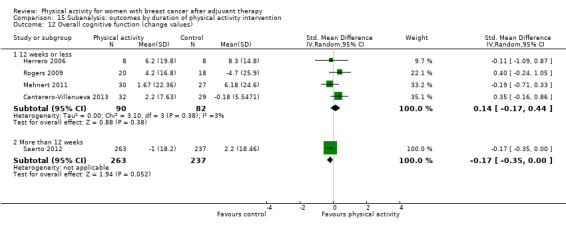
Comparison 15 Subanalysis: outcomes by duration of physical activity intervention, Outcome 12 Overall cognitive function (change values).
15.13
15.13. Analysis
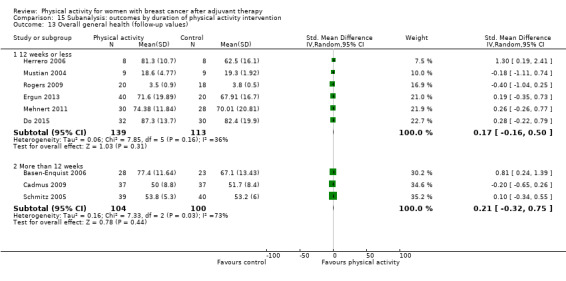
Comparison 15 Subanalysis: outcomes by duration of physical activity intervention, Outcome 13 Overall general health (follow‐up values).
15.14
15.14. Analysis
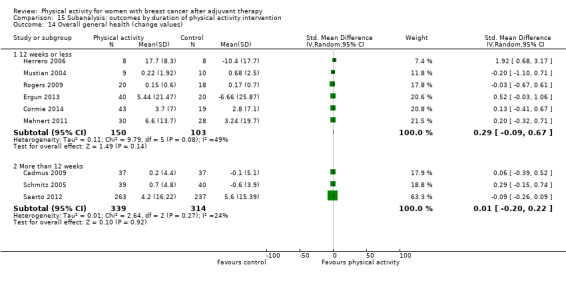
Comparison 15 Subanalysis: outcomes by duration of physical activity intervention, Outcome 14 Overall general health (change values).
15.15
15.15. Analysis
Comparison 15 Subanalysis: outcomes by duration of physical activity intervention, Outcome 15 Overall sexual function (follow‐up values).
15.16
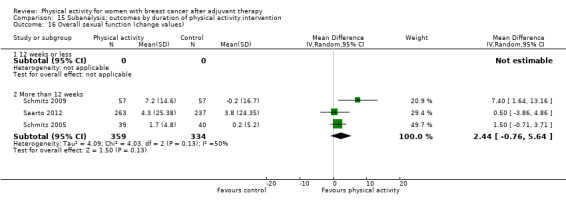
15.16. Analysis
Comparison 15 Subanalysis: outcomes by duration of physical activity intervention, Outcome 16 Overall sexual function (change values).
15.17
15.17. Analysis
Comparison 15 Subanalysis: outcomes by duration of physical activity intervention, Outcome 17 Overall sleep (follow‐up values).
15.18
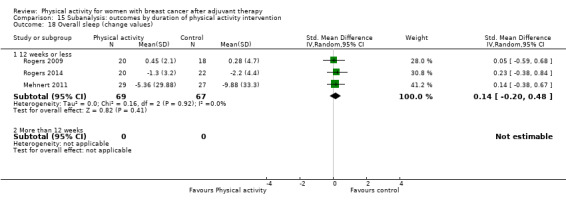
15.18. Analysis
Comparison 15 Subanalysis: outcomes by duration of physical activity intervention, Outcome 18 Overall sleep (change values).
15.19
15.19. Analysis
Comparison 15 Subanalysis: outcomes by duration of physical activity intervention, Outcome 19 Overall anxiety (follow‐up values).
15.20
15.20. Analysis
Comparison 15 Subanalysis: outcomes by duration of physical activity intervention, Outcome 20 Overall anxiety (change values).
15.21
15.21. Analysis
Comparison 15 Subanalysis: outcomes by duration of physical activity intervention, Outcome 21 Overall depression (follow‐up values).
15.22
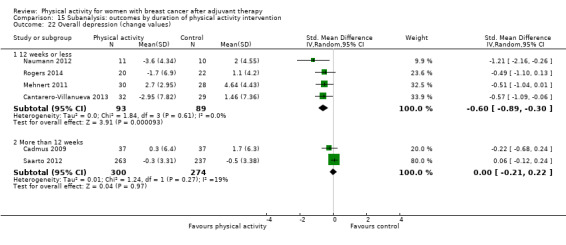
15.22. Analysis
Comparison 15 Subanalysis: outcomes by duration of physical activity intervention, Outcome 22 Overall depression (change values).
15.23
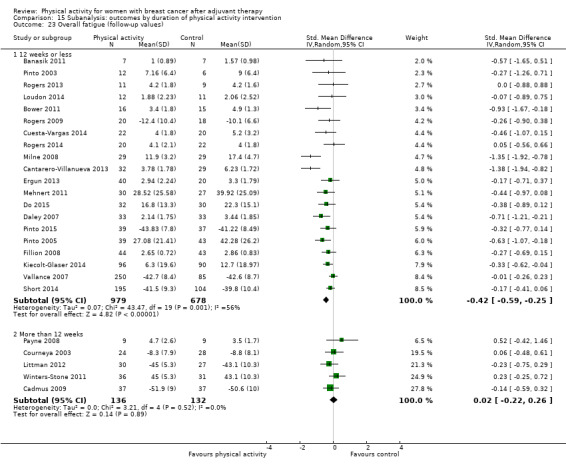
15.23. Analysis
Comparison 15 Subanalysis: outcomes by duration of physical activity intervention, Outcome 23 Overall fatigue (follow‐up values).
15.24
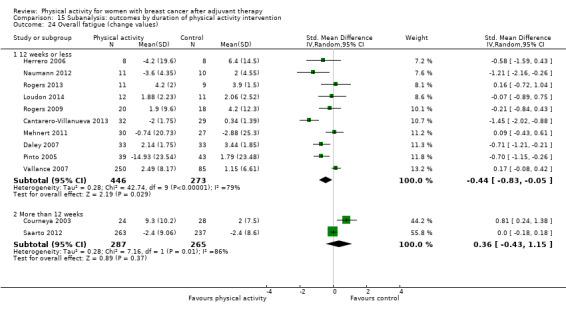
15.24. Analysis
Comparison 15 Subanalysis: outcomes by duration of physical activity intervention, Outcome 24 Overall fatigue (change values).
15.25
15.25. Analysis
Comparison 15 Subanalysis: outcomes by duration of physical activity intervention, Outcome 25 Overall pain/disability (follow‐up values).
15.26
15.26. Analysis
Comparison 15 Subanalysis: outcomes by duration of physical activity intervention, Outcome 26 Overall pain/disability (change values).
15.27
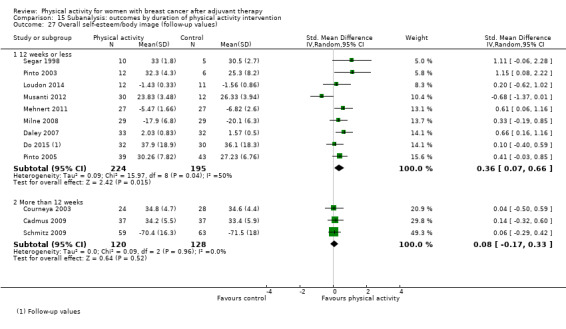
15.27. Analysis
Comparison 15 Subanalysis: outcomes by duration of physical activity intervention, Outcome 27 Overall self‐esteem/body image (follow‐up values).
15.28
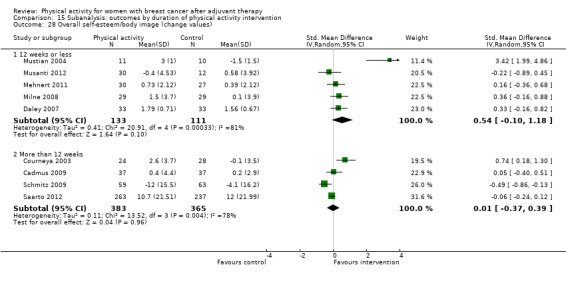
15.28. Analysis
Comparison 15 Subanalysis: outcomes by duration of physical activity intervention, Outcome 28 Overall self‐esteem/body image (change values).
15.29
15.29. Analysis
Comparison 15 Subanalysis: outcomes by duration of physical activity intervention, Outcome 29 Overall cardiorespiratory fitness (follow‐up values).
15.30
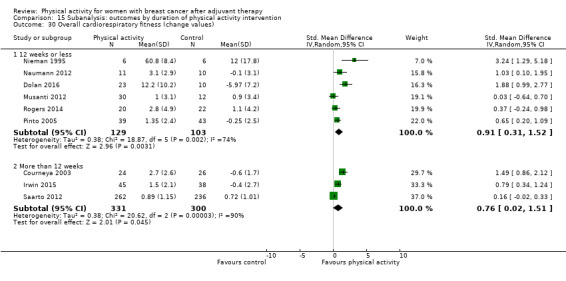
15.30. Analysis
Comparison 15 Subanalysis: outcomes by duration of physical activity intervention, Outcome 30 Overall cardiorespiratory fitness (change values).
15.31
15.31. Analysis
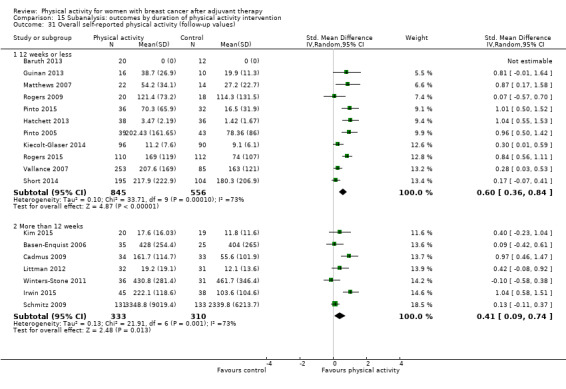
Comparison 15 Subanalysis: outcomes by duration of physical activity intervention, Outcome 31 Overall self‐reported physical activity (follow‐up values).
15.32
15.32. Analysis
Comparison 15 Subanalysis: outcomes by duration of physical activity intervention, Outcome 32 Overall self‐reported physical activity (change values).
15.33
15.33. Analysis
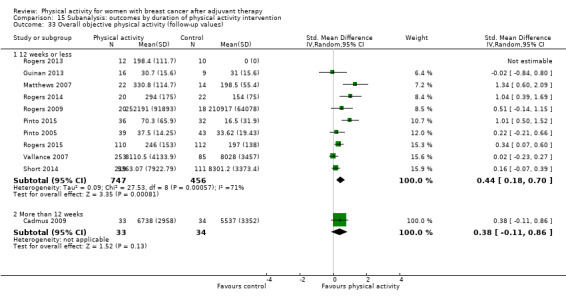
Comparison 15 Subanalysis: outcomes by duration of physical activity intervention, Outcome 33 Overall objective physical activity (follow‐up values).
15.34
15.34. Analysis
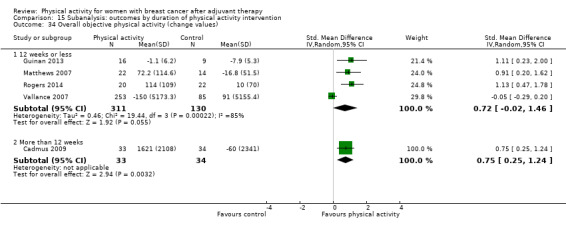
Comparison 15 Subanalysis: outcomes by duration of physical activity intervention, Outcome 34 Overall objective physical activity (change values).
15.35
15.35. Analysis
Comparison 15 Subanalysis: outcomes by duration of physical activity intervention, Outcome 35 Mass (follow‐up values).
15.36
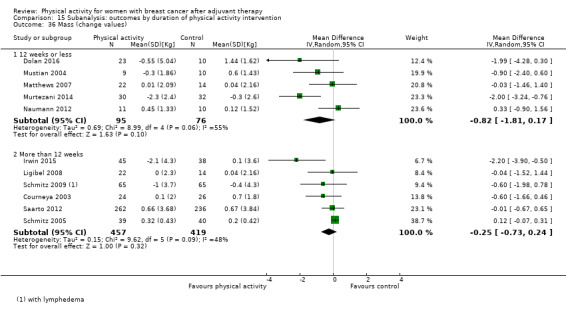
15.36. Analysis
Comparison 15 Subanalysis: outcomes by duration of physical activity intervention, Outcome 36 Mass (change values).
15.37
15.37. Analysis
Comparison 15 Subanalysis: outcomes by duration of physical activity intervention, Outcome 37 BMI (follow‐up values).
15.38
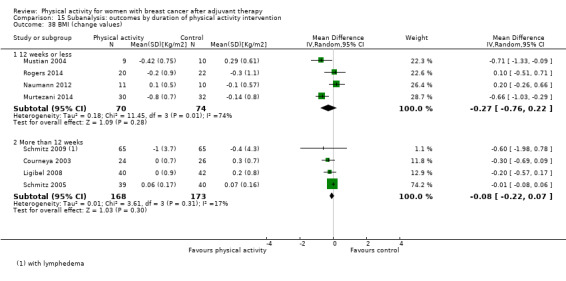
15.38. Analysis
Comparison 15 Subanalysis: outcomes by duration of physical activity intervention, Outcome 38 BMI (change values).
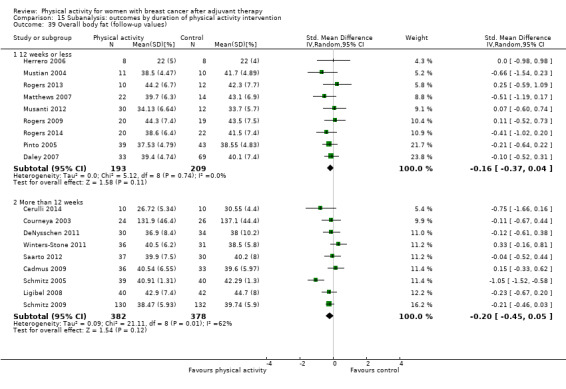
15.39
15.39. Analysis
Comparison 15 Subanalysis: outcomes by duration of physical activity intervention, Outcome 39 Overall body fat (follow‐up values).
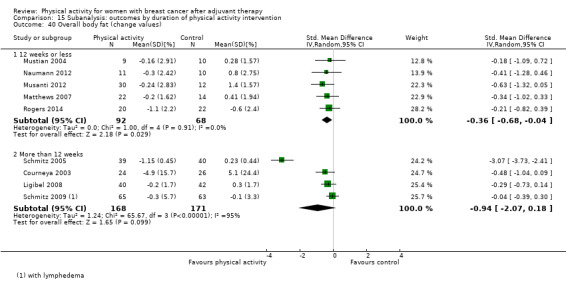
15.40
15.40. Analysis
Comparison 15 Subanalysis: outcomes by duration of physical activity intervention, Outcome 40 Overall body fat (change values).
15.41
15.41. Analysis
Comparison 15 Subanalysis: outcomes by duration of physical activity intervention, Outcome 41 Lower body strength (follow‐up values).
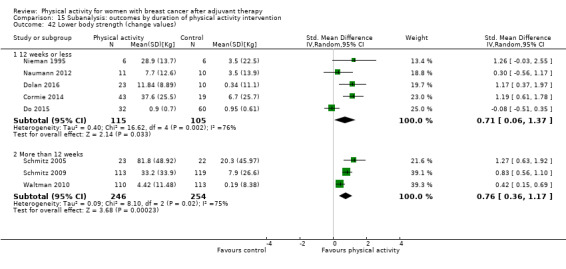
15.42
15.42. Analysis
Comparison 15 Subanalysis: outcomes by duration of physical activity intervention, Outcome 42 Lower body strength (change values).
15.43
15.43. Analysis
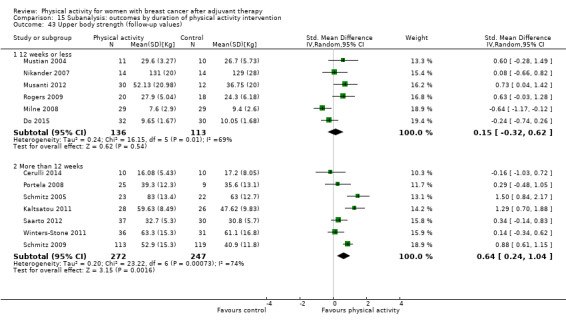
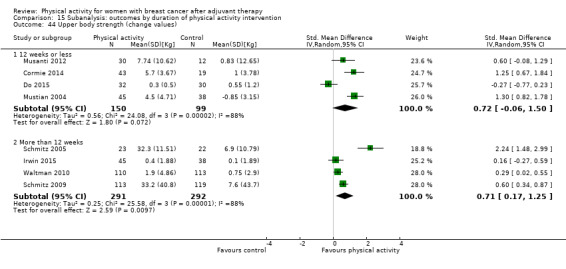
Comparison 15 Subanalysis: outcomes by duration of physical activity intervention, Outcome 43 Upper body strength (follow‐up values).
15.44
15.44. Analysis
Comparison 15 Subanalysis: outcomes by duration of physical activity intervention, Outcome 44 Upper body strength (change values).
16.1
16.1. Analysis
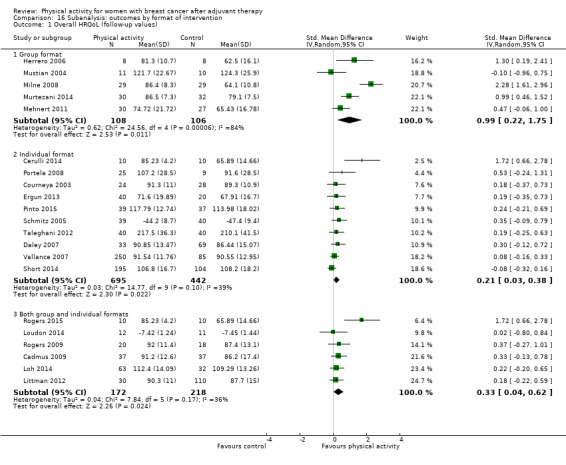
Comparison 16 Subanalysis: outcomes by format of intervention, Outcome 1 Overall HRQoL (follow‐up values).
16.2
16.2. Analysis
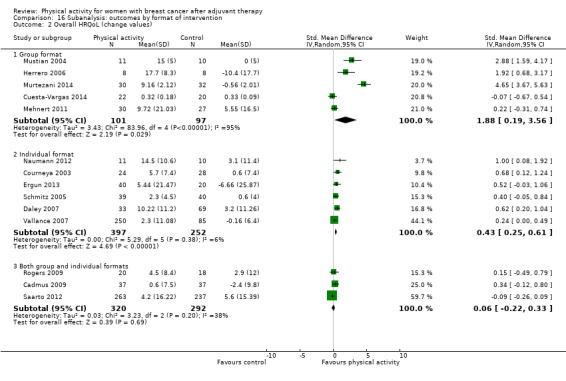
Comparison 16 Subanalysis: outcomes by format of intervention, Outcome 2 Overall HRQoL (change values).
16.3
16.3. Analysis
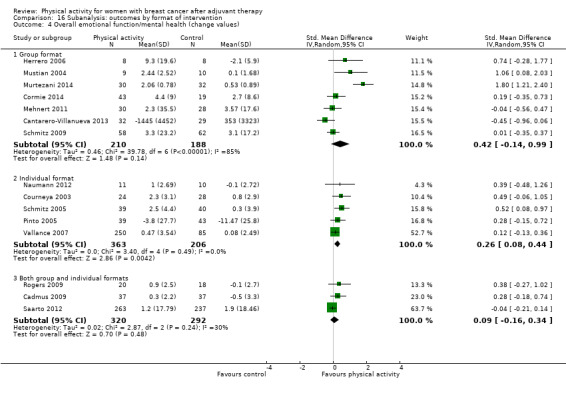
Comparison 16 Subanalysis: outcomes by format of intervention, Outcome 3 Overall emotional function/mental health (follow‐up values).
16.4
16.4. Analysis
Comparison 16 Subanalysis: outcomes by format of intervention, Outcome 4 Overall emotional function/mental health (change values).
16.5
16.5. Analysis
Comparison 16 Subanalysis: outcomes by format of intervention, Outcome 5 Overall physical function (follow‐up values).
16.6
16.6. Analysis
Comparison 16 Subanalysis: outcomes by format of intervention, Outcome 6 Overall physical function (change values).
16.7
16.7. Analysis
Comparison 16 Subanalysis: outcomes by format of intervention, Outcome 7 Overall role function (follow‐up values).
16.8
16.8. Analysis
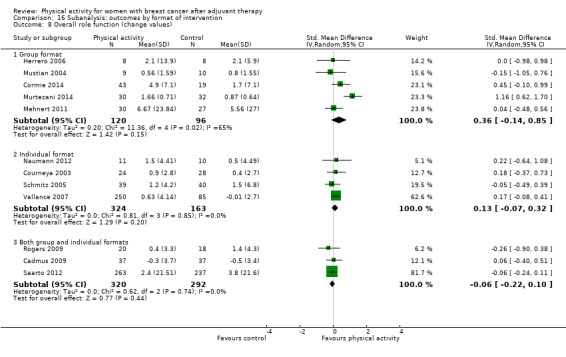
Comparison 16 Subanalysis: outcomes by format of intervention, Outcome 8 Overall role function (change values).
16.9
16.9. Analysis
Comparison 16 Subanalysis: outcomes by format of intervention, Outcome 9 Overall social well‐being/function (follow‐up values).
16.10
16.10. Analysis
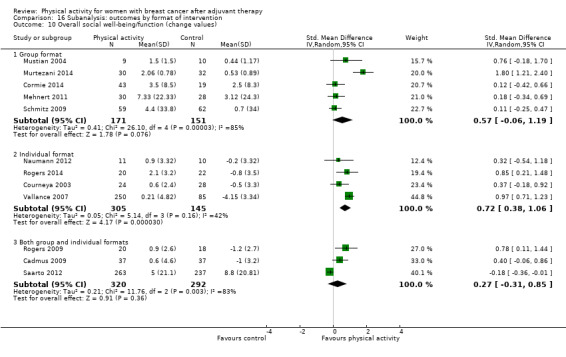
Comparison 16 Subanalysis: outcomes by format of intervention, Outcome 10 Overall social well‐being/function (change values).
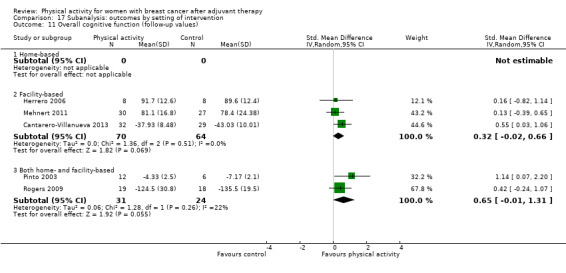
16.11
16.11. Analysis
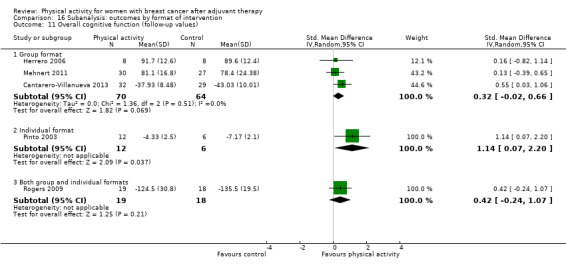
Comparison 16 Subanalysis: outcomes by format of intervention, Outcome 11 Overall cognitive function (follow‐up values).
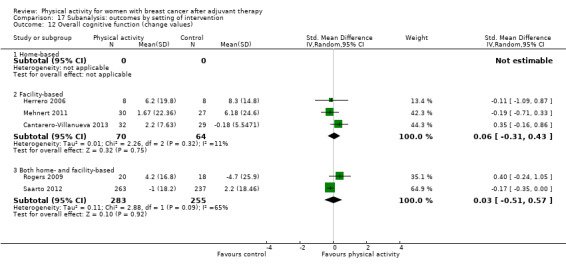
16.12
16.12. Analysis
Comparison 16 Subanalysis: outcomes by format of intervention, Outcome 12 Overall cognitive function (change values).
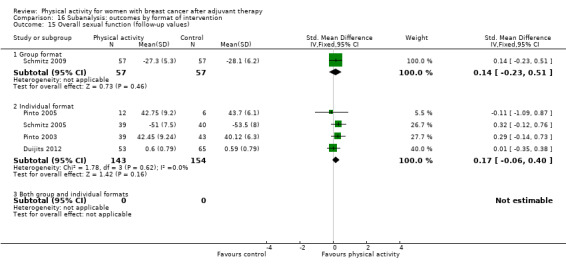
16.13
16.13. Analysis
Comparison 16 Subanalysis: outcomes by format of intervention, Outcome 13 Overall general health (follow‐up values).
16.14
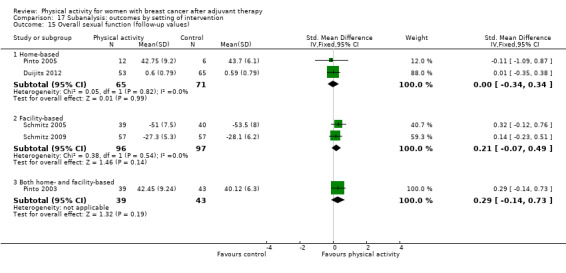
16.14. Analysis
Comparison 16 Subanalysis: outcomes by format of intervention, Outcome 14 Overall general health (change values).
16.15
16.15. Analysis
Comparison 16 Subanalysis: outcomes by format of intervention, Outcome 15 Overall sexual function (follow‐up values).
16.16
16.16. Analysis
Comparison 16 Subanalysis: outcomes by format of intervention, Outcome 16 Overall sleep (follow‐up values).
16.17
16.17. Analysis
Comparison 16 Subanalysis: outcomes by format of intervention, Outcome 17 Overall anxiety (follow‐up values).
16.18
16.18. Analysis
Comparison 16 Subanalysis: outcomes by format of intervention, Outcome 18 Overall anxiety (change values).
16.19
16.19. Analysis
Comparison 16 Subanalysis: outcomes by format of intervention, Outcome 19 Overall depression (change values).
16.20
16.20. Analysis
Comparison 16 Subanalysis: outcomes by format of intervention, Outcome 20 Overall depression (follow‐up values).
16.21
16.21. Analysis
Comparison 16 Subanalysis: outcomes by format of intervention, Outcome 21 Overall fatigue (follow‐up values).
16.22
16.22. Analysis
Comparison 16 Subanalysis: outcomes by format of intervention, Outcome 22 Overall fatigue (change values).
16.23
16.23. Analysis
Comparison 16 Subanalysis: outcomes by format of intervention, Outcome 23 Overall pain/disability (follow‐up values).
16.24
16.24. Analysis
Comparison 16 Subanalysis: outcomes by format of intervention, Outcome 24 Overall pain/disability (change values).
16.25
16.25. Analysis
Comparison 16 Subanalysis: outcomes by format of intervention, Outcome 25 Overall self‐esteem/body image (follow‐up values).
16.26
16.26. Analysis
Comparison 16 Subanalysis: outcomes by format of intervention, Outcome 26 Overall self‐esteem/body image (change values).
16.27
16.27. Analysis
Comparison 16 Subanalysis: outcomes by format of intervention, Outcome 27 Overall cardiorespiratory fitness (follow‐up values).
16.28
16.28. Analysis
Comparison 16 Subanalysis: outcomes by format of intervention, Outcome 28 Overall cardiorespiratory fitness (change values).
16.29
16.29. Analysis
Comparison 16 Subanalysis: outcomes by format of intervention, Outcome 29 Overall self‐reported physical activity (follow‐up values).
16.30
16.30. Analysis
Comparison 16 Subanalysis: outcomes by format of intervention, Outcome 30 Overall self‐reported physical activity (change values).
16.31
16.31. Analysis
Comparison 16 Subanalysis: outcomes by format of intervention, Outcome 31 Overall objective physical activity (follow‐up values).
16.32
16.32. Analysis
Comparison 16 Subanalysis: outcomes by format of intervention, Outcome 32 Overall objective physical activity (change values).
16.33
16.33. Analysis
Comparison 16 Subanalysis: outcomes by format of intervention, Outcome 33 Mass (follow‐up values).
16.34
16.34. Analysis
Comparison 16 Subanalysis: outcomes by format of intervention, Outcome 34 Mass (change values).
16.35
16.35. Analysis
Comparison 16 Subanalysis: outcomes by format of intervention, Outcome 35 BMI (follow‐up values).
16.36
16.36. Analysis
Comparison 16 Subanalysis: outcomes by format of intervention, Outcome 36 BMI (change values).
16.37
16.37. Analysis
Comparison 16 Subanalysis: outcomes by format of intervention, Outcome 37 Overall body fat (follow‐up values).
16.38
16.38. Analysis
Comparison 16 Subanalysis: outcomes by format of intervention, Outcome 38 Overall body fat (change values).
16.39
16.39. Analysis
Comparison 16 Subanalysis: outcomes by format of intervention, Outcome 39 Lower body strength (follow‐up values).
16.40
16.40. Analysis
Comparison 16 Subanalysis: outcomes by format of intervention, Outcome 40 Lower body strength (change values).
16.41
16.41. Analysis
Comparison 16 Subanalysis: outcomes by format of intervention, Outcome 41 Upper body strength (follow‐up values).
16.42
16.42. Analysis
Comparison 16 Subanalysis: outcomes by format of intervention, Outcome 42 Upper body strength (change values).
16.43
16.43. Analysis
Comparison 16 Subanalysis: outcomes by format of intervention, Outcome 43 Bone mineral density ‐ femoral neck (follow‐up and change values).
16.44
16.44. Analysis
Comparison 16 Subanalysis: outcomes by format of intervention, Outcome 44 Bone mineral density ‐ lumbar spine (follow‐up and change values).
16.45
16.45. Analysis
Comparison 16 Subanalysis: outcomes by format of intervention, Outcome 45 Bone mineral density ‐ total hip (follow‐up and change values).
17.1
17.1. Analysis
Comparison 17 Subanalysis: outcomes by setting of intervention, Outcome 1 Overall HRQoL (follow‐up values).
17.2
17.2. Analysis
Comparison 17 Subanalysis: outcomes by setting of intervention, Outcome 2 Overall HRQoL (change values).
17.3
17.3. Analysis
Comparison 17 Subanalysis: outcomes by setting of intervention, Outcome 3 Overall emotional function/mental health (follow‐up values).
17.4
17.4. Analysis
Comparison 17 Subanalysis: outcomes by setting of intervention, Outcome 4 Overall emotional function/mental health (change values).
17.5
17.5. Analysis
Comparison 17 Subanalysis: outcomes by setting of intervention, Outcome 5 Overall physical function (follow‐up values).
17.6
17.6. Analysis
Comparison 17 Subanalysis: outcomes by setting of intervention, Outcome 6 Overall physical function (change values).
17.7
17.7. Analysis
Comparison 17 Subanalysis: outcomes by setting of intervention, Outcome 7 Overall role function (follow‐up values).
17.8
17.8. Analysis
Comparison 17 Subanalysis: outcomes by setting of intervention, Outcome 8 Overall role function (change values).
17.9
17.9. Analysis
Comparison 17 Subanalysis: outcomes by setting of intervention, Outcome 9 Overall social well‐being/function (follow‐up values).
17.10
17.10. Analysis
Comparison 17 Subanalysis: outcomes by setting of intervention, Outcome 10 Overall social well‐being/function (change values).
17.11
17.11. Analysis
Comparison 17 Subanalysis: outcomes by setting of intervention, Outcome 11 Overall cognitive function (follow‐up values).
17.12
17.12. Analysis
Comparison 17 Subanalysis: outcomes by setting of intervention, Outcome 12 Overall cognitive function (change values).
17.13
17.13. Analysis
Comparison 17 Subanalysis: outcomes by setting of intervention, Outcome 13 Overall general health (follow‐up values).
17.14
17.14. Analysis
Comparison 17 Subanalysis: outcomes by setting of intervention, Outcome 14 Overall general health (change values).
17.15
17.15. Analysis
Comparison 17 Subanalysis: outcomes by setting of intervention, Outcome 15 Overall sexual function (follow‐up values).
17.16
17.16. Analysis
Comparison 17 Subanalysis: outcomes by setting of intervention, Outcome 16 Overall sexual function (change values).
17.17
17.17. Analysis
Comparison 17 Subanalysis: outcomes by setting of intervention, Outcome 17 Overall sleep (follow‐up values).
17.18
17.18. Analysis
Comparison 17 Subanalysis: outcomes by setting of intervention, Outcome 18 Overall sleep (change values).
17.19
17.19. Analysis
Comparison 17 Subanalysis: outcomes by setting of intervention, Outcome 19 Overall anxiety (follow‐up values).
17.20
17.20. Analysis
Comparison 17 Subanalysis: outcomes by setting of intervention, Outcome 20 Overall anxiety (change values).
17.21
17.21. Analysis
Comparison 17 Subanalysis: outcomes by setting of intervention, Outcome 21 Overall depression (follow‐up values).
17.22
17.22. Analysis
Comparison 17 Subanalysis: outcomes by setting of intervention, Outcome 22 Overall depression (change values).
17.23
17.23. Analysis
Comparison 17 Subanalysis: outcomes by setting of intervention, Outcome 23 Overall fatigue (follow‐up values).
17.24
17.24. Analysis
Comparison 17 Subanalysis: outcomes by setting of intervention, Outcome 24 Overall fatigue (change values).
17.25
17.25. Analysis
Comparison 17 Subanalysis: outcomes by setting of intervention, Outcome 25 Overall pain/disability (follow‐up values).
17.26
17.26. Analysis
Comparison 17 Subanalysis: outcomes by setting of intervention, Outcome 26 Overall pain/disability (change values).
17.27
17.27. Analysis
Comparison 17 Subanalysis: outcomes by setting of intervention, Outcome 27 Overall self‐esteem/body image (follow‐up values).
17.28
17.28. Analysis
Comparison 17 Subanalysis: outcomes by setting of intervention, Outcome 28 Overall self‐esteem/body image (change values).
17.29
17.29. Analysis
Comparison 17 Subanalysis: outcomes by setting of intervention, Outcome 29 Overall cardiorespiratory fitness (follow‐up values).
17.30
17.30. Analysis
Comparison 17 Subanalysis: outcomes by setting of intervention, Outcome 30 Overall cardiorespiratory fitness (change values).
17.31
17.31. Analysis
Comparison 17 Subanalysis: outcomes by setting of intervention, Outcome 31 Overall self‐reported physical activity (follow‐up values).
17.32
17.32. Analysis
Comparison 17 Subanalysis: outcomes by setting of intervention, Outcome 32 Overall self‐reported physical activity (change values).
17.33
17.33. Analysis
Comparison 17 Subanalysis: outcomes by setting of intervention, Outcome 33 Overall objective physical activity (follow‐up values).
17.34
17.34. Analysis
Comparison 17 Subanalysis: outcomes by setting of intervention, Outcome 34 Overall objective physical activity (change values).
17.35
17.35. Analysis
Comparison 17 Subanalysis: outcomes by setting of intervention, Outcome 35 Mass (follow‐up values).
17.36
17.36. Analysis
Comparison 17 Subanalysis: outcomes by setting of intervention, Outcome 36 Mass (change values).
17.37
17.37. Analysis
Comparison 17 Subanalysis: outcomes by setting of intervention, Outcome 37 BMI (follow‐up values).
17.38
17.38. Analysis
Comparison 17 Subanalysis: outcomes by setting of intervention, Outcome 38 BMI (change values).
17.39
17.39. Analysis
Comparison 17 Subanalysis: outcomes by setting of intervention, Outcome 39 Overall body fat (follow‐up values).
17.40
17.40. Analysis
Comparison 17 Subanalysis: outcomes by setting of intervention, Outcome 40 Overall body fat (change values).
17.41
17.41. Analysis
Comparison 17 Subanalysis: outcomes by setting of intervention, Outcome 41 Lower body strength (follow‐up values).
17.42
17.42. Analysis
Comparison 17 Subanalysis: outcomes by setting of intervention, Outcome 42 Lower body strength (change values).
17.43
17.43. Analysis
Comparison 17 Subanalysis: outcomes by setting of intervention, Outcome 43 Upper body strength (follow‐up values).
17.44
17.44. Analysis
Comparison 17 Subanalysis: outcomes by setting of intervention, Outcome 44 Upper body strength (change values).
17.45
17.45. Analysis
Comparison 17 Subanalysis: outcomes by setting of intervention, Outcome 45 Bone mineral density ‐ femoral neck (follow‐up and change values).
17.46
17.46. Analysis
Comparison 17 Subanalysis: outcomes by setting of intervention, Outcome 46 Bone mineral density ‐ lumbar spine (follow‐up and change values).
17.47
17.47. Analysis
Comparison 17 Subanalysis: outcomes by setting of intervention, Outcome 47 Bone mineral density ‐ total hip (follow‐up and change values).
18.1
18.1. Analysis
Comparison 18 Sensitivity analysis: outcomes by risk of bias, Outcome 1 Overall HRQoL (follow‐up values).
18.2
18.2. Analysis
Comparison 18 Sensitivity analysis: outcomes by risk of bias, Outcome 2 Overall HRQoL (change values).
18.3
18.3. Analysis
Comparison 18 Sensitivity analysis: outcomes by risk of bias, Outcome 3 Overall emotional function/mental health (follow‐up values).
18.4
18.4. Analysis
Comparison 18 Sensitivity analysis: outcomes by risk of bias, Outcome 4 Overall emotional function/mental health (change values).
18.5
18.5. Analysis
Comparison 18 Sensitivity analysis: outcomes by risk of bias, Outcome 5 Overall physical function (follow‐up values).
18.6
18.6. Analysis
Comparison 18 Sensitivity analysis: outcomes by risk of bias, Outcome 6 Overall physical function (change values).
18.7
18.7. Analysis
Comparison 18 Sensitivity analysis: outcomes by risk of bias, Outcome 7 Overall role function (follow‐up values).
18.8
18.8. Analysis
Comparison 18 Sensitivity analysis: outcomes by risk of bias, Outcome 8 Overall role function (change values).
18.9
18.9. Analysis
Comparison 18 Sensitivity analysis: outcomes by risk of bias, Outcome 9 Overall social well‐being/function (follow‐up values).
18.10
18.10. Analysis
Comparison 18 Sensitivity analysis: outcomes by risk of bias, Outcome 10 Overall social well‐being/function (change values).
18.11
18.11. Analysis
Comparison 18 Sensitivity analysis: outcomes by risk of bias, Outcome 11 Overall cognitive function (follow‐up values).
18.12
18.12. Analysis
Comparison 18 Sensitivity analysis: outcomes by risk of bias, Outcome 12 Overall cognitive function (change values).
18.13
18.13. Analysis
Comparison 18 Sensitivity analysis: outcomes by risk of bias, Outcome 13 Overall general health (follow‐up values).
18.14
18.14. Analysis
Comparison 18 Sensitivity analysis: outcomes by risk of bias, Outcome 14 Overall general health (change values).
18.15
18.15. Analysis
Comparison 18 Sensitivity analysis: outcomes by risk of bias, Outcome 15 Overall sexual function (follow‐up values).
18.16
18.16. Analysis
Comparison 18 Sensitivity analysis: outcomes by risk of bias, Outcome 16 Overall sexual function (change values).
18.17
18.17. Analysis
Comparison 18 Sensitivity analysis: outcomes by risk of bias, Outcome 17 Overall sleep (follow‐up values).
18.18
18.18. Analysis
Comparison 18 Sensitivity analysis: outcomes by risk of bias, Outcome 18 Overall sleep (change values).
18.19
18.19. Analysis
Comparison 18 Sensitivity analysis: outcomes by risk of bias, Outcome 19 Overall anxiety (follow‐up values).
18.20
18.20. Analysis
Comparison 18 Sensitivity analysis: outcomes by risk of bias, Outcome 20 Overall anxiety (change values).
18.21
18.21. Analysis
Comparison 18 Sensitivity analysis: outcomes by risk of bias, Outcome 21 Overall self‐esteem/body image (follow‐up values).
18.22
18.22. Analysis
Comparison 18 Sensitivity analysis: outcomes by risk of bias, Outcome 22 Overall self‐esteem/body image (change values).
18.23
18.23. Analysis
Comparison 18 Sensitivity analysis: outcomes by risk of bias, Outcome 23 Overall depression (follow‐up values).
18.24
18.24. Analysis
Comparison 18 Sensitivity analysis: outcomes by risk of bias, Outcome 24 Overall depression (change values).
18.25
18.25. Analysis
Comparison 18 Sensitivity analysis: outcomes by risk of bias, Outcome 25 Overall fatigue (follow‐up values).
18.26
18.26. Analysis
Comparison 18 Sensitivity analysis: outcomes by risk of bias, Outcome 26 Overall fatigue (change values).
18.27
18.27. Analysis
Comparison 18 Sensitivity analysis: outcomes by risk of bias, Outcome 27 Overall pain/disability (follow‐up values).
18.28
18.28. Analysis
Comparison 18 Sensitivity analysis: outcomes by risk of bias, Outcome 28 Overall pain/disability (change values).
18.29
18.29. Analysis
Comparison 18 Sensitivity analysis: outcomes by risk of bias, Outcome 29 Overall cardiorespiratory fitness (follow‐up values).
18.30
18.30. Analysis
Comparison 18 Sensitivity analysis: outcomes by risk of bias, Outcome 30 Overall cardiorespiratory fitness (change values).
18.31
18.31. Analysis
Comparison 18 Sensitivity analysis: outcomes by risk of bias, Outcome 31 Overall self‐reported physical activity (follow‐up values).
18.32
18.32. Analysis
Comparison 18 Sensitivity analysis: outcomes by risk of bias, Outcome 32 Overall self‐reported physical activity (change values).
18.33
18.33. Analysis
Comparison 18 Sensitivity analysis: outcomes by risk of bias, Outcome 33 Overall objective physical activity (follow‐up values).
18.34
18.34. Analysis
Comparison 18 Sensitivity analysis: outcomes by risk of bias, Outcome 34 Overall objective physical activity (change values).
18.35
18.35. Analysis
Comparison 18 Sensitivity analysis: outcomes by risk of bias, Outcome 35 Mass (follow‐up values).
18.36
18.36. Analysis
Comparison 18 Sensitivity analysis: outcomes by risk of bias, Outcome 36 Mass (change values).
18.37
18.37. Analysis
Comparison 18 Sensitivity analysis: outcomes by risk of bias, Outcome 37 BMI (follow‐up values).
18.38
18.38. Analysis
Comparison 18 Sensitivity analysis: outcomes by risk of bias, Outcome 38 BMI (change values).
18.39
18.39. Analysis
Comparison 18 Sensitivity analysis: outcomes by risk of bias, Outcome 39 Overall body fat (follow‐up values).
18.40
18.40. Analysis
Comparison 18 Sensitivity analysis: outcomes by risk of bias, Outcome 40 Overall body fat (change values).
18.41
18.41. Analysis
Comparison 18 Sensitivity analysis: outcomes by risk of bias, Outcome 41 Lower body strength (follow‐up values).
18.42
18.42. Analysis
Comparison 18 Sensitivity analysis: outcomes by risk of bias, Outcome 42 Lower body strength (change values).
18.43
18.43. Analysis
Comparison 18 Sensitivity analysis: outcomes by risk of bias, Outcome 43 Upper body strength (follow‐up values).
18.44
18.44. Analysis
Comparison 18 Sensitivity analysis: outcomes by risk of bias, Outcome 44 Upper body strength (change values).
18.45
18.45. Analysis
Comparison 18 Sensitivity analysis: outcomes by risk of bias, Outcome 45 Bone mineral density ‐ femoral neck (follow‐up and change values).
18.46
18.46. Analysis
Comparison 18 Sensitivity analysis: outcomes by risk of bias, Outcome 46 Bone mineral density ‐ lumbar spine (follow‐up and change values).

Update of

References

References to studies included in this review

Banasik 2011 {published data only}
    1. Banasik J, Williams H, Haberman M, Blank SE, Bendel R. Effect of Iyengar yoga practice on fatigue and diurnal salivary cortisol concentration in breast cancer survivors. Journal of the American Academy of Nurse Practitioners 2011;23(3):135‐42. - PubMed
Baruth 2013 {published data only}
    1. Baruth M, Wilcox S, Der AC, Heiney S. Effects of home‐based walking on quality of life and fatigue outcomes in early stage breast cancer survivors: a 12‐week pilot study. Journal of Physical Activity and Health 2015;12 Suppl 1:S110‐S8. - PubMed
Basen‐Enquist 2006 {published data only}
    1. Basen‐Engquist K, Taylor CL, Rosenblum C, Smith MA, Shinn EH, Greisinger A, et al. Randomized pilot test of a lifestyle physical activity intervention for breast cancer survivors. Patient Education & Counseling 2006;64(1‐3):225‐34. - PubMed
Blank 2005 {published data only}
    1. Blank SE, Kittel J, Haberman MR. Active practice of Iyengar yoga as an intervention for breast cancer survivors. International Journal of Yoga Therapy 2003;13(1):51‐9.
Bower 2011 {published data only}
    1. Bower JE, Garet D, Sternlieb B, Ganz PA, Irwin MR, Olmstead R, et al. Yoga for persistent fatigue in breast cancer survivors: a randomized controlled trial. Cancer 2012;118(15):3766‐75. - PMC - PubMed
    1. Bower JE, Greendale G, Crosswell AD, Garet D, Sternlieb B, Ganz PA, et al. Yoga reduces inflammatory signalling in fatigued breast cancer survivors: a randomized controlled trial. Psychoneuroendocrinology 2014;43:20‐9. - PMC - PubMed
Cadmus 2009 {published data only}
    1. Cadmus LA, Salovey P, Yu H, Chung G, Kasl S, Irwin ML. Exercise and quality of life during and after treatment for breast cancer: results of two randomized controlled trials. Psycho‐Oncology 2009;18(4):343‐52. - PMC - PubMed
    1. Cadmus‐Bertram L, Littman AJ, Ulrich CM, Stovall R, Ceballos RM, McGregor BA, et al. Predictors of adherence to a 26‐week Viniyoga intervention among post‐treatment breast cancer survivors. Journal of Alternative and Complementary Medicine 2013;19(9):751‐8. - PMC - PubMed
    1. Irwin ML, Cadmus L, Alvarez‐Reeves M, O'Neil M, Mierzejewski E, Latka R, et al. Recruiting and retaining breast cancer survivors into a randomized controlled exercise trial: the Yale Exercise and Survivorship Study. Cancer 2008;112(11 Suppl):2593‐606. - PMC - PubMed
    1. Irwin ML, Varma K, Alvarez‐Reeves M, Cadmus L, Wiley A, Chung GG, et al. Randomized controlled trial of aerobic exercise on insulin and insulin‐like growth factors in breast cancer survivors: the Yale Exercise and Survivorship Study. Cancer Epidemiology Biomarkers and Prevention 2009;18(1):306‐13. - PMC - PubMed
    1. Irwin ML, varez‐Reeves M, Cadmus L, Mierzejewski E, Mayne ST, Yu H, et al. Exercise improves body fat, lean mass, and bone mass in breast cancer survivors. Obesity 2009;17(8):1534‐41. - PMC - PubMed
Cantarero‐Villanueva 2013 {published data only}
    1. Cantarero‐Villanueva I, Fernandez‐Lao C, Cuesta‐Vargas AI, Moral‐Avila R, Fernandez‐De‐Las‐Penas C, Arroyo‐Morales M. The effectiveness of a deep water aquatic exercise program in cancer‐related fatigue in breast cancer survivors: a randomized controlled trial. Archives of Physical Medicine and Rehabilitation 2013;94(2):221‐30. - PubMed
Carson 2009 {published data only}
    1. Carson JW, Carson KM, Porter LS, Keefe FJ, Seewaldt VL. Yoga of Awareness program for menopausal symptoms in breast cancer survivors: results from a randomized trial. Supportive Care in Cancer 2009;17(10):1301‐9. - PubMed
Cerulli 2014 {published data only}
    1. Cerulli C, Minganti C, Santis C, Tranchita E, Quaranta F, Parisi A. Therapeutic horseback riding in breast cancer survivors: a pilot study. Journal of Alternative & Complementary Medicine 2014;20(8):623‐9. - PubMed
Cormie 2014 {published data only}
    1. Cormie P, Pumpa K, Galvao DA, Turner E, Spry N, Saunders C, et al. Is it safe and efficacious for women with lymphedema secondary to breast cancer to lift heavy weights during exercise: a randomised controlled trial. Journal of Cancer Survivorship 2013;7(3):413‐24. - PubMed
Courneya 2003 {published data only}
    1. Courneya KS, Jones LW, Mackey JR, Fairey AS. Exercise beliefs of breast cancer survivors before and after participation in a randomized controlled trial. International Journal of Behavioral Medicine 2006;13(3):259‐64. - PubMed
    1. Courneya KS, Mackey JR, Bell GJ, Jones LW, Field CJ, Fairey AS. Randomized controlled trial of exercise training in postmenopausal breast cancer survivors: cardiopulmonary and quality of life outcomes. Journal of Clinical Oncology 2003;21(9):1660‐8. - PubMed
    1. Fairey AS, Courneya KS, Field CJ, Bell GJ, Jones LW, Mackey JR. Effects of exercise training on fasting insulin, insulin resistance, insulin‐like growth factors, and insulin‐like growth factor binding proteins in postmenopausal breast cancer survivors: a randomized controlled trial. Cancer Epidemiology, Biomarkers & Prevention 2003;12(8):721‐7. - PubMed
    1. Fairey AS, Courneya KS, Field CJ, Bell GJ, Jones LW, Mackey JR. Randomized controlled trial of exercise and blood immune function in postmenopausal breast cancer survivors. Journal of Applied Physiology 2005;98(4):1534‐40. - PubMed
    1. Fairey AS, Courneya KS, Field CJ, Bell GJ, Jones LW, Martin BS, et al. Effect of exercise training on C‐reactive protein in postmenopausal breast cancer survivors: a randomized controlled trial. Brain, Behavior, & Immunity 2005;19(5):381‐8. - PubMed
Cuesta‐Vargas 2014 {published data only}
    1. Cuesta‐Vargas AI, Buchan J, Arroyo‐Morales M. A multimodal physiotherapy programme plus deep water running for improving cancer‐related fatigue and quality of life in breast cancer survivors. European Journal of Cancer Care 2014;23(1):15‐21. - PubMed
Daley 2007 {published data only}
    1. Daley AJ, Crank H, Mutrie N, Saxton JM, Coleman R. Determinants of adherence to exercise in women treated for breast cancer. European Journal of Oncology Nursing 2007;11(5):392‐9. - PubMed
    1. Daley AJ, Crank H, Mutrie N, Saxton JM, Coleman R. Patient recruitment into a randomised controlled trial of supervised exercise therapy in sedentary women treated for breast cancer. Contemporary Clinical Trials 2007;28(5):603‐13. - PubMed
    1. Daley AJ, Crank H, Saxton JM, Mutrie N, Coleman R, Roalfe A. Randomized trial of exercise therapy in women treated for breast cancer. Journal of Clinical Oncology 2007;25(13):1713‐21. - PubMed
    1. Daley AJ, Mutrie N, Crank H, Coleman R, Saxton J. Exercise therapy in women who have had breast cancer: design of the Sheffield women's exercise and well‐being project. Health Education Research 2004;19(6):686‐97. - PubMed
DeNysschen 2011 {published data only}
    1. DeNysschen CA, Brown JK, Cho MH, Dodd MJ. Nutritional symptom and body composition outcomes of aerobic exercise in women with breast cancer. Clinical Nursing Research 2011;20(1):29‐46. - PubMed
Do 2015 {published data only}
    1. Do J, Cho Y, Jeon J. Effects of a 4‐week multimodal rehabilitation program on quality of life, cardiopulmonary function, and fatigue in breast cancer patients. Journal of Breast Cancer 2015;18:87‐96. - PMC - PubMed
Dolan 2016 {published data only}
    1. Dolan LB, Campbell K, Gelmon K, Neil‐Sztramko S, Holmes D, McKenzie DC. Interval versus continuous aerobic exercise training in breast cancer survivors ‐ a pilot RCT. Supportive Care in Cancer 2016;24(1):119‐27. - PubMed
Duijits 2012 {published data only}
    1. Duijts SF, Oldenburg HS, Beurden M, Aaronson NK. Cognitive behavioral therapy and physical exercise for climacteric symptoms in breast cancer patients experiencing treatment‐induced menopause: design of a multicenter trial. BMC Women's Health 2009;9:15. - PMC - PubMed
    1. Duijts SFA, Beurden M, Oldenburg HSA, Hunter MS, Kieffer JM, Stuiver MM, et al. Efficacy of cognitive behavioral therapy and physical exercise in alleviating treatment‐induced menopausal symptoms in patients with breast cancer: results of a randomized, controlled, multicenter trial. Journal of Clinical Oncology 2012;30(33):4124‐33. - PubMed
    1. Mewes JC, Steuten LM, Duijts SF, Oldenburg HS, Beurden M, Stuiver MM, et al. Cost‐effectiveness of cognitive behavioral therapy and physical exercise for alleviating treatment‐induced menopausal symptoms in breast cancer patients. Journal of Cancer Survivorship 2015;9(1):126‐35. - PubMed
Ergun 2013 {published data only}
    1. Ergun M, Eyigor S, Karaca B, Kisim A, Uslu R. Effects of exercise on angiogenesis and apoptosis‐related molecules, quality of life, fatigue and depression in breast cancer patients. European Journal of Cancer Care 2013;22(5):626‐37. - PubMed
Fillion 2008 {published data only}
    1. Fillion L, Gagnon P, Leblond F, Gelinas C, Savard J, Dupuis R, et al. A brief intervention for fatigue management in breast cancer survivors. Cancer Nursing 2008;31(2):145‐59. - PubMed
Guinan 2013 {published data only}
    1. Guinan EM, Hussey JM, Walsh JM, Kennedy MJ, Connolly EM. The effect of aerobic exercise on the metabolic risk profile of breast cancer survivors 2‐6 months post chemotherapy. Journal of Clinical Oncology 2011;29(27):1983–92.
Hatchett 2013 {published data only}
    1. Hatchett A, Hallam JS, Ford MA. Evaluation of a social cognitive theory‐based email intervention designed to influence the physical activity of survivors of breast cancer. Psycho‐Oncology 2013;22:829–36. - PubMed
Heim 2007 {published data only}
    1. Heim ME, Malsburg ML, Niklas A. Randomized controlled trial of a structured training program in breast cancer patients with tumor‐related chronic fatigue. Onkologie 2007;30(8‐9):429‐34. - PubMed
Herrero 2006 {published data only}
    1. Gómez AM, Martinez C, Fiuza‐Luces C, Herrero F, Pérez M, Madero L, et al. Exercise training and cytokines in breast cancer survivors. International Journal of Sports Medicine 2011;32:461‐7. - PubMed
    1. Herrero F, San Juan AF, Fleck SJ, Balmer J, Pérez M, Cañete S, et al. Combined aerobic and resistance training in breast cancer survivors: a randomized, controlled pilot trial. International Journal of Sports Medicine 2006;27(7):573‐80. - PubMed
Irwin 2015 {published data only}
    1. Irwin ML, Cartmel B, Gross CP, Ercolano E, Li F, Yao X, et al. Randomized exercise trial of aromatase inhibitor‐induced arthralgia in breast cancer survivors. Journal of Clinical Oncology 2015;33(10):1104‐11. - PMC - PubMed
Kaltsatou 2011 {published data only}
    1. Kaltsatou A, Mameletzi D, Douka S. Physical and psychological benefits of a 24‐week traditional dance program in breast cancer survivors. Journal of Bodywork and Movement Therapies 2011;15(2):162‐7. - PubMed
Kiecolt‐Glaser 2014 {published data only}
    1. Derry HM, Jaremka LM, Bennett JM, Peng J, Andridge R, Shapiro C, et al. Yoga and self‐reported cognitive problems in breast cancer survivors: a randomized controlled trial. Psycho‐Oncology 2015;24(8):958‐66. - PMC - PubMed
    1. Kiecolt‐Glaser JK, Bennett JM, Andridge R, Peng J, Shapiro CL, Malarkey WB, et al. Yoga's impact on inflammation, mood, and fatigue in breast cancer survivors: a randomized controlled trial. Journal of Clinical Oncology 2014;32(10):1040‐9. - PMC - PubMed
Kim 2015 {published data only}
    1. Kim SH, Cho YU, Kim SJ, Hong S, Han MS, Choi E. The effect on bone outcomes of adding exercise to supplements for osteopenic breast cancer survivors: a pilot randomized controlled trial. Cancer Nursing 2016;39(2):144‐52. - PubMed
Ligibel 2008 {published data only}
    1. Ligibel JA, Campbell N, Partridge A, Chen WY, Salinardi T, Chen H, et al. Impact of a mixed strength and endurance exercise intervention on insulin levels in breast cancer survivors. Journal of Clinical Oncology 2008;26(6):907‐12. - PubMed
    1. Ligibel JA, Giobbie‐Hurder A, Olenczuk D, Campbell N, Salinardi T, Winer EP, et al. Impact of a mixed strength and endurance exercise intervention on levels of adiponectin, high molecular weight adiponectin and leptin in breast cancer survivors. Cancer Causes & Control 2009;20(8):1523‐8. - PubMed
Littman 2012 {published data only}
    1. Littman AJ, Bertram LC, Ceballos R, Ulrich CM, Ramaprasad J, McGregor B, et al. Randomized controlled pilot trial of yoga in overweight and obese breast cancer survivors: effects on quality of life and anthropometric measures. Supportive Care in Cancer 2012;20(2):267‐77. - PMC - PubMed
Loh 2014 {published data only}
    1. Loh SY, Lee SY, Murray L. The Kuala Lumpur Qigong trial for women in the cancer survivorship phase‐efficacy of a three‐arm RCT to improve QOL. Asian Pacific Journal of Cancer Prevention 2014;15(19):8127‐34. - PubMed
Loudon 2014 {published data only}
    1. Loudon A, Barnett T, Piller N, Immink MA, Visentin D, Williams AD. The effect of yoga on women with secondary arm lymphoedema from breast cancer treatment. BMC Complementary and Alternative Medicine 2012;12:66. - PMC - PubMed
    1. Loudon A, Barnett T, Piller N, Immink MA, Visentin D, Williams AD. Yoga management of breast cancer‐related lymphoedema: a randomised controlled pilot‐trial. BMC Complementary and Alternative Medicine 2014;14:214. - PMC - PubMed
Malicka 2011 {published data only}
    1. Malicka I, Stefanska M, Rudziak M, Jarmoluk P, Pawlowska K, Szczepanska‐Gieracha J, et al. The influence of Nordic walking exercise on upper extremity strength and the volume of lymphoedema in women following breast cancer treatment. Isokinetics and Exercise Science 2011;19(4):295‐304.
Martin 2013 {published data only}
    1. Martin E, Battaglini C, Groff D, Naumann F. Improving muscular endurance with the MVe Fitness Chair™ in breast cancer survivors: a feasibility and efficacy study. Journal of Science & Medicine in Sport 2013;16(4):372‐6. - PubMed
Matthews 2007 {published data only}
    1. Matthews CE, Wilcox S, Hanby CL, Ananian C, Heiney SP, Gebretsadik T, et al. Evaluation of a 12‐week home‐based walking intervention for breast cancer survivors. Supportive Care in Cancer 2007;15(2):203‐11. - PubMed
McKenzie 2003 {published data only}
    1. McKenzie DC, Kalda AL. Effect of upper extremity exercise on secondary lymphedema in breast cancer patients: a pilot study. Journal of Clinical Oncology 2003;21(3):463‐6. - PubMed
Mehnert 2011 {published data only}
    1. Mehnert A, Veers S, Howaldt D, Braumann KM, Koch U, Schulz KH. Effects of a physical exercise rehabilitation group program on anxiety, depression, body image, and health‐related quality of life among breast cancer patients. Onkologie 2011;34(5):248‐53. - PubMed
Milne 2008 {published data only}
    1. Milne HM, Wallman KE, Gordon S, Courneya KS. Effects of a combined aerobic and resistance exercise program in breast cancer survivors: a randomized controlled trial. Breast Cancer Research and Treatment 2008;108(2):279‐88. - PubMed
    1. Milne HM, Wallman KE, Gordon S, Courneya KS. Impact of a combined resistance and aerobic exercise program on motivational variables in breast cancer survivors: a randomized controlled trial. Annals of Behavioral Medicine 2008;36(2):158‐66. - PubMed
Murtezani 2014 {published data only}
    1. Murtezani A, Ibraimi Z, Bakalli A, Krasniqi S, Disha ED, Kurtishi I. The effect of aerobic exercise on quality of life among breast cancer survivors: a randomized controlled trial. Journal of Cancer Research and Therapeutics 2014;10(3):658‐64. - PubMed
Musanti 2012 {published data only}
    1. Musanti R. A study of exercise modality and physical self‐esteem in breast cancer survivors. Medicine & Science in Sports & Exercise 2012;44(2):352‐61. - PubMed
Mustian 2004 {published data only}
    1. Janelsins MC, Davis PG, Wideman L, Katula JA, Sprod LK, Peppone LJ, et al. Effects of Tai Chi Chuan on insulin and cytokine levels in a randomized controlled pilot study on breast cancer survivors. Clinical Breast Cancer 2011;11(3):161‐70. - PMC - PubMed
    1. Mustian KM, Katula JA, Gill DL, Roscoe JA, Lang D, Murphy K. Tai Chi Chuan, health‐related quality of life and self‐esteem: a randomized trial with breast cancer survivors. Supportive Care in Cancer 2004;12(12):871‐6. - PubMed
    1. Mustian KM, Katula JA, Zhao H. A pilot study to assess the influence of tai chi chuan on functional capacity among breast cancer survivors. Journal of Supportive Oncology 2006;4(3):139‐45. - PubMed
    1. Peppone LJ, Mustian K, Rosier RN, Piazza KM, Hicks DG, Palesh OG, et al. The effect of tai chi chuan on bone remodeling and cytokines among breast cancer survivors: a feasibility trial. Journal of Clinical Oncology 2009;27(15):9610.
    1. Peppone LJ, Mustian KM, Janelsins MC, Palesh OG, Rosier RN, Piazza KM, et al. Effects of a structured weight‐bearing exercise program on bone metabolism among breast cancer survivors: a feasibility trial. Clinical Breast Cancer 2010;10:224‐9. - PMC - PubMed
Naumann 2012 {published data only}
    1. Naumann F, Martin E, Philpott M, Smith C, Groff D, Battaglini C. Can counselling add value to an exercise intervention for improving quality of life in breast cancer survivors? A feasibility study. Journal of Supportive Oncology 2012;10(5):188‐94. - PubMed
Nieman 1995 {published data only}
    1. Nieman DC, Cook VD, Henson DA, Suttles J, Rejeski WJ, Ribisl PM, et al. Moderate exercise training and natural killer cell cytotoxic activity in breast cancer patients. International Journal of Sports Medicine 1995;16(5):334‐7. - PubMed
Nikander 2007 {published data only}
    1. Nikander R, Sievänen H, Ojala K, Oivanen T, Kellokumpu‐Lehtinen P, Saarto T. Effect of a vigorous aerobic regimen on physical performance in breast cancer patients ‐ a randomized controlled pilot trial. Acta Oncologica 2007;46(2):181‐6. - PubMed
Payne 2008 {published data only}
    1. Payne JK, Held J, Thorpe J, Shaw H. Effect of exercise on biomarkers, fatigue, sleep disturbances, and depressive symptoms in older women with breast cancer receiving hormonal therapy. Oncology Nursing Forum 2008;35(4):635‐42. - PubMed
Peppone 2015 {published data only}
    1. Peppone LJ, Janelsins MC, Kamen C, Mohile SG, Sprod LK, Gewandter JS, et al. The effect of YOCAS© yoga for musculoskeletal symptoms among breast cancer survivors on hormonal therapy. Breast Cancer Research and Treatment 2015;150(3):597‐604. - PMC - PubMed
Pinto 2003 {published data only}
    1. Pinto BM, Clark MM, Maruyama NC, Feder SI. Psychological and fitness changes associated with exercise participation among women with breast cancer. Psycho‐Oncology 2003;12(2):118‐26. - PubMed
Pinto 2005 {published data only}
    1. Pinto BM, Frierson GM, Rabin C, Trunzo JJ, Marcus BH. Home‐based physical activity intervention for breast cancer patients. Journal of Clinical Oncology 2005;23(15):3577‐87. - PubMed
    1. Pinto BM, Rabin C, Dunsiger S. Home‐based exercise among cancer survivors: adherence and its predictors. Psycho‐Oncology 2009;18(4):369‐76. - PMC - PubMed
    1. Pinto BM, Rabin C, Papandonatos GD, Frierson GM, Trunzo JJ, Marcus BH. Maintenance of effects of a home‐based physical activity program among breast cancer survivors. Supportive Care in Cancer 2008;16(11):1279‐89. - PMC - PubMed
    1. Pinto BM, Trunzo JJ, Rabin C, Cady B, Fenton MA, Herman A, et al. Recruitment strategies for a home‐based physical activity intervention for breast cancer patients. Journal of Clinical Psychology in Medical Settings 2004;11(3):171‐8.
    1. Rabin C, Pinto BM, Frierson G. Mediators of a randomized controlled physical activity intervention for breast cancer survivors. Journal Sport Exercise Psychology 2006;28:269‐84.
Pinto 2015 {published data only}
    1. Pinto B, Stein K, Dunsiger S. Peer mentorship to promote physical activity among cancer survivors: effects on quality of life. Psycho‐Oncology 2015;24:1295‐302. - PMC - PubMed
    1. Pinto BM, Stein K, Dunsiger S. Peers promoting physical activity among breast cancer survivors: a randomized controlled trial. Health Psychology 2015;34(5):463‐72. - PMC - PubMed
Portela 2008 {published data only}
    1. Portela A, Santaella C, Gómez C, Burch A. Feasibility of an exercise program for Puerto Rican women who are breast cancer survivors. Rehabilitation Oncology 2008;2(26):20‐31. - PMC - PubMed
Rahnama 2010 {published data only}
    1. Nuri R, Kordi MR, Moghaddasi M, Rahnama N, Damirchi A, Rahmani‐Nia F, et al. Effect of combination exercise training on metabolic syndrome parameters in postmenopausal women with breast cancer. Journal of Cancer Research and Therapeutics 2012;8(2):238‐42. - PubMed
    1. Rahnama N, Nouri R, Rahmaninia F, Damirchi A, Emami H. The effects of exercise training on maximum aerobic capacity, resting heart rate, blood pressure and anthropometric variables of postmenopausal women with breast cancer. Journal of Research in Medical Sciences 2010;15(2):78‐83. - PMC - PubMed
Rogers 2009 {published data only}
    1. Rogers LQ, Hopkins‐Price P, Vicari S, Markwell S, Pamenter R, Courneya KS, et al. Physical activity and health outcomes three months after completing a physical activity behavior change intervention: persistent and delayed effects. Cancer Epidemiology Biomarkers and Prevention 2009;8(5):1410‐8. - PubMed
    1. Rogers LQ, Hopkins‐Price P, Vicari S, Pamenter R, Courneya KS, Markwell S, et al. A randomized trial to increase physical activity in breast cancer survivors. Medicine and Science in Sports and Exercise 2009;41(4):935‐46. - PubMed
    1. Rogers LQ, Markwell S, Hopkins‐Price P, Vicari S, Courneya KS, Hoelzer K, et al. Reduced barriers mediated physical activity maintenance among breast cancer survivors. Journal of Sport & Exercise Psychology 2011;33(2):235‐54. - PMC - PubMed
    1. Rogers LQ, McAuley E, Anton PM, Courneya KS, Vicari S, Hopkins‐Price P, et al. Better exercise adherence after treatment for cancer (BEAT Cancer) study: rationale, design, and methods. Contemporary Clinical Trials 2012;33.(1):124‐37. - PMC - PubMed
Rogers 2013 {published data only}
    1. Rogers LQ, Fogleman A, Trammell R, Hopkins‐Price P, Vicari S, Rao K, et al. Effects of a physical activity behavior change intervention on inflammation and related health outcomes in breast cancer survivors: pilot randomized trial. Integrative Cancer Therapies 2013;12(4):323‐35. - PMC - PubMed
Rogers 2014 {published data only}
    1. Rogers LQ, Fogleman A, Trammell R, Hopkins‐Price P, Spenner A, Vicari S, et al. Inflammation and psychosocial factors mediate exercise effects on sleep quality in breast cancer survivors: pilot randomized controlled trial. Psycho‐Oncology 2015;24(3):302‐10. - PMC - PubMed
    1. Rogers LQ, Vicari S, Trammell R, Hopkins‐Price P, Fogleman A, Spenner A, et al. Biobehavioral factors mediate exercise effects on fatigue in breast cancer survivors. Medicine & Science in Sports & Exercise 2014;46(6):1077‐88. - PMC - PubMed
Rogers 2015 {published data only}
    1. Rogers LQ, Courneya KS, Anton PM, Hopkins‐Price P, Verhulst S, Vicari SK, et al. Effects of the BEAT Cancer physical activity behavior change intervention on physical activity, aerobic fitness, and quality of life in breast cancer survivors: a multicenter randomized controlled trial. Breast Cancer Research and Treatment 2015;149(1):109‐19. - PMC - PubMed
Saarto 2012 {published data only}
    1. Luoma ML, Hakamies‐Blomqvist L, Blomqvist C, Nikander R, Gustavsson‐Lilius M, Saarto T. Experiences of breast cancer survivors participating in a tailored exercise intervention ‐ a qualitative study. Anticancer Research 2014;34(3):1193‐9. - PubMed
    1. Nikander R, Sievanen H, Ojala K, Kellokumpu‐Lehtinen PL, Palva T, Blomqvist C, et al. Effect of exercise on bone structural traits, physical performance and body composition in breast cancer patients ‐ a 12‐month RCT. Journal of Musculoskeletal Neuronal Interactions 2012;12(3):127‐35. - PubMed
    1. Saarto T, Penttinen HM, Sievanen H, Kellokumpu‐Lehtinen PL, Hakamies‐Blomqvist L, Nikander R, et al. Effectiveness of a 12‐month exercise program on physical performance and quality of life of breast cancer survivors. Anticancer Research 2012;32(9):3875‐84. - PubMed
    1. Saarto T, Sievanen H, Kellokumpu‐Lehtinen P, Nikander R, Vehmanen L, Huovinen R, et al. Effect of supervised and home exercise training on bone mineral density among breast cancer patients. A 12‐month randomised controlled trial. Osteoporosis International 2012;23:1601–12. - PubMed
Schmitz 2005 {published data only}
    1. Ahmed RL, Thomas W, Yee D, Schmitz KH. Randomized controlled trial of weight training and lymphedema in breast cancer survivors. Journal of Clinical Oncology 2006;24(18):2765‐72. - PubMed
    1. Ohira T, Schmitz KH, Ahmed RL, Yee D. Effects of weight training on quality of life in recent breast cancer survivors: the Weight Training for Breast Cancer Survivors (WTBS) study. Cancer 2006;106(9):2076‐83. - PubMed
    1. Schmitz KH, Ahmed RL, Hannan PJ, Yee D. Safety and efficacy of weight training in recent breast cancer survivors to alter body composition, insulin, and insulin‐like growth factor axis proteins. Cancer Epidemiology Biomarkers & Prevention 2005;14(7):1672‐80. - PubMed
Schmitz 2009 {published data only}
    1. Brown JC, Schmitz KH. Weight lifting and physical function among survivors of breast cancer: a post hoc analysis of a randomized controlled trial. Journal of Clinical Oncology 2015;33(19):2184‐9. - PMC - PubMed
    1. Brown JC, Troxel AB, Schmitz KH. Safety of weightlifting among women with or at risk for breast cancer‐related lymphedema: musculoskeletal injuries and health care use in a weightlifting rehabilitation trial. Oncologist 2012;17(8):1120‐8. - PMC - PubMed
    1. Hayes SC, Speck RM, Reimet E, Stark A, Schmitz KH. Does the effect of weight lifting on lymphedema following breast cancer differ by diagnostic method: results from a randomized controlled trial. Breast Cancer Research and Treatment 2011;130(1):227‐34. - PubMed
    1. Schmitz KH, Ahmed RL, Troxel A, Cheville A, Smith R, Lewis‐Grant L, et al. Weight lifting in women with breast‐cancer‐related lymphedema. New England Journal of Medicine 2009;361(7):664‐73. - PubMed
    1. Schmitz KH, Ahmed RL, Troxel AB, Cheville A, Lewis‐Grant L, Smith R, et al. Weight lifting for women at risk for breast cancer‐related lymphedema: a randomized trial. JAMA 2010;304(24):2699‐705. - PubMed
Segar 1998 {published data only}
    1. Segar ML, Katch VL, Roth RS, Garcia AW, Portner TI, Glickman SG, et al. The effect of aerobic exercise on self‐esteem and depressive and anxiety symptoms among breast cancer survivors. Oncology Nursing Forum 1998;25(1):107‐13. - PubMed
Short 2014 {published data only}
    1. Short CE, James EL, Girgis A, D’Souza MI, Plotnikoff RC. Main outcomes of the Move More for Life Trial: a randomised controlled trial examining the effects of tailored‐print and targeted‐print materials for promoting physical activity among post‐treatment breast cancer survivors. Psycho‐Oncology 2014;24(7):771‐8. - PubMed
    1. Short CE, James EL, Girgis A, McElduff P, Plotnikoff RC. Move more for life: the protocol for a randomised efficacy trial of a tailored‐print physical activity intervention for post‐treatment breast cancer survivors. BMC Cancer 2012;12:172. - PMC - PubMed
    1. Short CE, James EL, Plotnikoff RC. Theory‐ and evidence‐based development and process evaluation of the Move More for Life program: a tailored‐print intervention designed to promote physical activity among post‐treatment breast cancer survivors. International Journal of Behavioral Nutrition and Physical Activity 2013;10:124. - PMC - PubMed
Taleghani 2012 {published data only}
    1. Taleghani F, Karimain J, Babazadeh S, Mokarian F, Tabatabaiyan M, Samimi MA, et al. The effect of combined aerobic and resistance exercises on quality of life of women surviving breast cancer. Iranian Journal of Nursing and Midwifery Research 2012;17(1):47‐51. - PMC - PubMed
Vallance 2007 {published data only}
    1. Vallance J, Plotnikoff RC, Karvinen KH, Mackey JR, Courneya KS. Understanding physical activity maintenance in breast cancer survivors. American Journal of Health Behavior 2010;34(2):225‐36. - PubMed
    1. Vallance JK, Courneya KS, Plotnikoff RC, Dinu I, MacKey JR. Maintenance of physical activity in breast cancer survivors after a randomized trial. Medicine and Science in Sports and Exercise 2008;40(1):173‐80. - PubMed
    1. Vallance JK, Courneya KS, Plotnikoff RC, Mackey JR. Analyzing theoretical mechanisms of physical activity behavior change in breast cancer survivors: results from the Activity Promotion (ACTION) trial. Annals of Behavioral Medicine 2008;35(2):150‐8. - PubMed
    1. Vallance JK, Courneya KS, Plotnikoff RC, Yasui Y, Mackey JR. Randomized controlled trial of the effects of print materials and step pedometers on physical activity and quality of life in breast cancer survivors. Journal of Clinical Oncology 2007;25(17):2352‐9. - PubMed
    1. Vallance JKH. Promoting physical activity in breast cancer survivors: a randomized controlled trial. Dissertation Abstracts International Section A: Humanities and Social Sciences [Internet] 2008;68(7):2877.
Waltman 2010 {published data only}
    1. McGuire R, Waltman N, Zimmerman L. Intervention components promoting adherence to strength training exercise in breast cancer survivors with bone loss. Western Journal of Nursing Research 2011;33(5):671‐89. - PubMed
    1. Ott C, Waltman N, Twiss J, Gross G, Lindsey A, Moore T. Predictors of adherence to strength training at six months in breast cancer survivors at risk for osteoporosis. Oncology Nursing Forum 2007;34(1):200‐1.
    1. Ott CD, Twiss JJ, Waltman NL, Gross GJ, Lindsey AM. Challenges of recruitment of breast cancer survivors to a randomized clinical trial for osteoporosis prevention. Cancer Nursing 2006;29(1):21‐33. - PubMed
    1. Twiss JJ, Waltman NL, Berg K, Ott CD, Gross GJ, Lindsey AM. An exercise intervention for breast cancer survivors with bone loss. Journal of Nursing Scholarship 2009;41(1):20‐7. - PubMed
    1. Waltman NL, Twiss JJ, Ott CD, Gross GJ, Lindsey AM, Moore TE, et al. The effect of weight training on bone mineral density and bone turnover in postmenopausal breast cancer survivors with bone loss: a 24‐month randomized controlled trial. Osteoporosis International 2010;21(8):1361‐9. - PubMed
Winters‐Stone 2011 {published data only}
    1. Dobek J, Winters‐Stone KM, Bennett JA, Nail L. Musculoskeletal changes after 1 year of exercise in older breast cancer survivors. Journal of Cancer Survivorship: Research and Practice 2014;8(2):304‐11. - PubMed
    1. Winters‐Stone KM, Dobek J, Bennett JA, Nail LM, Leo MC, Schwartz A. The effect of resistance training on muscle strength and physical function in older, postmenopausal breast cancer survivors: a randomized controlled trial. Journal of Cancer Survivorship 2012;6(2):189‐99. - PMC - PubMed
    1. Winters‐Stone KM, Dobek J, Nail L, Bennett JA, Leo MC, Naik A, et al. Strength training stops bone loss and builds muscle in postmenopausal breast cancer survivors: a randomized, controlled trial. Breast Cancer Research and Treatment 2011;127(2):447‐56. - PMC - PubMed
    1. Winters‐Stone KM, Dobek J, Nail LM, Bennett JA, Leo MC, Torgrimson‐Ojerio B, et al. Impact + resistance training improves bone health and body composition in prematurely menopausal breast cancer survivors: a randomized controlled trial. Osteoporosis International 2013;24(5):1637‐46. - PMC - PubMed
    1. Winters‐Stone KM, Leo MC, Schwartz A. Exercise effects on hip bone mineral density in older, post‐menopausal breast cancer survivors are age dependent. Archives of Osteoporosis 2012;7(1‐2):301‐6. - PMC - PubMed

References to studies excluded from this review

Anderson 2012 {published data only}
    1. Anderson RT, Kimmick GG, McCoy TP, Hopkins J, Levine E, Miller G, et al. A randomized trial of exercise on well‐being and function following breast cancer surgery: the RESTORE trial. Journal of Cancer Survivorship 2012;6(2):172‐81. - PMC - PubMed
Benton 2014 {published data only}
    1. Benton MJ, Schlairet MC, Gibson DR. Change in quality of life among breast cancer survivors after resistance training: is there an effect of age?. Journal of Aging and Physical Activity 2014;22(2):178‐85. - PubMed
Bloom 2008 {published data only}
    1. Bloom JR, Stewart SL, D'Onofrio CN, Luce J, Banks PJ. Addressing the needs of young breast cancer survivors at the 5 year milestone: can a short‐term, low intensity intervention produce change?. Journal of Cancer Survivorship: Research and Practice 2008;2(3):190‐204. - PubMed
Buffart 2012 {published data only}
    1. Buffart L, Ross W, Chinapaw M, Brug J, Knol D, Korstjens I, et al. How does exercise improve cancer survivors' quality of life?. Journal of Science and Medicine in Sport 2012;15:S333‐S4.
Burnham 2002 {published data only}
    1. Burnham TR, Wilcox A. Effects of exercise on physiological and psychological variables in cancer survivors. Medicine & Science in Sports & Exercise 2002;34(12):1863‐7. - PubMed
Cadmus‐Bertram 2011 {published data only}
    1. Cadmus Bertram LA, Pierce JP, Patterson RE, Ojeda‐Fournier H, Newman VA, Parker BA. Training overweight/obese older women at high risk for breast cancer to use web‐based weight loss tools: the HELP pilot study. Journal of Clinical Oncology 2011;29(27):233.
Cantarero‐Villanueva 2012 {published data only}
    1. Cantarero‐Villanueva I, Fernandez‐Lao C, Fernandez‐de‐las‐Penas C, Lopez‐Barajas IB, Del‐Moral‐Avila R, la‐Llave‐Rincon AI, et al. Effectiveness of water physical therapy on pain, pressure pain sensitivity, and myofascial trigger points in breast cancer survivors: a randomized, controlled clinical trial. Pain Medicine (United States) 2012;13(11):1509‐19. - PubMed
Cantarero‐Villanueva 2012a {published data only}
    1. Cantarero‐Villanueva I, Fernandez‐Lao C, Moral‐Avila R, Fernandez‐de‐Las‐Penas C, Feriche‐Fernandez‐Castanys MB, Arroyo‐Morales M. Effectiveness of core stability exercises and recovery myofascial release massage on fatigue in breast cancer survivors: a randomized controlled clinical trial. Evidence‐Based Complementary and Alternative Medicine 2012;2012:1‐9. [DOI: 10.1155/2012/620619] - DOI - PMC - PubMed
    1. Cantarero‐Villanueva I, Fernandez‐Lao C, Diaz‐Rodriguez L, Fernandez‐de‐las‐Penas C, Moral‐Avila R, Arroyo‐Morales M. A multimodal exercise program and multimedia support reduce cancer‐related fatigue in breast cancer survivors: a randomised controlled clinical trial. European Journal of Integrative Medicine 2011;3(3):e189‐e200.
Cantarero‐Villanueva 2013a {published data only}
    1. Cantarero‐Villanueva I, Fernández‐Lao C, Caro‐Morán E, Morillas‐Ruiz J, Galiano‐Castillo N, Díaz‐Rodríguez L, et al. Aquatic exercise in a chest‐high pool for hormone therapy‐induced arthralgia in breast cancer survivors: a pragmatic controlled trial. Clinical Rehabilitation 2013;27(2):123‐32. - PubMed
Carter 2012 {published data only}
    1. Carter CL, Onicescu G, Cartmell KB, Sterba KR, Tomsic J, Alberg AJ. The comparative effectiveness of a team‐based versus group‐based physical activity intervention for cancer survivors. Supportive Care in Cancer 2012;20(8):1699‐707. - PubMed
Casla 2015 {published data only}
    1. Casla S, Lopez‐Tarruella S, Jerez Y, Marquez‐Rodas I, Galvao DA, Newton RU, et al. Supervised physical exercise improves VO2max, quality of life, and health in early stage breast cancer patients: a randomized controlled trial. Breast Cancer Research and Treatment 2015;153(2):371‐82. - PubMed
Cheema 2006 {published data only}
    1. Cheema BSB, Gaul CA. Full‐body exercise training improves fitness and quality of life in survivors of breast cancer. Journal of Strength & Conditioning Research 2006;20(1):14‐21. - PubMed
Cho 2006 {published data only}
    1. Cho OH, Yoo YS, Kim NC. Efficacy of comprehensive group rehabilitation for women with early breast cancer in South Korea. Nursing & Health Sciences 2006;8(3):140‐6. - PubMed
Cohen 2010 {published data only}
    1. Cohen L, Chen Z, Arun B, Shao Z, Dryden M, Xu L, et al. External Qigong therapy for women with breast cancer prior to surgery. Integrative Cancer Therapies 2010;9(4):348‐53. - PubMed
Culos‐Reed 2006 {published data only}
    1. Culos‐Reed S, Carlson LE, Daroux LM, Hately‐Aldous S. A pilot study of yoga for breast cancer survivors: physical and psychological benefits. Psycho‐Oncology 2006;15(10):891‐7. - PubMed
Cunningham 1998 {published data only}
    1. Cunningham AJ, Edmonds CV, Jenkins GP, Pollack H, Lockwood GA, Warr D. A randomized controlled trial of the effects of group psychological therapy on survival in women with metastatic breast cancer. Psycho‐Oncology 1998;7(6):508‐17. - PubMed
D'Atillio 2007 {published data only}
    1. D'Attilio MG, Angelillo A, Fochitto M, Sorrentino P, Capelli G, Federico B, et al. Adapted physical activity for breast cancer patients. Can the quality of life be enhanced?. Igiene Moderna 2007;128(5):167‐78.
Damush 2006 {published data only}
    1. Damush TM, Perkins A, Miller K. The implementation of an oncologist referred, exercise self‐management program for older breast cancer survivors. Psycho‐Oncology 2006;15(10):884‐90. - PubMed
Danhauer 2009 {published data only}
    1. Danhauer SC, Mihalko SL, Russell GB, Campbell CR, Felder L, Daley K, et al. Restorative yoga for women with breast cancer: finding from a randomized pilot study. Psycho‐Oncology 2009;18(4):360‐8. - PMC - PubMed
De Backer 2007 {published data only}
    1. Backer IC, Breda E, Vreugdenhil A, Nijziel MR, Kester AD, Schep G. High‐intensity strength training improves quality of life in cancer survivors. Acta Oncologica 2007;46(8):1143‐51. - PubMed
Demark 2006 {published data only}
    1. Demark WW, Clipp EC, Morey MC, Pieper CF, Sloane R, Snyder DC, et al. Lifestyle intervention development study to improve physical function in older adults with cancer: outcomes from project LEAD. Journal of Clinical Oncology 2006;24:3465‐73. - PMC - PubMed
Dimeo 2008 {published data only}
    1. Dimeo F, Schwartz S, Wesel N, Voigt, Thiel E. Effects of an endurance and resistance exercise program on persistent cancer‐related fatigue after treatment. Annals of Oncology 2008;19(8):1495‐9. - PubMed
Djuric 2002 {published data only}
    1. Djuric Z, DiLaura NM, Jenkins I, Darga L, Jen CK, Mood D, et al. Combining weight‐loss counseling with the weight watchers plan for obese breast cancer survivors. Obesity Research 2002;10(7):657‐65. - PubMed
Eyigor 2010 {published data only}
    1. Eyigor S, Karapolat H, Yesil H, Uslu R, Durmaz B. Effects of pilates exercises on functional capacity, flexibility, fatigue, depression and quality of life in female breast cancer patients: a randomized controlled study. European Journal of Physical & Rehabilitation Medicine 2010;46(4):481‐7. - PubMed
Fernandez‐Lao 2012 {published data only}
    1. Fernandez‐Lao C, Cantarero‐Villanueva I, Fernandez‐De‐Las‐Penas C, Moral‐Avila R, Castro‐Sanchez AM, Arroyo‐Morales M. Effectiveness of a multidimensional physical therapy program on pain, pressure hypersensitivity, and trigger points in breast cancer survivors: a randomized controlled clinical trial. Clinical Journal of Pain 2012;28(2):113‐21. - PubMed
Fernandez‐Lao 2013 {published data only}
    1. Fernandez‐Lao C, Cantarero‐Villanueva I, Ariza‐Garcia A, Courtney C, Fernandez‐De‐Las‐Penas C, Arroyo‐Morales M. Water‐ versus land‐based multimodal exercise program effects on body composition in breast cancer survivors: a controlled clinical trial. Supportive Care in Cancer 2013;21(2):521‐30. - PubMed
Fong 2014 {published data only}
    1. Fong SSM, Ng SSM, Luk WS, Chung JWY, Ho JSC, Ying M, et al. Effects of qigong exercise on upper limb lymphedema and blood flow in survivors of breast cancer: a pilot study. Integrative Cancer Therapies 2014;13(1):54‐61. - PubMed
Galantino 2013 {published data only}
    1. Galantino ML, Callens ML, Cardena GJ, Piela NL, Mao JJ. Tai chi for well‐being of breast cancer survivors with aromatase inhibitor‐associated arthralgias: a feasibility study. Alternative Therapies in Health and Medicine 2013;19(6):38‐44. - PubMed
Gordon 2005 {published data only}
    1. Gordon LG, Battistutta D, Scuffham P, Tweeddale M, Newman B. The impact of rehabilitation support services on health‐related quality of life for women with breast cancer. Breast Cancer Research & Treatment 2005;93(3):217‐26. - PubMed
Hanna 2008 {published data only}
    1. Hanna LR, Avila PF, Meteer JD, Nicholas DR, Kaminsky LA. The effects of a comprehensive exercise program on physical function, fatigue, and mood in patients with various types of cancer. Oncology Nursing Forum 2008;35(3):461‐9.
Hayes 2013 {published data only}
    1. Hayes SC, Rye S, Disipio T, Yates P, Bashford J, Pyke C, et al. Exercise for health: a randomized, controlled trial evaluating the impact of a pragmatic, translational exercise intervention on the quality of life, function and treatment‐related side effects following breast cancer. Breast Cancer Research and Treatment 2013;137(1):175‐86. - PubMed
Headley 2004 {published data only}
    1. Headley JA, Ownby KK, John LD. The effect of seated exercise on fatigue and quality of life in women with advanced breast cancer. Oncology Nursing Forum 2004;31(5):977‐83. - PubMed
Hojan 2013 {published data only}
    1. Hojan K, Molinska‐Glura M, Milecki P. Physical activity and body composition, body physique, and quality of life in premenopausal breast cancer patients during endocrine therapy ‐ a feasibility study. Acta Oncologica (Stockholm, Sweden) 2013;52(2):319‐26. - PubMed
Hsiao‐Fang 2013 {published data only}
    1. Hsiao‐Fang H, Tsai‐Chung L, Liang‐Chih L, Chien‐Teng W, Ya‐Jung W. Effects of a walking program on fatigue and exercise capacity in post‐surgery breast cancer women [Chinese]. Journal of Nursing 2013;60(5):53‐63. - PubMed
Hsieh 2008 {published data only}
    1. Hsieh CC, Sprod LK, Hydock DS, Carter SD, Hayward R, Schneider CM. Effects of a supervised exercise intervention on recovery from treatment regimens in breast cancer survivors. Oncology Nursing Forum 2008;35(6):909‐15. - PMC - PubMed
Hunt‐Shanks 2006 {published data only}
    1. Hunt‐Shanks TT, Blanchard CM, Baker F, Hann D, Roberts CS, McDonald J, et al. Exercise use as complementary therapy among breast and prostate cancer survivors receiving active treatment: examination of exercise intention. Integrative Cancer Therapies 2006;5(2):109‐16. - PubMed
Husebo 2014 {published data only}
    1. Husebo AM, Dyrstad SM, Mjaaland I, Soreide JA, Bru E. Effects of scheduled exercise on cancer‐related fatigue in women with early breast cancer. ScientificWorldJournal 2014;2014:271828. - PMC - PubMed
Hutnick 2005 {published data only}
    1. Hutnick NA, Williams NI, Kraemer WJ, Orsega‐Smith E, Dixon RH, Bleznak AD, et al. Exercise and lymphocyte activation following chemotherapy for breast cancer. Medicine and Science in Sports and Exercise 2005;37(11):1827‐35. - PubMed
Ibfelt 2011 {published data only}
    1. Ibfelt E, Rottmann N, Kjaer T, Hoybye MT, Ross L, Frederiksen K. No change in health behavior, BMI or self‐rated health after a psychosocial cancer rehabilitation: results of a randomized trial. Acta Oncologica 2011;50(2):289‐98. - PubMed
Isabell 2010 {published data only}
    1. Isabell UB, Maja R. Yoga supports physical and mental well‐being after breast cancer surgery. Journal of Psychosomatic Obstetrics and Gynecology 2010;31:125.
Jeff 2012 {published data only}
    1. Jeffs E, Wiseman T. Randomised controlled trial to determine the benefit of daily home‐based exercise in addition to self‐care in the management of breast cancer‐related lymphoedema: a feasibility study. Supportive Care in Cancer 2012;21(4):1013‐23. - PubMed
Johansson 2005 {published data only}
    1. Johansson K, Tibe K, Weibull A, Newton RU. Low intensity resistance exercise for breast cancer patients with arm lymphedema with or without compression sleeve. Lymphology 2005;38(4):167‐80. - PubMed
Johnsson 2013 {published data only}
    1. Johnsson A, Johnsson A, Johansson K. Physical activity during and after adjuvant chemotherapy in patients with breast cancer. Physiotherapy 2013;99(3):221‐7. - PubMed
Kilbreath 2006 {published data only}
    1. Kilbreath S, Refshauge K, Beith J, Lee M. Resistance and stretching shoulder exercises early following axillary surgery for breast cancer. Rehabilitation Oncology 2006;24(2):9‐14.
Kilbreath 2012 {published data only}
    1. Kilbreath SL, Refshauge KM, Beith JM, Ward LC, Lee M, Simpson JM, et al. Upper limb progressive resistance training and stretching exercises following surgery for early breast cancer: a randomized controlled trial. Breast Cancer Research and Treatment 2012;133(2):667‐76. - PubMed
Kilgour 2008 {published data only}
    1. Kilgour RD, Jones DH, Keyserlingk JR. Effectiveness of a self‐administered, home‐based exercise rehabilitation program for women following a modified radical mastectomy and axillary node dissection: a preliminary study. Breast Cancer Research and Treatment 2008;109(2):285‐95. - PubMed
Kim Soo 2011 {published data only}
    1. Kim SH, Shin MS, Lee HS, Lee ES, Ro JS, Kang HS, et al. Randomized pilot test of a simultaneous stage‐matched exercise and diet intervention for breast cancer survivors. Oncology Nursing Forum 2011;38(2):E97‐E106. - PubMed
Kovacic 2011 {published data only}
    1. Kovacic T, Kovacic M. Impact of relaxation training according to Yoga in Daily Life system on perceived stress after breast cancer surgery. Integrative Cancer Therapies 2011;10(1):16‐26. - PubMed
LaStayo 2011 {published data only}
    1. LaStayo PC, Marcus RL, Dibble LE, Smith SB, Beck SL. Eccentric exercise versus usual‐care with older cancer survivors: the impact on muscle and mobility ‐ an exploratory pilot study. BMC Geriatrics 2011;11:5. - PMC - PubMed
Lee 2010 {published data only}
    1. Lee SA, Kang J, Kim YD, An AR, Kim S, Kim Y, et al. Effects of a scapula‐oriented shoulder exercise programme on upper limb dysfunction in breast cancer survivors: a randomized controlled pilot trial. Clinical Rehabilitation 2010;24(7):600‐13. - PubMed
Ligibel 2012 {published data only}
    1. Ligibel JA, Meyerhardt J, Pierce JP, Najita J, Shockro L, Campbell N, et al. Impact of a telephone‐based physical activity intervention upon exercise behaviors and fitness in cancer survivors enrolled in a cooperative group setting. Breast Cancer Research and Treatment 2012;132(1):205‐13. - PMC - PubMed
May 2008 {published data only}
    1. May AM, Weert E, Korstjens I, Hoekstra‐Weebers JEHM, Schans CP, Zonderland ML, et al. Improved physical fitness of cancer survivors: a randomised controlled trial comparing physical training with physical and cognitive‐behavioural training. Acta Oncologica 2008;47(5):825‐34. - PubMed
McClure 2010 {published data only}
    1. McClure MK, McClure RJ, Day R, Brufsky AM. Randomized controlled trial of the Breast Cancer Recovery Program for women with breast cancer‐related lymphedema. American Journal of Occupational Therapy 2010;64(1):59‐72. - PubMed
Mefferd 2007 {published data only}
    1. Mefferd K, Nichols JF, Pakiz B, Rock CL. A cognitive behavioral therapy intervention to promote weight loss improves body composition and blood lipid profiles among overweight breast cancer survivors. Breast Cancer Research and Treatment 2007;104(2):145‐52. - PubMed
Moadel 2007 {published data only}
    1. Moadel AB, Shah C, Wylie‐Rosett J, Harris MS, Patel SR, Hall CB, et al. Randomized controlled trial of yoga among a multiethnic sample of breast cancer patients: effects on quality of life. Journal of Clinical Oncology 2007;25(28):4387‐95. - PubMed
Naraphong 2015 {published data only}
    1. Naraphong W, Lane A, Schafer J, Whitmer K, Wilson BR. Exercise intervention for fatigue‐related symptoms in Thai women with breast cancer: a pilot study. Nursing Health Science 2015;17(1):33–41. - PubMed
Naumann 2012a {published data only}
    1. Naumann F, Munro A, Martin E, Magrani P, Buchan J, Smith C, et al. An individual‐based versus group‐based exercise and counselling intervention for improving quality of life in breast cancer survivors: a feasibility and efficacy study. Psycho‐Oncology 2012;21(10):1136‐9. - PubMed
Noble 2012 {published data only}
    1. Noble M, Russell C, Kraemer L, Sharratt M. UW WELL‐FIT: the impact of supervised exercise programs on physical capacity and quality of life in individuals receiving treatment for cancer. Supportive Care in Cancer 2012;20(4):865‐73. - PubMed
Oh 2010 {published data only}
    1. Oh B, Butow P, Mullan B, Clarke S, Beale P, Pavlakis N, et al. Impact of Medical Qigong on quality of life, fatigue, mood and inflammation in cancer patients: a randomized controlled trial. Annals of Oncology 2010;21(3):608‐14. - PMC - PubMed
Oldervoll 2011 {published data only}
    1. Oldervoll LM, Loge JH, Lydersen S, Paltiel H, Asp MB, Nygaard UV, et al. Physical exercise for cancer patients with advanced disease: a randomized controlled trial. Oncologist 2011;16(11):1649‐57. - PMC - PubMed
Pinto 2008 {published data only}
    1. Pinto BM, Rabin C, Abdow S, Papandonatos GD. A pilot study on disseminating physical activity promotion among cancer survivors: a brief report. Psycho‐Oncology 2008;17(5):517‐21. - PubMed
Pinto 2013 {published data only}
    1. Pinto BM, Dunsiger S, Waldemore M. Physical activity and psychosocial benefits among breast cancer patients. Psycho‐Oncology 2013;22(10):2193‐9. - PubMed
    1. Pinto BM, Papandonatos GD, Goldstein MG. A randomized trial to promote physical activity among breast cancer patients. Health Psychology 2013;32(6):616‐26. - PubMed
Rabin 2006 {published data only}
    1. Rabin CS, Pinto BM, Trunzo JJ, Frierson GM, Bucknam LM. Physical activity among breast cancer survivors: regular exercisers vs participants in a physical activity intervention. Psycho‐Oncology 2006;15(4):344‐54. - PubMed
Rabin 2009 {published data only}
    1. Rabin C, Pinto B, Dunsiger S, Nash J, Trask P. Exercise and relaxation intervention for breast cancer survivors: feasibility, acceptability and effects. Psycho‐oncology 2009;18(3):258‐66. - PubMed
Sandel 2005 {published data only}
    1. Sandel SL, Judge JO, Landry N, Faria L, Ouellette R, Majczak M. Dance and movement program improves quality‐of‐life measures in breast cancer survivors. Cancer Nursing 2005;28(4):301‐9. - PubMed
Schmidt 2012 {published data only}
    1. Schmidt T, Weisser B, Jonat W, Baumann FT, Mundhenke C. Gentle strength training in rehabilitation of breast cancer patients compared to conventional therapy. Anticancer Research 2012;32(8):3229‐33. - PubMed
Schneider 2007 {published data only}
    1. Schneider CM, Hsieh CC, Sprod LK, Carter SD, Hayward R. Effects of supervised exercise training on cardiopulmonary function and fatigue in breast cancer survivors during and after treatment. Cancer 2007;110(4):918‐25. - PubMed
Schwartz 1999 {published data only}
    1. Schwartz AL. Fatigue mediates the effects of exercise on quality of life. Quality of Life Research 1999;8(6):529‐38. - PubMed
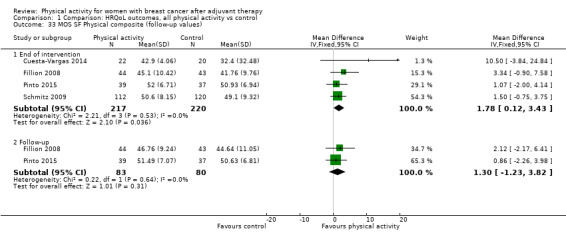
Segal 2001 {published data only}
    1. Segal R, Evans W, Johnson D, Smith J, Colletta S, Gayton J, et al. Structured exercises improves physical functioning in women with stages I and II breast cancer: results of a randomized controlled trial. Journal of Clinical Oncology 2001;19(3):657‐65. - PubMed
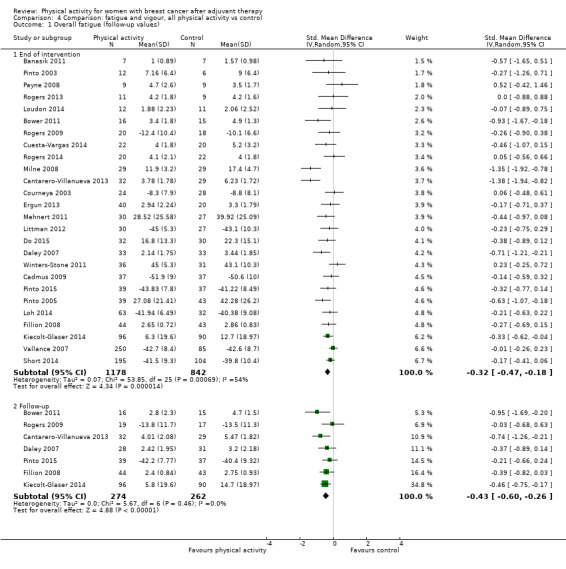
Sherman 2010 {published data only}
    1. Sherman KA, Heard G, Cavanagh KL. Psychological effects and mediators of a group multi‐component program for breast cancer survivors. Journal of Behavioral Medicine 2010;33(5):378‐91. - PubMed
Speed‐Andrews 2010 {published data only}
    1. Speed‐Andrews AE, Stevinson C, Belanger LJ, Mirus JJ, Courneya KS. Pilot evaluation of an Iyengar yoga program for breast cancer survivors. Cancer Nursing 2010;33(5):369‐81. - PubMed
Sprod 2005 {published data only}
    1. Sprod LK, Drum SN, Bentz AT, Carter SD, Schneider CM. The effects of walking poles on shoulder function in breast cancer survivors. Integrative Cancer Therapies 2005;4(4):287‐93. - PubMed
Sprod 2010 {published data only}
    1. Sprod LK, Palesh OG, Janelsins MC, Peppone LJ, Heckler CE, Jacob Adams M, et al. Exercise, sleep quality, and mediators of sleep in breast and prostate cancer patients receiving radiation therapy. Community Oncology 2010;7(10):463‐71. - PMC - PubMed
Stan 2012 {published data only}
    1. Stan DL, Rausch SM, Sundt K, Cheville AL, Youdas JW, Krause DA, et al. Pilates for breast cancer survivors: Impact on physical parameters and quality of life after mastectomy. Clinical Journal of Oncology Nursing 2012;16(2):131‐41. - PubMed
Stan 2013 {published data only}
    1. Stan D, Cheville A, Croghan I, Pruthi S. Randomized controlled study of yoga versus strengthening exercises in breast cancer survivors with persistent fatigue. Supportive Care in Cancer 2013;21:S261‐S2. - PubMed
Stevinson 2007 {published data only}
    1. Stevinson C. Exercise programme improves functional outcomes during breast cancer therapy. Focus on Alternative & Complementary Therapies 2007;12(3):202‐3.
Szczwpanska‐Gieracha 2010 {published data only}
    1. Szczepanska‐Gieracha J, Malicka I, Figula M, Rymaszewska J, Wozniewski M. The influence of eight‐week Nordic walking exercise on life quality of women after mastectomy. Onkologia Polska 2010;13(2):90‐5.
Tang 2010 {published data only}
    1. Tang M, Liou T, Lin C. Improving sleep quality for cancer patients: benefits of a home‐based exercise intervention. Supportive Care in Cancer 2010;18(10):1329‐39. - PubMed
Taso 2014 {published data only}
    1. Taso CJ, Lin HS, Lin WL, Chen SM, Huang WT, Chen SW. The effect of yoga exercise on improving depression, anxiety, and fatigue in women with breast cancer: a randomized controlled trial. Journal of Nursing Research 2014;22(3):155‐64. - PubMed
Thorsen 2005 {published data only}
    1. Thorsen L, Skovlund E, Stromme SB, Hornslien K, Dahl AA, Fossa SD. Effectiveness of physical activity on cardiorespiratory fitness and health‐related quality of life in young and middle‐aged cancer patients shortly after chemotherapy. Journal of Clinical Oncology 2005;23(10):2378‐88. - PubMed
Tidhar 2010 {published data only}
    1. Tidhar D, Katz‐Leurer M. Aqua lymphatic therapy in women who suffer from breast cancer treatment‐related lymphedema: a randomized controlled study. Supportive Care in Cancer 2010;18(3):383‐92. - PubMed
Turner 2004 {published data only}
    1. Turner J, Hayes S, Reul‐Hirche H. Improving the physical status and quality of life of women treated for breast cancer: a pilot study of a structured exercise intervention. Journal of Surgical Oncology 2004;86(3):141‐6. - PubMed
Ulger 2010 {published data only}
    1. Ulger O, Yagli NV. Effects of yoga on the quality of life in cancer patients. Complementary Therapies in Clinical Practice 2010;16(2):60‐3. - PubMed
Van Puymbroeck 2011 {published data only}
    1. Puymbroeck M, Schmid A, Shinew KJ, Hsieh PC. Influence of Hatha yoga on physical activity constraints, physical fitness, and body image of breast cancer survivors: a pilot study. International Journal of Yoga Therapy 2011;21:49‐60. - PubMed
Van Weert 2005 {published data only}
    1. Weert E, Hoekstra‐Weebers J, Grol B, Otter R, Arendzen H, Postema K, et al. A multidimensional cancer rehabilitation program for cancer survivors ‐ effectiveness on health‐related quality of life. Journal of Psychosomatic Research 2005;58(6):485‐96. - PubMed
Wong 2012 {published data only}
    1. Wong P, Muanza T, Hijal T, Masse L, Pillay S, Chasen M, et al. Effect of exercise in reducing breast and chest‐wall pain in patients with breast cancer: a pilot study. Current Oncology 2012;19(3):e129‐e35. - PMC - PubMed
Wu 2008 {published data only}
    1. Wu H, Dodd MJ, Cho MH. Patterns of fatigue and effect of exercise in patients receiving chemotherapy for breast cancer. Oncology Nursing Forum 2008;35(5):E90‐E9.
Yuen 2007 {published data only}
    1. Yuen HK, Sword D. Home‐based exercise to alleviate fatigue and improve functional capacity among breast cancer survivors. Journal of Allied Health 2007;36:e257‐e75. - PubMed

References to studies awaiting assessment

Lahart 2016 {published data only}
    1. Lahart IM, Metsios GS, Nevill AM, Kitas GD, Carmichael AR. Randomised controlled trial of a home‐based physical activity intervention in breast cancer survivors. BMC Cancer 2016;16:234. [DOI: 10.1186/s12885-016-2258-5] - DOI - PMC - PubMed
Lohrisch 2011 {published data only}
    1. Lohrisch CA, McKenzie D, Truong P, Jesperson D, Gelmon KA, Premji S. Randomized trial of exercise versus control for musculoskeletal symptoms from adjuvant anastrozole for postmenopausal early breast cancer. Journal of Clinical Oncology 2011;29(S15):636.
Luu 2014 {published data only}
    1. Luu X, Rifkind K, Dhage S, Castaneda M, Zeng X, Joseph KAP. The effects of yoga on urban underserved breast cancer patients. Journal of Clinical Oncology 2014;32:e17557.

References to ongoing studies

Deli‐Conwright 2014 {published data only}
    1. Dieli‐Conwright CM, Mortimer JE, Schroeder ET, Courneya K, Demark‐Wahnefried W, Buchanan TA. Randomized controlled trial to evaluate the effects of combined progressive exercise on metabolic syndrome in breast cancer survivors: rationale, design, and methods. BMC Cancer 2014;14(1):238. - PMC - PubMed
Galiano‐Castillo 2013 {published data only}
    1. Galiano‐Castillo N, Ariza‐Garcia A, Cantarero‐Villanueva I, Fernandez‐Lao C, Diaz‐Rodriguez L, Legeren‐Alvarez M. Telehealth system (e‐CUIDATE) to improve quality of life in breast cancer survivors: rationale and study protocol for a randomized clinical trial. Trials 2013;14(1):187. [NCT01801527] - PMC - PubMed
IRCT2014042117379N1 {published data only}
    1. IRCT2014042117379N1. Comparing self‐efficacy, outcome expectations for promoting the physical activity of the women with breast cancer in two groups with and without educational program. http://apps.who.int/trialsearch/Trial2.aspx?TrialID=IRCT2014042117379N1 (accessed 16 July 2016).
KIlbreath 2011 {published data only}
    1. Kilbreath S, Refshauge KM, Beith J, Ward L, Sawkins K, Paterson R, et al. Prevention of osteoporosis as a consequence of aromatase inhibitor therapy in postmenopausal women with early breast cancer: rationale and design of a randomized controlled trial. Contemporary Clinical Trials 2011;32(5):704‐9. [ACTRN12608000220369] - PubMed
NCT02057536 {published data only}
    1. NCT02057536. The Effect of an Exercise Program in Breast Cancer Patients With Joint Pain While Taking Aromatase Inhibitors. https://clinicaltrials.gov/show/NCT02057536 (accessed 16 July 2016).
NCT02235051 {published data only}
    1. NCT02235051. Exercise Intervention in Preventing Breast Cancer Recurrence in Postmenopausal Breast Cancer Survivors. https://clinicaltrials.gov/show/NCT02235051 (accessed 16 July 2016).
NCT02332876 {published data only}
    1. NCT02332876. Physical Activity and Neuropsychological Outcomes in a Cancer Population. https://ClinicalTrials.gov/show/NCT02332876 (accessed 16 July 2016).
NCT02420249 {published data only}
    1. NCT02420249. Qigong for Breast Cancer Survivors. https://ClinicalTrials.gov/show/NCT02420249 (accessed 16 July 2016).
NCT02433067 {published data only}
    1. NCT02433067. Physical Activity Intervention on Myocardial Function in Patients With HER2 + Breast Cancer (CARDAPAC). https://clinicaltrials.gov/show/NCT02433067 (accessed 16 July 2016).
NCT02527889 {published data only}
    1. NCT02527889. The Effect of Resistive Exercise on Forearm Blood Flow and Tissue Oxygenation Among Breast Cancer Survivors With or at Risk for Breast Cancer‐related Lymphoedema (BCRL). https://clinicaltrials.gov/show/NCT02527889 (accessed 16 July 2016).

Additional references

Azim 2011
    1. Azim HA Jr, Azambuja E, Colozza M, Bines J, Piccart MJ. Long‐term toxic effects of adjuvant chemotherapy in breast cancer. Annals of Oncology 2011;22(9):1939‐47. - PubMed
Ballard‐Barbash 2012
    1. Ballard‐Barbash R, Friedenreich CM, Courneya KS, Siddiqi SM, McTiernan A, Alfano CM. Physical activity, biomarkers, and disease outcomes in cancer survivors: a systematic review. Journal of the National Cancer Institute 2012;104(11):815‐40. - PMC - PubMed
Battaglini 2014
    1. Battaglini CL, Mills RC, Phillips BL, Lee JT, Story CE, Nascimento MG, et al. Twenty‐five years of research on the effects of exercise training in breast cancer survivors: a systematic review of the literature. World Journal of Clinical Oncology 2014;5(2):177‐90. - PMC - PubMed
Beasley 2012
    1. Beasley JM, Kwan ML, Chen WY, Weltzien EK, Kroenke CH, Lu W, et al. Meeting the physical activity guidelines and survival after breast cancer: findings from the after breast cancer pooling project. Breast Cancer Research and Treatment 2012;131(2):637‐43. - PMC - PubMed
Beisecker 1997
    1. Beisecker A, Cook MR, Ashworth J, Hayes J, Brecheisen M, Helmig L, et al. Side effects of adjuvant chemotherapy: perceptions of node‐negative breast cancer patients. Psycho‐Oncology 1997;6(2):85‐93. - PubMed
Bluethmann 2015
    1. Bluethmann SM, Vernon SW, Gabriel KP, Murphy CC, Bartholomew LK. Taking the next step: a systematic review and meta‐analysis of physical activity and behavior change interventions in recent post‐treatment breast cancer survivors. Breast Cancer Research and Treatment 2015;149(2):331‐42. - PMC - PubMed
Bluethmann 2016
    1. Bluethmann SM, Bartholomew LK, Murphy CC, Vernon SW. Use of theory in behavior change interventions: an analysis of programs to increase physical activity in posttreatment breast cancer survivors. Health Education & Behavior 2016;May 25:[Epub ahead of print]. [DOI: 10.1177/1090198116647712] - DOI
Bourke 2013
    1. Bourke L, Homer KE, Thaha MA, Steed L, Rosario DJ, Robb KA, et al. Interventions for promoting habitual exercise in people living with and beyond cancer. Cochrane Database of Systematic Reviews 2013, Issue 9. [DOI: 10.1002/14651858.CD010192.pub2] - DOI - PubMed
Bourke 2014
    1. Bourke L, Homer KE, Thaha MA, Steed L, Rosario DJ, Robb KA, et al. Interventions to improve exercise behaviour in sedentary people living with and beyond cancer: a systematic review. British Journal of Cancer 2014;110(4):831‐41. - PMC - PubMed
Bovelli 2010
    1. Bovelli D, Plataniotis G, Roila F, ESMO Guidelines Working Group. Cardiotoxicity of chemotherapeutic agents and radiotherapy‐related heart disease: ESMO Clinical Practice Guidelines. Annals of Oncology 2010;21(Suppl 5):277‐82. - PubMed
Bradt 2011
    1. Bradt J, Goodill SW, Dileo C. Dance/movement therapy for improving psychological and physical outcomes in cancer patients. Cochrane Database of Systematic Reviews 2011, Issue 10. [DOI: 10.1002/14651858.CD007103.pub2] - DOI - PubMed
Bray 2013
    1. Bray F, Ren J‐S, Masuyer E, Ferlay J. Global estimates of cancer prevalence for 27 sites in the adult population in 2008. International Journal of Cancer 2013;132:1133‐45. - PubMed
Brown 2011
    1. Brown JC, Huedo‐Medina TB, Pescatello LS, Pescatello SM, Ferrer RA, Johnson BT. Efficacy of exercise interventions in modulating cancer‐related fatigue among adult cancer survivors: a meta‐analysis. Cancer Epidemiology Biomarkers and Prevention 2011;20(1):123‐33. - PubMed
Brown 2012
    1. Brown JC, Huedo‐Medina TB, Pescatello LS, Ryan SM, Pescatello SM, Moker E, et al. The efficacy of exercise in reducing depressive symptoms among cancer survivors: a meta‐analysis. PLoS ONE 2012;7(1):e30955. - PMC - PubMed
Buffart 2012a
    1. Buffart LM, Uffelen JG, Riphagen II, Brug J, Mechelen W, Brown WJ, et al. Physical and psychosocial benefits of yoga in cancer patients and survivors: a systematic review and meta‐analysis of randomized controlled trials. BMC Cancer 2012;12:559. - PMC - PubMed
Button 2015
    1. Button KS, Kounali D, Thomas L, Wiles NJ, Peters TJ, Welton NJ, et al. Minimal clinically important difference on the Beck Depression Inventory‐II according to the patient's perspective. Psychological Medicine 2015;45(15):3269‐79. - PMC - PubMed
Camoriano 1990
    1. Camoriano JK, Loprinzi CL, Ingle JN, Therneau TM, Krook JE, Veeder MH. Weight change in women treated with adjuvant therapy or observed following mastectomy for node‐positive breast cancer. Journal of Clinical Oncology 1990;8(8):1327‐34. - PubMed
Candy 2016
    1. Candy B, Jones L, Vickerstaff V, Tookman A, King M. Interventions for sexual dysfunction following treatments for cancer in women. Cochrane Database of Systematic Reviews 2016;2:Cd005540. - PMC - PubMed
Carayol 2013
    1. Carayol M, Bernard P, Boiché J, Riou F, Mercier B, Cousson‐Gélie F, et al. Psychological effect of exercise in women with breast cancer receiving adjuvant therapy: what is the optimal dose needed?. Annals of Oncology 2013;24:291‐300. - PubMed
Caspersen 1985
    1. Caspersen CJ, Powell KE, Christenson GM. Physical activity, exercise, and physical fitness: definitions and distinctions for health‐related research. Public Health Reports 1985;100(2):126–31. - PMC - PubMed
Cella 2002
    1. Cella D, Eton DT, Lai JS, Peterman AH, Merkel DE. Combining anchor and distribution‐based methods to derive minimal clinically important differences on the Functional Assessment of Cancer Therapy (FACT) anemia and fatigue scales. Journal of Pain and Symptom Management 2002;24(6):547‐61. - PubMed
Cella 2002a
    1. Cella D, Hahn EA, Dineen K. Meaningful change in cancer‐specific quality of life scores: differences between improvement and worsening. Quality of Life Research 2002;11(3):207‐21. - PubMed
Chan 2015
    1. Chan RJ, McCarthy AL, Devenish J, Sullivan KA, Chan A. Systematic review of pharmacologic and non‐pharmacologic interventions to manage cognitive alterations after chemotherapy for breast cancer. European Journal of Cancer 2015;51(4):437‐50. - PubMed
Cheema 2008
    1. Cheema B, Gaul CA, Lane K, Fiatarone Singh MA. Progressive resistance training in breast cancer: a systematic review of clinical trials. Breast Cancer Research and Treatment 2008;109(1):9‐26. - PubMed
Cheema 2014
    1. Cheema BS, Kilbreath SL, Fahey PP, Delaney GP, Atlantis E. Safety and efficacy of progressive resistance training in breast cancer: a systematic review and meta‐analysis. Breast Cancer Research and Treatment 2014;148(2):249‐68. - PubMed
Chiu 2015
    1. Chiu HY, Huang HC, Chen PY, Hou WH, Tsai PS. Walking improves sleep in individuals with cancer: a meta‐analysis of randomized, controlled trials. Oncology Nursing Forum 2015;42(2):E54‐E62. - PubMed
Chung 2013
    1. Chung C, Lee S, Hwang S, Park E. Systematic review of exercise effects on health outcomes in women with breast cancer. Asian Nursing Research 2013;7(3):149‐59. - PubMed
Cochran 1954
    1. Cochran WG. The combination of estimates from different experiments. Biometrics 1954;10(1):101‐29.
Craft 2012
    1. Craft LL, Vaniterson EH, Helenowski IB, Rademaker AW, Courneya KS. Exercise effects on depressive symptoms in cancer survivors: a systematic review and meta‐analysis. Cancer Epidemiology Biomarkers and Prevention 2012;21(1):3‐19. - PMC - PubMed
Cramer 2013
    1. Cramer H, Lauche R, Klose P, Lange S, Langhorst J, Dobos GJ. Yoga for women diagnosed with breast cancer. Cochrane Database of Systematic Reviews 2013, Issue 10. [DOI: 10.1002/14651858.CD010802] - DOI - PMC - PubMed
Cramp 2010
    1. Cramp F, James A, Lambert J. The effects of resistance training on quality of life in cancer: a systematic literature review and meta‐analysis. Supportive Care in Cancer 2010;18(11):1367‐76. - PubMed
Cramp 2012
    1. Cramp F, Byron‐Daniel J. Exercise for the management of cancer‐related fatigue in adults. Cochrane Database of Systematic Reviews 2012;11:Cd006145. - PMC - PubMed
de Jong 2002
    1. Jong N, Courtens AM, Abu‐Saad HH, Schouten HC. Fatigue in patients with breast cancer receiving adjuvant chemotherapy: a review of the literature. Cancer Nursing 2002;25(4):283‐97. - PubMed
Demark‐Wahnefried 2005
    1. Demark‐Wahnefried W, Aziz NM, Rowland JH, Pinto BM. Riding the crest of the teachable moment: promoting long‐term health after the diagnosis of cancer. Journal of Clinical Oncology 2005;23(24):5814‐30. - PMC - PubMed
DerSimonian 1986
    1. DerSimonian R, Laird N. Meta‐analysis in clinical trials. Controlled Clinical Trials 1986;7:177‐88. - PubMed
Duijts 2011
    1. Duijts SF, Faber MM, Oldenburg HS, Beurden M, Aaronson NK. Effectiveness of behavioral techniques and physical exercise on psychosocial functioning and health‐related quality of life in breast cancer patients and survivors ‐ a meta‐analysis. Psycho‐Oncology 2011;20(2):115‐26. - PubMed
Eastell 1993
    1. Eastell R, Robins SP, Colwell T. Evaluation of bone turnover in type I osteoporosis using biochemical markers specific for both bone formation and bone resorption. Osteoporosis International 1993;3:255‐260. - PubMed
Egger 1997
    1. Egger M, Davey Smith G, Schneider M, Minder C. Bias in meta‐analysis detected by a simple, graphical test. BMJ 1997;315(7109):629‐34. - PMC - PubMed
Eton 2004
    1. Eton DT, Cella D, Yost KJ, Yount SE, Peterman AH, Neuberg DS, et al. A combination of distribution‐ and anchor‐based approaches determined minimally important differences (MIDs) for four endpoints in a breast cancer scale. Journal of Clinical Epidemiology 2004;57(9):898‐910. - PubMed
Ferlay 2013
    1. Ferlay J, Soerjomataram I, Ervik M, Dikshit R, Eser S, Mathers C, et al. GLOBOCAN 2012 v1.0, Cancer Incidence and Mortality Worldwide: IARC CancerBase No. 11 [Internet]. Lyon, France: International Agency for Research on Cancer; 2013. Available from http://globocan.iarc.fr (accessed April 2014).
Ferrer 2011
    1. Ferrer RA, Huedo‐Medina TB, Johnson BT, Ryan S, Pescatello LS. Exercise interventions for cancer survivors: a meta‐analysis of quality of life outcomes. Annals of Behavioral Medicine 2011;41(1):32‐47. - PMC - PubMed
Fong 2012
    1. Fong DY, Ho JW, Hui BP, Lee AM, Macfarlane DJ, Leung SS, et al. Physical activity for cancer survivors: meta‐analysis of randomised controlled trials. BMJ 2012;344:e70. - PMC - PubMed
Galvao 2005
    1. Galvao DA, Newton RU. Review of exercise intervention studies in cancer patients. Journal of Clinical Oncology 2005;23(4):899‐909. - PubMed
Greenland 1985
    1. Greenland S, Robins JM. Estimation of common effect parameter from sparse follow up data. Biometrics 1985;41:55‐68. - PubMed
Guyatt 2008
    1. Guyatt GH, Oxman AD, Vist G, Kunz R, Falck‐Ytter Y, Alonso‐Coello P, et al. Rating quality of evidence and strength of recommendations. GRADE: an emerging consensus on rating quality of evidence and strength of recommendations. BMJ 2008;336:924‐6. - PMC - PubMed
Higgins 2003
    1. Higgins JPT, Thompson SG, Deeks JJ, Altman DG. Measuring inconsistency in meta‐analyses. BMJ 2003;327:557‐60. - PMC - PubMed
Higgins 2011
    1. Higgins JPT, Green S (editors). Cochrane Handbook for Systematic Reviews of Interventions Version 5.1.0 (updated March 2011). The Cochrane Collaboration, 2011. Available from www.cochrane‐handbook.org.
Holmes 2005
    1. Holmes MD, Chen WY, Feskanich D, Kroenke CH, Colditz GA. Physical activity and survival after breast cancer diagnosis. JAMA 2005;293(20):2479‐86. - PubMed
IARC 2012
    1. International Agency for Research on Cancer. Latest World Cancer Statistics. Lyon, France: International Agency for Research on Cancer; 2013; Vol. Press release no. 223.
Ibrahim 2011
    1. Ibrahim EM, Al‐Homaidh A. Physical activity and survival after breast cancer diagnosis: meta‐analysis of published studies. Medical Oncology 2011;28(3):753‐65. - PubMed
Ingram 2007
    1. Ingram C, Visovsky C. Exercise intervention to modify physiologic risk factors in cancer survivors. Seminars in Oncology Nursing 2007;23(4):275‐84. - PubMed
Jemal 2011
    1. Jemal A, Bray F, Center MM, Ferlay J, Ward E, Forman D. Global cancer statistics. CA: A Cancer Journal for Statistics 2011;61(2):69‐90. - PubMed
Keilani 2016
    1. Keilani M, Hasenoehrl T, Neubauer M, Crevenna R. Resistance exercise and secondary lymphedema in breast cancer survivors ‐ a systematic review. Supportive Care in Cancer 2016;24(4):1907‐16. - PubMed
Knols 2005
    1. Knols R, Aaronson NK, Uebelhart D, Fransen J, Aufdemkampe G. Physical exercise in cancer patients during and after medical treatment: a systematic review of randomized and controlled clinical trials. Journal of Clinical Oncology 2005;23(16):3830‐42. - PubMed
Knols 2010
    1. Knols RH, Bruin ED, Shirato K, Uebelhart D, Aaronson NK. Physical activity interventions to improve daily walking activity in cancer survivors. BMC Cancer 2010;10:406. - PMC - PubMed
Kodama 2009
    1. Kodama S, Saito K, Tanaka S, Maki M, Yachi Y, Asumi M, et al. Cardiorespiratory fitness as a quantitative predictor of all‐cause mortality and cardiovascular events in healthy men and women: a meta‐analysis. JAMA 2009;301(19):2024‐35. - PubMed
Kriska 1990
    1. Kriska AM, Knowler WC, LaPorte RE. Development of a questionnaire to examine relationship of physical activity and diabetes in Pima Indians. Diabetes Care 1990;13:401‐11. - PubMed
Kroenke 2005
    1. Kroenke CH, Chen WY, Rosner B, Holmes MD. Weight, weight gain, and survival after breast cancer diagnosis. Journal of Clinical Oncology 2005;23(7):1370‐8. - PubMed
Lahmann 2005
    1. Lahmann PH, Schulz M, Hoffmann K, Boeing H, Tjonneland A, Olsen A, et al. Long‐term weight change and breast cancer risk: the European prospective investigation into cancer and nutrition (EPIC). British Journal of Cancer 2005;93:582‐9. - PMC - PubMed
Lee 2010a
    1. Lee MS, Choi TY, Ernst E. Tai chi for breast cancer patients: a systematic review. Breast Cancer Research and Treatment 2010;120(2):309‐16. - PubMed
Lynch 2011
    1. Lynch BM, Neilson HK, Friedenreich CM. Physical activity and breast cancer prevention. Recent Results in Cancer Research 2011;186:13‐42. - PubMed
Mantel 1959
    1. Mantel N, Haenszel W. Statistical aspects of the analysis of data from retrospective studies. Journal of the National Cancer Institute 1959;22:719‐48. - PubMed
Markes 2009
    1. Markes M, Brockow T, Resch KL. Exercise for women receiving adjuvant therapy for breast cancer. Cochrane Database of Systematic Reviews 2006, Issue 4. [DOI: 10.1002/14651858.CD005001.pub2] - DOI - PubMed
McAuley 2000
    1. McAuley L, Pham B, Tugwell P, Moher D. Does the inclusion of grey literature influence estimates of intervention effectiveness reported in meta‐analyses?. Lancet 2000;356:1228–31. - PubMed
McNeely 2006
    1. McNeely ML, Campbell KL, Rowe BH, Klassen TP, Mackey JR, Courneya KS. Effects of exercise on breast cancer patients and survivors: a systematic review and meta‐analysis. Canadian Medical Association Journal 2006;175(1):34‐41. - PMC - PubMed
McNeely 2010
    1. McNeely ML, Campbell K, Ospina M, Rowe BH, Dabbs K, Klassen TP, et al. Exercise interventions for upper‐limb dysfunction due to breast cancer treatment. Cochrane Database of Systematic Reviews 2010, Issue 6. [DOI: 10.1002/14651858.CD005211.pub2] - DOI - PubMed
Meneses‐Echavez 2015
    1. Meneses‐Echavez JF, Gonzalez‐Jimenez E, Ramirez‐Velez R. Effects of supervised exercise on cancer‐related fatigue in breast cancer survivors: a systematic review and meta‐analysis. BMC Cancer 2015;15:77. - PMC - PubMed
Mishra 2012a
    1. Mishra SI, Scherer RW, Geigle PM, Berlanstein DR, Topaloglu O, Gotay CC, et al. Exercise interventions on health‐related quality of life for cancer survivors. Cochrane Database of Systematic Reviews 2012, Issue 8. [DOI: 10.1002/14651858.CD007566.pub2] - DOI - PMC - PubMed
Mishra 2012b
    1. Mishra SI, Scherer RW, Snyder C, Geigle PM, Berlanstein DR, Topaloglu O. Exercise interventions on health‐related quality of life for people with cancer during active treatment. Cochrane Database of Systematic Reviews 2012, Issue 8. [DOI: 10.1002/14651858.CD008465.pub2] - DOI - PMC - PubMed
Moher 2010
    1. Moher D, Hopewell S, Schulz KF, Montori V, Gotzsche PC, Devereaux PJ, et al. CONSORT 2010 explanation and elaboration: updated guidelines for reporting parallel group randomised trials. BMJ 2010;340:c869. - PMC - PubMed
Nelson 2016
    1. Nelson NL. Breast cancer‐related lymphedema and resistance exercise: a systematic review. Journal of Strength & Conditioning Research 2016;Jan 29:[Epub ahead of print]. [DOI: 10.1519/JSC.0000000000001355] - DOI - PubMed
Pan 2015
    1. Pan Y, Yang K, Shi X, Liang H, Zhang F, Lv Q. Tai chi chuan exercise for patients with breast cancer: a systematic review and meta‐analysis. Evidence‐Based Complementary and Alternative Medicine 2015;2015:535237. - PMC - PubMed
Paramanandam 2014
    1. Paramanandam VS, Roberts D. Weight training is not harmful for women with breast cancer‐related lymphoedema: a systematic review. Journal of Physiotherapy 2014;60(3):136‐43. - PubMed
Physical Activity Guidelines 2008
    1. Physical Activity Guidelines Advisory Committee. Physical Activity Guidelines Advisory Committee Report, 2008. Washington: US Department of Health and Human Services. Available at http://www.health.gov/paguidelines/Report/pdf/CommitteeReport.pdf (accessed 09 January 2018) 2008.
RevMan [Computer program]
    1. Nordic Cochrane Centre, The Cochrane Collaboration. Review Manager 5 (RevMan 5). Version 5.3. Copenhagen: Nordic Cochrane Centre, The Cochrane Collaboration, 2014.
Schmitz 2010
    1. Schmitz KH, Courneya KS, Matthews C, Demark‐Wahnefried W, Galvão D, Pinto BM, et al. American College of Sports Medicine roundtable on exercise guidelines for cancer survivors. Medicine and Science in Sport and Exercise Science 2010;42(7):1409‐26. - PubMed
Shoemaker 2013
    1. Shoemaker MJ, Curtis AB, Vangsnes E, Dickinson MG. Clinically meaningful change estimates for the six‐minute walk test and daily activity in individuals with chronic heart failure. Cardiopulmonary Physical Therapy Journal 2013;24(3):21‐9. - PMC - PubMed
Spark 2013
    1. Spark LC, Reeves MM, Fjeldsoe BS, Eakin EG. Physical activity and/or dietary interventions in breast cancer survivors: a systematic review of the maintenance of outcomes. Journal of Cancer Survivorship: Research and Practice 2013;7(1):74‐82. - PubMed
Speck 2010
    1. Speck RM, Courneya KS, Masse LC, Duval S, Schmitz KH. An update of controlled physical activity trials in cancer survivors: a systematic review and meta‐analysis. Journal of Cancer Survivorship: Research and Practice 2010;4(2):87‐100. - PubMed
Vallance 2008
    1. Vallance JK, Courneya KS, Plotnikoff RC, Yasui Y, Mackey JR. Randomized controlled trial of the effects of print materials and step pedometers on physical activity and quality of life in breast cancer survivors. Journal of Clinical Oncology 2007;25(17):2352‐9. - PubMed
Winters‐Stone 2010
    1. Winters‐Stone KM, Schwartz A, Nail LM. A review of exercise interventions to improve bone health in adult cancer survivors. Journal of Cancer Survivorship: Research and Practice 2010;4(3):187‐201. - PubMed
Yang 2016
    1. Yang GS, Kim HJ, Griffith KA, Zhu S, Dorsey SG, Renn CL. Interventions for the treatment of aromatase inhibitor‐associated arthralgia in breast cancer survivors: a systematic review and meta‐analysis. Cancer Nursing 2016;Jun 21:[Epub ahead of print]. [DOI: 10.1097/NCC.0000000000000409] - DOI - PubMed
Yost 2011
    1. Yost KJ, Eton DT, Garcia SF, Cella D. Minimally important differences were estimated for six Patient‐Reported Outcomes Measurement Information System‐Cancer scales in advanced‐stage cancer patients. Journal of Clinical Epidemiology 2011;64(5):507‐16. - PMC - PubMed
Zeng 2014
    1. Zeng Y, Huang M, Cheng AS, Zhou Y, So WK. Meta‐analysis of the effects of exercise intervention on quality of life in breast cancer survivors. Breast Cancer (Tokyo, Japan) 2014;21(3):262‐74. - PubMed
Zhu 2016
    1. Zhu G, Zhang X, Wang Y, Xiong H, Zhao Y, Sun F. Effects of exercise intervention in breast cancer survivors: a meta‐analysis of 33 randomized controlled trials. OncoTargets and Therapy 2016;9:2153‐68. - PMC - PubMed
Zimmer 2016
    1. Zimmer P, Baumann FT, Oberste M, Wright P, Garthe A, Schenk A, et al. Effects of exercise interventions and physical activity behavior on cancer related cognitive impairments: a systematic review. BioMed Research International 2016;2016:1820954. - PMC - PubMed

References to other published versions of this review

Lahart 2014
    1. Lahart IM, Metsios GS, Nevill AM, Carmichael AR. Physical activity for women with breast cancer after adjuvant therapy. Cochrane Database of Systematic Reviews 2014, Issue 9. [DOI: 10.1002/14651858.CD011292] - DOI - PMC - PubMed