Review
. 2018 Aug;74(8):1751-1758.
doi: 10.1002/ps.4870. Epub 2018 Mar 7.

Improved insect-proofing: expressing double-stranded RNA in chloroplasts

Affiliations
Review

Improved insect-proofing: expressing double-stranded RNA in chloroplasts

Julia Bally et al. Pest Manag Sci. 2018 Aug.

Abstract

RNA interference (RNAi) was discovered almost 20 years ago and has been exploited worldwide to silence genes in plants and animals. A decade later, it was found that transforming plants with an RNAi construct targeting an insect gene could protect the plant against feeding by that insect. Production of double-stranded RNA (dsRNA) in a plant to affect the viability of a herbivorous animal is termed trans-kingdom RNAi (TK-RNAi). Since this pioneering work, there have been many further examples of successful TK-RNAi, but also reports of failed attempts and unrepeatable experiments. Recently, three laboratories have shown that producing dsRNA in a plant's chloroplast, rather than in its cellular cytoplasm, is a very effective way of delivering TK-RNAi. Our review examines this potentially game-changing approach and compares it with other transgenic insect-proofing schemes. © 2018 The Authors. Pest Management Science published by John Wiley & Sons Ltd on behalf of Society of Chemical Industry.

Keywords: Chloroplast; Kingdom; RNAi; Trans.


Figures

Figure 1
Figure 1
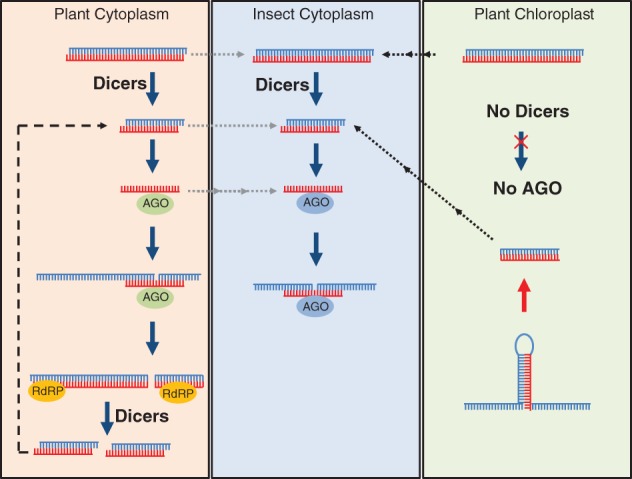
Parallel RNA silencing pathways in the plant cytoplasm, insect cytoplasm and plant chloroplast. In the plant cytoplasm, delivered dsRNA or hpRNA is processed by Dicer enzymes into primary siRNAs, which in turn direct AGO1 to their target mRNAs. Silencing amplification producing secondary siRNAs is then driven by RdRps. This amplification mechanism is absent in insect cells because of the lack of RdRps. In plant chloroplasts, as there is no Ago and DCL activity, dsRNA delivered into this compartment are not processed.
Figure 2
Figure 2
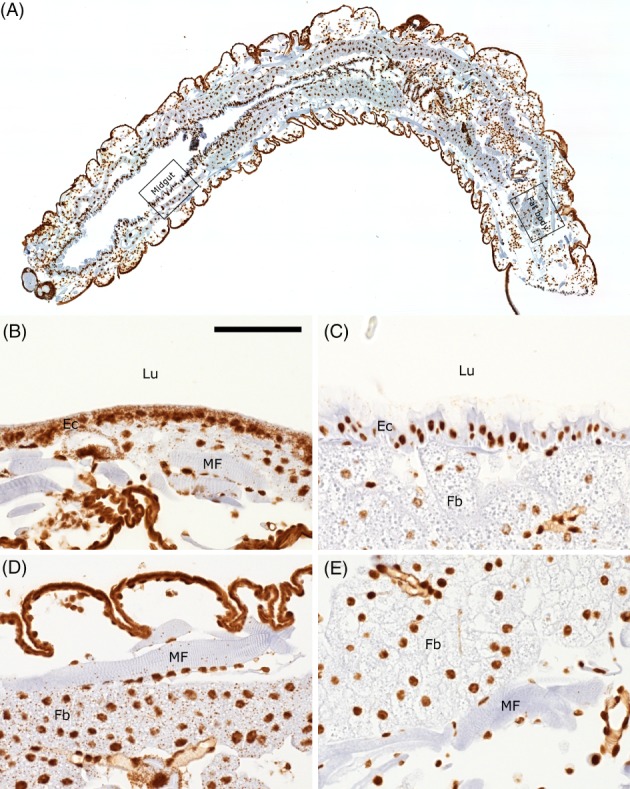
Characterization of RNAi spread in D. v. virgifera larva using single‐molecule RNAscope in situ hybridization to detect V‐ATPase C. (A) An overview image of an entire first‐instar D. v. virgifera larva longitudinal section probed with an irrelevant bacterial gene (RNAscope probe dihydrodipicolinate reductase (dapB) DapB; negative control). The anterior portion of the larva is to the left, and the posterior is to the right. Regions representative of the midgut regions shown in panels (B) and (D), and posterior fat body regions shown in (C) and (E) are indicated with boxes. (B) A representative region of the anterior midgut, probed for V‐ATPase C mRNA (small brown speckles). Before the larvae have fed on dsRNA, a large number of V‐ATPase C mRNAs are present in the midgut enterocytes, and a smaller number are present in fat body and muscle fiber cells. Background signal in nuclei and cuticle is represented by Brown diaminobenzidine(DAB) staining. (C) After 48 h of feeding on diet containing V‐ATPase C‐specific dsRNA, the amount of V‐ATPase C mRNA in the enterocytes of the anterior midgut is dramatically reduced. Only a few faint mRNA speckles remain. (D) Before feeding V‐ATPase C dsRNA, the fat body and, to a lesser extent, the muscle fiber cells in the posterior portion of the larva contain V‐ATPase C mRNA. (E) After feeding on V‐ATPase C dsRNA for 48 h, the level of V‐ATPase C mRNA in the posterior fat body and muscle fibers is reduced nearly to zero, clearly demonstrating systemic spread of RNAi in this animal. Lu, lumen; MF, muscle fibers; EC, enterocytes; Fb, fat body. Scale bar = 50 μm; panels (B), (C), (D), and (E) are at the same magnification. This illustration is a high‐magnification image of a sister section from the study by Li et al. 70. The section was prepared and probed as described in Li et al. 70
Figure 3
Figure 3
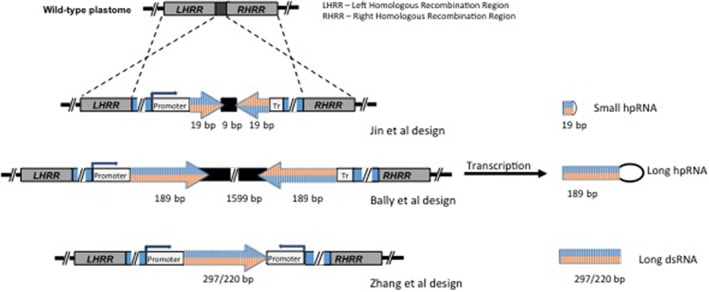
Schematic representation of transformation vectors for dsRNA expression from the plastid genome used in the three reports of cpTK‐RNAi. The targeted plastid genome region is represented. The left homologous recombination region (LHRR) and right homologous recombination region (RHRR) are the left and right plastid recombination regions, respectively, present in all transforming vectors. The cassettes have been designed to produce three different types of dsRNA: small hpRNA, long hpRNA and long dsRNA.

References

    1. Culliney TW, Crop Losses to Arthropods, in Pimentel D, Peshin R, editors. Integrated Pest Management: Pesticide Problems, Vol 3, Springer Netherlands, Dordrecht, pp. 201–225 (2014).
    1. Narva KE, Storer NP and Meade T, Chapter Four ‐ Discovery and Development of Insect‐Resistant Crops Using Genes from Bacillus thuringiensis, in Advances in Insect Physiology, ed. by Tarlochan SD. and Sarjeet SG. Vol. 47, Academic Press, pp. 177–247 (2014).
    1. Carrière Y, Fabrick JA and Tabashnik BE, Can Pyramids and Seed Mixtures Delay Resistance to Bt Crops? Trends Biotechnol 34:291–302 (2016). - PubMed
    1. Baum JA, Bogaert T, Clinton W, Heck GR, Feldmann P, Ilagan O, et al, Control of coleopteran insect pests through RNA interference. Nature Biotechnol 25:1322–1326 (2007). - PubMed
    1. Mao Y‐B, Cai W‐J, Wang J‐W, Hong G‐J, Tao X‐Y, Wang L‐J et al, Silencing a cotton bollworm P450 monooxygenase gene by plant‐mediated RNAi impairs larval tolerance of gossypol. Nat Biotech 25:1307–1313 (2007). - PubMed

Substances