Cortical Abnormalities Associated With Pediatric and Adult Obsessive-Compulsive Disorder: Findings From the ENIGMA Obsessive-Compulsive Disorder Working Group
- PMID: 29377733
- PMCID: PMC7106947
- DOI: 10.1176/appi.ajp.2017.17050485
Cortical Abnormalities Associated With Pediatric and Adult Obsessive-Compulsive Disorder: Findings From the ENIGMA Obsessive-Compulsive Disorder Working Group
Abstract
Objective: Brain imaging studies of structural abnormalities in OCD have yielded inconsistent results, partly because of limited statistical power, clinical heterogeneity, and methodological differences. The authors conducted meta- and mega-analyses comprising the largest study of cortical morphometry in OCD ever undertaken.
Method: T1-weighted MRI scans of 1,905 OCD patients and 1,760 healthy controls from 27 sites worldwide were processed locally using FreeSurfer to assess cortical thickness and surface area. Effect sizes for differences between patients and controls, and associations with clinical characteristics, were calculated using linear regression models controlling for age, sex, site, and intracranial volume.
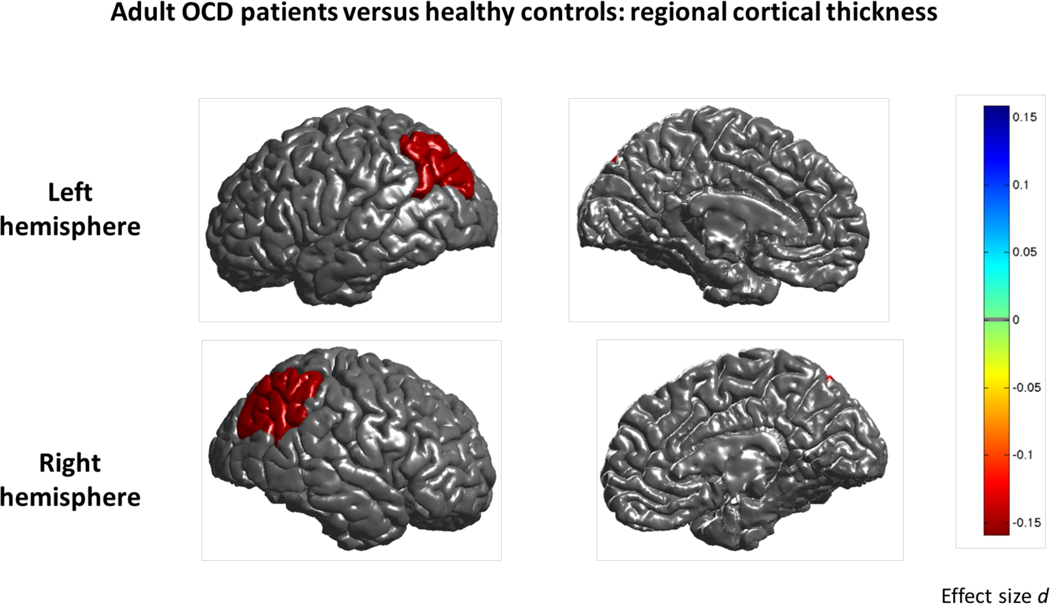
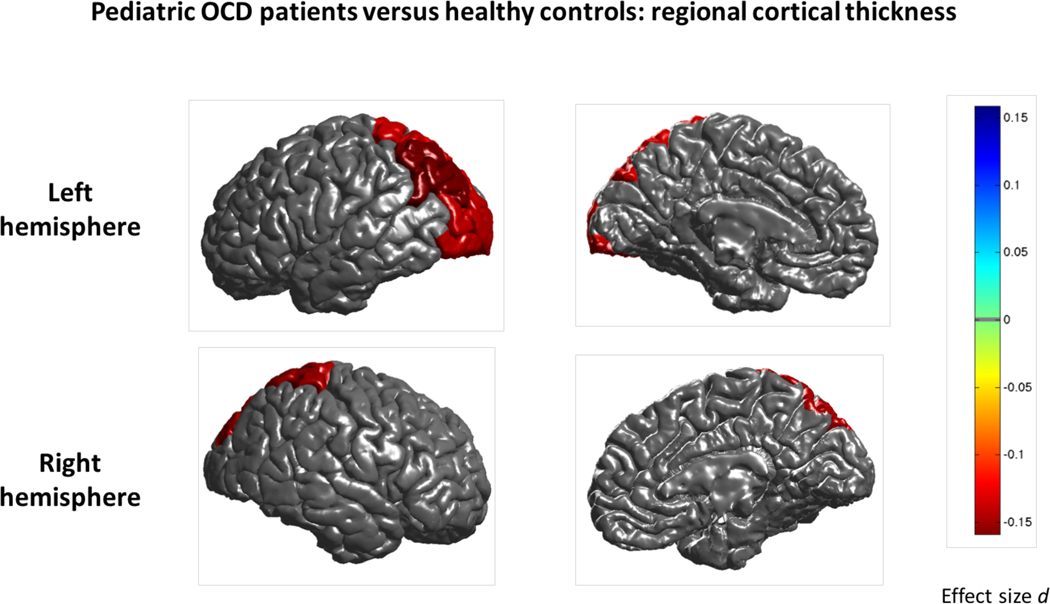
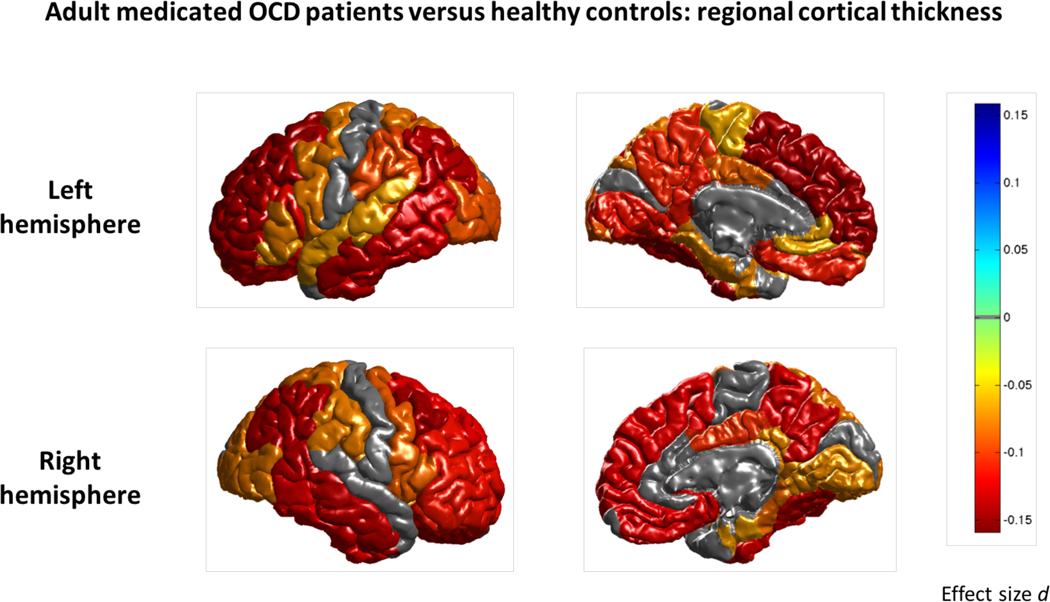
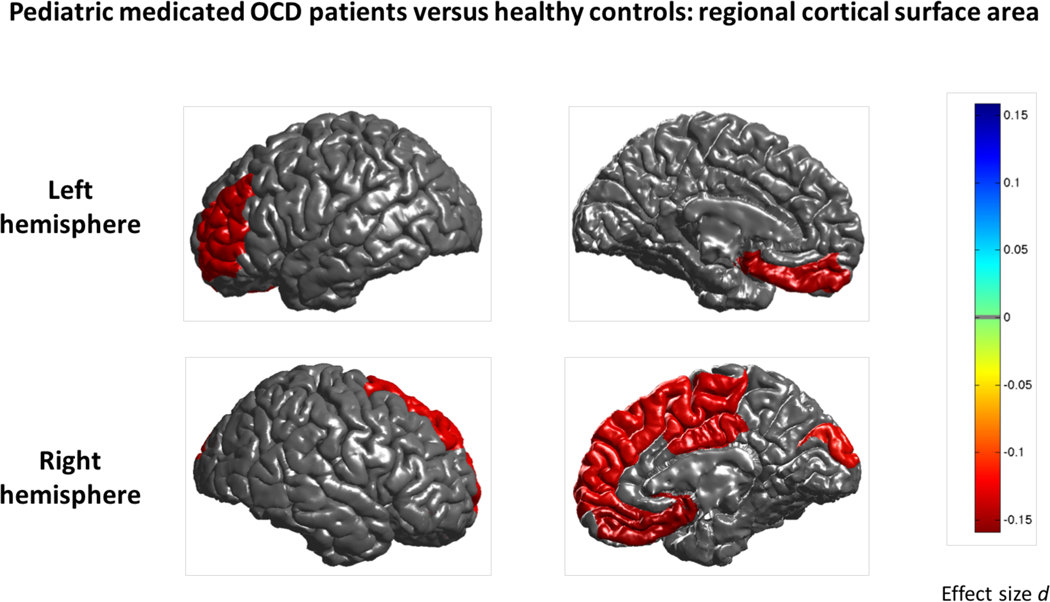
Results: In adult OCD patients versus controls, we found a significantly lower surface area for the transverse temporal cortex and a thinner inferior parietal cortex. Medicated adult OCD patients also showed thinner cortices throughout the brain. In pediatric OCD patients compared with controls, we found significantly thinner inferior and superior parietal cortices, but none of the regions analyzed showed significant differences in surface area. However, medicated pediatric OCD patients had lower surface area in frontal regions. Cohen's d effect sizes varied from -0.10 to -0.33.
Conclusions: The parietal cortex was consistently implicated in both adults and children with OCD. More widespread cortical thickness abnormalities were found in medicated adult OCD patients, and more pronounced surface area deficits (mainly in frontal regions) were found in medicated pediatric OCD patients. These cortical measures represent distinct morphological features and may be differentially affected during different stages of development and illness, and possibly moderated by disease profile and medication.
Keywords: Cortical Thickness; FreeSurfer; MRI; Obsessive-Compulsive Disorder; Surface Area.
Figures
References
-
- van den Heuvel OA, van Wingen G, Soriano-Mas C, Alonso P, Chamberlain SR, Nakamae T, Denys D, Goudriaan AE, Veltman DJ: Brain circuitry of compulsivity. Eur. Neuropsychopharmacol. 2016; 26:810–827 - PubMed
-
- Piras F, Piras F, Chiapponi C, Girardi P, Caltagirone C, Spalletta G: Widespread structural brain changes in OCD: A systematic review of voxel-based morphometry studies. Cortex 2015; 62:89–108 - PubMed
-
- Button KS, Ioannidis JP a, Mokrysz C, Nosek BA, Flint J, Robinson ESJ, Munafò MR: Power failure: why small sample size undermines the reliability of neuroscience. Nat. Rev. Neurosci. 2013; 14:365–76 - PubMed
-
- Thompson PM, Andreassen OA, Arias-Vasquez A, Bearden CE, Boedhoe PS, Brouwer RM, Buckner RL, Buitelaar JK, Bulaeva KB, Cannon DM, Cohen RA, Conrod PJ, Dale AM, Deary IJ, Dennis EL, de Reus M a., Desrivieres S, Dima D, Donohoe G, Fisher SE, Fouche J-P, Francks C, Frangou S, Franke B, Ganjgahi H, Garavan H, Glahn DC, Grabe HJ, Guadalupe T, Gutman B a., Hashimoto R, Hibar DP, Holland D, Hoogman M, Pol HEH, Hosten N, Jahanshad N, Kelly S, Kochunov P, Kremen WS, Lee PH, Mackey S, Martin NG, Mazoyer B, McDonald C, Medland SE, Morey RA, Nichols TE, Paus T, Pausova Z, Schmaal L, Schumann G, Shen L, Sisodiya SM, Smit DJ a., Smoller JW, Stein DJ, Stein JL, Toro R, Turner J a., van den Heuvel M, van den Heuvel O a., van Erp TGM, van Rooij D, Veltman DJ, Walter H, Wang Y, Wardlaw JM, Whelan CD, Wright MJ, Ye J: ENIGMA and the Individual: Predicting Factors that Affect the Brain in 35 Countries Worldwide. Neuroimage 2017; 145;389–408 - PMC - PubMed
Publication types
MeSH terms
Grants and funding
LinkOut - more resources
Full Text Sources
Other Literature Sources
Medical
Miscellaneous