


The Camden & Islington Research Database: Using electronic mental health records for research
- PMID: 29377897
- PMCID: PMC5788349
- DOI: 10.1371/journal.pone.0190703
The Camden & Islington Research Database: Using electronic mental health records for research
Abstract
Background: Electronic health records (EHRs) are widely used in mental health services. Case registers using EHRs from secondary mental healthcare have the potential to deliver large-scale projects evaluating mental health outcomes in real-world clinical populations.
Methods: We describe the Camden and Islington NHS Foundation Trust (C&I) Research Database which uses the Clinical Record Interactive Search (CRIS) tool to extract and de-identify routinely collected clinical information from a large UK provider of secondary mental healthcare, and demonstrate its capabilities to answer a clinical research question regarding time to diagnosis and treatment of bipolar disorder.
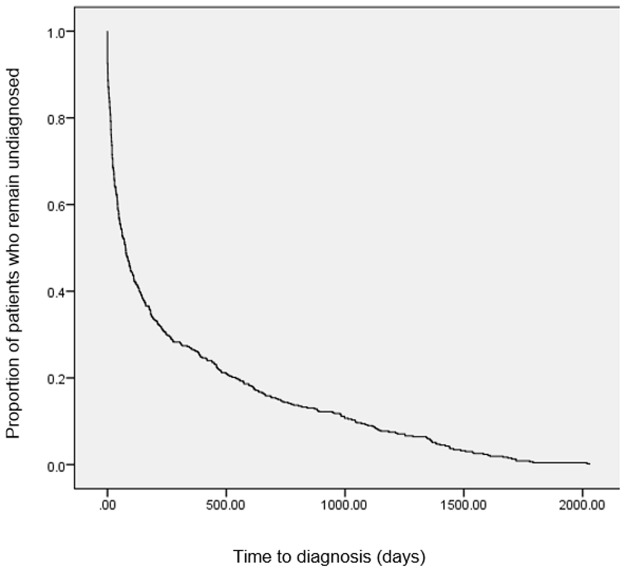
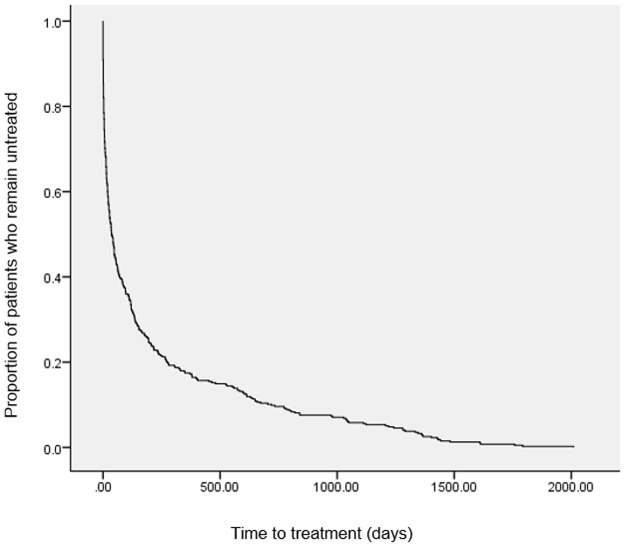
Results: The C&I Research Database contains records from 108,168 mental health patients, of which 23,538 were receiving active care. The characteristics of the patient population are compared to those of the catchment area, of London, and of England as a whole. The median time to diagnosis of bipolar disorder was 76 days (interquartile range: 17-391) and median time to treatment was 37 days (interquartile range: 5-194). Compulsory admission under the UK Mental Health Act was associated with shorter intervals to diagnosis and treatment. Prior diagnoses of other psychiatric disorders were associated with longer intervals to diagnosis, though prior diagnoses of schizophrenia and related disorders were associated with decreased time to treatment.
Conclusions: The CRIS tool, developed by the South London and Maudsley NHS Foundation Trust (SLaM) Biomedical Research Centre (BRC), functioned very well at C&I. It is reassuring that data from different organizations deliver similar results, and that applications developed in one Trust can then be successfully deployed in another. The information can be retrieved in a quicker and more efficient fashion than more traditional methods of health research. The findings support the secondary use of EHRs for large-scale mental health research in naturalistic samples and settings investigated across large, diverse geographical areas.
Conflict of interest statement
Figures
References
-
- Lichtenberg P, Kaplan Z, Grinshpoon A, Feldman D, Nahon D. The goals and limitations of Israel’s psychiatric case register. Psychiatr Serv. 1999;50(8):1043–8. Epub 1999/08/13. doi: 10.1176/ps.50.8.1043 . - DOI - PubMed
-
- Perera G, Broadbent M, Callard F, Chang CK, Downs J, Dutta R, et al. Cohort profile of the South London and Maudsley NHS Foundation Trust Biomedical Research Centre (SLaM BRC) Case Register: current status and recent enhancement of an Electronic Mental Health Record-derived data resource. BMJ open. 2016;6(3):e008721 Epub 2016/03/05. doi: 10.1136/bmjopen-2015-008721 . - DOI - PMC - PubMed
-
- Safran C, Bloomrosen M, Hammond WE, Labkoff S, Markel-Fox S, Tang PC, et al. Toward a national framework for the secondary use of health data: an American Medical Informatics Association White Paper. J Am Med Inform Assoc. 2007;14:1–9. doi: 10.1197/jamia.M2273 - DOI - PMC - PubMed
-
- Weiskopf NG, Weng C. Methods and dimensions of electronic health record data quality assessment: enabling reuse for clinical research. J Am Med Inform Assoc. 2013;20(1):144–51. Epub 2012/06/27. doi: 10.1136/amiajnl-2011-000681 . - DOI - PMC - PubMed
-
- Stewart R, Soremekun M, Perera G, Broadbent M, Callard F, Denis M, et al. The South London and Maudsley NHS Foundation Trust Biomedical Research Centre (SLAM BRC) case register: development and descriptive data. BMC psychiatry. 2009;9:51 Epub 2009/08/14. doi: 10.1186/1471-244X-9-51 . - DOI - PMC - PubMed
Publication types
MeSH terms
Grants and funding
LinkOut - more resources
Full Text Sources
Other Literature Sources
Medical
