


The Gestalt of functioning in autism spectrum disorder: Results of the international conference to develop final consensus International Classification of Functioning, Disability and Health core sets
- PMID: 29378422
- PMCID: PMC6376609
- DOI: 10.1177/1362361318755522
The Gestalt of functioning in autism spectrum disorder: Results of the international conference to develop final consensus International Classification of Functioning, Disability and Health core sets
Abstract
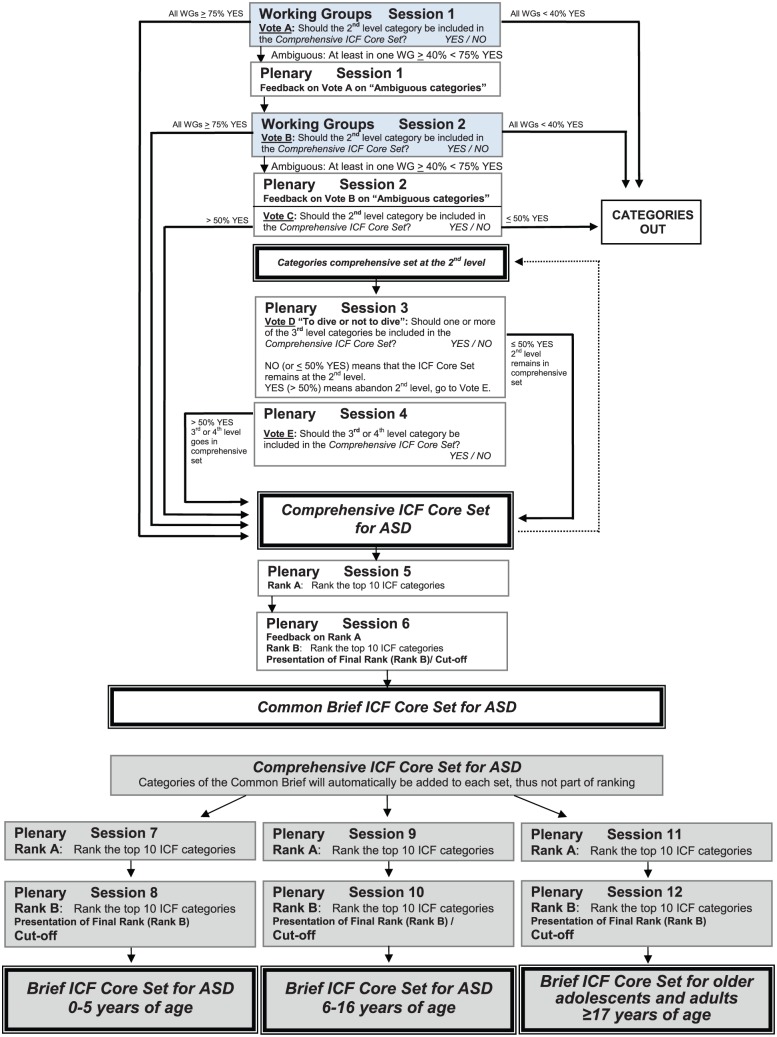
Autism spectrum disorder is associated with diverse social, educational, and occupational challenges. To date, no standardized, internationally accepted tools exist to assess autism spectrum disorder-related functioning. World Health Organization's International Classification of Functioning, Disability and Health can serve as foundation for developing such tools. This study aimed to identify a comprehensive, a common brief, and three age-appropriate brief autism spectrum disorder Core Sets. Four international preparatory studies yielded in total 164 second-level International Classification of Functioning, Disability and Health candidate categories. Based on this evidence, 20 international autism spectrum disorder experts applied an established iterative decision-making consensus process to select from the candidate categories the most relevant ones to constitute the autism spectrum disorder Core Sets. The consensus process generated 111 second-level International Classification of Functioning, Disability and Health categories in the Comprehensive Core Set for autism spectrum disorder-one body structure, 20 body functions, 59 activities and participation categories, and 31 environmental factors. The Common Brief Core Set comprised 60 categories, while the age-appropriate core sets included 73 categories in the preschool version (0- to 5-year-old children), 81 in the school-age version (6- to 16-year-old children and adolescents), and 79 in the older adolescent and adult version (⩾17-year-old individuals). The autism spectrum disorder Core Sets mark a milestone toward the standardized assessment of autism spectrum disorder-related functioning in educational, administrative, clinical, and research settings.
Keywords: Disability and Health core sets; International Classification of Functioning; assessment; autism spectrum disorder; consensus conference; disability; functioning.
Conflict of interest statement
Figures
References
-
- American Psychiatric Association (APA) (2013) Diagnostic and Statistical Manual of Mental Disorders (DSM-5). Washington, DC: Pilgrim Press.
-
- Ayuso-Mateos JL, Avila CC, Anaya C, et al. (2013) Development of the International Classification of Functioning, Disability and Health core sets for bipolar disorders: results of an international consensus process. Disability and Rehabilitation 35(25): 2138–2146. - PubMed
-
- Baxter AJ, Brugha TS, Erskine HE, et al. (2015) The epidemiology and global burden of autism spectrum disorders. Psychological Medicine 45(3): 601–613. - PubMed
-
- Bölte S. (2009) The ICF and its meaning for child and adolescent psychiatry. Zeitschrift Für Kinder- Und Jugendpsychiatrie Und Psychotherapie 37(6): 495–497. - PubMed
-
- Bölte S. (2017) Autism-Europe International Congress 2016-Autism research and practice in Europe 2016. Autism 21(1): 3–4. - PubMed
Publication types
MeSH terms
LinkOut - more resources
Full Text Sources
Other Literature Sources
Medical
