


Integrated omics data of two annual ryegrass (Lolium multiflorum L.) genotypes reveals core metabolic processes under drought stress
- PMID: 29378511
- PMCID: PMC5789592
- DOI: 10.1186/s12870-018-1239-z
Integrated omics data of two annual ryegrass (Lolium multiflorum L.) genotypes reveals core metabolic processes under drought stress
Abstract
Background: Annual ryegrass (Lolium multiflorum L.) is a commercially important, widely distributed forage crop that is used in the production of hay and silage worldwide. Drought has been a severe environmental constraint in its production. Nevertheless, only a handful of studies have examined the impact of short-term drought stress on annual ryegrass. The aim of this study was to explore how stress-induced core metabolic processes enhance drought tolerance, or adaptation to drought, in annual ryegrass.
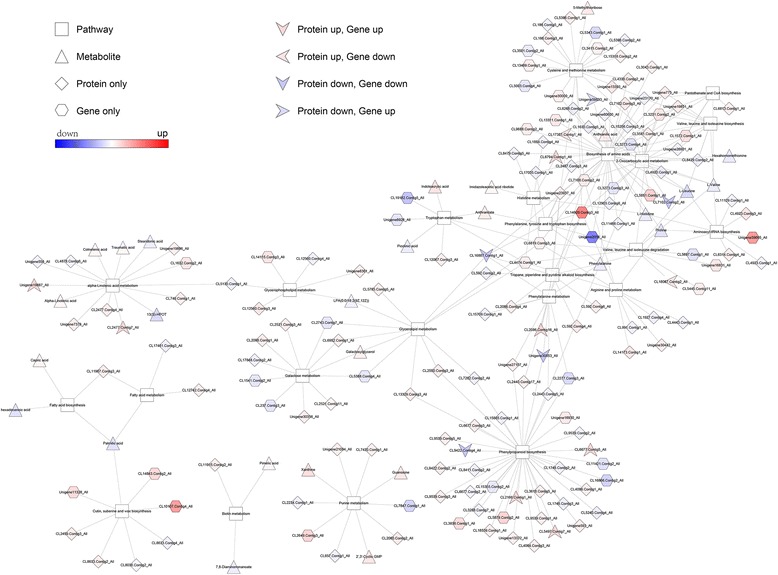
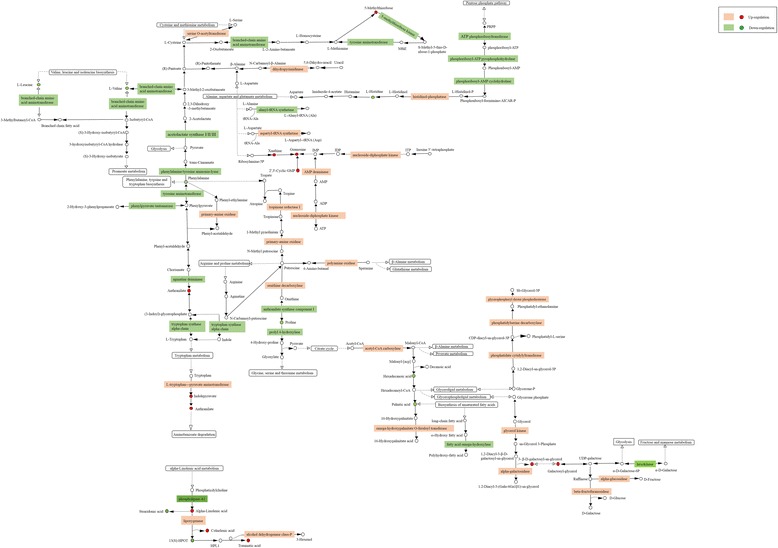
Results: We profiled the transcriptomes, proteomes, and metabolomes of two annual ryegrass genotypes: the drought-resistant genotype "Abundant 10" and drought-susceptible genotype "Adrenalin 11." We identified differentially expressed metabolites and their corresponding proteins and transcripts that are involved in 23 core metabolic processes, in response to short-term drought stress. Protein-gene-metabolite correlation networks were built to reveal the relationships between the expression of transcripts, proteins, and metabolites in drought-resistant annual ryegrass. Furthermore, integrated metabolic pathways were used to observe changes in enzymes corresponding with levels of amino acids, lipids, carbohydrate conjugates, nucleosides, alkaloids and their derivatives, and pyridines and their derivatives. The resulting omics data underscored the significance of 23 core metabolic processes on the enhancement of drought tolerance or adaptation to drought in annual ryegrass.
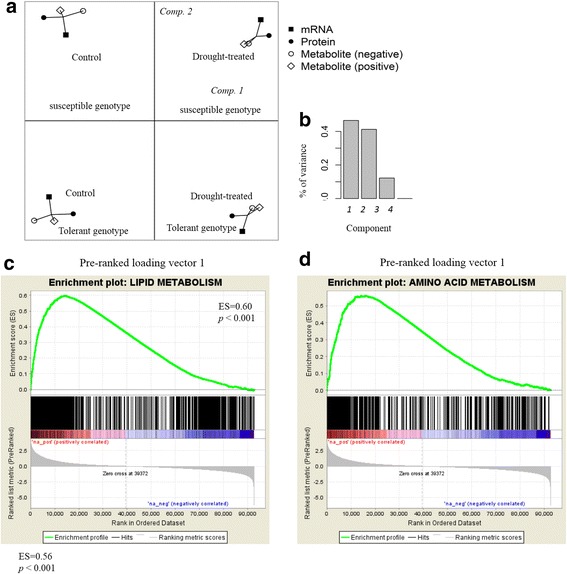
Conclusions: The regulatory networks were inferred using MCoA and correlation analysis to reveal the relationships among the expression of transcripts, proteins, and metabolites that highlight the corresponding elements of these core metabolic pathways. Our results provide valuable insight into the molecular mechanisms of drought resistance, and represent a promising strategy toward the improvement of drought tolerance in annual ryegrass.
Keywords: Annual ryegrass (Lolium multiflorum); Drought; Metabolism; Metabolome; Omics; Proteome; Transcriptome.
Conflict of interest statement
Consent for publication
Not applicable.
Competing interests
The authors declare that they have no competing interests.
Publisher’s Note
Springer Nature remains neutral with regard to jurisdictional claims in published maps and institutional affiliations.
Figures
References
-
- Borawska-Jarmułowicz B, Mastalerczuk G, Gozdowski D, Małuszyńska E, Szydłowska A. The sensitivity of Lolium Perenne and Poa Pratensis to salinity and drought during the seed germination and under different photoperiod conditions. Zemdirbyste-Agriculture. 2017;104(1):71–78. doi: 10.13080/z-a.2017.104.010. - DOI
-
- Bettaieb I, Zakhama N, Wannes WA, Kchouk M, Marzouk B. Water deficit effects on Salvia Officinalis fatty acids and essential oils composition. Sci Hortic Amsterdam. 2009;120(2):271–275. doi: 10.1016/j.scienta.2008.10.016. - DOI
-
- Toumi I, Gargouri M, Nouairi I, Moschou P, Salem-Fnayou AB, Mliki A, Zarrouk M, Ghorbel A. Water stress induced changes in the leaf lipid composition of four grapevine genotypes with different drought tolerance. Biol Plant. 2008;52(1):161–164. doi: 10.1007/s10535-008-0035-2. - DOI
Publication types
MeSH terms
Substances
Grants and funding
LinkOut - more resources
Full Text Sources
Other Literature Sources
